
Snooker betting tips for 2026: form, value and the bookmaker's edge
 Available in US

Snooker looks like a quiet game to bet on. A handful of stars dominate, the calendar is short and a single frame can swing a £100 stake. That is exactly why tip sheets circulate so freely around the World Championship each spring — and exactly why most of them are not worth the paper they are printed on. The frame-by-frame structure of the sport creates a temptation to “predict” with confidence that the data never supports. The honest answer is that a price on snooker is a price on probability, and probability is what you have to work out before the bet goes in.
This page is a guide rather than a tip sheet. It walks through how snooker betting actually settles, what a value bet looks like once the bookmaker’s margin is taken out, where offers help and where they cost more than they look, and how to tell whether a bookmaker holds a Gambling Commission licence for customers in Great Britain. The sporting side of things — the Crucible, the UK Championship, the Wuhan Open, the Shanghai Masters and the rest of the World Snooker Tour calendar — gets covered at the depth the calendar deserves, and the licensed operator set sits beside it so a punter can pick a brand that fits the way he wants to bet rather than the way a marketing email wants him to bet.
October 30, 2026 · Review against the Gambling Commission’s public register for Great Britain.
The sport behind the market
Snooker is played with 22 balls: a white cue ball, 15 reds and six colours worth yellow 2, green 3, brown 4, blue 5, pink 6 and black 7. The maximum break is 147 — every red with a black, then all six colours in order — and that ceiling is the reason an outright market on a tournament can collapse in the second session of a first-round match. A full-size table is 12 ft by 6 ft with six pockets, and most professional matches are best of 7, 9 or 11 frames. Best-of-19 first rounds and a best-of-35 final at the Crucible, where the World Championship has been held since 1977, mean a single session of eight or nine frames can shift the outright price more than the entire group stage of a football tournament. Snooker has one governing body for the professional game, the WPBSA, and a separate one for amateurs, the IBSF; neither decides what a bookmaker may offer. That decision belongs to the operator’s own licence and house rules.
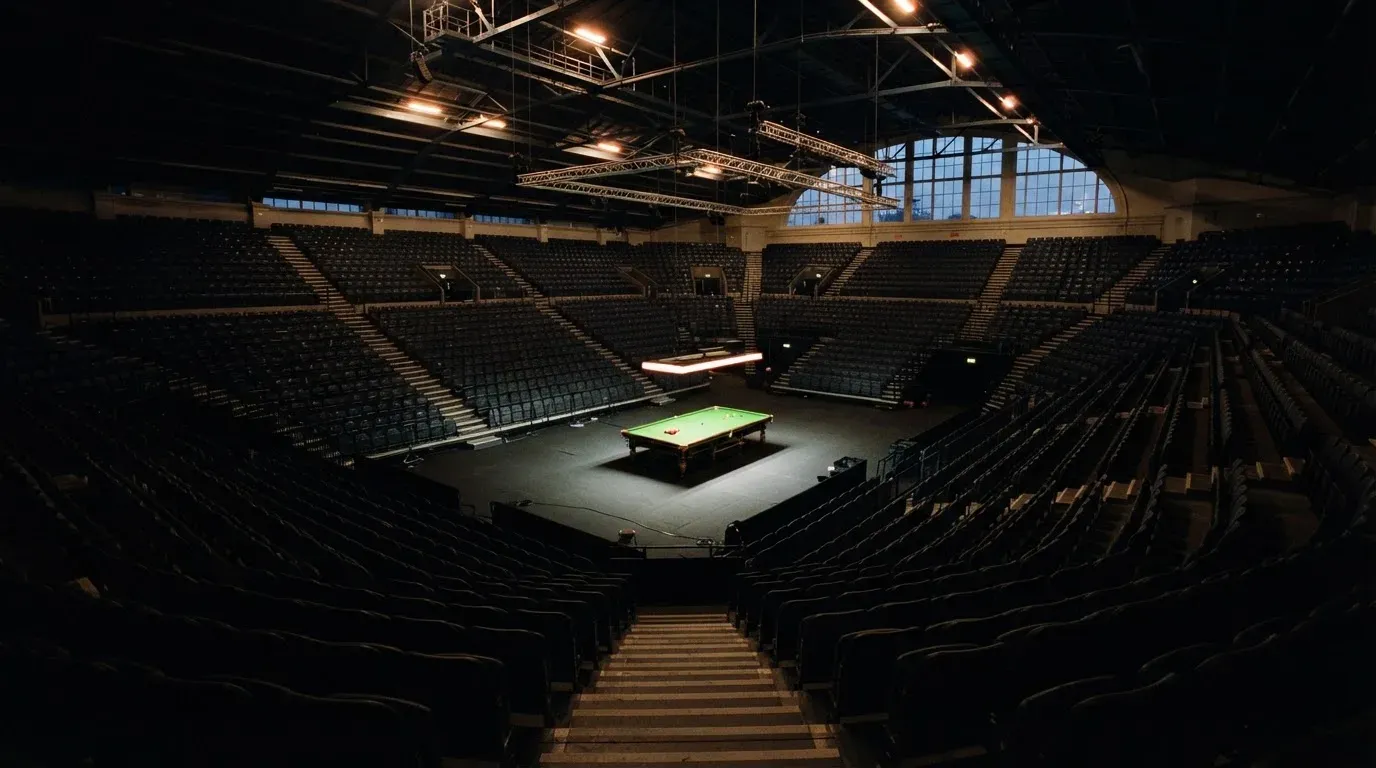
Stephen Hendry and Ronnie O’Sullivan hold seven world titles each in the modern era. Joe Davis won 15 in a row from 1927 to 1946, an era so far from the modern tour that comparing the records is closer to folklore than form. The 2026 World Snooker Championship, played from 18 April to 4 May at the Crucible, finished with Wu Yize beating Shaun Murphy 18-17 in the final; the winner’s share was £500,000 from a £2,395,000 prize fund. Numbers like that are why the outright market on the World Championship moves early and moves hard — a finalist gets a price too, and a semi-finalist in late April is a different trade than a quarter-finalist in late April.
The calendar a bookmaker hangs his outrights on
The professional tour runs roughly October to May, with ranking events clustered around the majors. The World Championship at the Crucible is the headline, but the UK Championship in York, the Masters at Alexandra Palace, the Wuhan Open, the Shanghai Masters and the invitational Champion of Champions all draw outright markets. The shorter the event and the larger the field, the wider the early prices, and the more a value bet either lives or dies on the way the first round shakes out. Snooker’s short-frame structure means the outright market is not the only game in town — frame handicaps, first-frame winner, total frames in a session, century breaks and “race to X frames” all run alongside match winner, and that is where most of the volume sits during a match.

Why a snooker match is harder to price than a football match
Football has 90 minutes, two teams, three outcomes and a goal worth roughly 0.25 expected goals. Snooker has 22 balls, a table, a referee and two players, and a frame can finish in 20 minutes or two hours. Public form data is thinner than football’s: head-to-heads, ranking points and recent results are the only inputs a casual punter can find without a subscription to a tracking site. That thinness is the point. A thinner information market rewards research harder, and a thinner one also rewards patience — a price on an out-of-form favourite at a major is often shorter than it should be, because casual money has piled in against a big name. Reading that kind of mispricing is the work.
What a licensed UK bookmaker looks like in 2026
Every operator that takes bets from customers in Great Britain needs a Gambling Commission licence, wherever the operator is based, since the Gambling (Licensing and Advertising) Act 2014 amended sections 33 and 36 of the Gambling Act 2005. A Curaçao, Maltese or Gibraltar licence on its own does not authorise a brand to deal with GB customers, and the duty sits at the point of consumption rather than the place of incorporation. No single brand is “the only” licensed one — the Commission’s public register lists hundreds, and the comparison below is a sample, not a shortlist.
Identity checks happen before the first deposit. A punter cannot register, deposit a single £5 note and start betting anonymously at a licensed site — name, address and date of birth are verified up front, and a free-bet or bonus stake will not slip through either. That fact sits beside the next one: every GB-licensed online operator is also a GAMSTOP member, and the multi-operator self-exclusion scheme has been a mandatory licence condition for online brands since 31 March 2020. Self-exclusion periods run six months, one year, five years, or five years with auto-renewal, and after the minimum period the exclusion stays in place for a further seven years unless the customer asks GAMSTOP to lift it. GAMSTOP covers online sites and apps; the betting shops run a separate scheme.
Credit cards are banned for gambling in Great Britain (since 14 April 2020, LCCP condition 6.1.2), including credit-card-funded payments through an e-wallet. Debit cards and bank-based payments are not covered by the ban. A state list of permitted payment methods and any rule for or against cryptocurrency deposits at licensed operators is not on the statute book — describe payments from the operator’s own terms rather than from a state list.
The check that takes 30 seconds
The Commission’s public register is searchable by business name, trading name, domain or account number. A punter who sees a brand on a comparison page can search the domain and read off the licence number, the categories on the licence, the licence holder’s name and any operating name. That is the only verification that protects him. A .co.uk domain proves nothing — licensed operators use .com as well as .co.uk — and the absence of a British domain proves nothing either. A claim that a brand is “UK licensed” without an account number on the Commission’s register is a marketing line, and a punter who cannot find the brand on the register is, in practice, betting with an unlicensed brand whether the homepage says otherwise or not.
Where the consumer sits if a licensed operator fails
A licensed brand sits inside a defined consumer-protection regime: GAMSTOP coverage, a Commission complaints route, an approved alternative-dispute-resolution body, and a duty to pay winnings on settled bets. The 10x bonus wagering cap and the £150 rolling-30-days financial vulnerability check are also licence conditions; the first has been in force since 19 January 2026, the second is in force since 28 February 2025. An offshore brand that takes GB customers without a Commission licence sits outside all of that. A punter whose funds are held, whose self-exclusion is ignored or whose identity has been stolen has, in practice, no British consumer redress. The framing is honest rather than moral: licensed means checks and limits; unlicensed means none of those. Neither is “the safe choice” by default.
What a non-licensed site does and does not do
An unlicensed brand is not “illegal” for the punter to use — no offence aimed at a customer who merely bets on an unlicensed site was found in the statute — but the operator commits an offence under section 33 of the Gambling Act 2005 by providing the facilities without the licence the Act requires. Enforcement runs through disruption rather than blocking: cease-and-desist notices, search-engine referrals, work with registrars, hosts and payment providers, and court-order DNS blocking powers the Commission has been given or is about to receive. The point for a punter is not the enforcement story, it is the protection story: no GAMSTOP, no Commission complaints, no ADR, no British consumer redress, no bonus cap, no vulnerability check, and no guarantee that a winning bet will be paid.
Staying in control of a snooker account
Snooker is a fast-staking sport. Best-of-7 matches settle inside an afternoon, a session of four or five frames at a major can take an hour, and a punter can blow a £200 bankroll in a weekend without doing anything unusual. The safer-gambling tools that the licensed operators offer sit on top of that:
- Deposit limits. Operators must offer a gross deposit limit on a fixed time frame; the first changes have applied since 31 October 2025, and a second phase was scheduled for 30 September 2026 — but the state of play is not established.
- Financial vulnerability check (LCCP 3.4.4, in force since 30 August 2024). A public-record check that applies when a customer’s deposits minus withdrawals exceed £150 in a rolling 30 days (since 28 February 2025). It is a bankruptcy or county-court-judgment check, not an income or credit-reference check.
- Financial risk assessments. Announced in a staged plan with no start date; the press often calls them “affordability checks” — write “announced, staged, no start date”, not “in force”.
- Product restrictions and self-exclusion. Operators can take a product away from a customer (no sports betting, no in-play, no casino) at their discretion, and self-exclusion is the customer-side version of the same lever.
- Help. GamCare runs the National Gambling Helpline, GambleAware is the funded education body, the NHS runs gambling clinics, and Gamblers Anonymous runs peer-support meetings. A punter who has stopped enjoying a session can stop. A punter who cannot stop alone can ask.
The marketing rule that runs alongside all this is the CAP Code section 16 standard: marketing must be socially responsible, must not be of strong appeal to under-18s, and no one who is or seems to be under 25 may appear gambling in an advertisement (with a limited exception for marketing placed where a bet can be made directly). That rule is about who may appear in the advertisement, not about who may bet — the minimum age to bet at a licensed site is 18. A punter who is asked for ID on a deposit is being treated to the licence condition, not picked on. A punter who can deposit £5,000 in an hour without a check is, in practice, on an unlicensed brand.
Crypto and anonymity at a snooker betting site
Cryptocurrency payments for snooker betting do not have a clean answer in Great Britain. The ban on credit cards for gambling does not extend to debit cards, bank transfers or e-wallets, and no state list of permitted payment methods exists. Whether a licensed operator accepts a cryptocurrency deposit is a question for that operator’s own terms, and an unlicensed operator that runs on bitcoin takes GB customers at the cost of the consumer-protection regime. There is no British named-account rule on the statute book that forces a real-name match at every licensed site, but identity verification before the first deposit means the de facto rule is real-name and verified-name regardless of the payment method.
What “anonymity” means on a crypto-friendly offshore site is narrower than it looks. The blockchain is a public ledger, every transaction is permanently visible and a wallet’s history can be reconstructed from open-source tooling. The anonymity is in the gap between the wallet and the customer’s name, and that gap closes the moment a withdrawal asks for proof of source of funds. A punter who wants to bet on snooker with bitcoin is, in practice, picking an offshore brand, accepting the loss of British consumer redress and paying for that with a more involved withdrawal process than a debit-card punter at a licensed brand. The frame-by-frame structure of snooker rewards a quick deposit and a quick withdrawal more than most sports do, and the friction is real.
Bonuses and free bets on snooker
A snooker welcome offer sits inside the same regime as any other: a credit of free bets or bonus funds that comes with a set of conditions. The 10x cap on wagering requirements has been in force since 19 January 2026, so any offer whose small print demands more than 10x the bonus in turnover is, by definition, outside the regime a licensed brand runs under. Whether the cap applies to free bets with no wagering condition is not established, and any cap on the money value of a bonus is not established either.
The conditions that matter most for snooker:
- Expiry. Free bets at several of the operators reviewed expire in 7 days. A punter whose next two weekends are clear can clear them; a punter whose weekends are not can lose them.
- Minimum price. Several operators require the qualifying bet or the free bet itself to be placed at minimum odds (EVS, 1/2, 4/5 in different places). Snooker’s outright prices on the favourite are usually short enough to qualify, but frame-handicap and first-frame-winner markets can be shorter than the threshold.
- Market restrictions. Trixies, Patents and Yankees are not always allowed on free bets at one of the operators reviewed, and acca insurance usually requires a minimum number of selections. A punter who likes a Lucky 15 on a snooker afternoon has to read the small print.
- Stake returned. A “free bet” is rarely a refund in cash. The stake is usually not returned with the winnings, so a £10 free bet at 3/1 returns £30 profit, not £40. Marketing calls that a “free bet”. A punter reading the small print sees a different shape.
- Mixed-product bans. A promotion that requires gambling on two or more product types — bet on snooker to get free casino spins, for example — is banned for licensed operators since 19 January 2026.
The honest reading of a snooker welcome offer is that the offer is the price, the wagering is the cost and the small print is the contract. A punter who reads the small print before the offer is in a different position than a punter who reads it after the free bets are sitting in his account with three days to expiry.
Acronyms the small print uses
- SP (starting price). The price the runner starts at, fixed by the bookmaker at the off. Mostly relevant to horse racing, occasionally to outright markets that settle at SP.
- BOG (best odds guaranteed). If the starting price is bigger than the price taken, the bigger price is paid. The two operators reviewed with explicit BOG terms apply it to UK and Irish horse racing, not to snooker, and one applies it from 9am on race days, the other from 8am. BOG does not, in either case, save the snooker punter anything.
- Enhanced odds / price boost. A price that the operator has deliberately raised on one selection. Boosted odds usually come with stake caps and minimum-odds restrictions, and the boost is rarely as generous as it looks once the small print is read.
- Acca insurance. A refund as a free bet if one leg of an accumulator lets the punter down. The conditions are tight at the operator reviewed — opt-in, minimum stake £5, minimum odds 1/2, maximum refund £20 as a free bet that expires in 7 days, and bets must be placed and settled on the same day. The insurance costs a £5 stake before it pays anything, and the maximum payout is £20.
- Cash out. Settling the bet early at a price the operator sets. Useful on a snooker match where the favourite has fallen 3-1 behind and the price on him has drifted out to a number that no longer reflects the table — a cash out at that point locks in some of the original stake, and the rest of the match becomes a free roll.
Live betting and cash out on snooker
In-play betting on snooker is the operator’s bread and butter. The sessions at the Crucible are built for it: four or five frames in an afternoon, a session that finishes inside an hour or two, and a price on every frame. The controls are the operator’s licence conditions and customer-protection duties rather than a separate statute, so the depth of the in-play offer is the operator’s choice. Some licensed brands run frame-by-frame prices, first-ball-of-a-frame prices, race-to-50 prices and totals on century breaks in a session. Others run match winner and the next frame only.
Cash out is the operator’s offer to settle the bet before the match is over. On a snooker match that has gone far a frame or two, the cash-out price can move quickly — a clearance to potting at 50 with two reds left changes the price on the next frame inside a few seconds. The price the operator offers is the operator’s price: it is rarely a mid-market or an exchange price, and the spread between the cash-out price and the “true” price on the same selection is the operator’s take. A punter who cashes out early is, in practice, paying the operator to take the bet off his hands at a price the operator chose. That is useful when the bet is going badly and a smaller loss is better than a larger one; it is expensive when the bet is going well and the punter would rather let it ride.
The settled-frame markets are where snooker separates itself from football. A football match has 90 minutes and a half-time cash-out point. A snooker match has a frame-by-frame structure that gives a punter something to react to every 20 or 30 minutes. The trap is over-trading: a £10 stake at the start of a session can become fifteen £2 cash-outs by the end, and the operator’s spread on each cash-out compounds. A punter who wants to use it well sets a rule — cash out only when the price moves past a number, or only on the next frame after a set — and trades against his own rule rather than against the operator.
Bet builders on snooker
Bet builders on snooker are a thinner market than the football equivalent. The variables — match winner, total frames, century breaks, highest break, first-frame winner — are combinable on some operators and not on others, and the operator’s pricing on a bet builder is built out of the constituent prices rather than from a single market margin. The pricing is, in practice, worse than the pricing on the underlying selections, and a bet builder is, in practice, a convenience fee for the operator. A punter who wants the same exposure can usually back the underlying markets separately and get a better combined price, with the trade-off that the bets settle independently rather than as a single slip.
Predictions and strategy on a snooker match
A snooker tip sheet is, by construction, a list of opinions about who will win. The honest reading is that the opinions are probability estimates, and the price the bookmaker offers is his own probability estimate, and the difference between them is the bet. A value bet is a price that is bigger than the true probability once the operator’s margin is accounted for — a 50% chance at odds of 2.20 is value, because the true probability is 50% and the price pays better than evens. A 50% chance at odds of 1.80 is not value, even though the bet wins often enough to feel like it. The margin is the cut the operator takes off every market, and the cut is the reason “tips that win” can still lose money over a season.
A punter who wants to build his own tips works from a smaller set of inputs than a football punter does. Public form data is thin. Head-to-heads go back further than is informative, ranking points move slower than current form and recent results over a season are usually a better input than a single title. Crucible form is different from ranking-event form, and ranking-event form is different from invitational form. The signal that wins at a major is not the same as the signal that wins at a small ranking event, and the punter who uses one set of data for both is over-fitting.
The signal that breaks a model is the cue ball. A single missed shot on a red changes the price on the next frame. The punter who watches the table sees something the form data does not — whether the favourite is missing long pots, whether the underdog is playing a safety pattern that punter fits better, whether the favourite’s break-building is off, whether the frame is going to go to a re-spot. None of that is a tip. All of it is information that fits into a probability estimate.
Why no tip is ever certain
Snooker is, structurally, a sport of long tails. A 147 break is the upper bound on a single visit, a fluke on a snooker on the colours is a one-in-a-hundred shot that decides a frame, and a referee call on a foul can change a frame in the last ball. A punter who prices a match on the favourite’s ranking is pricing on the median, and the median is rarely what happens in a best-of-35 final. The honest answer is that the best tip is a value bet at a price the punter has reasoned about out of himself, placed on a market the punter understands, at a stake the punter can afford to lose, and walked away from when the match goes a different way than the model said.
The longer a tipster runs, the closer his hit rate converges to his true probability estimate. A punter who follows a tipster should read the tipster’s long-term record rather than his last-week record, and a tipster whose published record is a marketing tool is, in practice, a marketing tool. A punter who wants to bet on snooker with the same discipline a punter uses on any other sport does the work: he prices the match himself, he sizes the stake against his bankroll, and he does not chase losses with a bigger stake on the next match.
Staking and bankroll discipline
A snooker bankroll is shorter than a football bankroll. A best-of-7 settles inside an afternoon, a snooker Saturday has three or four matches on at once, and a stake of 2% of bankroll per bet is a higher number than a punter expects. The discipline is the same across sports: a fixed unit (1% to 5% of bankroll), a fixed record (every bet, win or lose), and a fixed rule (walk away at a daily loss limit, walk away at a weekly loss limit, walk away when the form is poor). The trap on snooker is the volume — a punter can place a dozen bets in a session at the Crucible, and a dozen bets at 2% of bankroll is a quarter of the bankroll in a single afternoon. The discipline is to set a smaller unit on a snooker Saturday than on a single football match.
The other discipline is record-keeping. A punter who does not record his bets does not know whether his tipster is making him money or losing him money. A spreadsheet with date, event, market, stake, odds, return and a one-line note on the reasoning is enough. A punter who reads his own spreadsheet after a year has a different picture than a punter who reads his memory after a year.
The bets a snooker punter can place
Snooker is not a sport of exotic markets, but it has more than outright winner and match winner. The market list that a punter can compare the operators on is short enough to read carefully:
- Outright winner. A bet on the winner of a tournament. The price moves early and moves on every result, and the field at the World Championship is 32 players. A punter who prices an outright has to price every first-round match at the same time.
- Match winner. A bet on the winner of a single match. The shortest priced market, the highest volume, the lowest margin. A punter who uses only this market is, in practice, paying the bookmaker’s margin on the most efficient market the operator offers.
- Frame winner / first-frame winner. A bet on a single frame. The shortest priced market on a frame-by-frame basis, and the market where the operator’s margin is widest.
- Frame handicap. A handicap on the total number of frames the favourite wins by. Useful when the favourite is too short on the match winner and the underdog is too long, and a punter wants to back the favourite at a better price.
- Total frames over / under. A bet on whether the match finishes in more or fewer frames than the line. Useful on a best-of-17 or best-of-35 match where the favourite is short and the punter expects a tight match.
- Century breaks / highest break. A bet on the number of century breaks in a match or the highest break of the match. Useful at the Crucible, where the form data is richer than at a smaller ranking event.
- Race to X frames. A bet on which player reaches X frames first. A middle ground between match winner and frame winner, and a market where a punt can be done on the back of a single session.
- Each-way. Two bets of equal stake — one on the win, one on the place. Snooker’s each-way terms are set by the operator and vary by event. A punter who backs each-way on an outright doubles his cost and halves his return per unit, and the place terms need reading.
- Bet builder. A combination bet on a single match. The pricing is, in practice, worse than the underlying selections, and the convenience fee is the operator’s take.
- Cash out. Settling the bet early at the operator’s price. Useful when the bet is going badly, expensive when the bet is going well.
The odds format a UK punter reads is fractional by habit and decimal by regulation. A 5/1 shot is a 6.00 decimal shot — the conversion is a ÷ b + 1. An “evens” shot is 1/1 and 2.00 decimal, and “odds-on” means shorter than evens. A punter who reads decimal odds multiplies the stake by the decimal odds to get the return, and subtracts the stake to get the profit. A punter who reads fractional odds multiplies the stake by the numerator and divides by the denominator, then adds the stake to get the return. The two formats are the same number dressed in two costumes.
What a bookmaker’s margin costs the punter
A bookmaker’s margin is the operator’s cut on every market. The arithmetic is the other side of the odds: a market with no margin would price every outcome so the implied probabilities add up to exactly 100%, and a market with a 5% margin prices every outcome so the implied probabilities add up to 105%. The extra 5% is the operator’s take, and the payout share is 1 ÷ (1/odds₁ + … + 1/oddsₙ) summed over every outcome. On a two-way market at decimal odds of 1.90 / 1.90, the payout share is 1 ÷ (1/1.90 + 1/1.90) = 1 ÷ (0.5263 + 0.5263) = 1 ÷ 1.0526, which is roughly 0.95 — a 95% payout share and a 5% margin. On a three-way market at 1.70 / 4.50 / 5.00 the payout share is lower and the margin higher. On a 30-way market at the World Championship the margin is, in practice, very high and the payout share is, in practice, very low.
The honest reading is that the bookmaker’s margin is the price of betting, and the price is on every market, and the punter who is not paying it is the punter who is not betting. The bookmaker’s edge on a snooker match winner is rarely published in a single number, but a punter who reads three prices on the same match at three operators sees the spread: 1.85 / 1.95 / 1.91 on the favourite, for instance, is a spread of 0.10 in decimal odds, which is roughly 5% of the payout share. The lowest of the three is the cheapest market for the punter, and the highest of the three is the most expensive. A punter who reads three of them on every market places his bets at the cheapest end of the spread.
A punter who wants to see the operator’s margin in the odds can do the arithmetic himself. The implied probability of a 2.00 shot is 1 ÷ 2.00 = 50%. The implied probability of a 1.90 shot is 1 ÷ 1.90 = 52.6%. Sum the implied probabilities of every outcome in the market and subtract 100%, and the remainder is the overround. On a 1.90 / 1.90 market the sum is 105.3% and the margin is 5.0%. On a 1.85 / 1.95 market the sum is 105.4% and the margin is about 5.1%. The arithmetic is the punter’s calculator, and the calculator says the operator keeps about 5p of every £1 bet on a snooker match winner over a long run.
Ten licensed operators reviewed for snooker
The list below is a sample of the brands a UK punter can place a snooker bet with through a Gambling Commission licence. Each review covers the licence, what the operator’s own terms state and what the brand is worth for a snooker punter. No brand is “the only” licensed one; a place in the comparison is not a licence, and an offer described here is the offer the operator’s own terms state.
The columns below are bookmaker names, the Gambling Commission remote licence number and licence holder, and what the operator’s own terms state on snooker betting. The licence holder is the company that holds the licence — several operators share a parent, and the licence holder is the name a registration check sees on the Commission’s register, not the trading name a punter logs in under.
| Brand | Gambling Commission licence | What the operator’s own terms state |
|---|---|---|
| Fafabet | 057385-R-333191-006 (Taichi Tech Limited) | Best Odds Guaranteed on UK and Irish horse racing win and each-way bets from 9am on race days; if the starting price is bigger than the original price, the bigger odds are paid. |
| Tote | 054779-R-331321-008 (TDCO Limited) | Tote is the pool-betting brand of UK horse racing; the pool-betting product on a snooker event, if offered, runs on the operator’s own pool rules rather than fixed-odds. |
| Swifty Sports | 058957-R-334734-006 (Swifty Global (UK) Ltd) | Best Odds Guaranteed, Cash Out on markets including horse racing and football, daily price boosts, live streaming and in-play betting; Bet Builder is listed as coming soon. |
| BoyleSports | 039469-R-319383-025 (Boylesports Enterprise) | Acca Insurance requires opt-in, a minimum stake of £5, minimum odds of 1/2 and pays a maximum refund of £20 as a free bet that expires in 7 days; bets must be placed and settled on the same day. |
| Smarkets | 039173-R-319366-011 (Smarkets (Malta) Limited) | Two-factor authentication, live charts and an order book view, a quick trade-out option and 24/7 live chat support. The licence is a remote betting intermediary, which is the betting-exchange licence category. |
| VBet | 044662-R-324273-022 (SCGO Limited) | Bet Builder, pre-match and in-play betting, live streaming and a live calendar with results and stats. |
| QuinnBet | 061011-R-335683-004 (QuinnBet (Gibraltar) Limited) | Free bets are valid for 7 days from credit and can be used on any market at odds of 1/2 (1.5) or greater, with maximum odds of 50/1; straight accumulators are allowed but Trixies, Patents and Yankees are not. |
| Geoff Banks | 054095-R-330366-010 (GB Sports Advisors Limited) | Live in-play prices and ante-post prices on future events. |
| Midnite | 101839-R-342850-001 (Midnite Limited) | Welcome offer for new customers who bet £5 or more on pre-match odds of EVS (2.0) or greater within 14 days of sign-up: £25 in free bets and 50 free spins, valid for 7 days. |
| BetMGM | 039198-R-319450-029 (LeoVegas Gaming PLC) | Welcome offer for new UK customers who deposit £10 or more and place a sports bet within 7 days: four £10 free bets (two football accumulators of 4+ selections and two sports multiples of 2+), valid for 7 days, minimum odds and opt-in required. |
Fafabet — a snooker punter looking for a thin in-play offer
Fafabet’s licence sits with Taichi Tech Limited under account 57385, and the brand’s stated feature is Best Odds Guaranteed on UK and Irish horse racing from 9am on race days. A snooker punter does not benefit from that feature on a snooker match — the brand’s BOG applies to horse racing only — and the rest of the in-play offer is described in general terms rather than at snooker-specific depth. The book is licensed and the comparison can be made, but a snooker-only punter is paying for features he does not use.
The verdict: Fafabet is a fit for a punter whose betting calendar includes UK and Irish horse racing and who wants a BOG that pays on the bigger of the original price and the starting price from 9am on race days. The horse-racing BOG is the main draw.
Tote — a snooker punter looking for a pool-betting alternative
Tote is the pool-betting brand of UK horse racing, and the licence under account 54779 is held by TDCO Limited. A pool-betting product on a snooker event, if offered, runs on the operator’s own pool rules rather than fixed-odds, and the dividend is calculated from the pool rather than the bookmaker’s margin. A punter who wants a pool product on a major at the Crucible, if Tote offers one, sees a different price structure than a fixed-odds punter, and the spread is the dividend rather than the margin.
The verdict: Tote is a fit for a punter who understands pool betting and who wants a dividend-priced alternative to fixed-odds on the events the brand covers. A fixed-odds snooker fan might find the pool-based payouts unusual.
Swifty Sports — a snooker punter looking for cash out and live streaming
Swifty Sports’ licence sits with Swifty Global (UK) Ltd under account 58957, and the brand’s stated feature is a wide in-play and live-streaming offer and Bet Builder as coming soon. A snooker punter who wants frame-by-frame cash out and live pictures of the smaller ranking events can read the brand’s live-streaming schedule to check the depth of the snooker coverage. A punter who wants Bet Builder on a snooker match has, at the moment the terms were read, a feature that is listed as coming soon rather than live.
The verdict: Swifty Sports appeals to those who want cash out on settled-frame markets and live pictures of the smaller ranking events. Those seeking active Bet Builders may need to wait for further feature updates.
BoyleSports — a snooker punter looking for acca insurance
BoyleSports’ licence sits with Boylesports Enterprise under account 39469, and the brand’s stated feature is Acca Insurance — minimum £5 stake, minimum odds 1/2, maximum £20 refund as a free bet that expires in 7 days, bets placed and settled on the same day. The insurance pays £20 in the worst case, costs £5 before it pays anything, and the £20 is a free bet whose stake is not returned with the winnings. A punter who backs a four-fold snooker accumulator and loses on one leg sees a £20 free bet credited; a punter who backs a single loses nothing and gets nothing.
The verdict: BoyleSports is a fit for a snooker punter who likes accumulators on snooker afternoons and who wants the insurance of a one-leg refund. Singles punters might look elsewhere for more direct betting value.
Smarkets — a snooker punter looking for an exchange
Smarkets’ licence sits with Smarkets (Malta) Limited under account 39173, and the licence category is remote betting intermediary — the betting-exchange category. A punter who wants to back and lay on a snooker match has a different product at Smarkets than at the other operators reviewed, and the two-factor authentication, the live charts and the order-book view are exchange features rather than bookmaker features. The commission on a winning lay bet is the operator’s take, and the spread on a snooker market is the gap between the best back price and the best lay price.
The verdict: Smarkets provides a betting exchange platform for those who want to back and lay on the same match, or who want to trade a position rather than hold it. For those who prefer a traditional bookie interface, exchanges can appear overly complex.
VBet — a snooker punter looking for Bet Builder and live streaming
VBet’s licence sits with SCGO Limited under account 44662, and the brand’s stated features are Bet Builder, pre-match and in-play betting, live streaming and a live calendar with results and stats. A snooker punter who wants a Bet Builder on a snooker match can read the brand’s snooker markets to check the depth of the combinable selections, and the live calendar tells the punter which events are scheduled for live pictures. The combination of Bet Builder and live streaming is a heavier feature set than the BOG-only brands reviewed.
The verdict: VBet is a fit for a snooker punter who wants Bet Builder and live streaming on the smaller ranking events. Those specifically targeting horse racing might find other operators more focused on that sport.
QuinnBet — a snooker punter looking for free-bet flexibility
QuinnBet’s licence sits with QuinnBet (Gibraltar) Limited under account 61011, and the brand’s stated feature is the free-bet terms: 7 days from credit, any market at odds of 1/2 (1.5) or greater, maximum odds of 50/1, straight accumulators allowed but Trixies, Patents and Yankees not. A snooker punter who wants to use a free bet on a match winner or a frame handicap can do so at the threshold, and a punter who wants to use a free bet on a Lucky 15 has to read the small print — the system bets named are not allowed, even if the straight accumulators inside them would be.
The verdict: QuinnBet is a fit for a snooker punter who wants the flexibility of free bets on most markets. System betting fans might prefer an operator with fewer market restrictions.
Geoff Banks — a snooker punter looking for ante-post prices
Geoff Banks’ licence sits with GB Sports Advisors Limited under account 54095, and the brand’s stated features are live in-play prices and ante-post prices on future events. A snooker punter who wants to back an outright on a tournament months ahead of the draw can do so at the ante-post price, and the price moves on every result from now until the off. The risk is the non-runner rule — an ante-post bet on a player who withdraws before the tournament settles at a reduced price rather than as a full refund, and the rate of reduction is the operator’s set.
The verdict: Geoff Banks is a fit for a snooker punter who likes to back an outright months ahead and who reads the non-runner rule before staking. Live betting enthusiasts might find the ante-post focus restrictive.
Midnite — a snooker punter looking for a snooker-shaped welcome offer
Midnite’s licence sits with Midnite Limited under account 101839, and the brand’s stated welcome offer is £25 in free bets and 50 free spins for new customers who bet £5 or more on pre-match odds of EVS (2.0) or greater within 14 days of sign-up, with the free bets valid for 7 days. A snooker punter who wants to back a favourite at a major can qualify on the pre-match market, and the £5 qualifying stake is a smaller threshold than the £10 at other brands reviewed. The 50 free spins are a casino product and the mixed-product rule has banned offers that require gambling on two product types — the offer at Midnite is described as separate components, and a punter who wants only the free bets can use only the free bets.
The verdict: Midnite is a fit for a snooker punter who wants a lower qualifying stake on the welcome offer and who plans to use the free bets within 7 days. The free spins will appeal primarily to casino players.
BetMGM — a snooker punter looking for a sports-bet welcome offer
BetMGM’s licence sits with LeoVegas Gaming PLC under account 39198, and the brand’s stated welcome offer is four £10 free bets (two football accumulators of 4+ selections and two sports multiples of 2+) for new UK customers who deposit £10 or more and place a sports bet within 7 days, with the free bets valid for 7 days. A snooker punter who wants to use the football-accumulator free bets on a snooker match has to read the small print — the free bets are described as football accumulators and sports multiples, and the markets named are football and sports in different places.
The verdict: BetMGM is a fit for a punter whose betting calendar includes football accumulators and who can use the free bets on sports multiples. A snooker-only punter has thinner reasons to choose a football-shaped welcome offer.
The arithmetic a snooker punter can do without a calculator
The return on a single bet is the stake multiplied by the decimal odds, and the profit is the return minus the stake. A £10 stake at 3/1 (4.00 decimal) returns £40 and profits £30. A £10 stake at 1/2 (1.50 decimal) returns £15 and profits £5. A £10 each-way stake is two £10 bets — £20 in total — and the place part pays at a fraction of the win odds, usually 1/4 or 1/5 depending on the operator and the field. A £10 each-way bet at 5/1 on a four-runner field returns the win part on a win and 1/4 of the win odds on a place, so the place part returns £10 + (£10 × 5/4) = £10 + £12.50 = £22.50 on a place.
The arithmetic on a combination bet is the multiplication of the leg prices. A double at 3/1 and 4/1 is 4.00 × 5.00 = 20.00 decimal, and a £10 stake returns £200. A treble at 3/1, 4/1 and 6/1 is 4.00 × 5.00 × 7.00 = 140.00 decimal, and a £10 stake returns £1,400. The arithmetic is the operator’s calculation; the punter can do it on the back of an envelope. The trap is over-pricing a combination bet: a four-fold at 3/2, 6/4, 5/2 and 11/4 is 2.50 × 2.50 × 3.50 × 3.75 = 82.03, and the £10 stake returns £820, but the four legs each have their own probability and the four-fold is the product of four independent probabilities. The price looks like a bargain until the leg probabilities are worked out, and the worked-out product is rarely as generous as the price looks. A combination bet is, in practice, a more expensive bet than a single — the bookmaker’s margin compounds across every leg.
The arithmetic on a free bet whose stake is not returned is the stake multiplied by (decimal odds − 1), and the value is that figure multiplied by the payout share of the market. A £10 free bet at 4.00 decimal on a market with a 95% payout share is worth £10 × (4.00 − 1) × 0.95 = £10 × 3.00 × 0.95 = £28.50 on average over many such bets. A £10 free bet at 2.00 decimal on the same market is worth £10 × (2.00 − 1) × 0.95 = £9.50 on average. The free bet is worth more at a longer price and less at a shorter price, and the punter who uses a free bet at odds-on is paying the operator’s margin for the privilege of winning less than the free bet was.
The bookmaker’s edge over a season
A punter who places 200 snooker bets at an average price of 2.50 decimal and an average stake of £10 bets £2,000 in turnover. At a 5% margin on the market the bookmaker keeps about £100 of that £2,000, and the punter wins back about £1,900. The punter who has a true probability edge of 3% on his tips — a tipster who prices a 50% chance at 53% — wins back his £2,000 plus a 3% edge, which is £60 over the season. The punter who does not have the edge loses his £100 to the bookmaker over the season. The arithmetic is, in practice, the entire game: the punter with the edge wins; the punter without the edge pays the bookmaker for the privilege of betting.
A punter who wants to test his edge over a smaller sample than a season should track his bets to the spreadsheet, calculate his true probability on each bet, and compare the result at the end of 50 bets. A punter whose 50 bets show a positive edge should keep betting. A punter whose 50 bets show a negative edge should stop and read his record for the mistakes. The trap is the small sample: 50 bets is not enough to be sure, and the punter who stops after three losing bets or doubles his stake after three winning bets is, in practice, the punter who has not yet learned the discipline the sport requires.
The other edge: the bookmaker’s
The bookmaker’s edge is the margin. The punter’s edge is the probability estimate. The two are on the same side of the bet, and the bookmaker’s edge is always there. A punter who cannot beat the margin over a season cannot beat the bookmaker over a season, and the punter who can beat the margin over a season is, in practice, working hard at it. The arithmetic is honest: a 5% margin on a 2.00 market is a £5 cut of every £100 bet, and the punter’s edge has to be bigger than £5 of every £100 to come out ahead. The punter who comes out ahead over a season has done the work.
Frequently asked questions
How does a punter place a snooker bet?
A punter opens an account at a licensed operator, verifies his identity, deposits by debit card or bank transfer (credit cards are banned), and selects a snooker event from the operator’s sportsbook. The bet goes on a market — outright, match winner, frame winner, frame handicap, total frames, century breaks, race to X frames, or each-way — at a price the operator quotes. The bet settles when the event settles, and the return is the stake multiplied by the decimal odds. Cash out is the operator’s offer to settle the bet early at a price the operator sets. A punter who has not read the small print on the offer, the market or the cash-out rule is, in practice, betting without the contract in front of him.
Is snooker betting legal in Great Britain?
Snooker betting is legal at a licensed operator — a brand that holds a Gambling Commission remote licence for customers in Great Britain. Since the Gambling (Licensing and Advertising) Act 2014, an operator whose remote facilities are used in Great Britain needs a Commission licence wherever the operator is based. A Curaçao, Maltese or Gibraltar licence is not a substitute. The minimum age is 18 and identity is verified before the first deposit. An unlicensed brand is not illegal for the punter to use, but the operator commits an offence by providing the facilities without the licence the Act requires, and the punter loses the British consumer-protection regime.
What is a value bet?
A value bet is a price that is bigger than the true probability once the operator’s margin is accounted for. A 50% chance at 2.20 is a value bet because the price pays better than evens. A 50% chance at 1.80 is not a value bet even though the bet wins often enough to feel like one. The margin is the cut the operator takes off every market, and the cut is the reason “tips that win” can still lose money over a season. A punter who bets only on value bets, at a stake he can afford to lose, on a market he understands, is in a different position than a punter who bets on tips.
What is the bookmaker’s margin and how can it be seen in the odds?
The operator’s margin is the cut taken off every market. On a two-way market at 1.90 / 1.90 the implied probabilities add up to 105.3%, the payout share is 95% and the margin is 5.0%. On a three-way market the margin is wider. On a 30-way outright at the World Championship the margin is very wide. The arithmetic is the punter’s calculator: implied probability of a 2.00 shot is 1 ÷ 2.00 = 50%; sum the implied probabilities of every outcome in the market and subtract 100%, and the remainder is the overround, which helps estimate the margin. The punter who reads three prices on the same match at three operators sees the spread, and the cheapest of the three is the cheapest market for the punter.
How is the return on a bet worked out from the stake and the odds?
The return is the stake multiplied by the decimal odds. A £10 stake at 3/1 (4.00 decimal) returns £40 and profits £30. A £10 stake at 1/2 (1.50 decimal) returns £15 and profits £5. A combination bet multiplies the leg prices into one price, and a £10 stake at 4.00 × 5.00 = 20.00 returns £200. On a free bet whose stake is not returned, the value is the stake multiplied by (decimal odds − 1) multiplied by the payout share of the market, and the figure is an average over many such bets rather than a guaranteed outcome. A punter who works out the return before the bet goes in has the contract in front of him.
How can a punter check that a bookmaker holds a Gambling Commission licence?
The Commission’s public register is searchable by business name, trading name, domain or account number. A punter who sees a brand on a comparison page can search the domain and read off the licence number, the categories on the licence, the licence holder’s name and any operating name. A .co.uk domain proves nothing — licensed operators use .com as well as .co.uk — and the absence of a British domain proves nothing either. A claim of “UK licensed” without an account number on the Commission’s register is a marketing line, and a punter who cannot find the brand on the register is, in practice, betting with an unlicensed brand whether the homepage says otherwise or not. The check takes 30 seconds and is the only verification that protects the punter.
Tennis, darts & cue sports – oddsguaranteed
Content created by the «oddsguaranteed» team
