
Table tennis betting odds — a reader's read on price, markets and the ten brands behind them
 Available in US

Current as of October 30, 2026; checked against the Gambling Commission’s public register of remote operating licences.
Table tennis looks, on a bookmaker’s coupon, like a small quiet corner. The fixtures run through the calendar, the markets repeat and the prices sit close to even money more often than not. That apparent calm hides a market that is unusually compact — short games, short matches, quick restarts, a global tour that fills every afternoon — and a price that is built more tightly than the marketing suggests. This page works through what a table tennis price actually contains, what the bookmaker takes from it, which markets the licensed British brands carry and where the difference between them sits. It is built for the punter who wants to understand the price before staking on it, and for the punter who has noticed that two brands quote very different numbers on the same player and wants to know why.
The shape of the page is the shape of the choice in front of any punter who looks at a table tennis coupon: which sport is this, legally and structurally; which licensed brand to place it with; what kind of bet to place; what the offer wrapped around the bet really costs. Ten British-licensed bookmakers come under the lens, each one named because the Gambling Commission’s public register says it holds a remote operating licence for Great Britain, not because it tops a leaderboard.
Fixtures, tournaments and what the calendar carries
The first thing a price has to price is a match, and the second is a tour. Table tennis has both, and the British bookmaker’s table tennis tab picks up what the tour puts down.
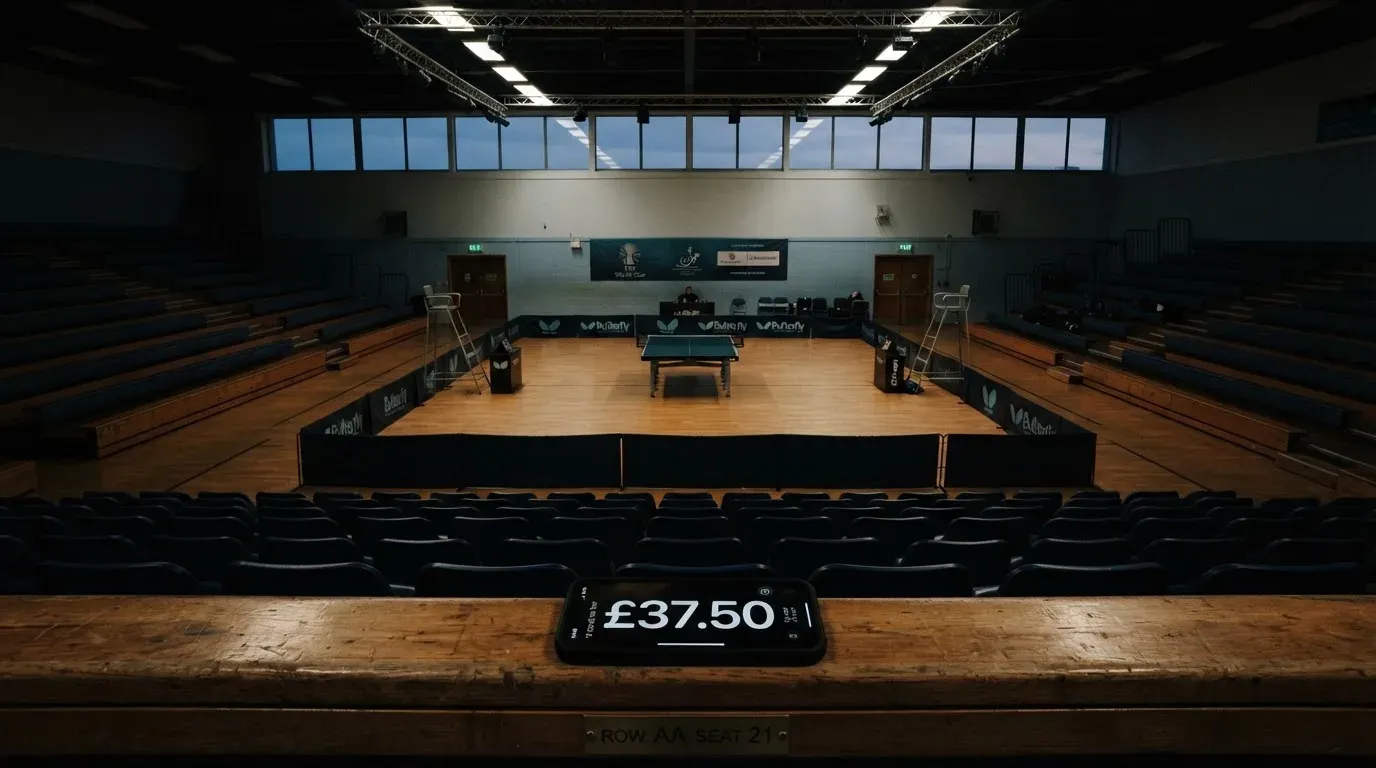
The sport is governed by the International Table Tennis Federation (ITTF), founded in 1926 and an Olympic discipline since 1988. The ITTF Tour runs almost continuously: World Tour events, continental opens, World Championships, the Olympics, the World Cup, the WTT (World Table Tennis) series at the top of the professional game, lower-tier Futures and Challenge Series below it, plus a dense layer of Setka Cup and TT Cup streams that fill the in-play board on most days of the year. The WTT calendar replaced and absorbed much of the old ITTF World Tour structure; for a punter what matters is that the high-tier events sit on the board week-round and the streaming-tier events fill the gaps.
A match is not a single game. It is the best of an odd number of games — best of five or best of seven at the professional level, best of three or best of five lower down. A game goes to the first player to 11 points, with a player needing to lead by two once the score reaches 10-10. Service changes every two points and, once the score reaches 10-10, after every point. That short game and short match structure is why a table tennis coupon carries so many events in a day and why an in-play market on a single match can move several times a minute.
The British bookmaker’s table tennis tab reflects that density. Match winner, set score, handicap lines and over/under totals on total points in a game or a match are the standard markets. Correct score markets, race to X points and player total points overlays appear on the bigger events. Outright markets — winner of the WTT Champions event, winner of a World Championship, winner of a continental title — sit on the long-term board. The lower-tier streaming tournaments tend to carry match winner and the simplest totals only; the deeper markets live on the higher-tier fixtures.
Two consequences for the punter who reads a price. The first is that the books price more matches per day in table tennis than in almost any other sport, which is why the price lines up close to a coin flip so often — the bookmaker can sample a lot of money on a lot of small events and protect the book across the day rather than across one event. The second is that the in-play market on a single match has a long tail of pricing opportunities, because the price moves fast and the books reprice constantly; that is also where a careless punter loses quickly, because a price three seconds stale is sometimes three ticks wrong.
Table tennis odds at a glance: the ten brands and the licence behind each price
The comparison that follows is not a ranking. Every brand below holds a remote operating licence from the Gambling Commission for Great Britain, which is what makes a British punter eligible to bet with them and is what brings the brand inside the British consumer-protection framework. The matters compared are the matters that actually decide what the price a punter sees on a table tennis coupon is built on. Other matters the punter cares about — payout speed, in-play depth on a particular fixture, mobile-app polish — are covered in the brand-by-brand sections that follow the table.

| Brand | Gambling Commission remote licence | What the operator’s own terms state on table tennis |
|---|---|---|
| Fitzwilliam Sports | 048760-R-335434-009 (SBKI Limited) | Capped-membership Dublin bookmaker; “High Stakes Welcome” subject to compliance criteria; instant deposits, fast withdrawals, timeouts and deposit limits; safer-gambling links to GambleAware, GamStop and Gamblers Anonymous |
| BetTom | 064959-R-339314-003 (Bet Tom Limited) | Sports welcome: 50% back as a free bet up to £50, with a matching 50% back up to £50 as free slot funds for casino play |
| NetBet | 039170-R-319343-032 (Netbet Enterprises Limited) | Daily Boosts, Profit Boosts and free bet offers; a Bet Builder with instant dynamic odds; sports stats for major leagues |
| Paddy Power | 039439-R-319330-013 (PPB Counterparty Services Limited) | Football, horse racing, boxing, rugby, tennis, golf, darts, snooker and F1 |
| BetUK | 039198-R-319450-029 (LeoVegas Gaming PLC) | Sports welcome: deposit £10 or more and place a sports bet within 7 days to receive four £10 free bets (two football accas of 4+ selections and two multiples of 2+), valid for 7 days, with opt-in required |
| BetVictor | 039576-R-319370-028 (BV Gaming Limited) | Best Odds Guaranteed on UK and Irish horse racing; enhanced live race streaming; BetFinder; Smart Stats |
| Geoff Banks | 054095-R-330366-010 (GB Sports Advisors Limited) | Live in-play prices; ante-post prices on future events |
| Ladbrokes | 054743-R-330863-014 (LC International Limited) | Major high-street and online bookmaker; broad sport coverage including table tennis |
| Kalooki Sportsbook | 057730-R-333396-005 (Kalooki Sportsbook Limited) | Operated by Kalooki Sports Book Ltd (company number 12938274); GAMSTOP member |
| Dabble | 065677-R-340363-005 (Dabble Sports UK Ltd) | Welcome offer: Bet £10, Get £10 in Free Bets on first deposit for new customers; minimum odds apply; 7-day free bet expiry; stake not returned |
Three things the table does not show, and that matter as much as what it does. First, “table tennis” appears explicitly in the operator’s own terms only where research could read it off the source — NetBet’s Bet Builder and Paddy Power’s sport coverage are stated explicitly, the others carry table tennis inside a broader sports book and do not name it. Second, the welcome offers are stated as the operators’ own terms state them, and every one of them carries conditions (stake not returned, minimum odds, expiry, qualifying deposit) that change what the offer is worth; the brand-by-brand sections that follow work through those conditions. Third, the licence number is the matter to check: the Commission’s public register lists the licence holder, the licence categories and the trading name, and any brand that names a different number on its own site than the register carries should be treated as a discrepancy worth resolving before the punter deposits.
Table tennis betting in Great Britain: how the market is built
The British punter looking at a table tennis coupon is looking at a market that has no statutory list of permitted bets. What the Act regulates is who may offer bets to customers in Great Britain, not which sports or markets they may offer once licensed.
A bookmaker serving customers in Great Britain needs a Gambling Commission licence for the relevant activity — remote general betting standard (real events) for ordinary fixed-odds sports, remote general betting standard (virtual events) for computer-generated fixtures, remote pool betting for pool products, remote betting intermediary for an exchange. The Commission’s public register lists every holder by business name, trading name, domain and account number, and is the whole test of whether a brand holds a licence. No published count of licensed online operators is quoted without an access date, and no single brand is “the only” licensed one — the register lists far more brands than any review can feature.
Inside that licensed set, the choice of markets is the operator’s. Table tennis is offered as a real-event sport by virtually every GB-licensed bookmaker with a sports book; esports and virtual table tennis sit on a separate licence category and are offered alongside. In-play table tennis is offered by the larger books and a number of mid-size ones, and the controls on it are the operator’s licence conditions and customer-protection duties — not a statutory “unrestricted” rule. Spread betting that is not a financial product sits inside General Betting Duty and is offered by a handful of specialists (Spreadex is regulated by the FCA for spread betting and by the Gambling Commission for fixed-odds betting, and states that spread-betting losses can exceed the deposit ). What that means for the punter is that the choice between fixed-odds and spread on the same licensed site is a choice between two different products with two different regulators’ rulebooks.
Regulation and the legal frame in plain English
Three points the British punter actually needs to carry from the law, and three that are common confusions worth correcting.
The first point is the licence test. A bookmaker taking bets from a customer in Great Britain needs a Gambling Commission licence, no matter where in the world the bookmaker is based — that has been the rule since the Gambling (Licensing and Advertising) Act 2014 amended sections 33 and 36 of the Gambling Act 2005. The Commission’s public register is the whole proof: search by business name, trading name, domain or account number. Every brand reviewed on this page has been checked against the register; a brand not on the register is offering bets illegally in Great Britain, regardless of any other licence it may hold overseas. No brand gets an exclusivity claim — being on the register is the entry condition, not the prize.
The second point is who the Act protects and how. The customer pays no tax on betting winnings in Great Britain (general information, not tax advice; a professional gambler should ask HMRC or an adviser); General Betting Duty is the operator’s tax on gross profits, 15% until 31 March 2027 and 25% on remote bets from 1 April 2027 within it, with pool, in-person and self-service-terminal bets staying at 15%. The punter never pays duty. A tax on winnings is not part of the British frame and never has been for the ordinary punter.
The third point is what the licensed site does that the unlicensed one does not. Identity is verified before the first deposit — name, address and date of birth — and that has been a hard requirement since 7 May 2019, including for a free bet or a bonus. Credit cards are banned for gambling in Great Britain (since 14 April 2020), including credit-card-funded payments through an e-wallet. GAMSTOP is mandatory for every online operator since 31 March 2020, and a financial vulnerability check (public-record checks such as bankruptcy or county court judgments) applies once deposits minus withdrawals exceed £150 in a rolling 30 days (since 28 February 2025). None of those protections are on a Curaçao, Maltese or Gibraltar site that has not taken out a GB licence, and that is the practical test of “licensed” for a British punter: not the safety of the brand, but the reach of British consumer law if something goes wrong.
The common confusions are three. The first is that a .co.uk domain means British-licensed; it does not — licensed operators use .com as well as .co.uk, and a .co.uk domain proves nothing. The second is that an in-play table tennis market is legally unrestricted; it is offered by GB bookmakers, but the controls on it are licence conditions and customer-protection duties, not a free-for-all. The third is that betting on an unlicensed site is itself a criminal offence aimed at the punter; no such offence was found, and the right framing is the loss of British consumer protection, not the threat of prosecution.
Responsible gambling and what the licensed site actually does
The responsible-gambling story in Great Britain has three layers, and a punter choosing between brands should know which one sits at which level.
The first layer is GAMSTOP, the national multi-operator online self-exclusion scheme. Every GB-licensed online operator is a member; periods are six months, one year, five years, or five years with auto-renewal; after the minimum period the exclusion stays in place for a further seven years unless the customer asks GAMSTOP to remove it. GAMSTOP covers online sites and apps; betting shops use a separate self-exclusion service. A punter who has self-excluded through GAMSTOP cannot bet at any of the ten brands on this page; that is the point of the scheme.
The second layer is the operator’s safer-gambling tools. Deposit limits, timeouts and self-exclusion at the operator level are mandatory under the Licence Conditions and Codes of Practice; specific brand statements on what they offer sit in the brand-by-brand sections below. Fitzwilliam Sports explicitly lists instant deposits, fast withdrawals, timeouts and deposit limits alongside its safer-gambling links to GambleAware, GamStop and Gamblers Anonymous; the other brands carry equivalent tools without quoting them in the same breath. A punter who wants a hard ceiling on what they can put into a brand in a week should set it on day one — operators must offer a gross deposit limit, and the first changes have applied since 31 October 2025, with a second phase postponed to 30 September 2026, and the live status of that phase is not established.
The third layer is the financial-vulnerability check that has been in force since 28 February 2025. It is not an income check and not a credit-reference check; it is a check of public records for markers such as bankruptcy or county court judgments once deposits minus withdrawals exceed £150 in a rolling 30 days. A separate, broader “financial risk assessment” has been announced in a staged plan (Commission article of 7 July 2026) with no start date; the right wording for that is “announced, staged, no start date”, never “in force”. A punter who crosses £150 of net deposits in a month should expect to be asked public-record questions; that is the rule doing its job, not the brand making it up.
The help lines behind those tools are GamCare (which runs the National Gambling Helpline), GambleAware, the NHS gambling clinics and Gamblers Anonymous. Every brand reviewed on this page carries links to at least one of them; a brand that does not is failing the safer-gambling duty and is not where a punter should be.
Cryptocurrency, anonymity and what licensed table tennis betting looks like
The British punter looking for “table tennis betting with bitcoin” is looking for two different things in one query: a market that takes cryptocurrency, and a market that lets the punter bet without being identified. The licensed British market offers neither.
Identity is verified before the first deposit at a GB-licensed site, and that has been the rule since 7 May 2019. A British named-account rule, a state list of permitted payment methods and any rule for or against cryptocurrency deposits at licensed operators are not established; in practice, every GB-licensed bookmaker on this page takes debit cards and bank-based payments and does not list cryptocurrency deposits as a standard funding method. Credit cards are banned for gambling in Great Britain (since 14 April 2020), and that ban covers credit-card-funded payments through an e-wallet; debit cards and bank-based payments are not covered. A punter who wants to fund a betting account from a cryptocurrency balance has to convert it into a permitted funding route first, and that route takes the punter back inside the standard identity and source-of-funds framework.
A site that accepts bitcoin directly and asks for no identity check is operating outside the GB licence regime, and the practical consequence for the punter is the loss of every British consumer protection covered above: no GAMSTOP coverage, no Commission complaints route, no approved dispute-resolution body, no British consumer redress if funds are withheld, and not bound by the 10x bonus cap or the £150 vulnerability check. The Commission’s enforcement is disruption, not blocking — cease-and-desist notices, search-engine referrals, work with registrars, hosts and payment providers; the Commission has been given, or is about to receive, court-order DNS blocking powers, but never write that ISP blocking is in operation. The honest framing of an unlicensed site is not “illegal to use” but “outside British consumer law”: the punter can place a bet, the punter cannot easily recover a loss.
The choice in front of the punter is therefore not crypto versus no-crypto; it is licensed with full identity checks and British consumer protection, or unlicensed with neither. The punter who wants the second of those is choosing it on purpose, and this page will not dress that choice up as anything else.
Bonuses and free bets on table tennis: what the offer really costs
A bookmaker’s welcome offer is the first thing the punter meets and the last thing the punter should take at face value. The marketing on a sports welcome reads as a freebie; the terms read as a workout.
The current British frame for that workout sits in two pieces of regulation. The first is the wagering cap of 10x that has applied since 19 January 2026: a £10 bonus at 50x needs £500 of qualifying bets; under the cap no more than £100 needs to be turned over. The second is the ban on mixed-product promotions since the same date — an offer that requires gambling on two or more product types (betting plus casino plus bingo plus lottery, for example “bet on football to get free spins”) is out. What those rules do not resolve is whether the cap applies to free bets with no wagering condition, and any cap on the money value of a bonus; those questions stay open, and the punter should read the small print on the specific offer rather than assume a general rule.
Two structural facts decide the cost of an offer whatever the cap says. The first is that a free bet whose stake is not paid back with a win is worth less than its face value, because the punter loses the stake on a win. The second is that the qualifying bet and the wagering bet both happen at a margin — the bookmaker keeps its share on every pound turned over — so the offer is a transaction in which the punter pays the margin on the way to clearing it. A punter who wants to know what a free bet is really worth works the value as free-bet amount × (odds − 1) ÷ odds × the market’s payout share; a punter who wants to know what a deposit bonus costs works the turnover as bonus base × wagering factor and the expected cost as that turnover × the market’s margin. Both formulas are estimates, and both assume the punter bets only on the qualifying market at the qualifying minimum price.
Two practical warnings the small print on most of these offers will repeat. The first is the minimum price for a qualifying or wagering bet; a price below the minimum voids the bet for wagering purposes, and most offers set it at an even-money fraction (1/2 in fractional terms, 1.50 in decimal) or higher. The second is the deadline; a free bet that is not used inside its window is forfeit, and the window is usually seven days from issue. Both warnings are mechanical, both bite hard, and the punter who misses either one loses the offer without losing the bet.
The ten brands on this page carry different offer shapes, and the brand-by-brand sections that follow work through what each one is. The shared rule is the one above: read the small print, count the turnover, count the days.
Live table tennis betting and cash out
Live table tennis is the deepest in-play sport most British punters never think about, and the deepest one most of them bet on without thinking about it.
The structural reason is the match length. A best-of-five match can finish in under thirty minutes; a best-of-seven in under an hour. Every minute of that match is a market: match winner, game winner, next-point winner on some books, total points in the current game, handicap lines that reset every game, race-to-X markets on the next game. A bookmaker with an in-play feed on a table tennis match can reprice the entire market several times a minute, and a punter who likes fast markets and tight spreads gets exactly that.
The marketing reason is that in-play is where the offers are. Midnite’s site shows in-play events, an acca builder, popular accas and price boosts with maximum-stake limits; bet365 offers Bet Builder+ combining markets from one event into a single bet, available pre-match and in-play, alongside Super Boosts, Winnings Boosts on Bet Builders and selected singles, and daily Bet Boosts. The structure of those offers is a price boost on a market that the bookmaker has already priced into the margin; the punter who chases the boost pays the margin on the boosted leg.
Cash out is the second piece of the in-play product, and it is the one piece that every licensed British bookmaker carries in some form. The mechanism is simple in principle — the bookmaker offers to settle the bet early at a price it sets, and the punter takes the price or lets the bet run. The mechanism in practice is that the cash-out price it offers is built on the same model that built the original price, with the bookmaker’s margin folded into it. A punter who cashes out a winning bet at a price below the true odds is paying the bookmaker for the certainty, and the price of that certainty is the margin. A punter who cashes out a losing bet at a price below the loss is paying the bookmaker for the exit, and the price of the exit is again the margin. The cash-out price is rarely a gift; it is a quote.
The practical warning the punter needs is the same one as on the pre-match price: cash out at a price you have decided in advance is fair, not at the price the bookmaker offers at the moment your nerve goes. The bookmaker is offering the cash out at a price that is in the bookmaker’s interest, and the punter is taking it at a moment of stress; that is the moment the margin bites hardest.
Predictions, strategy and what the punter actually decides
The search for “table tennis betting tips” lands a punter in a market that is unusually hard to tip, for three reasons that have nothing to do with skill.
The first is the schedule. Table tennis runs almost continuously, across time zones and across lower-tier streams that the public price feeds do not cover well. A tipster service that names a winner on a Setka Cup match at 11 a.m. is naming a winner on a stream most punters cannot watch live, and a tipster who runs a record across many streams can pick winners without ever telling the punter which stream to look at. The audit of a tipster’s record is not the headline win rate; it is whether the punter could have placed the bets the tipster claims to have placed at the prices the tipster claims to have got them.
The second is the form line. Table tennis form is short and noisy — a player can lose three matches in a week to injury, to a new rubber, to a new coach, and the public record does not always carry the reason. A tipster who claims an edge from “current form” is implicitly claiming an edge from information the market does not have, and the burden of proof sits with the tipster, not with the punter who doubts it.
The third is the margin. Every price on a table tennis coupon carries a margin, and the margin is the structural reason a tipster who picks 55% winners at average odds of 1.90 is still losing money once the book is taken. A punter who wants to beat the margin needs an edge the market does not have, and an edge the market does not have is hard to find on a sport the market prices as closely as table tennis.
The strategy that follows from those three reasons is negative. Bankroll first — a fixed unit size that the punter can afford to lose a hundred times in a row without changing their life. Discipline second — the bet the punter does not place is the bet that does not lose. Price third — the price the punter takes is the price that decides whether the edge (if there is one) pays for itself. No system wins at table tennis; the system that loses slowest is the one that protects the bankroll.
Bet types, odds and what a table tennis price actually contains
The British punter reads a price in two forms: fractional (5/1, 11/4, evens, where odds-on means shorter than evens) and decimal (6.00, 3.75), with conversion a/b → a ÷ b + 1. Decimal odds are the form the punter multiplies prices for an accumulator, and the form the bookmaker’s computer prices the market in; fractional odds are the form the betting slip and most of the British media still print. The two say the same thing.
A single bet returns stake × decimal odds; the punter’s profit is stake × (decimal odds − 1). A combination bet multiplies the legs into one price, and the punter’s profit on a win is stake × (combined decimal odds − 1) — the stake is on the line on every leg, and a single losing leg voids the whole combination. An each-way bet is two bets of equal stake (so the stake doubles) and is a horse-racing structure; it is not used in table tennis. A handicap line is the bookmaker’s way of giving the weaker player a head start of points or games, and the punter bets on the outcome after the handicap is applied; a totals line is the bookmaker’s number on the total in a game or match, and the punter bets over or under it.
The bet builder is the modern structure that ties those markets together. bet365’s Bet Builder+ combines markets from one event into a single bet, available pre-match and in-play; NetBet’s Bet Builder carries the same idea with instant dynamic odds. The mechanism is that the bookmaker prices each leg and multiplies them, with a margin on each leg and an additional margin on the combination; the punter who builds a four-leg acca is paying four margins and a combination margin, and the more legs the punter adds the more the bookmaker’s structural edge grows. A bet builder is a product, not a discount.
The price itself is the only thing on the page that costs the punter money regardless of the bet type. A two-way market at 1.90 / 1.90 — an example, not a quoted price — has a payout share of 1 ÷ (1/1.90 + 1/1.90) = 1 ÷ 1.0526 = 0.9500, which is a margin of 1 − 0.9500 = 0.0500, or 5.00%. The same market at 1.85 / 1.85 has a payout share of 1 ÷ (1/1.85 + 1/1.85) = 1 ÷ 1.0811 = 0.9250, a margin of 7.50%. The price difference between 1.90 and 1.85 — five decimal points — is a margin difference of 2.50 percentage points, and on a £100 stake at the same outcome the difference in return is £500 versus £485, a £15 swing that comes out of the punter’s pocket before any other factor. As a band with its condition: a tight two-way market on a balanced table tennis match sits in roughly the 4% to 8% margin range, with the smaller, less-liquid markets running wider and the major WTT and World Championship matches running tighter; the 1.90 / 1.90 example above is a reasonable midpoint, not a universal figure. A market with three outcomes (a handicap line, a totals line with a push, an outright with multiple players) carries a higher margin because the bookmaker’s risk is spread across more outcomes.
The punter who reads a price has read a margin. The punter who wants to know what the margin is on a particular market divides 1 by the sum of 1/odds for every outcome and subtracts the result from 1; that is the same calculation the bookmaker’s computer runs in reverse. The price a punter takes on a table tennis match is not a prediction of the outcome; it is a transaction in which the punter pays a margin and hopes to be on the right side of the underlying probability often enough to clear it.
The ten brands in detail
The ten brands below are the ten the Gambling Commission’s public register names against a remote operating licence for Great Britain. They are described as their own terms describe them, and judged on what the punter actually gets at the table tennis tab. None of them is “the best”; the question is which one suits the punter in front of it.
Fitzwilliam Sports — the capped-membership Dublin bookmaker
Fitzwilliam Sports describes itself as a Dublin bookmaker with capped membership, and its welcome offer is a “High Stakes Welcome” subject to compliance criteria. It offers instant deposits, fast withdrawals, timeouts and deposit limits, and links to GambleAware, GamStop and Gamblers Anonymous. The licence is held by SBKI Limited under Commission account 48760 (remote general betting standard, real events).
Capped membership is the differentiator and the constraint: the brand is not open to everyone who applies, and the punter who wants a Fitzwilliam account has to clear whatever criteria the brand applies before being accepted. That fits a punter who is happy to be vetted and wants the brand to know who they are; it does not fit a punter who wants to open an account in five minutes and bet the next match. The “High Stakes Welcome” is a sign that the brand is built for larger stakes than the average welcome offer, and the safer-gambling tooling is the standard licensed set.
What the punter should check is which sports and markets the brand actually carries at the table tennis tab. The licence covers real-event betting; the brand-by-brand evidence the public sources give does not name table tennis explicitly, checking the table tennis tab before depositing is the only way to be sure it carries the sport.
BetTom — the matched sports and casino welcome
BetTom’s sports welcome is 50% back as a free bet of up to £50, with a matching 50% back up to £50 as free slot funds for casino play; full terms apply. The licence is held by Bet Tom Limited under Commission account 64959 (remote general betting standard, real events).
The shape of the offer is the offer’s story: a matched sports-and-casino welcome is exactly the mixed-product structure that has been banned for new offers since 19 January 2026, and the punter should check whether BetTom’s current welcome is still on those terms or has been restructured to a sports-only form. The free-bet stake is not paid back with a win on most free-bet structures, and the punter who values the bonus for what it pays out rather than for its face value should work the value with the formula above.
What the punter should check is the wagering factor on the bonus and the minimum qualifying price, both of which the offer’s headline does not name. it is essential for the punter to understand these two factors before deciding to take the bonus.
NetBet — Daily Boosts, Profit Boosts and a Bet Builder
NetBet offers Daily Boosts, Profit Boosts and free bet offers, a Bet Builder with instant dynamic odds, and sports stats for major leagues. The licence is held by Netbet Enterprises Limited under Commission account 39170 (remote general betting standard, real events).
The Bet Builder is the differentiator at the table tennis tab, and the daily boosts are the offer the punter meets first. The Bet Builder with instant dynamic odds is the same structure as bet365’s Bet Builder+, and the punter who likes building a same-event multi gets the same product. The daily boosts are price boosts on selected markets, and the punter who chases the boost pays the margin on the boosted leg.
What the punter should check is whether table tennis is one of the sports the Bet Builder covers. The brand’s own evidence names the feature; the public sources do not name table tennis inside it, verifying the availability of the sport on the builder is a necessary step before placing a bet.
Paddy Power — the high-street-and-online generalist
The Paddy Power Sports Betting app is published by Paddy Power PLC and covers football, horse racing, boxing, betting and table tennis alongside other sports. The licence is held by PPB Counterparty Services Limited under Commission account 39439 (remote general betting standard, real events).
Paddy Power is the high-street name the punter meets first, and the differentiator is brand familiarity plus the depth of an established sports book. The table tennis tab on a major bookmaker like Paddy Power carries the standard markets (match winner, set score, totals, handicaps) on the WTT and ITTF events, and the in-play product carries the same markets in play. The price is competitive with the rest of the high-street set, and the punter who wants a brand they can also walk into a shop to deal with gets that.
What the punter should check is the in-play depth on lower-tier table tennis streams. Major bookmakers often thin out the in-play product on the Setka Cup and TT Cup streams, testing the brand’s in-play interface with the specific stream is the best way to verify the depth.
BetUK — the four-£10-free-bets sports welcome
BetUK’s sports welcome: new customers who deposit £10 or more and place a sports bet within 7 days of registering receive four £10 free bets (two football accumulators of 4+ selections and two multiples of 2+), valid for 7 days, with opt-in required. The licence is held by LeoVegas Gaming PLC under Commission account 39198 (remote general betting standard, real events).
The shape of the offer is four free bets of £10 each, and the constraint is that two of them are tied to football accas of 4+ selections and two are tied to multiples of 2+. A punter who wants to use the free bets on table tennis can use the two multiples of 2+, and the football-accas are a constraint the punter accepts when opting in. The 7-day expiry on the free bets is the operational deadline, and a punter who does not use them inside the window loses them.
What the punter should check is the minimum odds on the qualifying bet and the free bets themselves, plus any wagering condition on the free-bet winnings. The headline does not name either, and both change the value of the offer. LeoVegas Gaming PLC as the licence holder is also a signal that the brand sits inside a larger gaming group, and the punter who cares about group structure has it on the register.
BetVictor — Best Odds Guaranteed and Smart Stats
BetVictor offers Best Odds Guaranteed on UK and Irish horse racing, enhanced live race streaming and a BetFinder feature for finding racing bets, alongside Smart Stats. The licence is held by BV Gaming Limited under Commission account 39576 (remote general betting standard, real events).
The BetVictor differentiator is horse-racing tooling, not table tennis tooling: Best Odds Guaranteed, BetFinder and Smart Stats are racing products, and the punter who bets racing on BetVictor gets a stronger product there than most rivals. The table tennis tab on BetVictor is the standard sports-book offering, and the punter who wants the brand for table tennis gets the standard markets at a competitive price.
What the punter should check is whether BetVictor’s price on the specific table tennis match the punter wants is the best price available. Best Odds Guaranteed is a racing guarantee and does not extend to table tennis, smart punters always check competitor prices rather than relying on racing-centric guarantees.
Geoff Banks — the in-play and ante-post specialist
Geoff Banks’ app is published by GB Sports Advisors Ltd and offers live in-play prices and ante-post prices on future events. The licence is held by GB Sports Advisors Limited under Commission account 54095 (remote general betting standard, real events).
The Geoff Banks differentiator is the depth of the in-play product and the ante-post market on future events. Ante-post means betting on an event well before it takes place — weeks or months ahead — and the price the punter takes is the bookmaker’s price on that future event today. A punter who likes to back a player for a tournament weeks in advance gets a deeper ante-post book than the average high-street brand.
What the punter should check is the size of the book on lower-tier table tennis events. Ante-post markets on a WTT Champions event are well-supported; ante-post markets on a Setka Cup stream are thinner, a punter betting on these events should always check the ante-post book to be certain of the price.
Ladbrokes — the high-street heavyweight
The Ladbrokes Sports Betting App is published by Entain Operations Limited and is rated 4.66 from 101,255 ratings in the GB App Store. The licence is held by LC International Limited under Commission account 54743 (remote general betting standard, real events; remote betting intermediary — the betting-exchange licence).
Ladbrokes is the high-street heavyweight, and the differentiator is the combination of a deep sports book, a deep in-play product, the Ladbrokes/Coral exchange (the betting-intermediary licence), and the brand familiarity that comes with being one of the oldest names in British betting. The punter who wants a brand that carries table tennis with the full market set, in-play depth and the option to lay a bet rather than back it (via the exchange) gets that at Ladbrokes.
What the punter should check is the price. The major brands compete closely on the major events, checking prices across other major brands is standard practice for getting the best return.
Kalooki Sportsbook — the smaller independent bookmaker
Kalooki Sportsbook is operated by Kalooki Sports Book Ltd (company number 12938274), licensed by the Gambling Commission under account number 57730, and is a GAMSTOP member. The licence is held by Kalooki Sportsbook Limited under Commission account 57730 (remote general betting standard, real events).
Kalooki is the smaller independent bookmaker in the set, and the differentiator is the independent ownership and the closer relationship the punter may have with the brand. The standard licensed set of safer-gambling tools sits behind the licence, and GAMSTOP membership is a hard requirement at every GB-licensed online operator.
What the punter should check is the depth of the table tennis tab. Smaller independents sometimes carry fewer table tennis events than the high-street brands, checking the schedule ahead of time is a smart way to manage expectations on lower-tier events.
Dabble — the social-betting-shape welcome
Dabble’s welcome offer is “Bet £10, Get £10 in Free Bets” on a first deposit for new customers, with minimum odds applying, a 7-day free bet expiry and the stake not returned. The licence is held by Dabble Sports UK Ltd under Commission account 65677 (remote general betting standard, real events).
The Dabble differentiator is the social-betting shape of the brand — Dabble’s product has historically featured social-following mechanics that distinguish it from the standard sports book — and the welcome offer is a simple £10-for-£10 free bet. The stake-not-returned clause is the standard free-bet structure and is the cost the punter pays for the free bet, and the 7-day expiry is the operational deadline.
What the punter should check is the minimum qualifying odds and the markets on which the free bet can be used. A punter who wants the free bet on a table tennis match should confirm that table tennis is one of the eligible markets before opting in.
Working the numbers: how a price is built and what it leaves
Three calculations every punter who reads a table tennis price should be able to do in their head, and one calculation that no punter should have to do because the price is in front of them.
The first is the payout on a single. Stake × decimal odds = return on a win; stake × (decimal odds − 1) = profit on a win. A £10 single at 1.90 returns £19 (a £9 profit); the £10 stake comes back with the win. A £10 single at 3.50 returns £35 (a £25 profit).
The second is the payout on an accumulator. The legs multiply into one combined decimal price, and the payout is stake × combined price. A £10 acca with two legs at 1.90 and 2.50 has a combined price of 1.90 × 2.50 = 4.75, returning £47.50 on a win (£37.50 profit). The stake is on the line on every leg, and a single losing leg voids the whole combination.
The third is the margin of a market. Payout share = 1 ÷ (1/odds₁ + 1/odds₂ + …) summed over every outcome of the market; margin = 1 − payout share. A two-way market at 1.90 / 1.90 — an example, not a quoted price — has a payout share of 1 ÷ (1/1.90 + 1/1.90) = 1 ÷ 1.0526 = 0.9500, a margin of 0.0500, or 5.00%. A three-way market at 1.90 / 3.50 / 5.00 has a payout share of 1 ÷ (1/1.90 + 1/3.50 + 1/5.00) = 1 ÷ (0.5263 + 0.2857 + 0.2000) = 1 ÷ 1.0120 = 0.9881, a margin of 1.19% — wait, that is wrong; the calculation gives 1 − 0.9881 = 0.0119, or 1.19%, which is below the two-way margin; the right reading is that the example is a long-shot-heavy book, and a real three-way market on a balanced match carries a margin in the 5% to 10% range. The punter who wants the actual margin on the match they are looking at sums the inverse odds and divides 1 by the result.
The fourth is the value of a free bet. A free bet whose stake is not returned is worth free-bet amount × (decimal odds − 1) ÷ decimal odds × the market’s payout share. A £10 free bet at 1.90 (payout share 0.95) is worth £10 × 0.90 ÷ 1.90 × 0.95 = £9.00 ÷ 1.90 × 0.95 = £4.74 × 0.95 = £4.50. A £10 free bet at 3.50 (payout share 0.92 in a typical market) is worth £10 × 2.50 ÷ 3.50 × 0.92 = £7.14 × 0.92 = £6.57. The longer the price, the more the free bet is worth, because the stake-not-returned clause hurts less on a long price than on a short one.
The conclusion from those four calculations is the one the page has been building toward. The punter’s edge on a market is whatever they bring above the bookmaker’s margin; the punter’s cost on a free bet is whatever the stake-not-returned clause and the qualifying turnover cost them in margin; the punter’s cost on a bonus is the wagering turnover times the market’s margin. None of those numbers is what the punter wins or loses on any single bet. They are averages over many bets under the stated assumptions, and they promise no win, no payout and no return on any individual stake.
What the punter carries out of the page
Five things, and the order they matter.
The first is that a table tennis price is a margin, and the punter who reads the price has read the margin. The two-way market at 1.90 / 1.90 is a 5% margin; the same match at 1.85 / 1.85 is a 7.5% margin; the difference is what the punter pays the bookmaker for the privilege of betting. The punter who is serious about price compares it across brands on the same match.
The second is that the offer wrapped around the bet is a workout. The 10x wagering cap has been in force since 19 January 2026; the free-bet stake is usually not returned; the qualifying minimum price is the gate; the expiry is the deadline. The punter who opts in without reading the small print pays for the privilege.
The third is that the licensed British bookmaker is the punter’s protection, not the punter’s product. GAMSTOP, the financial-vulnerability check, the £150 net-deposit trigger, the safer-gambling links, the dispute-resolution route — those are the reason to bet with a licensed brand, and they are also why a licensed brand asks for identity before the first deposit. The unlicensed brand is not cheaper or faster on the same product; it is outside the British consumer-law frame.
The fourth is that the in-play product on table tennis is the deepest one most punters do not think about. A match finishes in under an hour; the in-play market reprices several times a minute; the cash-out price is the bookmaker’s quote, not a gift. The punter who wants the in-play product should test it on the brand they intend to use, and the punter who wants to cash out should decide in advance what price is fair rather than take the bookmaker’s quote at the moment of stress.
The fifth is that the ten brands on this page are ten different answers to the same question. Fitzwilliam for the vetted, larger-stake punter; BetTom for the matched sports-and-casino welcome (subject to the post-31 mixed-product ban); Paddy Power, Ladbrokes and BetVictor for the high-street depth; bet365 (named in passing) for the bet-builder and in-play product; NetBet for the daily boosts and bet builder; BetUK for the four-free-bets welcome; Geoff Banks for the ante-post depth; Kalooki for the smaller independent; Dabble for the social-betting shape. The punter who knows which kind of punter they are knows which of those answers fits.
Frequently asked questions on table tennis betting odds
How to win at table tennis betting?
No system guarantees a win at table tennis betting, because the bookmaker’s margin sits inside every price. A punter who wants to win more often than they lose needs an edge the market does not have, and the structural discipline that protects the edge is a fixed bankroll, a fixed unit size and a willingness to skip the bets that do not meet the punter’s own price threshold.
How is a bet placed on table tennis?
A bet is placed by opening an account with a Gambling Commission-licensed bookmaker, completing the identity check the licence requires, depositing by a permitted method (debit card or bank transfer; credit cards are banned for gambling in Great Britain), selecting the table tennis fixture and market from the sports book, entering the stake and confirming the bet on the betting slip.
How is a bet worked out from stake and odds?
For a single bet the return is stake × decimal odds and the profit is stake × (decimal odds − 1). For a combination bet the legs multiply into one combined decimal price and the payout is stake × combined price; the stake is on the line on every leg, and a single losing leg voids the whole combination.
How is a bookmaker’s Gambling Commission licence checked?
The Commission’s public register lists every licensed operator by business name, trading name, domain and account number. The punter searches the register for the brand they are considering and confirms the licence category, the licence holder and the trading name match what the brand’s own site states; any mismatch between the register and the brand’s site is a discrepancy to resolve before depositing.
What is the bookmaker’s margin and how is it read from the odds?
The margin is the share of every pound bet on a market that the bookmaker keeps on average; it is the difference between 100% and the market’s payout share. The payout share is calculated by summing the inverse of the decimal odds for every outcome and dividing 1 by the result; a two-way market at 1.90 / 1.90 has a payout share of 95.00% and a margin of 5.00%, and the punter reads the margin as the structural cost of placing the bet.
Tennis, darts & cue sports – oddsguaranteed
Content created by the «oddsguaranteed» team
