
Darts Betting Odds in 2026: What the Price Actually Carries
 Available in US
Data current as of October 30, 2026 and checked against the UK Gambling Commission’s public register.
Darts looks like a small sport on paper — two players, a board, a chalk score — but the betting market behind it is wider than most newcomers expect. The PDC World Championship alone drew 128 players at Alexandra Palace across the 2025/26 edition, with Luke Littler taking the title 7–1 against Gian van Veen and a £1,000,000 winner’s cheque to go with a £5,000,000 prize fund. Outside the World Championship the calendar never really stops: Premier League Darts, the Players Championship events, the European Championship, the Grand Slam of Darts, the World Grand Prix and the World Series of televised finals give a licensed bookmaker something to price almost every week of the year. That’s the shelf the odds sit on, and it is also the reason the price of a darts market varies more than people who haven’t watched the sport closely tend to assume.
What follows is a working map of that market. It opens with the structure of the sport itself, because every market on a betting slip — match winner, handicap, total legs, highest checkout, 180s — sits on top of how 501 is actually played and how legs finish. From there it walks through the legal frame in Great Britain, the bonus and free-bet landscape that is genuinely the most heavily marketed part of any bookmaker’s darts page, the live and in-play product, and the markets themselves: how an odds compiler builds a price, what the margin looks like inside that price, and how a punter reads both. The end of the page closes a ten-bookmaker shortlist of UK-licensed brands that carry darts in depth, with a written assessment of what each one does well and where it falls short for this sport in particular.
The angle through all of it is consequence: not “what does this offer look like” but “what does it cost the person who takes it, and when does that cost show up.” A 100% bonus that requires fifty times its value in bets is not the same product as one that requires ten; a live market priced over 7% margin is not the same product as one priced over 4%. Those differences rarely appear on the homepage, and they are the ones that decide whether a weekend account ends up where the bettor wanted.
How Darts Is Played — and Why That Matters to the Markets
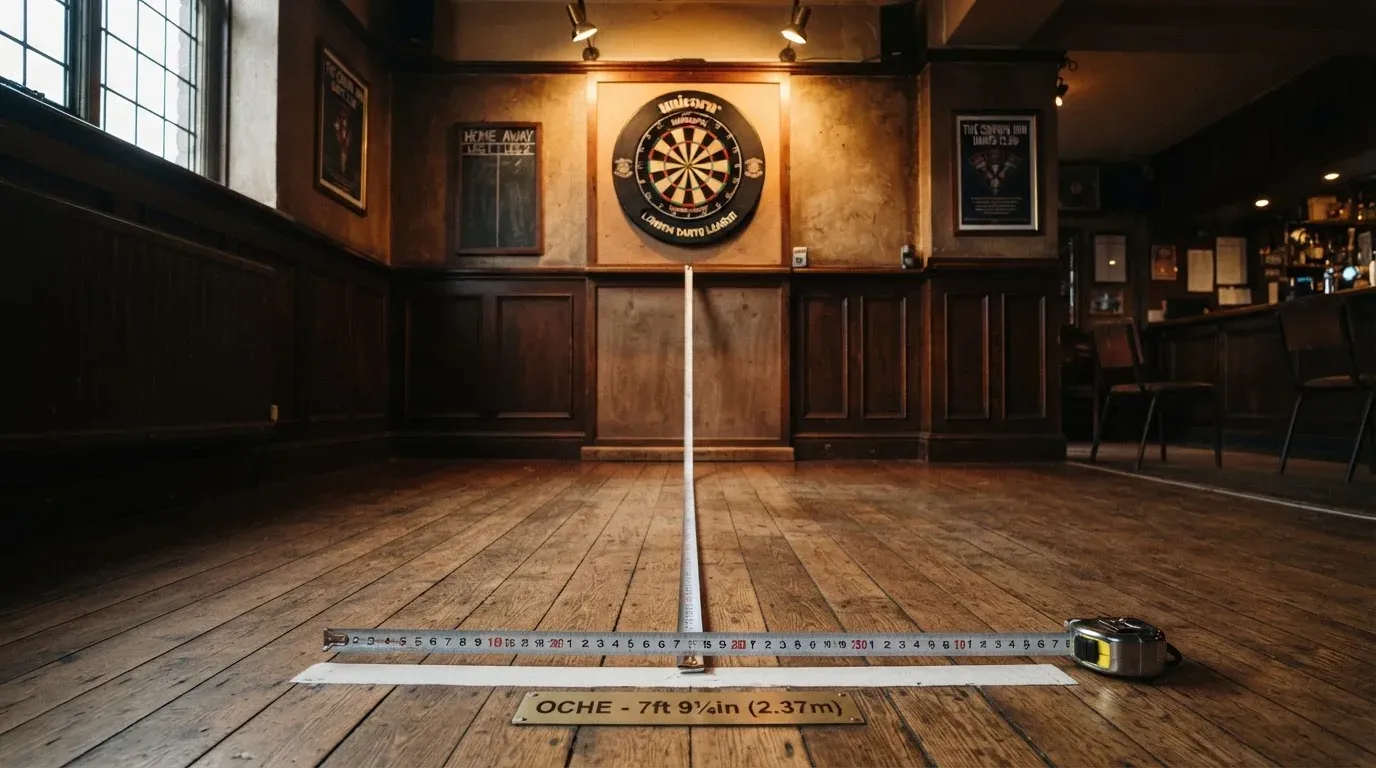
A standard dartboard is divided into 20 numbered segments, each split into a single, a double and a treble ring; the bullseye at the centre scores 50, with the outer ring worth 25. Players stand 2.37 metres back (7 ft 9 in) and aim at a bullseye mounted 1.73 metres above the floor. The geometry is fixed, the equipment is regulated by the governing bodies, and the rules of the game are simple enough that the betting markets can mirror what is actually happening on stage.
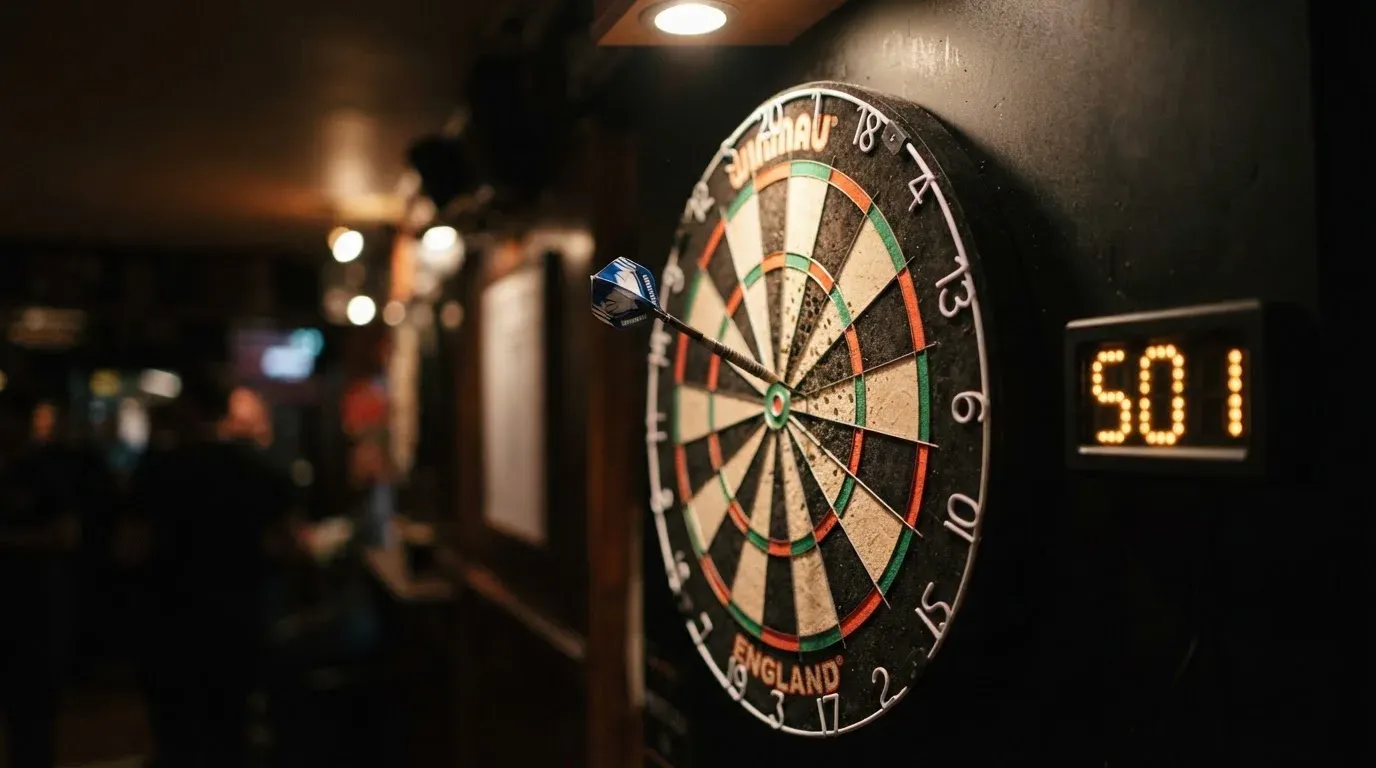
In 501 — the format that runs most televised PDC matches from the World Championship down to floor events — a player starts on 501 and must finish on a double or the bullseye. The highest checkout a player can hit in three darts is 170 (treble 20, treble 20, bullseye), which is why the world record keeps being set and reset. The shortest possible leg takes nine darts if a player hits nothing but doubles and maximum scores — a sequence that almost never happens in practice, but explains the floor under any “total legs” market. Once a format is set, the betting slips are built on top of it.
Match formats at the 2026 PDC World Championship read as follows. Rounds one and two were first to three sets, rounds three and four first to four, the quarter-finals first to five, the semis first to six and the final first to seven. Inside a set, a leg is won by the first player to finish on a double; a set is typically best of five legs. Longer matches mean more legs, more variance and — for the punter — more opportunities for an in-play market to move before the advertised price reflects the score. Short matches compress the scoreboard into a smaller window and put a premium on the favourite’s ability to hold throw. Both are honest products, priced for what they are.
What follows is the part that the betting markets actually sit on.
The formats that drive the slip
Three formats cover almost every televised event.
- 501, legs-based, as above. The bread and butter of PDC broadcast darts and the format that the vast majority of televised “match winner” markets are priced on.
- Legs-based formats with shorter races. The Players Championship final uses shorter matches, which compress variance and tend to shorten the odds on the favourite.
- “Sets and legs” hybrids. Used in major championships; the World Darts Championship uses legs within sets, with the match format above. Outright markets usually quote the same bet as a single price, but the in-play market moves leg by leg rather than set by set.
A bookmaker that doesn’t show the format on the market header is one to treat carefully — the difference between “first to three sets” and “first to five legs” is the difference between a market with room for a comeback and one without.
What the scoreboard gives the bookmaker
The leg-by-leg nature of the scoring system is what gives darts its distinctive in-play feel. A player down five legs to love can win a match from there only if the format leaves the room, which a legs-based race generally does and a sets-based match may not. The odds compiler knows this, and the live market moves accordingly. It is also why “next leg winner” is the cleanest in-play market on most darts books — it has the shortest gap between an event happening on stage and a market reflecting it. “Next set” is more compressed and tends to swing less.
The 180 — three darts in the treble 20 — is the sport’s signature statistic and the most heavily priced novelty market. Live streams overlay a running 180 count on the broadcast and the bookmaker’s market usually tracks it: most matches see a leaderboard between 0 and 3 maxes per player per set, and the market is a price on who lands more. Highest checkout is a slower market because a single visit decides it; the field narrows from all 128 to the finalists in the World Championship, which is why the outright highest-checkout market during the tournament is one of the few darts markets that genuinely justifies a small interest across all runners, not just the favourites.
The Legal Frame Around a GB-Licensed Darts Bet
In Great Britain there is no statutory list of permitted sports or markets — darts sits inside a wider permission to offer bets on real events, which every UK-licensed online bookmaker holds as part of its general betting licence. What decides whether a brand can take a bet from a customer in London, Cardiff or Edinburgh is the Gambling Commission’s public register, full stop. A Curaçao, Maltese or Gibraltar registration is not a substitute: since the Gambling (Licensing and Advertising) Act 2014, an operator whose remote facilities are used in Great Britain has to hold a Commission licence wherever it is based, under sections 33 and 36 of the Gambling Act 2005 as amended.
Identity verification happens before the first deposit. Since 7 May 2019 a licensed operator has had to confirm the customer’s name, address and date of birth before any money moves — including before a free bet or bonus is credited. There is no anonymous play at any of the brands reviewed below. Spread betting that counts as a financial product sits outside this regime and is regulated by the Financial Conduct Authority, which is why firms such as Spreadex carry two regulators — one for spread betting, one for fixed-odds betting — and the fixed-odds side is the part relevant to a darts punter. Spread betting losses can exceed deposits, which is its own warning worth reading on the operator’s own page.
The minimum age is 18, and the credit-card ban that took effect on 14 April 2020 covers any credit-card-funded payment to a gambling site, including via an e-wallet. Debit cards and bank-based transfers are not covered by that ban. Cryptocurrencies are not formally authorised or formally forbidden at GB-licensed sites; describe any crypto product only as the operator’s own terms set it out.
What an unlicensed site costs the customer
An offshore site without a Commission licence is not illegal for the customer. The offence under section 33 of the Gambling Act 2005 is aimed at the operator (up to 51 weeks’ imprisonment, a fine, or both on summary conviction in England and Wales, with a separate scale in Scotland). The cost of betting with one falls on the customer instead: no GAMSTOP coverage, no access to the Commission’s complaints and ADR route, no obligation on the operator to honour the 10x wagering cap that took effect on 19 January 2026, no automatic brake on the financial vulnerability check that runs at £150 net deposits in a rolling 30 days, and no British dispute-resolution service if funds are withheld. That is the trade, plainly.
What the customer gets for the licence
A licensed dart bet in 2026 comes with a set of consumer protections an offshore site does not match.
- GAMSTOP self-exclusion since 31 March 2020, which covers online sites and apps. Periods are six months, one year, five years or five years auto-renewing; after the minimum runs out the exclusion stays in place for a further seven years unless GAMSTOP is asked to lift it.
- A financial vulnerability check that has been in force since 30 August 2024 and uses public records (bankruptcy, county court judgments), not an income or credit-reference check.
- A deposit-limit framework (RTS 12) with the first phase live since 31 October 2025 and a second phase postponed to 30 September 2026.
- A 10x cap on bonus wagering requirements, in force since 19 January 2026.
- A ban on mixed-product promotions: an offer that requires gambling on two or more product types — betting, casino, bingo, lottery — has been out of bounds since the same January 2026 rule set.
- ADR via approved dispute resolution providers, free at the point of use, on top of the Commission’s own complaint route.
The verification-before-deposit rule that closes the door on anonymous play is sometimes framed as a downside. The honest read is that it is the trade one accepts in exchange for every protection above.
Safer Gambling in Darts Betting
Darts is unusual among televised sports in that a televised match can run for ninety minutes with very little dead air, the markets keep moving, and an in-play product is permanently live during the broadcast. That pace rewards self-discipline in a way a slower sport does not. The framework below is what an account at a licensed operator actually maps onto, in the language the operator’s safer-gambling tab uses.
GAMSTOP is the national multi-operator self-exclusion scheme for online betting in Great Britain. Periods are six months, one year, five years or five years with auto-renewal; once a period runs out the exclusion stays in place for a further seven years unless the customer asks for it to be lifted, at which point GAMSTOP does a 24-hour cooling-off review before reinstating the account. The scheme covers sites and apps, not betting shops — those use a separate land-based self-exclusion process.
The financial vulnerability check is the second tier. Since 30 August 2024, when a customer’s deposits minus withdrawals cross £150 in a rolling 30-day window, the operator runs a check against public records. It is not a credit-check, and it does not look at income; a public bankruptcy or county court judgment on file is the kind of marker that prompts a conversation, not a freeze. Above that threshold, an operator may also carry out a financial risk assessment under the staged plan the Commission set out in its July 2026 article, but those checks have no start date as of writing — the rule of thumb is to treat them as announced, staged and not yet in force.
Limit-setting lives with the punter. Operators must offer a gross deposit limit on a fixed time frame, and the customer chooses the cap. There is no statutory maximum stake in sports betting; the limit on the slip is either the operator’s own house stake or the punter’s deposit ceiling, whichever is lower. The practical takeaway is that anyone who finds themselves chasing losses during a televised session is closer to a GAMSTOP exclusion than they probably want to be.
Help is one tap away if it comes to that: GamCare runs the National Gambling Helpline, GambleAware funds treatment and signage, NHS gambling clinics are free at the point of use and Gamblers Anonymous runs local meetings across the country. Several brands on the shortlist below link to these services from the footer of every page. That is the floor under the operation, not the ceiling.
Bonuses and Free Bets on Darts
Darts is one of the most heavily marketed sports for bookmaker welcome offers, and the welcome offer is the single biggest financial commitment most casual darts punters make against any bookmaker. The headline price is rarely the headline cost. Wagering requirements, minimum odds, expiry windows, free-bet stake return rules, payment-method exclusions and the small print on acca insurance all sit on top of the number the advert shouts. A 100% match is not always a better deal than £40 in free bets after a £20 qualifying bet, and a “risk-free” first bet refunded as a free bet is not the same product as a refund in cash.
The regulation that governs all of it is fairly tight from 19 January 2026 onwards. Any bonus a bookmaker offers to a UK customer carries a wagering requirement capped at 10x — a £10 bonus needing £100 of qualifying bets, a £50 bonus needing £500, and so on. Mixed-product promotions are out. A free bet whose only condition is expiry and no wagering is outside the 10x cap in practice, though the position on a strict reading is not established. What that rule means for the punter is that a bonus line quoted as “50x the bonus” on an offshore site is now a hung number: a UK-licensed brand simply cannot compete on that basis, and the bookmaker has to convert the offer into free bets, odds boosts or acca insurance to attract the same headline. The product mix has tilted accordingly.
What every welcome offer on the shortlist actually pays
Two worked examples from this season’s terms pages, both described below as their own operators state them.
- Unibet’s UK welcome offer is “Get £40 in Free Bets when you bet £20”: a sports bet of £20 or more at minimum odds 2.0 (1/1), funded by debit card or instant bank transfer, free bets expiring within seven days of issue. The qualifying bet is a single stake, the free bet stake is not returned with a winning free bet, and only new GB customers qualify.
- Betboro’s UK welcome offer is a 100% matched free bet of up to £25 on the first qualifying wager: a debit-card deposit of at least £10, a first bet between £5 and £25 with at least three selections, each selection at 3/5 (1.60) or higher.
Two offers, two different shapes. Unibet pays a fixed £40 for a £20 trigger at a single price of 2.0; Betboro scales the free bet to the qualifying stake up to £25 but ties it to a small-stake multiple at a 1.60 minimum per leg. The headline price alone tells the reader almost nothing useful; the qualifying bet, the per-leg minimum odds and the expiry rule do the work.
Reading the small print
A short glossary of terms attached to most welcome offers on this market.
- Qualifying bet: the stake that unlocks the offer. The minimum and the minimum odds are what makes the offer generous or thin. A qualifier at evens (2.0) is normal for the market; anything below is restrictive.
- Free bet stake not returned: the standard position. A winning free bet pays profit only; the stake that won is taken back by the bookmaker. This is the rule, not the exception, and it is what drives the calculation in the section on what a free bet is worth.
- Minimum odds per selection: applies to free-bet stakes and sometimes to acca insurance. The 1.50 to 1.80 range is standard; a 2.0 minimum per leg on a five-fold is unusual and tightens the qualifying offer considerably.
- Expiry: typically seven days on a free bet, fourteen to thirty on a deposit bonus. The shorter the window, the more sharply the offer favours a punter who already has a bet in mind.
- Payment-method exclusions: deposit bonuses routinely exclude deposits from Skrill, Neteller and certain e-wallets, and a debit card is now the standard trigger for UK welcome offers.
- One-per-customer: standard. The trigger is usually the customer’s first bet, not the first deposit, and the IP, payment method and address are checked against previous accounts.
- Wagering requirement: the cap of 10x applies to a deposit bonus only. A free bet has no wagering requirement in the modern UK market.
The headline number is the smallest piece of information on the offer page. The qualifying bet, the minimum odds, the expiry window, the free-bet stake rule and the payment method are the bigger ones.
Acca insurance and the price-boost economy
Welcome offers are the entry point; recurring offers do most of the work over a season. Acca insurance — a stake refund as a free bet if one leg of a five-fold or higher loses — is now standard at most brands and is usually tied to a minimum odds-per-leg threshold around 1.5 or 1.6. A free-spinner on acca insurance is that the refund is a free bet and the stake is not returned on a win, so the effective yield of an insurance leg is the probability of one losing leg times the implied value of the free-bet token, which is rarely worth what the marketing language implies. A £10 free bet on a market priced 5.0 is worth roughly £10 × (5 − 1) ÷ 5 = £8 of expected value at a market with no margin; on a market with 6% margin that number drops by about a sixth. The bankroll value of an acca-insurance offer is therefore positive but small, and depends almost entirely on how often the punter actually lands in the position of one losing leg.
Price boosts (also called “enhanced odds” or “odds boosts”) work the opposite way: the bookmaker takes a short-priced favourite — Michael van Gerwen to win a Premier League night at 1.40 — and offers an inflated price of 2.0 for new customers or app users. The terms usually cap the stake at a token amount (£1 to £5) and the winning payouts at a hard ceiling (between £25 and £100), so the offer is closer to a free entry than to a serious play. The numbers can look attractive on the marketing page; the cap on winnings is what stops it costing the bookmaker.
Live Betting and Cash Out on Darts
The single biggest reason a punter sticks with one darts bookmaker over another is the live product. The match is being played and the market is moving; what the punter sees on screen during a televised session is closer to a financial trading screen than to a pre-game list, and the brands that build the best live experience earn the most in-play stake during the major championships.
The mechanics of a darts in-play market are different from those of a football one. There is no clock running, the score is updated leg by leg, and the market moves in tight jumps every time a player holds or breaks throw. The standard in-play market is “next leg winner”, which is the closest thing in darts to the next-point market in tennis: the price swings with the thrower’s position on a finish, narrows on a setup shot and resolves inside thirty seconds of the broadcast.
“Next set winner” is a slower product with a similar structure but over more darts, and is the market used for many televised frames when the match is at the longer race. “Race to three legs” — a side market on which player reaches the milestone first — appears on most major-brand books and resolves faster than the match winner. The outright match market updates almost constantly during the leg, then settles into a tighter band between legs while the cameras cut away.
Cash out on darts sits on top of these markets and is offered on most of the brands reviewed below; it is rarely available at every in-play price point, and the suspended periods during throws are exactly when a sharp customer would most want to use it. A short review of the cash-out framing is worth doing before settling on a bookmaker for live play.
What to look for in a live product
A practical list of what a darts punter actually uses a live book for.
- Speed of price updates. The market that lags the broadcast by more than four or five seconds is one to back off in heavy play; the price is no longer trading on what is happening on stage.
- Cash out availability on in-play markets. The standard position is cash out on singles and accumulators; the in-play cash out tends to be available on most televised matches but at a partial value below the headline price.
- Live streaming of tournaments. Race-by-race, the brands that stream PDC floor events and Premier League nights hold a material advantage in live product.
- Settlement speed. Most in-play markets settle within a minute of the final dart; accas settle within five minutes. A brand that stretches this past ten minutes in the user’s experience is doing so badly.
- Each-way, handicap and total legs coverage in-play. Most books price match winner, handicap and total legs; the better brands also price next-180 and highest checkout live.
The cash-out value the customer sees is computed by the bookmaker from a current mid-price on the market, with a margin taken out. A punter who wants to be sure the cash-out figure is fair has to compare it against the spread of available prices elsewhere — most brand apps now let you toggle cash out on and off per market.
Darts Betting Tips, Predictions and Bankroll
The honest framing of any darts betting tip starts with what tipsters can and cannot know. The talent curve on the PDC tour is genuinely wide — at one end, the world champion is a generational outlier, at the other, Tour Card holders are still fighting to keep their cards — which means the bookmaker’s margin and the price on a small favourite leave less room than a beginner typically assumes. A selection model based on form, head-to-head and format does better than a hunch, but no model beats the price on a 1.20 shot.
That said, three working principles help a punter decide where to put a stake.
- Read the format. A short race favours the favourite, a long race pulls the price back towards evens. The match-format line on the betting header is the first thing to scan.
- Read the surface, which in darts is the venue and stage. Alexandra Palace at the World Championship, the Bonus Arena at Premier League nights and the Butlin’s resort at the Players Championship finals all produce different average leg counts, which feeds both over/under on total legs and the outright.
- Read the price, which means looking at the implied margin. Two books at 1.85 / 1.85 are not the same product as two books at 1.91 / 1.83; the first pair is over 8% margin, the second is closer to 5%. A bet at one site is paid back at one rate; the same bet at another is paid back at a different rate.
The tipster industry around darts is not regulated in the same way as the betting market, and there is no licence for selling picks the way there is for taking bets. Profitability is not guaranteed; the bankroll is the punter’s responsibility and a tipster who charges for picks is selling information that often loses more than it wins. The safer habit is to keep a record of one’s own bets, look at the closing line at the bookmaker that took the bet and judge for oneself.
The deeper truth is that the price a punter sees three seconds before a match starts already reflects most of what a tipster could say. The remaining edge is in the live market, where the spread is wider and the odds compiler has to react in real time. That is the most interesting market in darts, and the one where the closed-loop punter has the cleanest chance to find a number that is off.
Markets, Odds and the Margin Behind the Price
The vocabulary a darts market uses is specific. Every punter on the sport meets the same menu, and a confident reading of the slip is built on knowing what each market settles to.
- Match winner. The book settles on the player who wins the required number of legs or sets. Outright winner on a tournament settles on the player who lifts the trophy. Outright on a tournament is normally available weeks in advance and the price moves with form.
- Handicap. A leg or set handicap applied to the underdog, expressed as +1.5 sets or +2.5 legs. Settles on the official result with the handicap applied.
- Total legs. Over/under on the total number of legs played in the match, on a market line that depends on format.
- 180s. Total 180s in a match, individual player 180s over a market line, or “most 180s”. The 180 is the highest-volume scoring visit and the easiest to count, so the market is priced accurately on most televised events.
- Highest checkout. Player to hit the highest three-dart finish in the match. A slower market because the field narrows as the match progresses; the outright for the World Championship is a popular small-stake bet each year.
- Correct score. Set score in a major championship final, set score in a Premier League final, and the match-result equivalent. Settles on the official scoreline.
- Race to X legs. Which player reaches the milestone first. Useful in short-form matches.
- Next leg / next set. Pure in-play markets that resolve every leg or set.
Outside the match markets, outright markets on tournaments sit longer: the World Championship, Premier League, World Matchplay, World Grand Prix, Grand Slam, Players Championship Finals and European Championship each carry an outright winner market priced from the moment the field is known.
How a book builds a price
A bookmaker’s margin is the cut the company takes from every unit staked across the outcomes of a market, before the punter is paid out. Two ways matter: the payout share and the margin, which are the same market seen from two sides.
Payout share sums the implied probabilities of every outcome and is converted into a percentage the market returns when the punter wins. Margin is 1 minus payout share and is what the book keeps on average. A market priced at 1.90 and 1.90 has a payout share of 1 ÷ (1/1.90 + 1/1.90) = 0.95, or 95%, so the margin is 1 − 0.95 = 0.05, or 5%. The same exercise at 1.80 and 1.80 gives a payout share of 90.0% and a margin of 10.0%. A 5% to 6% margin is a normal ballpark for a televised darts match market at a major bookmaker; a 7% to 9% margin is high; anything above 10% on a two-way match market is poor value relative to the rest of the market.
Worked on a 1.90 / 1.90 illustration: a £10 stake on either side returns £19 if successful, for a £9 profit. Across both outcomes, the book takes £20 in stakes and pays £19 × 2 = £38 only if the two stakes split, and only one outcome can win. The 5% comes from the gap between the £40 the book would need to pay out if both outcomes returned 100% and the £38 it actually pays.
That gap is what the punter pays for every bet placed. At a 5% margin, a punter staking £100 across many bets at 1.90 expects to make £95 back, or £5 less than put in. At 10% the figure is £90. Over a season that compounds, and is the reason the bankroll shrinks even when the picks are right.
What follows is the worked calculation behind that paragraph, presented as a result rather than a step-by-step.
What a margin of 5% actually costs
For an illustrative two-way market priced at 1.90 / 1.90 (decimal; the equivalent of 9/10 in fractional form), the implied probabilities add to 105.3%, the payout share is 95.0% and the bookmaker’s margin is 5.0%. A £10 stake returns £19 if the bet wins, which is £9 of profit. Across a season of bets at this margin, the expected cost works out as 5p for every £1 staked at that line: not a guaranteed loss on any single bet, but a steady leak across many. This is the band that most televised darts match markets sit inside when the price is sharp. Markets priced above 1.95 / 1.95 are sharper still (3% to 4% margin); markets priced below 1.85 / 1.85 are loose and the book is giving value back to the punter, usually because the bookmaker is less confident in the line than its competitors. The wider the margin, the steeper the leak; the slimmer the margin, the more the punter keeps on average. The price matters as much as the pick.
How a punter reads the margin in practice
The practical reading of a margin comes from doing the calculation, not memorising the formula. Every price on a slip has an implied probability — 1 ÷ decimal odds — and the sum across every outcome of a market is the overround, expressed as a percentage. Subtracting from 100 (or dividing into 100 depending on convention) gives the margin. The art is to scan the headline market first — the match winner — and only step into broader markets when the match price is at a normal margin. The brands that consistently deliver a 5% to 6% margin on televised match markets are the ones the rest of the slip should sit at; the brands that drop into 8% or 9% on the same market have weaker in-house compilation, and the punter is paying for it.
The Sport — Darts Year-Round
The darts calendar is unusually generous for bettors. Outside the major championships there is a year-round stream of floor events on the PDC Pro Tour, televised Premier League nights from February through May, World Series events over the summer and autumn, and the major championships that bookend the season.
The 2026 PDC World Championship was held at Alexandra Palace from 11 December 2025 to 3 January 2026, with 128 players (up from 96 in previous years), the same format of legs within sets, and the £5,000,000 prize fund paying £1,000,000 to the winner. Luke Littler’s 7–1 win over Gian van Veen in the final is the most recent reference point any bookmaker’s ante-post compilers used for the next World Championship.
Beyond the World Championship, the calendar’s interest points for a bettor are:
- Premier League Darts. February to May, weekly Thursday nights at arenas in the UK, Ireland and Europe. Each night is a field of eight to ten players playing a mini-league, with the top four progressing to a play-off. The outright league-winner market is the most heavily priced, and individual nights carry their own match markets, leg markets and 180 markets.
- World Matchplay. July at the Winter Gardens, Blackpool. A major invitational with a smaller field and longer format.
- World Grand Prix. October, distinctive “double-start” format (each leg starts on a double) which makes outs harder and tends to produce longer legs.
- Grand Slam of Darts. November, Wolverhampton Civic Hall, a group-then-knockout format.
- Players Championship Finals. November/December, Butlin’s Minehead. Field of the top 64 on the ProTour Order of Merit.
- European Championship. October in a continental European city.
- World Series of Darts Finals. November, a season-capping invitational.
Each of these events has outright and match markets at every UK-licensed bookmaker reviewed below. The bigger events (World Championship, Premier League, World Matchplay, World Grand Prix) attract the heaviest liquidity on both pre-match and in-play, and the brand’s price on these events tends to be sharper.
Outright betting on darts
An outright is a price on the winner of an event that runs for days or weeks. The price is in play from the moment the betting opens; the punter can take it days ahead, lock in a position and watch the field play out, or wait for the quarter-finals and take a much shorter price against a smaller field. The market convention at most UK books is that outright bets are settled on the player who lifts the trophy, with no Rule 4-style deductions for non-runners in most major-book policies. Each-way terms vary by event and operator and are described only as each book states them.
The closing line on a major is one of the most useful bits of data a punter can keep. A book that took 8/1 on a player weeks out and the player is 5/2 by the start of the semi-finals has either over-priced the player early, missed information, or both — and the same data point over a season gives the punter an honest read on which compilations are sharp and which are not.
Darts in 2026: Ten Bookmakers Ranked on What They Actually Do
The ten brands below all carry a Gambling Commission remote licence for general betting on real events in Great Britain. They are presented here in the order they are listed on the Commission’s public register against an active remote licence; they are not ranked by quality and the order is not a recommendation. Each one is reviewed below on what it brings to a darts punter and where it falls short. The licence number is the field on the register: the operator’s full legal name and the licence’s remote status are what the Commission’s own site confirms when the operator’s name is searched.
| Brand | Gambling Commission remote licence (account number, licence holder) | What the brand’s own terms state on the darts product |
|---|---|---|
| LiveScore Bet | 56859 · LiveScore Betting and Gaming (Gibraltar) Limited | In-play, acca builder with up to 10 selections, popular accas and price boosts with maximum-stake limits |
| Star Sports | 9177 · Star Racing Limited | Personal trader on a UK Freephone number during business hours, with email support as a fallback |
| Kwiff | 44448 · Eaton Gate Gaming Limited | App-store age rating 17+, surprise-price feature with the stake topped up after placement |
| Unibet | 45322 · Platinum Gaming Limited | £40 free bets for new customers on a £20 qualifying bet at minimum odds of 2.0; bet builders on football and other sports |
| Betboro | 44181 · Webmedia Development N.V. | Matched free bet up to £25 on the first wager; first bet £5 to £25, three selections at 3/5 (1.60) or higher |
| Tote | 54779 · TDCO Limited | Pool-betting heritage, single-wallet sportsbook and casino with a focus on UK and Irish racing |
| Copybet | 53774 · Copybet UK Limited | Best Odds Guaranteed every day on UK and Irish racing; first past the post honoured on horse racing |
| Betway | 39372 · Betway Limited | Free Bet Club: £25 of qualifying bets each week unlocks 2 × £5 in free bets after opt-in |
| Betfred | 39544 · Petfre (Gibraltar) Limited | 21 sports and over 2,000 casino-style games; published by Done Brothers (Cash Betting) Ltd |
| 888sport | 39028 · 888 UK Limited | Pre-match and in-play, Cash Out, Bet Builder, racing streams, BetFinder, live bet feed and daily boosted odds |
The table carries the licence, the operator and the headline product. The sections that follow assess what each one means for a darts punter in practice.
LiveScore Bet
LiveScore Bet’s strength in darts is the live product. The brand’s app carries a permanent live betting feed that updates during televised matches in real time, a bet builder that allows up to ten selections on a single bet slip, and a popular-accas display that surfaces other customers’ accumulators in near real time. The price boosts that appear in the app are usually paired with a maximum-stake limit — typically £10 to £25 per boost — which makes them closer to promotional tokens than to serious positions. The licence holder on the Commission’s register is LiveScore Betting and Gaming (Gibraltar) Limited, trading under Commission account 56859.
The bet builder’s ten-selection ceiling is the deepest in the comparison and helps a punter who wants to combine across markets — most 180s, highest checkout, match winner — on a single fixture. The brand covers pre-match and in-play across the major championships in depth, and a serious live darts punter will find the in-play feed quick enough to be the centre of a session. Where LiveScore Bet is thinner is on outright markets: the depth outside the World Championship and Premier League is shallower than at the larger multi-sport brands, and acca insurance is not always available at the same per-leg minimum odds as elsewhere.
The verdict: a strong pick for the punter who follows darts week-in, week-out and wants the deepest live market available in the comparison; less suited to the punter whose betting is limited to outright betting on the major championships.
Star Sports
Star Sports’ distinguishing feature is a UK Freephone number (08000 521 321) that connects the customer directly to a trader on the desk during business hours, alongside an email fallback. That is unusual for the comparison: most modern bookmakers have moved customer support to chat and email only, and the willingness to take a bet or resolve a query over the phone in 2026 is the brand’s own statement about the kind of customer it wants. Star Sports’ licence holder on the Commission’s register is Star Racing Limited, trading under Commission account 9177; the brand’s coverage of football listings in the wider market is well documented, and the darts product is presented only as the operator’s own listings carry it.
The phone-trader model favours a particular kind of punter: someone with a multi-leg position to place, who wants to talk through it, and who values the personal touch above an app-first experience. The app is functional rather than flashy, the live product is solid on the televised events and the markets are present without being unusually deep. Where Star Sports falls short is on the slickest features of the larger bookmakers — a bet builder is not the headline product, acca insurance is more limited and the in-play feed updates slower than LiveScore Bet’s. The trade is human service over app sophistication.
The verdict: the phone-first punter who likes to talk through a position before placing it; less suited to a session player who wants instant app-first placement on every market.
Kwiff
Kwiff is the dark horse of the comparison. The brand’s standout product is a “surprise” feature that boosts the stake — sometimes by a large multiple — on selected bets after placement. A £10 bet laid at 2.0 may come back priced as if it were £100 if Kwiff’s algorithm decides to surprise the customer on that line. The mechanism is regulated as a free-bet equivalent and Kwiff is operated by Eaton Gate Gaming Limited (Commission account 44448). The App Store age rating is 17+; Kwiff markets itself firmly to adults.
The surprise feature makes Kwiff distinct from any of the bookmakers with a more conventional price-boost product. A punter who likes the playful end of the market will find Kwiff’s marketing entertaining; a punter who wants a predictable price on every bet will find it less useful. The brand’s live product is fast on televised events, the in-play feed is competitive and the markets extend to most televised championships. Where Kwiff is smaller is on outright depth — the field on minor floor events is thinner than at the multi-sport bookmakers — and the customer-service operation is app-first without the Star Sports phone fallback.
The verdict: a strong fit for the punter who likes the marketing-led end of the market and a surprise price on selected bets; less suited to a professional approach that prices every bet to a sharp line.
Unibet
Unibet has been operating since 1999, and its UK site is run by Platinum Gaming Limited from Gibraltar under Commission account 45322 — one of the longer track records in the comparison, and a brand whose football and other major-sport products are among the deepest. The headline offer for new customers is £40 in free bets for a £20 qualifying bet at minimum odds of 2.0, with the free bets expiring within seven days. The new-customer offer is short, focused and well understood.
The free-bet stake is not returned with a winning free bet, the offer is gated to new GB customers using a debit card or instant bank transfer, and the seven-day expiry rules out a slow-roll strategy. The match markets on televised darts are deep, the bet builder on the bigger sports runs to a high selection count and the live feed is responsive in-app. Where Unibet is consistent is in delivery of a price: the margins on televised darts markets sit in the normal band for a serious bookmaker, not the loosest band in the market but not the tightest either. The brand is a good all-rounder.
The verdict: the broad-market punter who wants a major-book product on darts and a reasonable welcome offer; it is less of a fit for a punter seeking a specialist line with narrower pricing.
Betboro
Betboro is the smaller-bookmaker end of the comparison. The UK welcome offer is a 100% matched free bet of up to £25 on the first qualifying wager, requiring a debit card deposit of at least £10 and a first bet of between £5 and £25 on at least three selections, each at 3/5 (1.60) or higher. The shape is different from Unibet’s free-bet bonus: the matched-free-bet structure scales the offer to the qualifying stake, and the three-selection minimum pulls the qualifying bet firmly into an accumulator. The licence holder on the Commission’s register is Webmedia Development N.V., trading under Commission account 44181.
The smaller scale has consequences for the live product. The in-play feed updates at a respectable speed on televised events; the depth on outright markets and the lower-tier floor events is shallower than the larger bookmakers’. The bet builder is a smaller product than LiveScore Bet’s ten-selection offering, and the acca insurance is more limited. Where Betboro is competitive is on the welcome offer, which for a punter with a specific three-fold in mind is genuine value: a £25 first bet at three short prices unlocks £25 of matched free bet stake, and the 1.60 minimum per leg is mild. The free-bet stake is not returned on a win.
Betboro’s Verdict: A smaller-bookmaker experience for a punter who likes a competitive welcome offer and is happy with the smaller live feed; less suited to a serious session player who needs depth on every televised darts market.
Tote
Tote’s identity is rooted in pool betting — a heritage brand that traces back to the Tote’s original role as a state-backed bookmaker on UK and Irish racing. The modern Tote, run by TDCO Limited under Commission account 54779, combines a sportsbook with that legacy pool-betting product alongside a casino. The Tote’s pricing on horse racing is what most customers come for, and the platform’s separate Tote pools on racing are the main reason the brand appears on the comparison.
The darts product is solid rather than exceptional. The pre-match and in-play markets on televised events are present, the live feed updates reliably and the major championships are covered in depth. What Tote lacks relative to LiveScore Bet or Betfred is a distinctive darts feature — the brand does not lean on a bet builder, acca insurance or price boosts the way some of its competitors do. Where Tote is genuinely useful is the platform’s wider gambling product: a punter who wants racing, sports and a casino under one licence and one wallet will find the integration clean. The darts market is the secondary product, not the headline.
The verdict: the punter who wants racing-led bookmaker with sports and casino under one licence and is comfortable with a standard darts product; less suited to a punter whose betting is concentrated on the televised darts product alone.
Copybet
Copybet’s distinctiveness sits at the intersection of bookmaking and tipster-following. The platform lets customers follow selections from professional bettors and copy them into their own account, an unusual feature set in a GB-licensed comparison. The platform’s wider promotional terms run Best Odds Guaranteed all day, every day, on every UK and Irish racing fixture, and pays first past the post on horse racing even if the winner is later disqualified. The licence holder is Copybet UK Limited under Commission account 53774.
For a darts punter specifically, the copied-bet product is interesting only if the tipsters the platform surfaces have a darts track record worth copying — and that depends on the lineup. The platform’s standard darts markets are present; the in-play feed is functional. The Best Odds Guaranteed pledge is specifically on racing and does not extend to darts in the platform’s own marketing. The book is the right pick for a punter interested in the copy-trading concept, but for a pure darts punter the rest of the comparison has better depth.
The verdict: the punter interested in copy-trading across multiple sports and happy to be guided by other bettors; less suited to a pure darts punter looking for a deep televised-matches product.
Betway
Betway’s headline recurring offer is the Free Bet Club: weekly, after opt-in, £25 of qualifying bets unlocks 2 × £5 in free bets. That is a small recurring offer priced to be claimed weekly — £10 a week, or about £520 a year of free bet stake for a casual bettor staking £25 weekly. The figures change, and the customer’s own terms page is the source the auditor reads for the version in force, but the shape of the offer is consistent. The licence holder is Betway Limited under Commission account 39372.
Betway’s wider product is a serious sportsbook with a strong football offering. The darts product is mid-market: pre-match and in-play markets on televised events, live streams on football and tennis in the wider product, and a depth of outrights on the major championships comparable to the rest of the comparison. Where Betway is thinner is on a bet-builder product — the brand offers one, but with a more limited selection count than LiveScore Bet’s ten — and on a distinctive darts feature beyond the recurring free-bet offer. The book is a solid generalist.
The verdict: the punter looking for a recurring weekly offer on a major sportsbook; less suited to a punter whose darts betting is largely in-play on televised sessions.
Betfred
Betfred is one of the larger UK-licensed bookmakers, with the Betfred Sports, Casino & Games app published by Done Brothers (Cash Betting) Ltd and covering 21 sports alongside over 2,000 casino-style games. The licence holder on the Commission’s register is Petfre (Gibraltar) Limited under Commission account 39544, and the brand’s standing in UK betting — both online and on the high street — is one of the longest in the comparison.
The depth of Betfred’s darts product reflects the brand’s scale. Outrights on the major championships are deep, the live product on televised events is fast, the bet builder on the bigger sports runs to a multi-selection count and the in-play feed is among the quickest in the comparison. Betfred’s quirk is a stake or position-size limit on certain selections during a busy session — a practice that the brand does not advertise heavily and that affects a small minority of punters — and a customer-service operation that can be slower at peak times than some of the smaller bookmakers. The brand is a credible choice for the larger-stakes darts punter.
The verdict: the punter who wants a major-brand product with deep darts coverage across match markets and outrights; less suited to a casual punter looking for an undemanding app-first experience.
888sport
888sport’s product range is comprehensive: pre-match and in-play betting, Cash Out, a Bet Builder, racing streams, BetFinder form tools, a live bet feed and daily boosted odds. The wide feature set is what the brand markets and what shows up in the App Store description. The licence holder is 888 UK Limited under Commission account 39028.
The brand’s darts product is mid-to-strong. The live product on televised events is responsive, the boost offers are present each day and the bet builder runs to a multi-selection count short of LiveScore Bet’s ten but reasonable for the market. Where 888sport is thinner than Betfred or Unibet is on outright depth on minor floor events — the coverage is present but not as deep — and on the customer-service operation, which is app-first without the telephone offering of Star Sports. The brand is a credible all-rounder and a strong fit for a punter who likes a comprehensive feature set with a quick in-play feed.
The verdict: the punter who wants a feature-rich sportsbook with daily boosts and an in-play feed on darts; less suited to the punter whose betting is concentrated on outright futures.
Closing the Loop
A few principles carry the rest of the way.
The price is the product. A bet at 1.85 / 1.85 is paid back at a different rate than the same bet at 1.91 / 1.83. The headline match winner on the same fixture is more often than not a 5% to 6% margin market at a serious bookmaker; the broader the slip and the further from the headline, the more the margin tends to widen. A punter who scans the headline market first and only steps into leg markets, 180s and checkout markets where the price is sharp will keep more of what they stake, year on year.
A bonus is a free bet, not a gift. The 10x cap on wagering requirements that came in on 19 January 2026 has reset the welcome-offer market in the UK; free bets without wagering and acca insurance are the dominant products. The value of a £10 free bet at 5.0 on a market with no margin is the £10 × (5 − 1) ÷ 5 = £8 of expected value before the margin is taken, which is closer to £7 on a 6% margin market. The recurring offers (the Betway Free Bet Club, the Tote pools, the daily boosts at 888sport and Betfred) are the bigger financial commitment for a serious punter across a season than the welcome offer on any one book.
A licensed book is the cost one accepts for the protections one gets. GAMSTOP, the financial vulnerability check, the bonus cap and the dispute-resolution route are not free to the punter — the price is in the verification step before the first deposit and in the margin the book charges on every bet. The alternative is a wider margin and none of the protections, with no guarantee that any of the funds in the account can be recovered if they are withheld.
The sport gives the punter more weeks of betting than most sports do. The PDC runs a calendar that almost never stops, the live product is permanently running during the broadcast and the market is wide enough for a serious approach across a season. That is the table the odds sit on.
Frequently asked questions
What is darts betting and what markets does it cover?
Darts betting is wagering on professional darts matches, primarily PDC events such as the World Championship, Premier League, World Matchplay, World Grand Prix and Players Championship Finals. Standard markets include match winner, handicap, total legs, 180s (single match, player or “most 180s”), highest checkout, correct score, race to X legs and outright tournament winner. Live markets add “next leg winner”, “next set winner” and frame-level markets while the broadcast is running.
How does betting on darts work for new customers?
A new customer at a GB-licensed bookmaker verifies their identity before depositing, picks a darts match from the home page or live feed, taps the odds they want and enters a stake on the bet slip. The stake is debited from the cash balance when the bet is confirmed. A welcome offer (free bets, acca insurance, or a matched first bet) is credited once the qualifying bet has settled; the bonus, if any, carries the terms the operator’s own page sets.
What is a darts handicap bet and how is it settled?
A darts handicap bet applies a leg or set handicap to the underdog, expressed as +1.5 sets or +2.5 legs. The bet settles on the official result with the handicap added or subtracted — a player at +2.5 legs on a 6–4 match result wins any leg at +2.5, a player at +1.5 sets wins any set at +1.5, and so on. The handicap is set to balance the odds on each side.
Can a customer check that a bookmaker holds a UK Gambling Commission licence?
Yes. The Gambling Commission’s public register is searchable by business name, trading name, domain or account number at gamblingcommission.gov.uk. An entry that lists a remote general betting standard (real events) licence is the licence type that covers a darts bet. The licence number is published on the operator’s own site, usually at the foot of the home page in a link labelled “Licence” or “About us”; the entry on the register is the version the regulator holds.
How is a winning darts bet paid back?
The return on a winning bet is the stake multiplied by the decimal odds. A £10 bet at 2.50 returns £25, for a £15 profit. A combination bet multiplies the odds of the legs together — three legs at 2.0, 3.0 and 4.0 produce combined odds of 24.0, and a £10 stake on that combination returns £240 if all three legs win. The formula is the same for every sport and every market: stake × odds = return.
Tennis, darts & cue sports – oddsguaranteed
Content created by the «oddsguaranteed» team
