
Where Gaelic Football Meets the Betting Slip
 Available in US

Last checked against the Gambling Commission’s public register on October 30, 2026. Every licence number and operator term cited below was verified against that register and the operator’s own pages on the same day.
Gaelic football sits in an odd corner of the British betting market. It is the largest spectator sport on the island of Ireland by attendance, its All-Ireland Senior Football Championship final is the second-biggest sporting occasion in Ireland each July, and yet for most British-licensed bookmakers it is a Saturday-morning niche — a few match odds, a handful of handicaps, the occasional goalscorer line. The sport is governed by a single body, the Gaelic Athletic Association, and run almost entirely through amateur clubs, which means the volume of fixtures is high, the player data is thin and the market depth at any one match is shallow. None of that is an obstacle to betting on it; it is just the shape the market has.
This page walks through what a Gaelic football bet actually looks like at a licensed British bookmaker in 2026 — which sportsbooks cover the sport, what the betting slips carry, what the odds are telling you and which rules a bettor should know before staking. It is a guide, not a tip sheet: nobody can know who will win the next county final, and the page makes no claim to.
How the Sport Shapes the Bet
Senior inter-county Gaelic football matches last seventy minutes, played as two thirty-five-minute halves, and most adult club matches last sixty minutes. Each side fields fifteen players with a panel of up to fifteen substitutes, of whom six may be used. The pitch is a rectangular grass surface between 130 and 145 metres long and 80 to 90 metres wide — wider and longer than a football pitch, narrower than an Australian rules oval. That matters to a bettor because the dimensions reward different running patterns and different scoring habits than other codes a sportsbook also lists.
The scoring rule is the one that catches newcomers out. A goal — the ball driven under the crossbar into the net, signalled by the white flag — is worth three points. A point — the ball kicked or carried over the crossbar, signalled by the green flag — is worth one point. A team that scores 1–15 has actually scored eighteen points, not sixteen. Since 2025 the rule book has added a third scoring band: a shot from outside the new forty-metre arc on the run or from the hand carries two points instead of one, with the on-target rule unchanged. A market labelled “total points” at a Gaelic football match is settling on the sum of those goal-points and over-arc points, not just the single-cell additions, and the margin on that market is built around that quirk.
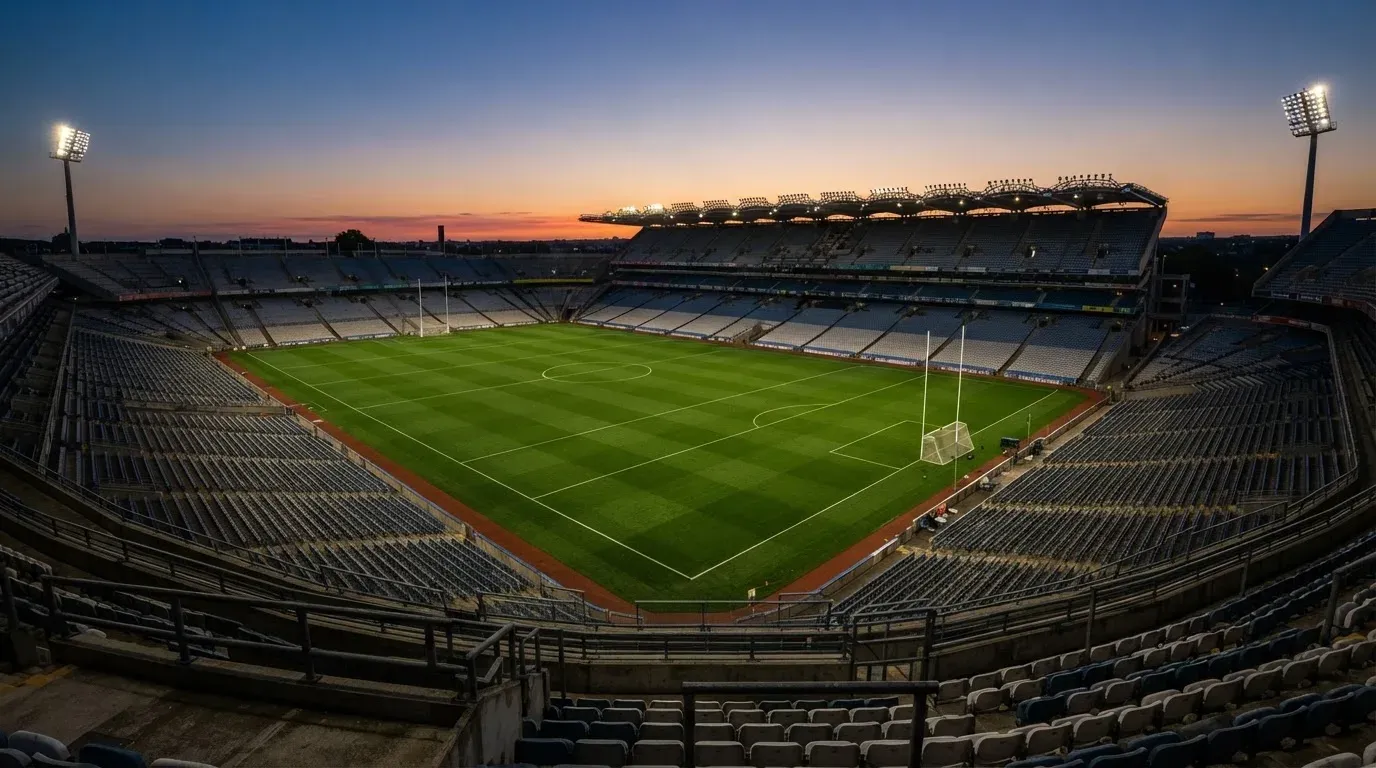
The sport is run by the Gaelic Athletic Association, which organises the All-Ireland Senior Football Championship. The final is played each July at Croke Park in Dublin, and the 2026 final on 26 July saw Mayo beat Kerry by 1–20 to 1–17, a margin of four points, giving Mayo their fourth title and leaving Kerry — the most-crowned county in the competition’s history at thirty-nine All-Ireland titles — still searching for a thirty-eighth since their last win in 2014. County and provincial championships run alongside the All-Ireland series through the summer, and club championships run through the autumn and winter, which gives a licensed sportsbook Gaelic football fixtures in some form for most of the calendar year.
What a Licensed British Sportsbook Looks Like
Great Britain has no state monopoly on sports betting and no cap on the number of licences. The Gambling Commission, a non-departmental public body sponsored by the Department for Culture, Media and Sport, regulates the whole commercial market under the Gambling Act 2005. Every operator that takes bets from customers in Great Britain needs a Commission licence, regardless of where the company itself is based — that has been the position since the Gambling (Licensing and Advertising) Act 2014 amended sections 33 and 36 of the 2005 Act, and it is why a Gibraltar-headquartered bookmaker and a London one run on the same licence conditions in this market. Northern Ireland is outside the 2005 Act and operates under older legislation; a “Great Britain licence” is exactly that and nothing more.

The Commission’s public register is the whole test of whether a brand holds a licence. It can be searched by business name, trading name, domain or account number, and the entry lists the licence categories the holder is authorised to operate under — typically *remote general betting standard (real events)* for an ordinary sportsbook, *remote betting intermediary* for a betting exchange, and separate categories for pool betting, virtual events and a limited remote licence. The categories matter because they tell you what kind of bets the operator can lay under the Commission’s rules; a brand licensed only for virtual events, for example, cannot lawfully take your money on a live county final. The licence number is also the single reliable answer to the question of which corporate entity actually runs the brand: Coral and Ladbrokes share a single licence holder, LC International Limited, and Paddy Power and Betfair share PPB Counterparty Services Limited — so the same parent company can run two or more licensed brands side by side, and the brand name is not the licence holder.
The ten bookmakers reviewed further down each hold a *remote general betting standard (real events)* licence for Great Britain, with one of them — the exchange — also holding the *betting intermediary* category. Several of the parent companies behind them are publicly traded, two are private, and one is run from inside a larger gaming group whose principal listing is on the Stockholm exchange. None of that is by itself a reason to pick one over another; what is worth knowing is that licensed means a route to a Commission complaint, a binding alternative-dispute-resolution procedure and the protection of GAMSTOP, and unlicensed means none of those things.
What the Law Says You Can Bet On
Britain has no statutory list of permitted sports or bet types. The Gambling Act 2005 leaves the contents of the betting programme to the operator’s licence and to the Licence Conditions and Codes of Practice (LCCP). In practice that means a licensed sportsbook can offer Gaelic football, kabaddi, a novelty market on the next royal wedding or a politics market on a general election — provided the licence covers it and the terms comply with the social responsibility code. It also means a sportsbook can refuse a bet, restrict a customer’s stake or close an account, and the law does not stand in the way.
In-play betting on Gaelic football is offered by most licensed British sportsbooks. The controls are the operator’s licence conditions and its own customer-protection duties; it is not legally “unrestricted”, and the bookmaker’s terms will normally reserve the right to suspend a market during a stoppage. Spread betting — a separate product where the payout varies with how right or wrong you are by how much, rather than all-or-nothing — sits in a different box: financial spread betting is regulated by the Financial Conduct Authority, not the Commission, and sports spread betting falls under General Betting Duty with the Commission’s general betting rules. One of the brands reviewed below, Spreadex, runs both kinds under both regulators, which is the reason its terms warn that spread betting losses can exceed the original deposit.
Betting exchanges — where punters back and lay against each other rather than against the bookmaker — run under the Commission’s *betting intermediary* licence. The exchange takes a commission on net winnings, sets its own rules and pays out from the losing side of the matched bet. Matchbook, reviewed below, is the most prominent exchange in the Irish and British market.
What Every Licensed Sportsbook Has to Give You
The same licence that lets a sportsbook take your money also binds it to a set of player-protection conditions. Five of them matter for a Gaelic football bettor in 2026.
The first is GAMSTOP. Every GB-licensed online operator has been a mandatory member since 31 March 2020. A customer who registers with GAMSTOP self-excludes from every member site for at least six months, with options at one year, five years, or five years with auto-renewal; after the minimum period the exclusion runs for a further seven years unless the customer asks GAMSTOP to remove it. Betting shops use a separate service, but every online bookmaker and every online casino covered here does. There is no upper limit on the length of the period and no way to bring it forward.
The second is identity verification before the first deposit. Since 7 May 2019 a licensed operator has had to verify a customer’s name, address and date of birth before the customer can deposit or place a bet — including when the bet is paid for by a free bet or a bonus. The verification draws on public records and may include a passport or driving-licence check. It is the reason there is no anonymous play at a licensed site, and the reason a British bettor at a licensed bookmaker cannot use a cryptocurrency deposit in the way a punter at an offshore site can.
The third is credit-card ban. Since 14 April 2020 (LCCP condition 6.1.2) no GB-licensed operator has been allowed to accept a credit card for gambling, including credit-card-funded payments through an e-wallet. Debit cards and bank transfers are unaffected. A bettor who tries to fund a Gaelic football bet with a credit card at a licensed book will be declined at the deposit screen.
The fourth is the financial vulnerability check (LCCP condition 3.4.4, in force since 30 August 2024, with the current threshold live since 28 February 2025). When a customer’s deposits minus withdrawals exceed £150 in a rolling thirty days, the operator runs a public-record check — for example, on bankruptcy registers or county-court judgments. It is not an income check and not a credit-reference check. It is the lightest tier of the three the Commission has signalled: a financial risk assessment — the affordability check of the press — was announced in a staged plan published on 7 July 2026, with no start date set. The audit cycle for that second tier has not begun.
The fifth is the bonus cap. Promotion rules in force since 19 January 2026 cap wagering requirements on bonuses at ten times the bonus amount — a £10 bonus at fifty-times wagering needed £500 of qualifying bets, and under the cap no more than £100 of qualifying bets is required. Mixed-product promotions, such as an offer that requires betting on football to unlock free spins on a slot, are banned. The cap covers bonuses with a wagering requirement; whether it covers free bets with no wagering condition, and any cap on the money value of a bonus, are not settled in the published guidance.
Help is built into the licence. The National Gambling Helpline runs through GamCare, and every licensed operator’s safer-gambling page links to GambleAware, the NHS gambling-clinic network and Gamblers Anonymous. Self-exclusion, time-outs and deposit limits are not optional extras — the operator has to offer them, and the customer has the right to use them.
What a Gaelic Football Betting Slip Carries
A typical Gaelic football match at a licensed British sportsbook opens with the same set of markets a football bettor would recognise: match result in regulation time, handicap lines, total points, both teams to score in regulation time, and the more Gaelic-specific totals on goals or two-point scores. Handicaps are quoted in points, not goals, because a goal is worth three points and the point spread that matters is the points spread, not the goals. In-play, the book will often offer next-goal, next-point, next-two-point and the method of scoring — a goal from play, a goal from a free or a forty-five, a point from play, a point from a free, a two-point from outside the arc. Player markets exist at the bigger matches but are sparse below inter-county level: a county final may carry first-goalscorer, last-goalscorer or player-total-points, and a club championship game below senior level usually carries none of them.
Bet builders — the same-game multiples where the bettor combines two or more markets from one fixture into a single price — are offered by most of the larger brands. Bet365 brands its offering Bet Builder+, Betfair brands it Bet Builder, Sporting Index runs the same product under its multi-markets umbrella, and 888sport carries the same feature under the Bet Builder name. A Bet Builder price is built from the underlying markets, which means the margin on a Bet Builder is the margin on each leg summed, and the cumulative overround is the single most expensive number on a Gaelic football coupon. A back-to-lay punter using an exchange can sometimes assemble the same selection for less, because the exchange takes commission on net winnings rather than embedding a margin into each leg.
Cash out is the other near-universal feature. Most licensed sportsbooks let a bettor settle a singles or multiples bet early, at a price the book recalculates from the live market minus a spread. Cash out is more useful at a Gaelic football match than at some other sports because scoring runs are long — a team can go ten or fifteen minutes without adding a score — and a settled bet is no longer exposed to the next score.
How the Odds Are Built
The odds are built around a margin, sometimes called overround, sometimes called the bookmaker’s take. Every price on a betting market is set so that, if every outcome won in proportion to its implied probability, the book would return less than 100% of the stake pool and keep the difference. The figure the book keeps is the margin.
Take a simple two-way market at decimal odds of 1.90 on each side. Implied probability on each side is one divided by 1.90, which is 52.6315%. Two sides at 52.6315% give a sum of 105.263%. The margin is the gap between that and 100% — about 5.26%, or roughly one-twentieth of every pound wagered on that market. A bettor at a margin of around 5% is paying the operator about five pence per pound staked just to have the bet on; a bettor at a margin of 10% is paying ten pence, and the cumulative cost over a season of betting is the difference. That is the entire reason a serious bettor looks at the margin before they look at the price.
In a more realistic three-way Gaelic football match — home win, draw, away win — a sportsbook offering decimal odds of 1.91 / 4.50 / 3.40 is offering implied probabilities of 52.36% / 22.22% / 29.41%, which sum to 103.99%, a margin of around 3.8%. The same fixture offered at 1.85 / 7.00 / 3.20 would carry implied probabilities of 54.05% / 14.29% / 31.25%, summing to 99.59% — a margin of minus 0.41%, which is an arbitrage in the punter’s favour and which no sportsbook would actually publish. The point is that the margin is what the bookmaker is taking, and the gap to 100% is the cost of doing business with the book. Whether the bet is Gaelic football, horse racing or a politics market, the math is the same; what changes is the size of the margin in each sport and each market, and the Gaelic football market, being thin, often carries a higher margin than a Premier League match at the same book.
The other thing the odds are doing is encoding the bookmaker’s view. A bookmaker with better information on a county final than the public will quote a tighter margin because it does not need to defend itself. A bookmaker quoting a fat margin is either uncertain or hedging against a sharp customer, and the price itself is the visible signal.
Reading and Converting the Odds
British sportsbooks quote fractional odds as their native tongue and decimal odds as the conversion. A fractional price of 5/1 — five to one — pays five pounds of profit for every pound staked, so a £10 bet at 5/1 returns £60 in total (£50 profit plus the £10 stake back). The decimal equivalent is 6.00: divide the numerator by the denominator and add one. 5/1 becomes 6.00, 11/4 becomes 3.75, evens (1/1) becomes 2.00. Fractional prices shorter than evens — 4/6, for example — are odds-on and read as the punter risking more than the profit; 4/6 becomes 1.67 in decimal.
A useful sanity check on a decimal price is the implied probability. A price of 2.50 implies a 40% chance; 3.00 implies 33.33%; 5.00 implies 20%. When two bookmakers disagree on the same selection at the same fixture, the disagreement is in the implied probability, not the price — and the punter who wants the better of the two is shopping for the highest implied probability, which is the highest decimal price.
Fractional and decimal are the same market seen from two sides. The math underneath is identical, and the bookmaker’s margin is the same number whichever form you read. The choice is purely a reading convention: most British punters grew up with 5/1 and 11/4; most of the rest of Europe and the betting exchanges use decimal as the default. None of the licensed British sportsbooks reviewed here quote only one form; both are always available, and the slip accepts whichever the punter prefers.
Bonuses, Free Bets and What They Really Cost
The bonus landscape at a licensed British sportsbook in 2026 is built around a small set of shapes: a free bet for new customers, a price boost, an acca insurance, a bet-and-get promotion, and — outside the welcome offer — a loyalty programme of free bets, boosts and the occasional each-way enhancement. Two features define the lot.
The first is that a free bet is a free bet, not a refund in cash. The stake is normally not returned with a winning free bet; a £10 free bet at decimal odds of 3.00 wins £20 of profit, not £30. The expected value of a free bet is calculated by the size of the free bet, the odds the punter takes it at and the margin of the market, and at the typical welcome offer the headline number is a poor guide. Coral’s headline “Get £40 in Free Bets when you bet £20” reads at face value as a £40 bonus, but the £40 is split into free bets whose stake is not returned with a win; the net expected value depends on the odds the punter takes those free bets at and the margin on the markets they are placed on, and is in normal circumstances well below £40. BetMGM’s four-£10-free-bets welcome offer for new UK customers who deposit £10 and place a sports bet within seven days is the same shape: four free bets, two for football accumulators of four or more selections and two for sports multiples of two or more, each valid for seven days.
The second is the wagering requirement, where one exists. The cap of ten times the bonus amount introduced on 19 January 2026 limits how steep a wagering requirement can be on a licensed British book, which matters because a £10 bonus at fifty-times wagering demanded £500 of bets before the bonus could be withdrawn, and many licensed operators had been close to or above that level. Under the cap, no bonus can demand more than £100 of qualifying bets per £10 of bonus.
Deadlines on free bets and bonuses are short. Coral’s free bets expire seven days after issue and are issued within seven days of the qualifying bet. BetMGM’s free bets are valid for seven days. A bettor who treats the welcome offer as a casual second thought rarely gets the value; the bettor who plans when the free bets will be placed, on what markets and at what minimum odds, gets the most of what is on the table.
Promo codes, voucher codes and affiliate links are not part of how this page talks about bonuses. The Commission’s rules and the ASA’s advertising code govern how an offer is marketed; the value of an offer is what it pays out, not how the customer got to it.
Live Betting, In-Play and Cash Out
Most of the licensed British sportsbooks carry Gaelic football in-play during the bigger championship weekends. The market depth at a typical county match is shallower than at a Premier League fixture at the same book — there may be only match odds, next-goal and a totals line — but the same mechanics apply. The book recalculates the price after every score; the cash-out price recalculates with it; the bettor who wants in is the one who accepts that the live price is always worse than the pre-match price by the in-play margin.
Live streaming of Gaelic football is rare at licensed British sportsbooks. Racing streams — horse racing and greyhounds — are common (Matchbook, Betfair and 888sport all carry them), but Gaelic football is a niche that few books have invested in. A bettor who wants to watch the match they have bet on will usually need a separate broadcast, and the licensed sportsbook has no obligation to provide one.
Cash out is the single most useful in-play feature for Gaelic football. The runs are long — teams can go ten minutes without scoring — and a settled bet removes the exposure to the next score. The trade-off is that cash-out carries its own margin: the price the book offers is the live mid-price minus a spread, and the spread is the bookmaker’s cut. A bettor who can hold their nerve and let the bet run usually gets more; a bettor who cannot tolerate the volatility uses cash out and pays for the certainty.
How a Serious Punter Reads a Gaelic Football Coupon
The serious approach to betting on Gaelic football is the same as the serious approach to betting on anything else, and it has four components.
The first is shop the margin. A margin of 5% on a match-odds market is a reasonable price for the privilege of betting on it; a margin of 8% is a tax that the punter pays on every bet; a margin of 10% is a sign that the book is uncertain or that the market is thin and that the punter is being asked to fund that uncertainty. A book with better information will quote a tighter margin, and the punter’s first job is to find the book that quotes the tightest.
The second is bet the price, not the team. A bet is a question about whether the price is right, not a declaration of who will win. A punter who has a strong view that Mayo will beat Kerry may still find the price of 1.40 too short to mean the bet is worth taking, because 1.40 implies a 71.4% chance and the punter’s view might be 65%. The discipline of asking whether the price is right is the discipline that separates a bettor from a fan.
The third is track the closing line. The price at kick-off is the most informative price the book publishes, because the book has had the longest time to incorporate new information. A punter who consistently gets on at a better price than the closing price is finding value; a punter who consistently gets on at a worse price is paying for the book.
The fourth is keep the staking plan flat. A flat unit stake — the same stake on every bet, regardless of confidence — is the staking plan that minimises ruin and makes the long-run edge legible. Variable staking, martingales and acca ladders are all ways of making the long-run result harder to read and the variance higher. The book does not care which staking plan the punter uses; the punter should.
The Operators, Side by Side
The ten operators below are listed in the order the comparison block uses; the order is not a ranking and not a recommendation. Each is a brand whose domain appears on the Gambling Commission’s public register against a corporate licence holder for Great Britain; each offers Gaelic football or a comparable niche sports product; each takes part in GAMSTOP and binds itself to the LCCP. The comparison column on the right of the table summarises what each operator’s own terms state about Gaelic football, in-play and the welcome offer — three points that decide whether the operator suits a given reader.
The comparison is built around three matters. The first is the licence number and holder, because that is the only reliable test of whether the brand is regulated for Great Britain at all. The second is the corporate identity behind the brand, because several well-known pairs (Ladbrokes and Coral, Paddy Power and Betfair) share a single licence holder. The third is what the operator’s own terms say about the subject — Gaelic football coverage, in-play, cash out, the welcome offer — because the licence tells you the brand is allowed to operate, and the terms tell you how it operates.
| Brand | Gambling Commission remote licence and licence holder | What the operator’s own terms say about Gaelic football |
|---|---|---|
| Matchbook | 039504-R-319407-024 · Triplebet Limited · *remote general betting standard (real events)* and *remote betting intermediary* | Exchange-only; back and lay markets on Gaelic football and hurling during championship weekends; Bet Builder, multiples and in-play; live streaming of horse racing and greyhounds, no streaming of GAA fixtures |
| 888sport | 039028-R-319297-014 · 888 UK Limited · *remote general betting standard (real events)* | Pre-match and in-play coverage of Gaelic football at the bigger fixtures; Cash Out, Bet Builder, racing streams, BetFinder form tools, a live bet feed and daily boosted odds |
| Betfair | 039439-R-319330-013 · PPB Counterparty Services Limited · *remote general betting standard (real events)* | Sportsbook and exchange under one licence holder; in-play, Bet Builder, free live streaming for UK and Irish horse racing and football, a 90 Minute Payout market |
| Sporting Index | 027343-R-308898-011 · Sporting Index Limited · *remote general betting standard (real events)* | Spread-betting and fixed-odds sportsbook; customers can switch between the two; in-play, Bet Builder for football, auto cash-out, Multi-Markets |
| NetBet | 039170-R-319343-032 · Netbet Enterprises Limited · *remote general betting standard (real events)* | Daily Boosts, Profit Boosts and free-bet offers; Bet Builder with instant dynamic odds; sports stats for the major leagues; GAA fixtures present on the sportsbook during the championship months |
| Coral | 054743-R-330863-014 · LC International Limited · *remote general betting standard (real events)* and *remote betting intermediary* | “Get £40 in Free Bets when you bet £20” — £20 qualifying sports bet at minimum odds of 2.0 (1/1), £40 in free bets issued within seven days and expiring seven days after issue, for new GB customers who opt in |
| Betmaster | 065699-R-339929-002 · BM Solutions GB Ltd · *remote general betting standard (real events)* | Football, cricket, horse racing, NFL and eSports (League of Legends, Dota 2); pre-match and in-play; GAA fixtures covered when in season |
| Tote | 054779-R-331321-008 · TDCO Limited · *remote general betting standard (real events)* | Pool betting and fixed odds on UK and Irish horse racing as the principal product; Gaelic football fixtures covered at the bigger championship weekends; Best Odds Guaranteed from 8 AM on the day of the race does not apply to Gaelic football |
| Kalooki Sportsbook | 057730-R-333396-005 · Kalooki Sportsbook Limited · *remote general betting standard (real events)* | Niche independent sportsbook operated by Kalooki Sports Book Ltd (company number 12938274); GAMSTOP member; GAA fixtures a focus of the sportsbook rather than an aside |
| BetMGM | 039198-R-319450-029 · LeoVegas Gaming PLC · *remote general betting standard (real events)* | “Bet £10 get £40 in free bets” — four £10 free bets (two football accumulators of four or more selections and two sports multiples of two or more), valid for seven days, for new UK customers who deposit £10 or more and place a sports bet within seven days, with minimum odds and opt-in |
The table is a snapshot of the licence register and the operator’s own terms on the date above; licence details and terms change and the reader should check both before staking. The licence number is the single reliable answer to whether the brand is regulated for Great Britain; the terms are the only reliable answer to what the brand does today.
The Ten Brands in Detail
Each brand below sits in the comparison for a different reason. The verdict at the foot of each write-up answers a different question: where one brand wins on price, another wins on liquidity, another on the depth of its in-play book, and another on the value of its welcome offer. The bettor’s job is to pick the brand that suits the bet.
Matchbook — the exchange that price-discovers
Matchbook runs as a betting exchange: punters back and lay against each other, the exchange matches the bets and takes a commission on net winnings rather than embedding one into each price. For Gaelic football that matters during the championship weekends, when liquidity is high enough for a back-to-lay punter to assemble a price the sportsbooks cannot match. The licence is a *remote betting intermediary* one in addition to *remote general betting standard (real events)*, and the holder is Triplebet Limited; the GB App Store listing notes Bet Builder, multiples, in-play and live streaming of horse racing and greyhounds.
The cost of the exchange is the commission, the lack of a Bet Builder of the kind a sportsbook offers and the fact that a thin market at a small fixture means no liquidity at all. The bettor who can navigate an exchange and place bets during a Gaelic football championship weekend will often get a tighter price at Matchbook than at any of the sportsbooks here; the bettor who cannot, or who wants a sportsbook’s Bet Builder, should look elsewhere.
The verdict: a strong choice for the experienced exchange punter who wants liquidity on the bigger GAA weekends; it lacks the acca insurance of a conventional sportsbook.
888sport — the broad-market sportsbook
888sport runs as a conventional sportsbook under 888 UK Limited and offers pre-match and in-play betting, Bet Builder, Cash Out, racing streams, BetFinder form tools, a live bet feed and daily boosted odds. The Gaelic football coverage is present at the bigger championship weekends and is sparse below that; the strengths of the brand are the breadth of its markets across other sports and the daily boosted-odds programme.
The verdict: a sensible choice for a bettor whose Gaelic football interest is one of several and who values the boosted-odds programme; not a deep GAA book.
Betfair — sportsbook and exchange under one roof
Betfair runs both a sportsbook and an exchange under PPB Counterparty Services Limited, and the GB App Store listing notes in-play, Bet Builder, free live streaming for UK and Irish horse racing and football, and a 90 Minute Payout market that settles the winner of a football match at the end of normal time even if the bet was placed at higher odds. The exchange is the better-known half of the business; the sportsbook is competitive at the bigger football and racing fixtures.
The verdict: a one-stop shop for the bettor who wants both an exchange and a sportsbook under one licence holder and one wallet, and a deep enough in-play book to matter on a Saturday of fixtures.
Sporting Index — the spread-betting option
Sporting Index lets customers switch between fixed odds and spread betting on the same site and runs in-play, Bet Builder for football, auto cash-out and Multi-Markets. Spread betting on Gaelic football is offered at some fixtures and is a different product from a fixed-odds bet: the payout varies with how right or wrong the punter is, and the loss can exceed the stake. The terms warn as much.
The verdict: the right shop for the punter who already understands spread betting and wants a one-account route between fixed odds and spread; not the shop for a beginner, because the risk profile of a spread bet is sharper than a fixed-odds one.
NetBet — the boosted-odds programme
NetBet runs Daily Boosts, Profit Boosts and free-bet offers; a Bet Builder with instant dynamic odds; and sports stats for the major leagues. The Gaelic football fixtures are present during the championship months and the welcome offer structure is built around a free-bet or staking-bonus shape.
The verdict: a reasonable pick for a casual bettor who values the boosted-odds programme and does not need a deep GAA book.
Coral — the welcome-offer headline
Coral’s headline welcome offer is “Get £40 in Free Bets when you bet £20”: a deposit and a sports bet of £20 or more at minimum odds of 2.0 (1/1), with £40 in free bets issued within seven days and expiring seven days after issue, for new GB customers who opt in. The licence is shared with Ladbrokes under LC International Limited, which is the parent group that runs both brands. The free bets are free bets, not refunds in cash — the stake is not returned with a win — and the expected value depends on the odds and the margin of the markets on which they are placed.
The verdict: the headline looks bigger than the realised value of a typical free bet at this shape, and the bettor who plans where the free bets go gets more than the one who lets them lapse.
Betmaster — the independent sportsbook
Betmaster runs as an independent sportsbook under BM Solutions GB Ltd, covering football, cricket, horse racing, NFL and eSports (League of Legends, Dota 2). The Gaelic football fixtures are covered at the championship weekends; the welcome-offer structure is a free-bet or staking-bonus shape.
The verdict: a reasonable pick for a bettor who wants an independent brand rather than one of the major groups and is willing to accept a thinner boosted-odds programme in return.
Tote — the pool-betting heritage
Tote runs pool betting and fixed odds on UK and Irish horse racing as its principal product and carries Gaelic football at the bigger championship weekends. The brand’s heritage is the Tote, the state-owned pool operator privatised in 2011; the licence holder is TDCO Limited. Best Odds Guaranteed applies to UK and Irish horse racing from 8 AM on the day of the race and is not a feature of the GAA book.
The verdict: a functional option for the racing punter who wants an occasional stake on Gaelic games; it is not a deep GAA book by comparison.
Kalooki Sportsbook — the niche GAA book
Kalooki Sportsbook is run by Kalooki Sports Book Ltd (company number 12938274) under Gambling Commission account 57730, is a GAMSTOP member and is positioned as a niche bookmaker with Gaelic games at the centre of its offer rather than as a corner of a broader sportsbook. For a bettor whose primary interest is Gaelic football and hurling, that positioning is the point.
The verdict: the right shop for the bettor whose Gaelic games interest is the reason they are looking at all; not the place for a bettor who wants a broad-market sportsbook.
BetMGM — the casino group’s sportsbook
BetMGM’s UK sportsbook sits under LeoVegas Gaming PLC, the Stockholm-listed gaming group, and runs a welcome offer of four £10 free bets — two for football accumulators of four or more selections and two for sports multiples of two or more — valid for seven days, for new UK customers who deposit £10 or more and place a sports bet within seven days, with minimum odds and opt-in required. The strength of the brand is the cross-sell from the casino side of the business, and the weakness is that the GAA book is a corner of the broader sportsbook rather than the centre.
The verdict: a sensible choice for the casino group’s sportsbook customers who also want a stake on the bigger GAA weekends; not the shop for a GAA-first bettor.
What the Bonus Cap Looks Like in Practice
The 19 January 2026 cap on wagering requirements at ten times the bonus amount is the rule that has reshaped the licensed British welcome offer the most in the last twelve months. A £10 bonus at fifty-times wagering demanded £500 of qualifying bets, and several licensed operators had offers at or above that level before the cap. Under the cap, no bonus can demand more than £100 of qualifying bets per £10 of bonus, and the £10 free-bet welcome offers at Coral and BetMGM sit comfortably inside the cap.
The second change — the ban on mixed-product promotions — closes off the offers that asked the punter to bet on football to unlock free spins on a slot or to play casino to clear a sports bonus. The cross-sell from one product to another is still allowed; what is banned is the conditional offer that ties one to the other. The effect on a Gaelic football bettor is that the welcome offer at a licensed sportsbook is now a clean sportsbook offer rather than a sportsbook-plus-casino bundle.
The third change — the cap on the size of a bonus with a wagering requirement — is not settled in the published guidance, which means a licensed operator can offer a large free-bet welcome with no wagering condition if the free bet carries no turnover. The cap applies to the wagering requirement, not to the size of the bonus, and the way the operator shapes its welcome offer is the way it stays inside the rules.
What the Tax and Levy Frame Looks Like
The player pays no tax on betting winnings in Great Britain, and the page states that as general information and not as tax advice. A professional gambler who books a profit from sports betting should ask HMRC or a tax adviser, because the line between a recreational punter and a professional is a fact-specific question.
The operator’s tax is General Betting Duty, a percentage of gross profits. From the policy paper of 26 November 2025, General Betting Duty stays at 15% for most products and rises to a new remote betting rate of 25% from 1 April 2027 within the existing structure, while remote bets on UK horse racing, bets on self-service betting terminals in licensed premises, pool betting and in-person betting stay at 15%. Until 1 April 2027 the remote rate stays at 15%. Spread betting has its own rates — 3% for financial and 10% for other — and the operator’s tax is a charge on the operator, not on the punter. The Commission’s statutory levy is a separate charge, also on the operator, and not a tax.
Whether an operator passes duty on through the odds is not established, and the page does not write that the punter is charged duty. The odds are the odds; the duty is the operator’s business; the punter’s bill is the margin on the market, not the tax on the book.
What an Unlicensed Brand Looks Like
A brand that takes bets from customers in Great Britain without a Gambling Commission licence is committing an offence under section 33 of the Gambling Act 2005 — on summary conviction, up to fifty-one weeks’ imprisonment, a fine up to level 5, or both, and six months’ imprisonment in Scotland. The offence is aimed at the operator. No offence aimed at a customer who merely bets on an unlicensed site has been found; the consequence of betting at one is the loss of protection, not the loss of liberty. The page does not write that betting on an unlicensed site is illegal for the punter, and does not write that it is legal for the punter; the page writes that it is unlicensed.
The loss of protection is the cost. No GAMSTOP coverage, no Commission complaints route, no approved dispute-resolution body, no British consumer redress if funds are withheld, no 10x bonus cap, no £150 financial vulnerability check, no debit-card ban, no identity verification before the first deposit. The odds may be better and the bonus may be larger, because the brand is not paying for the licence or the compliance; the bettor pays for both in the form of less recourse if the bet goes wrong.
Enforcement is disruption rather than blocking. The Commission issues cease-and-desist notices, refers sites to search engines and works with registrars, hosts and payment providers. Court-order DNS blocking powers are with the Commission or about to be, and the page does not write that ISP blocking is in operation.
Frequently Asked Questions
How does a bet on Gaelic football actually work?
A licensed British sportsbook carries Gaelic football during the championship months at the bigger fixtures and a smaller book year-round. A bettor picks a market — match result, handicap, total points, next score, both teams to score — picks a stake and confirms the bet. The bet is settled at the end of regulation time, with extra time and replays treated according to the market rules. The bettor’s stake is returned with a winning bet plus the profit; a free bet returns the profit only, and the stake is not paid back.
How can a Gambling Commission licence be checked?
The Commission’s public register can be searched by business name, trading name, domain or account number. The licence number, the licence holder and the categories the holder is authorised to operate under are listed on the entry, and that entry is the only reliable answer to whether a brand is regulated for Great Britain. The licence number is not the brand name, and several brands share a single licence holder — Coral and Ladbrokes under LC International Limited, Paddy Power and Betfair under PPB Counterparty Services Limited — so the brand name on its own is not a guarantee.
How is the return on a bet worked out from the stake and the odds?
For a bet at decimal odds, the total return is the stake multiplied by the odds, and the net profit is the stake multiplied by the odds minus one. A £10 stake at 3.80 returns £38 in total, of which £28 is profit and £10 is the stake. A combination bet multiplies the odds of the legs into a single price; a treble at decimal odds of 1.80, 2.20 and 1.95 carries odds of 7.722, and a £10 stake returns £77.22 in total.
What is the bookmaker’s margin and how is it visible in the odds?
The margin is the gap between the implied probabilities of all outcomes of a market and 100%. A two-way market at 1.90 on each side has implied probabilities of 52.6315% on each side, summing to 105.263% — a margin of around 5.26%. The bettor pays the margin on every bet, and a tighter margin means the book is keeping less per pound staked. Comparing margins across bookmakers on the same market is the comparison that matters, because the bet who wins at the tighter margin is keeping more of the long-run edge.
How do fractional odds such as 5/1 convert to decimal odds such as 6.00?
The decimal odds are the fractional numerator divided by the fractional denominator, plus one. 5/1 becomes 6.00; 11/4 becomes 3.75; evens (1/1) becomes 2.00; odds-on prices such as 4/6 become 1.67. The conversion works in both directions: a decimal price of 3.75 minus one, multiplied by the denominator of choice, gives the fractional numerator.
Which tools for controlling play does a licensed bookmaker have to offer?
A licensed operator has to offer GAMSTOP registration for self-exclusion, deposit limits, time-outs, reality checks and links to GamCare, GambleAware, the NHS gambling-clinic network and Gamblers Anonymous. A customer who registers with GAMSTOP self-excludes from every member site for at least six months. The operator is required to verify identity before the first deposit, to refuse credit-card deposits, and to run a financial vulnerability check on customers whose activity exceeds £150 in deposits minus withdrawals over a rolling thirty days. None of these tools are optional, and none of them depend on a customer asking.
Rugby, cricket & Gaelic – oddsguaranteed
Content created by the «oddsguaranteed» team
