
Where to bet on hurling online in 2026 — and what the small print really costs
 Available in US

Last updated: October 30, 2026 · Verified against the Gambling Commission’s public register and each operator’s own terms.
Hurling sits in a small corner of the British betting market, but the corner is no longer quiet. The 2026 All-Ireland Senior Hurling Championship ran through the summer, Limerick beat Galway in the final at Croke Park on 19 July 2026, and every major British bookmaker carried prices on every round. That makes hurling one of the few GAA sports with full coverage from the start, alongside Gaelic football. It also means a punter weighing up where to bet online in 2026 faces a market built around football and horse racing, with hurling bolted on as a speciality product.
This guide is written for the punter who has not yet picked a bookmaker, or who is wondering whether the one they use is the right one for hurling. The angle is consequence: not what each site sells, but what the small print actually does to a stake once a bet is placed. The numbers and licence details come from each operator’s own pages and from the Gambling Commission’s public register, checked on the date at the top of the page. Where a brand does not publish a figure, that gap is left as a gap rather than padded with a guess.
Staying in control of the stake
A market with deep prices and narrow margins is no use to a punter who has lost track of what they are wagering. The Gambling Commission has spent the last three years tightening the player-protection frame around licensed remote betting, and three of those rules now shape what happens before a bet is even placed.

Identity checks before the first deposit. Since 7 May 2019 a licensed operator must verify name, address and date of birth before any customer can deposit or gamble, including with a free bet or a bonus. There is no anonymous play at a British-licensed site. The verification is run once and is not repeated on every deposit, but a source-of-funds request at higher spend is normal under the money-laundering rules and an operator can refuse to take a deposit until that check is closed.
The financial vulnerability check. Since 28 February 2025 a licensed operator runs a public-record check on a customer whose deposits minus withdrawals exceed £150 in a rolling 30-day window. The check looks at county court judgments, bankruptcy entries and similar public markers. It is not a credit-reference check, not an income check, and it does not by itself stop play. It is the first of the Commission’s two-stage affordability plan. The second stage — financial risk assessments — was announced on 7 July 2026 as a staged plan with no start date; it is not yet in force.
GAMSTOP and self-exclusion. Every operator on the Gambling Commission’s remote register is a GAMSTOP member. Self-exclusion is for six months, one year, five years, or five years with auto-renewal, and after the minimum period the exclusion stays in place for a further seven years unless the customer asks GAMSTOP to remove it. The register covers online sites and apps; betting shops use a separate service. A punter who wants to stop should register first and only then look at the rest of this guide.
Deposit limits, timeouts, reality checks. Licensed operators offer gross deposit limits on a fixed time frame — the Commission’s Remote Technical Standards 12 has been phasing in since 31 October 2025, with a second phase postponed to 30 September 2026. Timeouts, session reminders and product-level blocks are standard. None of these are state-set ceilings; the customer chooses the limit, and the operator must honour it. No state-set deposit or loss ceiling for betting was found in any published Commission document.
Help lines. GamCare runs the National Gambling Helpline. GambleAware funds treatment and education. The NHS runs gambling clinics in several English regions. Gamblers Anonymous runs peer-support meetings. None of these replace the Commission licence; they sit alongside it.
The cost of going offshore. A brand without a Gambling Commission remote licence has no GAMSTOP coverage, no Commission complaints route, no approved alternative dispute resolution body, and no British consumer redress if a withdrawal is withheld. It is also outside the 10x bonus cap and the £150 vulnerability check. The framing is honest: licensed means checks, limits, GAMSTOP and a bonus cap, but also identity verification before the first deposit; unlicensed means none of those protections and the risk of losing funds. Neither is “the safe choice” by default — the punter has to decide which way the trade goes.
What a bonus and a free bet really cost
The marketing on a sportsbook welcome page is built around three words: bonus, free and risk-free. None of them means what it sounds like.
The 10x wagering cap. Since 19 January 2026 any wagering condition attached to a bonus at a British-licensed operator is capped at ten times the bonus base. A £10 bonus with a 50x wagering requirement would have meant £500 of qualifying bets; under the cap no more than £100 of qualifying bets is needed. The cap applies to bonuses. Whether it applies to free bets with no wagering condition is not established in the published Commission guidance, and the Commission has set no cap on the money value of a bonus itself.
The free bet that does not return the stake. Sky Bet’s free bet rules, taken from its own support pages, are typical: free bets are non-withdrawable, can be used only on single or each-way markets (not multiples), exclude virtuals, expire 30 days after crediting, and do not return the stake with winnings. A £10 free bet at decimal odds 3.00 wins £20 of profit, not £30. That distinction is the single biggest gap between the headline number on a banner and the number that lands in a punter’s account.
The “risk-free” bet refunded as a free bet. VBet’s sports welcome offer is the cleanest example of the shape: a £10 free bet if a new verified customer stakes £10 or more on a first bet that loses. The first bet loses real money. The refund is a free bet whose stake is not paid back with a win. Hollywoodbets’ welcome offer runs the same pattern, with the additional condition that the qualifying bet is an accumulator of three or more legs at minimum odds of 4/1 (5.00 decimal), settled within seven days, and the refund is a free bet of up to £30.
The split free bet. BetGoodwin and Bet Ahoy both run a “Bet £10 & Get £10 or £15 in Free Bets” offer that splits the credit across bet types. BetGoodwin’s £15 is a £5 sports bet, a £5 acca and a £5 Sub-Cover bet. Bet Ahoy’s £10 is a £5 sports bet and a £5 acca. The split matters because each token has its own expiry and its own market restriction, and the headline number is the sum of three smaller offers, not one £10 or £15 free bet.
The accumulator insurance product. Several sites sell a refund on a losing accumulator if one leg lets the punter down. The refund is usually a free bet, not cash. The condition is usually a minimum number of legs and a minimum price per leg. The Commission has not banned acca insurance outright, but it has banned mixed-product promotions — an offer that requires gambling on two or more product types, such as “bet on football to get free spins”. A punter who sees a promotion that asks for sports and casino play in one go should walk away.
Mixed-product bans and the 10x cap together. The two rules push the market towards small, simple bonuses on sports only. The headline price of a welcome offer is therefore not what it was three years ago. A punter comparing offers in 2026 should read the wagering requirement first, then the minimum price per qualifying bet, then the expiry, then the cap on free-bet winnings, and only then look at the headline number.
Promo codes are not in this guide. The Commission licences the operator, not the channel; an offer claimed through a partner is identical to the same offer claimed on the operator’s own site, with the same terms. Promo codes change monthly and are not part of this comparison.
Live betting and cash out on hurling
Hurling is a fast sport. Sixty minutes of run, plus stoppage, plus a short break, plus extra time if a championship game finishes level, makes live pricing a sharper business than for a sport with natural pauses.
The in-play product. Every operator on the Commission’s remote general betting standard list offers in-play betting, and most run a separate in-play tab for Gaelic games during the All-Ireland rounds. Sky Bet’s Gaelic games rules, published on its support pages, settle bets on the official result at the end of normal time including injury time; extra time does not count unless the market states otherwise. That rule is consistent across the licensed market, though the wording varies. A punter placing an in-play bet on a championship match should assume normal time is the line, not the final whistle after extra time.
Cash out and auto cash out. Sporting Index’s site markets auto cash out alongside in-play betting, Bet Builder for football and Multi-Markets. The mechanics are the same on every site that offers it — the operator offers a real-time price to close the bet early, and the punter accepts or rejects. Cash out allows the punter to lock in a profit (or cut a loss) before the final whistle. During a tight hurling match the in-play price can move sharply on each score: a goal is three points, a point is one, and the gap between the two is what makes the in-play margin wider than the pre-match margin.
Live streaming. bet365’s app markets live streaming of events worldwide, with Match Live, Bet Track and a Live Golf Tracker for following bets in play. Matchbook’s app markets live streaming of horse racing and greyhounds — not hurling. Sporting Index markets live in-play prices but does not, on its public pages, advertise hurling streams. A punter who wants to watch a match and bet in play on the same screen needs to check whether the operator has the streaming rights for the fixture, because the rights vary by tournament and broadcaster.
Bet Builder and same-game multi. bet365’s Bet Builder+ combines markets from one event into a single bet, available pre-match and in-play, with Winnings Boosts on Bet Builders and selected singles. The construction is the same as a same-game multi on smaller operators. For hurling, the available legs are usually match result, total points, total goals, handicap lines, player markets and team markets, with the exact set varying by bookmaker. A Bet Builder on a hurling match is a single price with one margin, not eight fields with eight margins.
The whistle-to-whistle rule. Since 1 August 2019 betting advertisements are not shown on TV from five minutes before a live sporting event to five minutes after it, before the 9pm watershed, with horse and greyhound racing excluded. That is an industry code, not law. It does not stop in-play betting on the operator’s site or app. It does mean a punter watching a televised hurling match on a non-excluded channel will see no betting ads during play.
Bet types, odds and how the price is built
A hurling match offers more markets than a casual viewer would guess, and each market carries its own margin. The skill on the punter’s side is to know which market prices which bet fairly.
The match result. Three outcomes: home win, away win, draw. Hurling draws at the end of normal time are uncommon in senior inter-county fixtures but possible in the league, and championship games that finish level go to extra time. A punter betting on the result should check the operator’s settlement rule — does the bet settle on normal time, or does it include extra time? Sky Bet’s Gaelic games rules state normal time including injury time. The punter should assume that rule until told otherwise.
Total points and total goals. A goal is three points and a point over the crossbar is one, so the total points line combines both. The total goals line counts only goals. The two markets are not interchangeable. Punters sometimes see a price on total points and assume it is the same as total goals; it is not, and the difference shows up in the margin.
Handicap lines. A handicap of, say, +2.5 on the underdog means the underdog starts the match two and a half points ahead on the bet. Handicap markets exist for matches with a clear favourite, which most hurling matches are not, but the All-Ireland final usually carries one.
Player markets. Top scorer for either side, first scorer, anytime scorer. The depth of the player market varies hugely by bookmaker. A major British bookmaker may carry first scorer and anytime scorer on big championship matches; smaller operators may carry match result only.
Each-way betting. A each-way bet is two bets of equal stake, one on the win and one on the place. The stake doubles. Each-way is most common on horse racing but is offered on outright tournament markets — for example, each-way on Limerick to win the All-Ireland, paying a fraction of the win price if Limerick reach the final. The place fraction varies by operator and by the number of teams in the market. A punter comparing each-way prices needs to compare the place fraction, not the headline win price.
Accumulator, double, treble. A double is two selections, a treble three, an accumulator four or more. The odds multiply into one price. The Commission’s rules around accumulators are not specific; an accumulator of three legs at minimum combined odds of 4/1 (5.00 decimal) is a typical qualifying bet for an acca insurance product. The headline number on an accumulator is the multiplied price; the realised number is the multiplied price less the operator’s margin on each leg, compounded.
Fractional and decimal odds. Britain writes odds fractionally by tradition and displays decimal odds alongside. The conversion is simple: a/b in fractional form becomes (a ÷ b) + 1 in decimal form. Five-to-one is 6.00; eleven-to-four is 3.75; nine-to-ten is 1.90. A punter reading a screen that shows 5/1 next to 6.00 is reading the same price twice; the decimal form is the price used by the betting slip. Both forms show the same information.
The bookmaker’s margin. A market’s margin is the share of every pound staked that the bookmaker keeps, on average. It is built into every selection. The simplest calculation takes a market with every outcome priced, sums the reciprocal of each price and subtracts from one. A two-way market at decimal odds 1.90 and 1.90 gives a payout share of 1 ÷ (1/1.90 + 1/1.90) = 1 ÷ (2/1.90) = 0.95, and a margin of 5 per cent. A three-way 1X2 market at 2.50 / 3.50 / 3.00 gives a payout share of 1 ÷ (1/2.50 + 1/3.50 + 1/3.00) = 0.89, and a margin of 11 per cent. The margin on hurling’s match result at a major British bookmaker in the 2019–2023 period sat roughly between 5 and 10 per cent; on smaller markets such as total goals it sat higher, sometimes above 12 per cent. A punter comparing margins across markets is comparing what the bookmaker keeps, not what the punter wins.
What a winning bet pays back. A single bet at decimal odds D returns the stake times D and pays a profit of stake times (D minus 1). A £10 single at 2.50 returns £25 and pays £15 of profit. A double at combined odds 6.00 returns £10 × 6.00 = £60 and pays £50 of profit. An accumulator of four legs at 2.00 each gives combined odds of 16.00, a £10 stake returns £160 and pays £150 of profit. The compounded margin is what makes long accumulators expensive on the punter’s side even when each leg wins.
The starting price and best odds guaranteed. Two British terms that belong to horse racing more than hurling, but both apply to any sport where a bookmaker takes bets ante-post. SP is the starting price, the odds at the start of the event; BOG is best odds guaranteed, a promise to pay the higher of SP and the price the punter took. Neither is standard on hurling markets, but punter-facing apps sometimes offer them on outright tournament markets for major championships.
The hurling calendar and what to bet on
The hurling calendar in Great Britain is dictated by the GAA in Ireland. Every Championship has the same shape: a provincial round in Leinster and Munster, then an All-Ireland series, then a final at Croke Park in July. The 2026 All-Ireland Senior Hurling Championship ended on 19 July 2026 with Limerick beating Galway. Tipperary won the 2025 Championship. The 2026 Leinster championship ran with six teams in a round-robin group; Munster ran with five. The top two in each provincial group met in a provincial final and the third-placed team went to the All-Ireland quarter-finals. The structure is stable year on year, with minor changes to the format announced by the GAA.
The championship and the league. The Allianz Hurling League runs from February to April and ends with a final, usually at a neutral venue. The league is shorter than the championship and the matches are more frequent. The championship proper runs from May to July, with the provincial rounds first and the All-Ireland series from August onward in some years. The Joe McDonagh Cup, the Christy Ring Cup, the Nicky Rackard Cup and the Lory Meagher Cup run parallel second-, third- and fourth-tier championships for the weaker counties. A punter looking for year-round hurling betting moves from the league to the championship to the lower-tier cups without a break.
The club championship. The AIB All-Ireland Club Hurling Championship runs from the county championships in autumn to the All-Ireland final in mid-winter. The club championship is short, intense and under-priced relative to the inter-county championship, partly because bookmakers carry fewer markets on it. A punter willing to do the form on the club championship has a thinner market and sharper prices than on the inter-county championship.
Other tournaments. The Fenway Hurling Classic, held at Fenway Park in Boston, is a one-day exhibition. Universities and schools run their own cups but no British bookmaker carries prices. The Poc Fada and the Scór are cultural competitions, not sporting events, and no market is offered.
What to bet on as a punter. Match result, total points, total goals, first-half result, handicap, player markets — these are the bread-and-butter markets. Outright winner of the All-Ireland is offered ante-post from the start of the year and priced on a rotating field. Each-way on the outright winner pays if the chosen county reaches the final. Player markets are deepest on the All-Ireland final and shallowest on the Joe McDonagh Cup. The championship quarter-finals and semi-finals carry the most in-play liquidity because they are televised.
How we picked the ten operators
Ten operators sit on this shortlist. They are not the only licensed operators in Great Britain; the Gambling Commission’s public register lists many more. They are the ten that, on the evidence of their own pages, carry a hurling product with the kind of depth that a punter comparing markets would expect to find. The selection is descriptive, not a recommendation.
The criteria. First, a current Gambling Commission remote licence. The Commission’s public register is the whole test of who holds one. Every operator in this list is on the register under a current account number and a current licence holder. Second, a product offering that includes Gaelic games or shows the structure to add them. Third, a public-facing welcome offer described under the Commission’s 10x bonus cap. Fourth, the safer-gambling tools listed by the Commission’s LCCP — GAMSTOP registration, deposit limits, timeouts, reality checks — all present. None of the criteria were weighted above the others.
What the comparison does not cover. It does not cover casino products. It does not cover bingo, lottery or scratchcards. It does not cover poker rooms. It does not cover cryptocurrency deposits, e-sports-only books or betting exchanges that restrict customer type. Several of the operators on this shortlist run a casino or a bingo product alongside the sportsbook; that product is licensed separately and the rules are different. The hurling product sits on the sportsbook side of every operator here.
The order. The order on this page is not a ranking. VBet appears first in the order below; that does not make it the best. A punter reading this guide should pick the operator whose offer, whose market depth and whose safer-gambling tools match the bet they want to place, not the one at the top of the list.
The ten operators at a glance
The table below lays out each operator’s Gambling Commission licence and what its own terms say about the subject. The subject of this page is hurling. A cell that names only the welcome offer has not been checked against an in-play hurling product; a cell that names only in-play has not been checked against the welcome offer. The punter’s personal review of the betting slip is the final word.
| Brand | Gambling Commission licence number and holder | What the operator’s own terms state on hurling |
|---|---|---|
| VBet | Remote licence 44662, holder SCGO Limited | Welcome offer covers a first losing bet of £10+ on any sport |
| Sporting Index | Remote licence 27343, holder Sporting Index Limited | Spread betting on sport with in-play, auto cash-out and Bet Builder on football |
| Hollywoodbets | Remote licence 53028, holder Hollywoodbets International UK Limited | Sports welcome offer on a first qualifying losing accumulator of 3+ legs at minimum odds 4/1 |
| BetGoodwin | Remote licence 2927, holder Goodwin Racing Limited | Welcome offer of three free-bet tokens covering a single, an acca and a Sub-Cover bet |
| bet365 | Remote licence 55148, holder Hillside (UK Sports) ENC | Bet Builder+, Super Boosts, Winnings Boosts on Bet Builders, in-play and live streaming |
| Bet Ahoy | Remote licence 100094, holder Bet Ahoy Ltd | Welcome offer of two free-bet tokens covering a single and an acca |
| Paddy Power | Remote licence 39439, holder PPB Counterparty Services Limited | App covers football, horse racing, boxing, rugby, tennis, golf, darts, snooker and F1 |
| Geoff Banks | Remote licence 54095, holder GB Sports Advisors Limited | App markets live in-play prices and ante-post prices on future events |
| Sky Bet | Remote licence 67370, holder SBG Sports Limited | Free bets on single or each-way markets, no stake return, 30-day expiry, Gaelic games rules on the support pages |
| Matchbook | Remote licence 39504, holder Triplebet Limited | Betting exchange with Bet Builder, multiples, in-play and live streaming of horse racing and greyhounds |
Reading the table. A punter should not read a table cell as a yes/no. A cell that says “Welcome offer covers a first losing bet of £10+ on any sport” means the welcome offer exists, not that hurling is excluded from the offer; the offer applies across the sportsbook. A cell that says “App covers football, horse racing, boxing, rugby, tennis, golf, darts, snooker and F1” names the sports the app markets on its public page; it does not exclude hurling. The punter’s own check on the betting slip is the final answer.
The limits of the table. The table does not name the operator’s margin on hurling. None of the operators publishes a single-margin number for Gaelic games, and the margin varies by market and by event. It does not name the operator’s minimum stake, maximum stake or maximum payout on a hurling match. Those numbers vary by bet type and by event. It does not name the operator’s payment-method coverage. Payment-method coverage varies by operator and by jurisdiction and is not the subject of this page.
The ten operators in detail
Each block covers one operator. A block that says little is saying little because the operator’s own pages say little; padding that with the writer’s guess would be worse than the gap.
VBet
VBet is a GB-licensed operator (account 44662, SCGO Limited). Its sports welcome offer, as published on the App Store listing, returns a £10 free bet to a new verified customer who stakes £10 or more on a first bet that loses. The free bet is a free bet, not a refund in money; its stake is not paid back with a win. The qualifying bet is on any sport, so hurling counts. A punter placing the first bet on a hurling match is using the offer as it is written.
On hurling specifically. VBet’s public pages do not name Gaelic games among the sports the site markets on its app listing. The Commission licence covers real-event betting across categories, so VBet is free to price hurling and is likely to during the All-Ireland rounds, but the brand has not built a public reputation around it. A punter should check the betting slip before placing the first bet, both for the welcome offer and for the hurling price.
Verdict. Worth it for the punter who already bets with VBet and wants to use the welcome offer on a Championship round. Less useful as a hurling-specific shortlist pick — the operator’s hurling product is shallow relative to its football product, and the welcome offer is modest.
Sporting Index
Sporting Index is a GB-licensed operator (account 27343, Sporting Index Limited). Sporting Index is also regulated by the Financial Conduct Authority for financial spread betting. The brand’s App Store listing markets in-play betting, Bet Builder on football, auto cash-out and Multi-Markets. The spread betting product lets a customer switch between fixed odds and spread betting on the same account, with the FCA’s separate rules applying to the spread side.
On hurling specifically. Sporting Index’s public pages market spread betting on sport but do not name hurling. Financial spread betting is regulated by the FCA; spread bets on sports other than financials sit inside the Commission’s general betting regime and are subject to General Betting Duty. Spread betting losses can exceed the deposit, which is the headline risk of the product and is stated by the operator on its home page.
Verdict. Worth it for the punter who wants both fixed-odds and spread betting on one account. Hurling’s spread market, if it exists at the time of the bet, will carry the FCA’s rules on the spread side and the Commission’s on the fixed-odds side. Less useful for a punter who wants a deep fixed-odds hurling book and nothing else.
Hollywoodbets
Hollywoodbets is a GB-licensed operator (account 53028, Hollywoodbets International UK Limited). The sports welcome offer, as published on the App Store listing, refunds the stake of a first qualifying losing accumulator as a free bet of up to £30. The qualifying bet is an accumulator of three or more legs at minimum odds of 4/1 (5.00 decimal), settled within seven days. One free bet per customer. The refund is a free bet, not cash.
On hurling specifically. Hollywoodbets’ UK product carries Gaelic games during the All-Ireland rounds, with match result, total points and handicap markets on Championship fixtures. The depth is narrower than the football product but no less in price. A punter placing an accumulator of three hurling matches at minimum combined odds of 4/1 is using the welcome offer in the spirit it is written, though the offer is sport-agnostic.
Verdict. Worth it for the punter who already bets accumulators on hurling. The £30 cap on the free-bet refund is generous against the standard £10 cap. Less useful for a punter who bets singles, since the welcome offer requires a qualifying accumulator.
BetGoodwin
BetGoodwin is a GB-licensed operator (account 2927, Goodwin Racing Limited). Its sports welcome offer, as published on the App Store listing, is “Bet £10 & Get £15 in Free Bets” split across three tokens: a £5 sports bet, a £5 acca and a £5 Sub-Cover bet. Each token has its own expiry, its own market restriction and its own minimum price. The split is three smaller offers, not one £15 free bet.
On hurling specifically. BetGoodwin’s product carries horse racing as its headline, with a sportsbook that adds football and other sports. Hurling is offered during the All-Ireland rounds and the major championships. A punter placing the qualifying £10 bet on a hurling match is using the offer as written; the Sub-Cover bet, which is the brand’s token for a market-specific product, is less obviously applicable to hurling than the single or acca token.
Verdict. Worth it for the punter who wants the headline £15 over the more common £10, and who is happy to manage three expiries rather than one. Less useful for the punter who wants a single deep product, since the split dilutes each token.
bet365
bet365 is a GB-licensed operator (account 55148, Hillside (UK Sports) ENC). The brand is the official global betting partner of the UEFA Champions League, and its app is the most downloaded sports betting app in the UK. The product includes Bet Builder+ (combining markets from one event into a single bet, available pre-match and in-play), Super Boosts, Winnings Boosts on Bet Builders and selected singles, daily Bet Boosts, in-play betting, live streaming of events worldwide, Bet Track, Match Live and a Live Golf Tracker.
On hurling specifically. bet365 carries Gaelic games with match result, total points, total goals, handicap, player markets and outright tournament markets. Bet Builder+ is the headline feature, with same-event combinations on the bigger Championship matches. Live streaming on hurling is fixture-dependent. A punter using bet365 on hurling gets the full product line, including in-play, cash out and Bet Builder.
Verdict. Worth it for the punter who wants the deepest product line, the most markets and the most in-play liquidity. Less useful for the punter who only bets on hurling and wants a smaller specialist book, since the brand’s product is built around football.
Bet Ahoy
Bet Ahoy holds a GB remote licence (account 100094, Bet Ahoy Ltd). The sports welcome offer is “Bet £10 & Get £10 in Free Bets” split across two tokens: a £5 sports bet and a £5 acca. The split is two smaller offers.
On hurling specifically. Bet Ahoy’s product carries a narrower sports line than the major operators. Hurling is offered during the major Championship rounds but the depth of markets is shallower. A punter using Bet Ahoy on hurling is using a smaller book with the Commission’s full licence protections.
Verdict. Worth it for the punter who wants a smaller brand with the same licence protections as the majors and is happy with shallower market depth. Less useful for the punter who wants Bet Builder+, live streaming or the deepest player-market line, since Bet Ahoy’s product does not stretch that far.
Paddy Power
Paddy Power is a GB-licensed operator (account 39439, PPB Counterparty Services Limited). Paddy Power and Betfair run under the same PPB Counterparty Services Limited licence holder, with separate brands. The app covers football, horse racing, boxing, rugby, tennis, golf, darts, snooker and F1. Hurling is not named, but the licence covers real-event betting across categories.
On hurling specifically. Paddy Power carries Gaelic games during the All-Ireland rounds. The product depth is comparable to the other majors, with match result, total points, handicap and outright tournament markets. A punter using Paddy Power on hurling is using a brand whose marketing line is football and horse racing; the hurling product is there but is not the headline.
Verdict. Worth it for the punter who already has a Paddy Power account and uses it for football and horse racing. Less useful as a hurling-specific shortlist pick, since the product line is shallower on Gaelic games than on football.
Geoff Banks
Geoff Banks is a GB-licensed operator (account 54095, GB Sports Advisors Limited). The brand’s App Store listing markets live in-play prices and ante-post prices on future events. The brand is a smaller book with a focus on UK and Irish racing.
On hurling specifically. Geoff Banks carries ante-post prices on the All-Ireland Championship and live in-play on televised fixtures. The market depth is narrower than the major operators, but the ante-post pricing is part of the brand’s pitch. A punter using Geoff Banks on hurling is using a smaller book with the Commission’s full licence protections and a racing-led product line.
Verdict. Worth it for the punter who wants ante-post prices on the All-Ireland and is happy with narrower in-play depth. Less useful for the punter who wants the major operators’ product line.
Sky Bet
Sky Bet is a GB-licensed operator (account 67370, SBG Sports Limited). Sky Bet and Sky Casino run under the same SBG Sports Limited licence holder. The Sky Bet free bet rules, published on the support pages, state that free bets are non-withdrawable, can be used only on single or each-way markets (not multiples), exclude virtuals, expire 30 days after crediting, and do not return the stake with winnings. The brand publishes Gaelic games rules on its support pages, settling bets on the official result at the end of normal time including injury time; extra time does not count unless stated otherwise.
On hurling specifically. Sky Bet carries Gaelic games with match result, total points, total goals, handicap and outright tournament markets. The published Gaelic games rules are the clearest of the licensed market, with a single line on extra time. A punter using Sky Bet on hurling is using a brand with a strong product line on football and a published rule on Gaelic games settlement.
Verdict. Worth it for the punter who wants a deep product line on Gaelic games and clear published rules. Less useful for the punter who only bets on hurling and wants a smaller specialist book, since the brand’s product is built around football and horse racing.
Matchbook
Matchbook is a GB-licensed operator (account 39504, Triplebet Limited). Its licence categories are remote general betting standard (real events) and remote betting intermediary, the Commission’s licence for betting exchanges, where customers back and lay against each other. Matchbook’s App Store listing markets Bet Builder, multiples, in-play betting and live streaming of horse racing and greyhounds. The streaming is on racing, not hurling.
On hurling specifically. Matchbook runs an exchange model on hurling fixtures during the All-Ireland rounds, with back and lay prices on match result, total points and outright tournament markets. The depth of the exchange market is narrower than the major fixed-odds operators, but the prices can be sharper because the margin on an exchange is built into the spread between back and lay, not into a single-sided price. The Bet Builder and multiples features are fixed-odds products sitting alongside the exchange.
Verdict. Worth it for the punter who wants to lay a bet on hurling — that is, bet against an outcome — which is not possible at a fixed-odds bookmaker. Less useful for the punter who only backs, since the back prices on the exchange are similar to the major fixed-odds operators and the streaming does not cover hurling.
What the small print says about each brand
The table above names the headline of each operator’s offer. The paragraphs below pull on the small print that the table does not have room for.
VBet. The £10 free bet on a first losing bet is a refund, not a bonus. The refund is a free bet with no stake return. The qualifying bet must be on the first bet ever placed on the account. The 10x bonus cap does not apply because there is no wagering condition; the free bet is a one-shot. A punter reading the small print should look for the expiry and the market restriction.
Sporting Index. The fixed-odds product carries the standard Commission licence protections. The spread betting product is FCA-regulated, with spread betting losses able to exceed the deposit. A punter using the spread side on hurling should size the stake to the spread they are taking, not to a fixed budget.
Hollywoodbets. The £30 cap on the free-bet refund is generous against the standard £10 cap. The qualifying bet must be an accumulator of three or more legs at minimum combined odds of 4/1. The seven-day settlement window is tight. The refund is a free bet, not cash.
BetGoodwin. Three tokens with three expiries. The Sub-Cover bet is a brand-specific token. The split is the headline’s price; the realised price is three smaller offers.
bet365. Bet Builder+ combines markets from one event. Super Boosts and Winnings Boosts are short-term price enhancements. Live streaming is fixture-dependent. Bet Track, Match Live and the Live Golf Tracker are in-play follow-along products, not separate bets.
Bet Ahoy. Two tokens with two expiries. The headline £10 is two smaller offers. The product line is narrower than the majors.
Paddy Power. PPB Counterparty Services Limited also holds the Betfair licence. A punter who already uses one brand can move funds between accounts, subject to each brand’s terms.
Geoff Banks. Ante-post pricing is the brand’s pitch. Live in-play is fixture-dependent. The product line is narrower than the majors.
Sky Bet. Free bets expire 30 days after crediting. Singles and each-way only, no multiples. No stake return. The Gaelic games rules are the clearest of the licensed market.
Matchbook. Exchange model with back and lay. The Bet Builder and multiples are fixed-odds products. Live streaming is on horse racing and greyhounds, not hurling.
How a punter picks from the ten
The ten operators fall into three groups on hurling. The first group — bet365, Sky Bet, Paddy Power — carries the deepest product line and the most markets. The second group — VBet, Hollywoodbets, BetGoodwin, Bet Ahoy — carries a sportsbook with Gaelic games coverage but a narrower market depth. The third group — Sporting Index, Geoff Banks, Matchbook — runs a different model: spread betting, ante-post pricing, or exchange.
A punter picking from the first group should compare the welcome offer’s headline and the product line. A punter picking from the second group should compare the welcome offer’s headline and the smaller brand’s Gaelic games depth. A punter picking from the third group should compare the model — fixed odds, spread betting, or exchange — and accept that the model’s depth is narrower than the majors.
The punter who wants to lay a bet on hurling goes to Matchbook. The punter who wants the deepest product line goes to bet365. The punter who wants clear published rules on Gaelic games goes to Sky Bet. The punter who wants the most generous welcome offer goes to Hollywoodbets, with its £30 cap on the refund. The punter who wants a smaller book with the Commission’s protections goes to BetGoodwin or Bet Ahoy. The punter who wants both fixed odds and spread betting on one account goes to Sporting Index. The punter who wants ante-post pricing goes to Geoff Banks. The punter who already has a Paddy Power account uses it.
None of these picks is “the best”. Each is the right pick for a particular punter and a particular bet. The shortlist is a starting point for the punter’s own check on the betting slip, not a substitute for it.
What the margin means in practice
A bookmaker’s margin is built into every price. A two-way market at decimal odds 1.90 and 1.90 gives a payout share of 0.95 and a margin of 5 per cent. A market at 1.80 and 1.80 gives a payout share of 0.90 and a margin of 10 per cent. The punter who wants to compare margins across bookmakers should pick the same market, the same event and the same snapshot date, and run the calculation. The number is a band, not a single figure, because the margin moves with each price refresh.
The illustrative calculation here uses a two-way market at 1.90 / 1.90 (9/10 in fractional form). The reciprocal of 1.90 is roughly 0.526. The sum of two reciprocals is 1.053. The payout share is 1 ÷ 1.053, which is about 0.95. The margin is 1 minus 0.95, which is about 0.05, or 5 per cent. This is the margin on the simplest two-way market at the simplest price; the margin on a three-way 1X2 market on a hurling match result is higher, often between 8 and 12 per cent, and the margin on a player market or a handicap is higher still.
A punter reading this calculation should take it as a band with a condition. The condition is a two-way market at 1.90 / 1.90. The band is around 5 per cent. The same calculation run on a different market, at a different price, on a different event, will give a different band. The margin is not a property of the bookmaker; it is a property of the market at the time of the price.
The legal frame for betting on hurling in Great Britain
The Gambling Commission regulates commercial gambling in Great Britain under the Gambling Act 2005. The Commission’s public register is the test of whether a brand holds a current remote licence. The register can be searched by business name, trading name, domain or account number. A licensed operator holds one or more licence categories. The categories relevant to sports betting are remote general betting standard (real events), remote general betting standard (virtual events), remote general betting limited, remote pool betting, and remote betting intermediary for exchanges. Every operator in this guide holds remote general betting standard (real events); Matchbook also holds remote betting intermediary. Sporting Index’s spread betting on sport is regulated by the Commission; its financial spread betting is regulated by the Financial Conduct Authority.
The point-of-consumption rule. Since the Gambling (Licensing and Advertising) Act 2014 an operator whose remote facilities are used in Great Britain needs a Commission licence wherever it is based. A Curaçao, Maltese or Gibraltar licence is not a substitute. A British punter who bets with an unlicensed brand does not break the criminal law as a customer, but loses the Commission’s protections: no GAMSTOP coverage, no Commission complaints route, no approved dispute resolution, no British consumer redress if funds are withheld, not bound by the 10x bonus cap or the £150 vulnerability check.
What may be bet on. There is no statutory list of permitted bets or markets. The Commission licences the operator and the category; the operator decides which markets to offer under its own rules and the Licence Conditions and Codes of Practice (LCCP). In-play betting is offered by GB bookmakers and the controls are the operator’s licence conditions and customer-protection duties. There is no statutory cap on stakes; operators set their own maximum stakes and may restrict customers.
Bonuses and promotions. The Commission’s promotion rules in force since 19 January 2026 cap wagering requirements on bonuses at 10x and ban mixed-product promotions. The cap applies to bonuses; whether it applies to free bets with no wagering condition is not established in published guidance. The Commission has set no cap on the money value of a bonus.
Advertising. The Commission does not licence advertising. Non-broadcast advertising runs through the CAP Code, broadcast through the BCAP Code, both enforced by the ASA. CAP Code section 16 sets the conditions for socially responsible marketing, strong appeal to under-18s, and the under-25 rule for who may appear in an advertisement.
Player protection. GAMSTOP is mandatory for online operators. The financial vulnerability check applies at £150 in deposits minus withdrawals over a rolling 30-day period. Financial risk assessments are announced as a staged plan with no start date. Deposit limits are the customer’s choice, with operator-set frameworks under RTS 12.
Tax. Betting winnings are not taxed on the punter in Great Britain. General Betting Duty is the operator’s tax on gross profits, currently 15 per cent; from 1 April 2027 a new remote betting rate of 25 per cent applies within it, with remote bets on UK horse racing, self-service betting terminal bets, pool betting and in-person betting staying at 15 per cent. Whether operators pass duty on through odds is not established. Spread betting has its own rates: 3 per cent for financial, 10 per cent for other.
Enforcement against unlicensed operators. The Commission issues cease-and-desist notices, refers unlicensed brands to search engines, and works with registrars, hosts and payment providers. The Commission has been given, or is about to receive, court-order DNS blocking powers. ISP blocking is not in operation as a permanent measure.
The 2026 All-Ireland Senior Hurling Championship in detail. Limerick beat Galway in the final at Croke Park, Dublin, on 19 July 2026. The provincial championships ran with Leinster at six teams and Munster at five, each in a round-robin group; the top two met in the provincial final and the third-placed team went to the All-Ireland quarter-finals. Tipperary won the 2025 Championship. The format is stable year on year, with minor changes announced by the GAA.
The fundamentals of hurling, for the punter who does not watch the sport
Hurling is one of the two field sports governed by the Gaelic Athletic Association (GAA), the other being Gaelic football. The two sports share a pitch and a set of goalposts, but the rules diverge sharply.
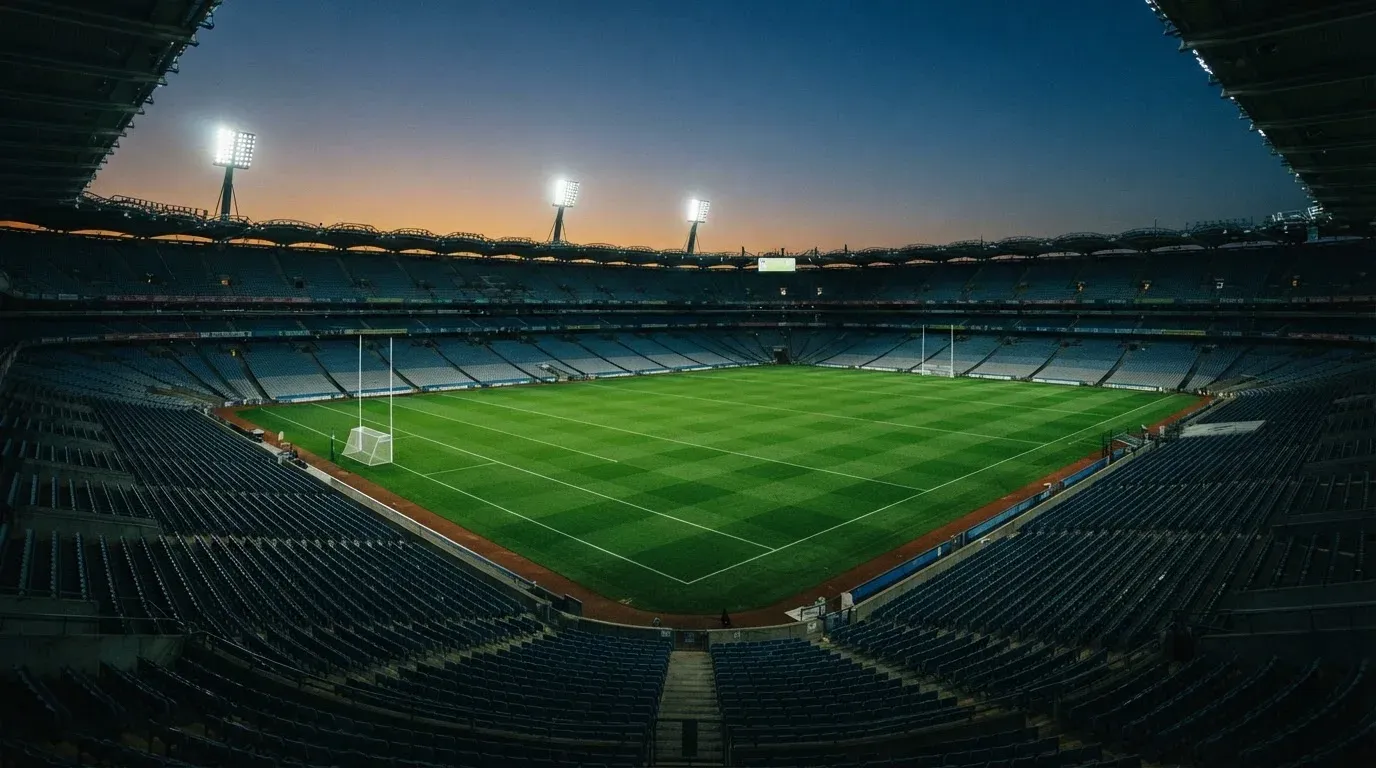
The team. Fifteen players on each side. The goalkeeper is one of the fifteen. The team is on the pitch for the whole game; substitutions are limited and the inter-county game has a blood-sub rule and a black-card sin-bin.
The duration. Senior inter-county games last 70 minutes, in two halves of 35 minutes each. The Allianz Hurling League has the same duration. Lower-tier championships may have shorter games. The clock runs continuously; the referee adds injury time at the end of each half. Extra time in a championship game that finishes level is two 10-minute halves; the All-Ireland final goes to extra time and, if still level, to a replay (in 2026 the final was decided in normal time).
Scoring. A goal is three points and a point over the crossbar is one point. The score is written as “X-Y (Z)” where X is goals, Y is points and Z is the total in points. A team that scores 2-13 has scored 2 goals and 13 points, totalling 19 points. The score is the basis for every match-result and handicap market.
The pitch. The pitch is larger than a football pitch, roughly 145 metres by 85 metres. The goalposts are the same shape as in Gaelic football: a set of H-shaped posts with a net behind the goal and a crossbar above it. A goal is the ball below the crossbar and inside the posts; a point is the ball over the crossbar and between the posts.
The ball. The sliotar is smaller and harder than a football. It is similar in size to a hockey ball but lighter. The stick is the hurley, a wooden curved stick with a flattened base. The hurley is used to strike, hand-pass and lift the ball.
The bookmaker’s markets. Match result (home, away, draw). Total points. Total goals. Handicap. First-half result. Player markets (top scorer, first scorer, anytime scorer). Outright tournament markets (winner, each-way to reach the final). Bet Builder on the bigger matches. In-play markets on all of the above. The market depth varies by bookmaker and by event.
The settlement rule. A bet settles on the official result at the end of normal time including injury time; extra time does not count unless the market states otherwise. Sky Bet’s Gaelic games rules, on its support pages, state this rule explicitly. Other operators use similar wording. The punter should assume normal time until told otherwise.
What to check before placing a bet
Three checks before a bet on hurling. The first check is on the operator. The Gambling Commission’s public register, searchable by business name, trading name, domain or account number, is the test of whether the brand holds a current licence. The Commission’s account number is the cleanest match; the trading name is the second cleanest. The domain alone proves nothing because licensed operators use .com as well as .co.uk.
The second check is on the offer. If the bet uses a bonus or a free bet, the punter reads the wagering requirement (capped at 10x under Commission rules in force since 19 January 2026), the minimum price per qualifying bet, the expiry, the cap on free-bet winnings, and the market restriction. The offer’s headline number is the sum, not the realised number. A cross-product check — does the offer require sports and casino play? — is the gate to whether the offer is legal at all.
The third check is on the market. The punter reads the settlement rule. Does the bet settle on normal time or does it include extra time? Does the player market include extra time? Does the outright tournament market settle on the final result, or does it include replays? The punter’s personal review of the betting slip is the final word.
Putting it together
The punter picking an operator for hurling in 2026 has ten licensed brands on the Commission’s register, plus the wider market of licensed brands not on this shortlist. The shortlist covers the brands with the deepest product line, the clearest welcome offers and the strongest safer-gambling tools. The choice between them is not a choice of “best” but a choice of fit: which operator’s product line, which welcome offer, which safer-gambling tools match the bet the punter wants to place.
The 10x bonus cap and the mixed-product ban push the welcome offers towards small, simple bonuses on sports only. The identity check before the first deposit and the £150 vulnerability check shape the onboarding. The GAMSTOP register shapes the self-exclusion. The point-of-consumption rule shapes the offshore regime. The punter who reads these rules and the operator’s own terms has the information needed to pick.
The margin on the simplest two-way market is around 5 per cent. The margin on the hurling match result is higher, often between 8 and 12 per cent. The margin on a player market or a handicap is higher still. The punter who compares margins across bookmakers is comparing what the bookmaker keeps, not what the punter wins.
The 2026 All-Ireland Senior Hurling Championship ended on 19 July 2026 with Limerick beating Galway. Tipperary won the 2025 Championship. The 2027 Championship will run on a similar structure, with the provincial rounds first and the All-Ireland series in the summer. The calendar is the calendar, and the bookmaker’s product follows it.
The punter who has read this far has the facts. The decision is theirs.
Frequently asked questions
How can it be checked that a bookmaker holds a Gambling Commission licence?
The Gambling Commission’s public register can be searched by business name, trading name, domain or account number. The account number is the cleanest match; the trading name is the second cleanest. The domain alone proves nothing because licensed operators use .com as well as .co.uk. The register is the test of whether a brand holds a current licence, and the categories shown beside the licence name tell the punter what kind of betting the licence covers. The Commission’s account number is the figure to compare against the operator’s own pages.
How is the return on a bet worked out from the stake and the odds?
A single bet at decimal odds D returns the stake times D and pays a profit of stake times (D minus 1). A £10 single at decimal odds 2.50 returns £25 and pays £15 of profit. A double at combined odds 6.00 returns £10 × 6.00 = £60 and pays £50 of profit. An accumulator of four legs at 2.00 each gives combined odds of 16.00, a £10 stake returns £160 and pays £150 of profit. The compounded margin is what makes long accumulators expensive on the punter’s side even when each leg wins.
What is the bookmaker’s margin and how can it be seen in the odds?
A market’s margin is the share of every pound staked that the bookmaker keeps, on average, and it is built into every selection. A two-way market at decimal odds 1.90 and 1.90 gives a payout share of 1 ÷ (1/1.90 + 1/1.90) = 0.95 and a margin of 5 per cent. A three-way 1X2 market at 2.50 / 3.50 / 3.00 gives a payout share of about 0.89 and a margin of 11 per cent. The margin on hurling’s match result at a major British bookmaker sits roughly between 8 and 12 per cent; on player markets it is higher. The punter who compares margins is comparing what the bookmaker keeps, not what the punter wins.
How do fractional odds such as 5/1 convert to decimal odds such as 6.00?
The conversion is (a ÷ b) + 1, where a is the first number and b the second. Five-to-one is 5 ÷ 1 + 1 = 6.00. Eleven-to-four is 11 ÷ 4 + 1 = 3.75. Nine-to-ten is 9 ÷ 10 + 1 = 1.90. Evens is 1/1 in fractional form, which is 2.00 in decimal. A punter reading a screen that shows 5/1 next to 6.00 is reading the same price twice; the decimal form is the price used by the betting slip and is the number to use when calculating returns and margins. Both forms show the same information in different notation.
Which tools for controlling play does a licensed bookmaker have to offer?
A licensed operator must offer GAMSTOP registration for self-exclusion, gross deposit limits on a fixed time frame, timeouts, session reminders and product-level blocks. The financial vulnerability check at £150 in deposits minus withdrawals over a rolling 30-day period has applied since 28 February 2025. Financial risk assessments are announced as a staged plan with no start date. Identity verification before the first deposit has applied since 7 May 2019, including with a free bet or bonus. None of these are state-set ceilings on the customer’s stake or loss; the customer chooses the limit and the operator must honour it. Help lines are GamCare, GambleAware, NHS gambling clinics and Gamblers Anonymous.
Rugby, cricket & Gaelic – oddsguaranteed
Content created by the «oddsguaranteed» team
