
Where to bet on snooker online in 2026 — and how to read what the bookmakers are offering
 Available in US
Snooker sits in an odd corner of the betting world. It moves more slowly than football and more quickly than golf, runs on a calendar of marquee events rather than weekly fixtures, and rewards a kind of attention that most other sports do not. Bettors who follow the tour know this already; the wider market is still catching up. A licensed bookmaker in Great Britain is allowed to take bets on snooker under its remote general betting licence, and most of the major names do, but the depth of the offering varies far more than the headlines suggest.
This page is built around that variation. It walks through how snooker is actually played and what that means for markets, how a UK licence is verified and what protections it brings, what live betting and a cash-out button cost, how the offers are structured and what they really require, and how to read the odds — including the margin sitting inside them. The licensed operators covered here are reviewed on the same fields, in the same order, so a comparison stays a comparison and not a list of separate sales pitches.
Data current as of October 30, 2026; operator terms checked against each brand’s own published conditions and the Gambling Commission’s public register.
The snooker calendar and what it does to a betting market
Snooker is a sport of long tournaments rather than weekly fixtures. The professional tour runs almost year-round, with a handful of ranking events and a small number of invitationals that the betting public cares about disproportionately.
The World Snooker Championship has been held at the Crucible Theatre, Sheffield since 1977. First-round ties are played to a best-of-19 format, the final to a best of 35, and the tournament routinely produces the kind of long, attritional frames that draw both television audiences and serious betting handle. The 2026 edition ran from 18 April to 4 May 2026 at the Crucible Theatre, with Wu Yize beating Shaun Murphy 18–17 in the final. The winner received £500,000 from a £2,395,000 prize fund. Below the championship sit the UK Championship, the Masters, the Champion of Champions and a tier of ranking events across Europe and Asia; the tour opens with the Championship League and closes with the Tour Championship, with the Crucible at the centre of the calendar.
A professional frame can last between ten and ninety minutes depending on the format. A World Championship semi-final is closer to seven hours of play spread across four sessions. That structure shapes how a betting market behaves — and how a licensed bookmaker in Great Britain prices it.
The fundamentals: balls, breaks and table size
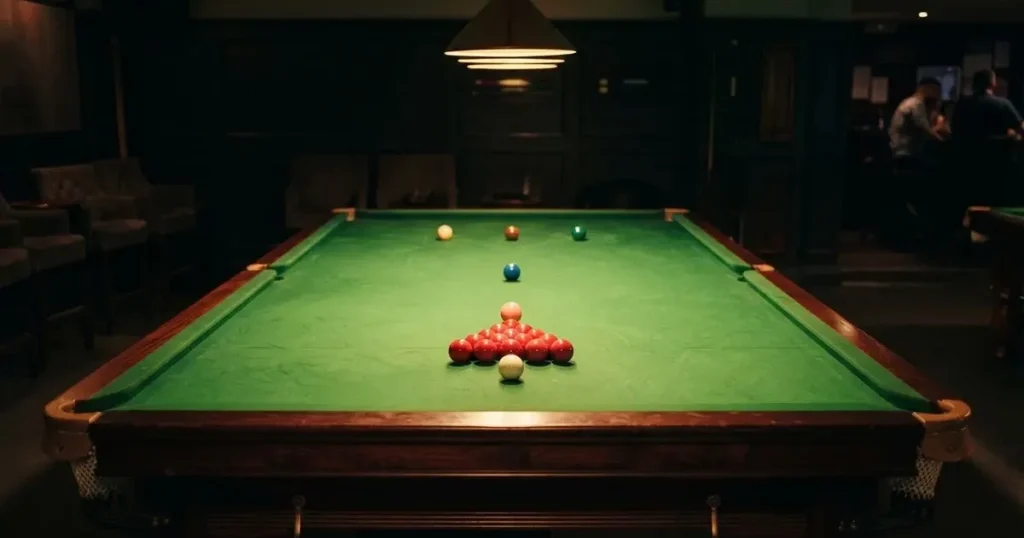
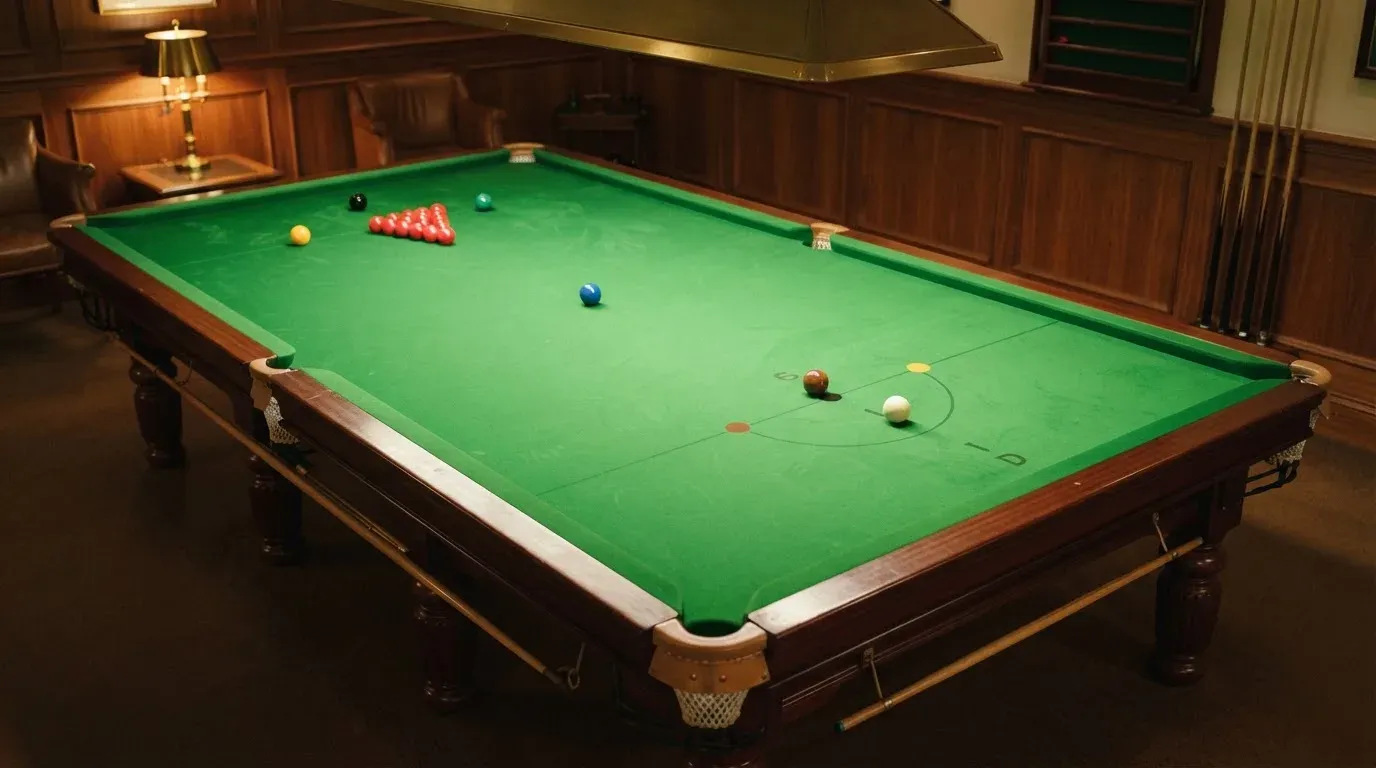
Snooker is played with 22 balls: a white cue ball, 15 reds and six colours worth yellow 2, green 3, brown 4, blue 5, pink 6 and black 7. The aim is straightforward in principle — pot balls in a set order, scoring more than your opponent — but the tactical depth is where the betting interest lives.
The maximum break is 147, made by potting all 15 reds with blacks and then all six colours in order. A century break (100 or more) is a marker of quality; a 147 is rare enough to reshape outright markets the moment it goes in. A full-size snooker table is 12 ft by 6 ft with six pockets, and most professional matches are best of 7, 9 or 11 frames outside the majors.
The two dominant figures of the modern era — Stephen Hendry and Ronnie O’Sullivan — have seven world championships each, while Joe Davis won fifteen in a row from 1927 to 1946, a record that underlines just how long this sport’s continuous history runs. Ronnie O’Sullivan’s peak dominance and Neil Robertson’s left-handed consistency, Judd Trump’s century-making volume and Mark Selby’s grinding safety play are all qualities a market interprets differently when pricing a single match.
Tournaments are run by the WPBSA, which owns the official rules, with the IBSF governing amateur competition. Frames are officiated by a referee, and frame-level data — including breaks of 50, 100 and 147 — is the bedrock of live in-play markets.
How the betting landscape is set up in Great Britain
Great Britain has no statutory list of permitted sports or markets. The Gambling Act 2005, as amended by the Gambling (Licensing and Advertising) Act 2014, requires any operator taking remote bets from customers in Great Britain to hold a Gambling Commission licence, regardless of where the company is incorporated. Sections 33 and 36 of the Act are the operative provisions; a Curaçao, Maltese or Gibraltar licence is not a substitute for serving GB customers online.
A licence is granted under one of several categories: remote general betting standard (real events), remote general betting standard (virtual events), remote general betting limited, remote pool betting and remote betting intermediary (the latter covers betting exchanges). Snooker sits inside the first of those — remote general betting standard (real events) — which is what every brand in this review holds. Spread betting on financial instruments is regulated by the Financial Conduct Authority rather than the Commission, and a customer must be aware that spread betting losses can exceed deposits, as the FCA-regulated firm’s own terms make clear.
What may be bet on is not enumerated anywhere in the statute. Operators offer markets under their own house rules, subject to the Licence Conditions and Codes of Practice (LCCP). In-play snooker betting is offered, and the controls are the operator’s licence conditions and customer-protection duties, not a separate statute. Markets commonly include match winner, frame handicap, total frames, first to pot a colour, century-break markets, outright winner, and a range of player-specific props. The depth varies sharply between brands and is one of the differences the comparison below tries to surface.
How to verify a Gambling Commission licence
Licensing is the public test of whether a brand can lawfully take bets from Great Britain, and the Commission’s public register is the only place it can be checked. The register can be searched by business name, trading name, domain or account number; it lists the licence category, the trading names the licence covers, and any operating conditions that have been added or amended.
The licensed operators in this review are all listed on the public register against a remote general betting standard (real events) licence. A handful run under the same licensee — Ladbrokes and Coral, for example — so what looks like two brands in the wider market is two trading names of one licence holder; that detail matters for the consumer-protection side. A licence number is not the same as a recommendation: a place in a comparison is not a licence, and no single brand is “the only” licensed operator. Domains prove nothing on their own either, since licensed operators use both .com and .co.uk. The Commission’s register is the only source that settles the question.
Several of the cards below quote licence numbers and account numbers for verification; readers should treat those as a key into the register, not as a guarantee in themselves.
Responsible gambling: what the licence buys you
Every GB-licensed online operator takes part in GAMSTOP, the national multi-operator online self-exclusion scheme, since 31 March 2020. Self-exclusion can be set for six months, one year, five years, or five years with auto-renewal. After the minimum period, the exclusion stays in place for a further seven years unless the customer asks GAMSTOP to remove it. GAMSTOP covers online sites and apps; high-street betting shops run a separate self-exclusion service. A self-exclusion through GAMSTOP blocks new account creation across every participating operator for the period chosen and disables existing accounts.
Beyond exclusion, the LCCP and the Remote Technical Standards set out the safeguarding duties a licensed brand owes. The minimum age is 18, and name, address and date of birth are verified before a customer can deposit or gamble, including with a free bet or bonus. A financial vulnerability check has applied to licensed remote betting since 28 February 2025, where a customer’s deposits minus withdrawals exceed £150 in a rolling 30 days; it is a public-record check, not an income or credit reference check. Financial risk assessments have been announced in a staged plan, with no start date at the time of writing — they are not in force. Deposit limits are the customer’s choice, not a state-set cap: operators must offer a gross deposit limit on a fixed time frame, but there is no statutory ceiling on what a betting account can take.
Help is widely available and clearly signposted at licensed sites: GamCare runs the National Gambling Helpline, GambleAware funds treatment and education, NHS gambling clinics handle the most serious cases, and Gamblers Anonymous runs peer-support meetings. The Commission’s safer-gambling standards require operators to display these routes in their products, not bury them.
Crypto, anonymity and the licensed-brand reality
Snooker betting with bitcoin, snooker betting with crypto and the broader cluster of “crypto snooker betting site” searches point at a market structure that sits outside what this review covers. The Commission’s published register contains no licensed snooker bookmaker that runs primarily on crypto rails, and the identity-verification regime in force since 7 May 2019 means there is no anonymous play at a licensed site. A reader who arrives at a “bitcoin snooker betting” site will, in the majority of cases, be looking at a brand that does not hold a Commission licence and therefore falls outside the protections described above.
That gap has a real cost. Where a brand is not GB-licensed, the customer loses GAMSTOP coverage, the Commission’s complaints route, access to an approved alternative-dispute-resolution body, any British consumer redress if funds are withheld, the 10x bonus wagering cap in force since 19 January 2026, and the £150 financial-vulnerability check threshold. The customer does not commit an offence by betting with such a brand; the offence sits with the operator under section 33 of the Gambling Act 2005. The reader’s loss is the loss of protection, not the loss of legality on their side of the screen.
The honest framing is two-sided. A licensed brand means identity checks, deposit verification and the friction that follows from the 2025/2026 tightening. An unlicensed brand means none of the protections above and a real risk that withdrawals stall or never arrive. Neither is automatically the safer choice by default.
What the offers and bonuses actually cost
Bonus advertising on snooker betting sites does not describe what an offer is. The headline figure is the credit; the wagering requirement, the minimum odds, the time limit and the markets that count towards turnover are the offer’s true cost. The licensor’s marketing rules cap the wagering requirement on bonuses at 10x since 19 January 2026, and they ban mixed-product promotions that demand play across two or more product types (betting plus casino, for example). Whether the 10x cap applies to free bets with no wagering condition, and any ceiling on the money value of a bonus, are not settled by the published rules.
The standard pattern at a UK-licensed bookmaker looks like this: a deposit bonus credits bonus funds equal to a percentage of the deposit (the familiar 100% on the way in), carries a wagering requirement measured in multiples of the bonus (or bonus plus deposit) at a stated minimum price, and an expiry measured in days rather than weeks. Free bets are a different beast — the stake is usually not paid back with a win, and a cap on free-bet winnings is normal. A “risk-free” refund as a free bet is not a refund in money; it is a credit on the same terms as any other free bet. Price boosts, accumulator insurance and cashback are three different mechanisms with three different cost structures and should be read as such.
A useful mental model: every offer’s headline number is the price the brand pays to acquire a customer, and the wagering requirement is what the customer pays to extract any of it. The two rarely match. A 100% deposit bonus at 10x on the bonus means a £10 bonus turns into £100 of required bets before the balance is withdrawable, and the market margin on each of those bets is what does the actual work of reducing the real value.
How to read a snooker betting offer
For a starter offer that pays the bonus only as a stake-not-returned free bet, the value is bonus amount multiplied by the fair value per unit at the price specified — research the licence rules say. Where research does not state a wagering multiple, write it qualitatively: the brand’s terms either match the 10x cap or fall well short of it, and the difference between those two camps is the difference between a routine and a heavy offer. A qualified bettor’s pre-flight check is the same three lines: minimum price, expiry and which markets count.
Offers labelled “best odds guaranteed” or “price boost” deserve separate handling. A BOG offer on horse racing pays the bigger of the price taken and the starting price; the same mechanism on snooker would be unusual and should be checked on the operator’s own terms. Price boosts inflate a single price for a defined stake and usually pay out at the boosted figure in cash — the brand’s own terms are the only source for what is and is not included.
Live snooker betting and the cash-out question
In-play snooker is a different product from pre-match snooker, and licensed brands offer it unevenly. The sport’s structure — long frames, lopsided scores, plenty of time between visits to the table — is friendly to live betting in principle. The practical question is whether a brand updates its prices frame by frame, whether it offers markets such as next-frame winner, total frames in the match, or century in the next frame, and whether the cash-out button is offered on those markets at all.
Cash out is the operator’s right, not a customer right: an operator may suspend cash out at any time, may take the price displayed only or near only, and may close the market mid-frame. The button is most useful on outright and match-winner markets; it is least useful on heavily in-play-priced props whose values swing quickly enough that the offered price lags the true. The deciding factor for a user is not whether the button exists — most major brands offer it — but whether the price it returns fairly tracks the live state of play.
Live streaming of snooker is offered by some operators directly and by others through partner feeds, and the rights landscape shifts tournament by tournament. A reader with a strong preference for in-play betting on a particular format should check whether the brand they prefer streams or prices the format they watch.
Frame-by-frame and outright: how snooker markets are built
Snooker betting odds break into two families: match markets and outright markets. Match markets settle in a single session of play. Outright markets settle over a tournament, with the leading positions updated after each round. Each carries its own margin, and a brand that looks tight on one is often softer on the other.
Common match markets at a UK-licensed bookmaker include:
- Match winner — three-way in the early rounds of a major event (A, B, draw in best-of-X formats where a draw is possible).
- Frame handicap — lines expressed in frames, typically +/- 1.5 to +/- 3.5 for ranking events.
- Total frames — set at 11.5 or 12.5 for a best-of-25 semi-final, for example.
- First to pot a colour, first century, highest break in the match.
Outright markets include tournament winner, each-way terms, top nationality, top seed, name the final, and reach-the-final markets. Each-way terms vary by tournament and by operator; a place generally pays a fraction of the win price, and the dead-heat rules matter at the tail of a field. A bet on the outright winner is settled after the final frame of the tournament, regardless of how the bet was placed.
Theory says nothing beats watching the form table, but the betting angle is closer to this: a player’s price reflects their ranking, their opponent’s ranking, the format and the venue. The brand does the same modelling a sharp bettor would do, then adds its margin on top. The job is to find the price that mismodels the opponent — and accept that the operator has had a look too.
Predictions, strategy and the limits of both
Snooker betting tips and today’s snooker betting predictions are phrases that pull a lot of search traffic and resolve very little of it. The honest framing is that no model, tipster or system can predict a winner with the consistency required to overcome a bookmaker’s margin over a long series of bets. The brand charges its margin on every bet, every market, every frame; the bettor’s edge, if it exists, is the size of the gap between the model’s true probability and the price the brand offers after margin.
What a disciplined bettor does instead is structural. A bank sized to absorb losing runs of 10–20 bets; staking set as a fixed percentage of bank rather than a fixed unit; markets restricted to those the bettor has reason to model (match winner, frame handicap, century markets); a log of every bet with the closing price, the stake and the outcome, kept for self-audit. None of this produces a winning tip; what it produces is the data needed to know whether a strategy has a positive expected value at all.
The margin inside the odds: what the bookmaker keeps
The bookmaker’s margin is the share of every pound bet that the operator keeps on average over a large number of bets, expressed as a percentage. It is the structural cost of every bet placed, the thing a tip cannot defeat and an offer cannot offset.
The standard formula: for a market with outcomes priced at decimal odds o₁, o₂, …, oₙ, the payout share is 1 divided by the sum of 1/oᵢ across every outcome. The margin is 1 minus that payout share. For a two-way market priced at decimal 1.90 and 1.90 — an illustrative example — the sum of 1/1.90 and 1/1.90 is roughly 1.0526 (or 105.3%), the payout share is roughly 95%, and the margin is 5%. The overround is 5.3% (the sum minus 1). The operator keeps about 5p of every £1 staked on average, before any offer, bonus or promotion is layered on top.
It is worth noting what the formula is not: it is not a probability, it is not the chance of losing a single bet, and it is not a promise about any one outcome. It is the average cut the operator takes per unit bet across the whole market. A market with a 3% margin is cheaper for the bettor than one at 7%; the difference between those two is bigger than it looks, because compounding across thousands of bets is what turns 4 percentage points into a serious drag.
How decimal and fractional odds describe the same price
UK bookmakers publish odds in fractional form by habit — 5/1, 11/4, evens (1/1) — but the price is the same number whether it is written with a slash or with a dot. The conversion is exact: decimal odds = numerator ÷ denominator + 1. So 5/1 becomes 6.00, 11/4 becomes 3.75, 4/6 becomes 1.67, evens (1/1) becomes 2.00.
Decimal odds show the full return per unit stake — stake plus profit, all in one number. Fractional odds show only the profit per unit stake, with the stake understood to come back on top. A £10 bet at 5/1 returns £60 (the £10 stake plus £50 profit); the same bet at 6.00 returns £60. The two notations point at the same place; the choice between them is reading preference.
Stake × odds gives the return. Stake × (odds − 1) gives the profit. The two are the building blocks of every working-out on this page.
The licensed snooker operator set, reviewed
The next ten cards cover licensed remote betting operators that serve Great Britain and offer snooker as part of their catalogue. Each is run under a Commission remote general betting standard (real events) licence; each takes part in GAMSTOP; each verifies identity before a customer can deposit. The cards describe what the operator’s terms state, not what an offer looks like on a banner ad. Where the terms describe a feature, the feature is mentioned; where they do not, no claim is made. The reviewed operators follow in the order set by the public register and the consumer-protection frame above.
DAZN Bet — strong on streaming, snooker depth still building
DAZN Bet runs under Commission remote licence 048756-R-327274-019, licence holder DZBT Limited, with the domain DAZN Bet on the register. Deposits start at £5 by debit card, Apple Pay, Paysafecard, Trustly and Skrill, and at £20 by PayPal, with no processing fees. The wagering catalogue is built around live and pre-match markets on mainstream sports; snooker sits inside that with the standard match-winner and outright markets. The honest read is that DAZN Bet’s snooker offering is wider than a niche-only bookmaker’s but not as deep as a snooker-specialist’s; the brand’s strength is the streaming integration with the broader DAZN subscription for customers who already use it.
Swifty Sports — rising catalogue, bet builder on its way
Swifty Sports runs under Commission remote licence 058957-R-334734-006, licence holder Swifty Global (UK) Ltd, with the domain swiftysports.co.uk on the register. The catalogue includes Best Odds Guaranteed, cash out on horse racing and football markets, daily price boosts, live streaming and in-play betting; the bet builder feature is listed as coming soon. Snooker coverage is in its growth phase and reading the in-play board is the most useful first check. A reader after a calm, plain-English interface will find this brand easier to scan than some of the larger names.
Ladbrokes — depth of catalogue and the brand name that does the work
Ladbrokes runs under Commission remote licence 054743-R-330863-014, licence holder LC International Limited, which also covers Coral under the same licence. The Ladbrokes Sports Betting App is published by Entain Operations Limited and is rated 4.66 from 101,255 ratings in the GB App Store. The snooker depth is among the largest a bettor will find, with outright, match and frame-handicap markets across the full World Snooker Tour calendar; live in-play prices frame by frame; and a bet builder applied to selected markets. The licence and the catalogue are strong; the worry is the brand’s own tendency to paper over fine details with bonus copy, which is why a reader should always check the actual terms attached to a price.
QuinnBet — racing strengths, snooker present but not its centre of gravity
QuinnBet runs under Commission remote licence 061011-R-335683-004, licence holder QuinnBet (Gibraltar) Limited, as listed on the public register. Best Odds Guaranteed applies to Irish and UK horse racing bets from 10:00am daily on singles, multiples and system bets, with a maximum benefit of £150 per customer per race. Snooker coverage is part of the wider sportsbook rather than a flagship offering; the player-prop markets exist but are not as wide as the football equivalent. A reader whose betting is heavily racing-led with snooker as a side interest will find this brand fits; a reader whose interest runs the other way will not.
DragonBet — Welsh-rooted, snooker on a mainstream-sport board
DragonBet runs under Commission remote licence 064908-R-339041-003, licence holder DragonBet Ltd, with the domain dragonbet.co.uk on the register. The brand’s app is published by DragonBet Ltd and features Welsh football and rugby markets, racing, American football, in-play betting and bet builder markets. Snooker falls into the general sportsbook alongside mainstream UK sports; outright and match-winner coverage is solid through the calendar, with frame and handicap markets on the bigger events. The pitch to a customer is the localised feel of a regional bookmaker combined with the catalogue depth a snooker bettor actually needs.
Copybet — BOG all day on racing, snooker through a mainstream sportsbook
Copybet runs under Commission remote licence 053774-R-330743-010, licence holder Copybet UK Limited, as listed on the public register. The brand offers best odds guaranteed all day, every day on all UK and Irish racing, and pays first past the post on horse racing even if the winner is later disqualified. Snooker sits inside the mainstream sportsbook and is offered in the standard match and outright form; in-play prices are offered on the marquee events. The brand’s strength is racing; for the snooker reader it is one of several listed options rather than the centre of gravity.
Bet600 — racing-led with snooker along for the ride
Bet600 runs under Commission remote licence 044731-R-323941-016, licence holder Tyche Tech Limited, with the domain bet600.co.uk on the register. Best Odds Guaranteed pays on horse racing where the starting price exceeds the price taken. Snooker coverage is part of the wider sportsbook rather than a focus area; a reader whose interest is split 80/20 between racing and snooker will find this brand useful on the racing side and competent on the snooker side. The licence and the consumer-protection frame are exactly the same as every other GB-licensed operator in this review.
Sporting Index — spread betting alongside fixed odds
Sporting Index runs under Commission remote licence 027343-R-308898-011, licence holder Sporting Index Limited, with the domain Sporting Index on the register. The brand offers the option to switch between fixed odds and spread betting, with in-play betting, a football bet builder, auto cash-out and multi-markets available on the catalogue. Spread betting on snooker is a niche product and the customer’s losses can exceed the deposit on financial spread bets under FCA regulation, which is the rule that applies to financial instruments — a fact a reader should know before opening the spread side of the book. The fixed-odds snooker offering is straightforward.
William Hill — depth and a long track record
William Hill runs under Commission remote licence 039225-R-319373-015, licence holder WHG (International) Limited, with the domain William Hill on the register. Best Odds Guaranteed pays on UK and Irish horse racing from 8 AM on the day of the race, on both single and multiple bets; it does not apply to ante-post, tote or pari-mutuel bets. Snooker coverage is deep: outright, match, frame handicap, total frames and a selection of player markets; in-play prices on the major tournaments are among the most responsive. The brand is one of the most established in the GB market, and the strongest argument for a bettor who prizes a long operational track record over the newest app interface.
LiveScore Bet — bet builder depth across mainstream sports
LiveScore Bet runs under Commission remote licence 056859-R-332720-005, licence holder LiveScore Betting and Gaming (Gibraltar) Limited, with the domain LiveScore Bet on the register. The bet builder allows up to 10 selections and covers match result, both teams to score, corners, total goals, player scoring and card markets — football-focused, with snooker covered through the standard pre-match and in-play markets. A snooker-only reader will find the football bet builder of little use and should look elsewhere in this review; a reader whose snooker interest is a side interest alongside football will find the catalogue works for both.
The licensed-snobet landscape at a glance
| Brand | Gambling Commission licence (account · holder) | What the operator’s own terms state |
|---|---|---|
| DAZN Bet | 048756 · DZBT Limited | Deposits from £5 by debit card, Apple Pay, Paysafecard, Trustly, Skrill; from £20 by PayPal; no processing fees |
| Swifty Sports | 058957 · Swifty Global (UK) Ltd | Best Odds Guaranteed, cash out on horse racing and football, daily price boosts, live streaming, in-play; bet builder listed as coming soon |
| Ladbrokes | 054743 · LC International Limited | Snooker depth across the World Snooker Tour calendar; in-play frame-by-frame; bet builder on selected markets |
| QuinnBet | 061011 · QuinnBet (Gibraltar) Limited | Best Odds Guaranteed on Irish and UK horse racing from 10:00, single/multiples/system; £150 cap per customer per race |
| DragonBet | 064908 · DragonBet Ltd | Welsh football and rugby markets, racing, American football, in-play, bet builder |
| Copybet | 053774 · Copybet UK Limited | Best Odds Guaranteed all day every day on UK and Irish racing; pays first past the post even if the winner is later disqualified |
| Bet600 | 044731 · Tyche Tech Limited | Best Odds Guaranteed on horse racing where SP exceeds the price taken |
| Sporting Index | 027343 · Sporting Index Limited | Switch between fixed odds and spread betting; in-play, football bet builder, auto cash-out, multi-markets |
| William Hill | 039225 · WHG (International) Limited | Best Odds Guaranteed on UK and Irish horse racing from 8 AM on race day; singles and multiples; no ante-post/tote/pari-mutuel |
| LiveScore Bet | 056859 · LiveScore Betting and Gaming (Gibraltar) Limited | Bet builder up to 10 selections on football markets (match result, BTTS, corners, total goals, player scoring, cards) |
Picking the right brand from a shortlist
The brands above share the same regulatory ceiling — Commission-licensed, GAMSTOP-member, identity-verified — and differentiate on what they offer beyond it. Three trade-offs are worth spelling out before settling on a name.
First, depth of snooker coverage. The brands with the deepest snooker offering here are the larger mainstream sportsbooks (Ladbrokes, William Hill) and the brands that have invested in the wider WST calendar as a strategic priority (Swifty Sports, DAZN Bet through its wider DAZN partnership). Niche-led brands such as QuinnBet, Bet600 and Copybet do offer snooker but frame it as a side market alongside their racing-led pitch.
Second, the in-play and cash-out question. Snooker frames move slowly compared with football, but the most useful in-play product is the one that updates frame by frame. William Hill, Ladbrokes and Sporting Index update most reliably; the in-play offering at smaller brands is a useful check before staking on it.
Third, the offer structure. The licensed brands are constrained by the 10x bonus wagering cap and the ban on mixed-product promotions; what differentiates them is the exact minimum odds for a qualifying bet, the deadline in days, and the markets that count toward turnover. A reader who treats the offer as a credit against future staking, not as free money, will be in the right frame.
A reader who wants snooker as their primary betting interest will be best served by Ladbrokes or William Hill for depth, or by Swifty Sports for a newer interface combined with a growing snooker offering. A reader who wants snooker as a side interest alongside football, racing and other mainstream sports will do well at DAZN Bet, DragonBet or LiveScore Bet. A reader with a sharp interest in spread betting on financial instruments will find Sporting Index serves that side cleanly but should remember that FCA-regulated spread betting is a different product from fixed-odds betting and carries a separate set of losses — losses can exceed deposit.
A short checklist for choosing a snooker bookmaker
- Check the licence on the Commission’s public register by name, trading name, domain or account number before signing up.
- Read the wagering requirement, minimum odds, expiry and qualifying markets on any offer, not the headline number.
- Confirm the snooker catalogue — match winner, frame handicap, total frames, outright — is offered on the formats you actually watch.
- Check in-play coverage and whether cash-out is offered on the in-play markets you want.
- Set a deposit limit on first registration, not after a loss run.
- Use GAMSTOP from the moment self-exclusion feels necessary, not after a problem.
The licensed market in one sentence
Every GB-licensed snooker bookmaker offers the same consumer-protection frame, the same GAMSTOP membership and the same identity-verification regime; what differentiates them is the depth of the snooker catalogue, the quality of the in-play product and the fine print of the offer. Read those three things and the rest is noise.
Frequently asked questions about snooker betting
How is a snooker bet actually placed?
Open an account with a Gambling Commission-licensed bookmaker, verify your identity, deposit funds, find snooker in the sports menu, choose a market (match winner, frame handicap, outright, for example), select a stake and confirm the bet on the betting slip. The bet is settled according to the official result of the event under the operator’s rules.
Is betting on snooker actually available?
Yes, every UK-licensed online sportsbook takes bets on snooker. The depth varies by brand — the larger mainstream sportsbooks offer outright, match and frame markets across the World Snooker Tour calendar, while smaller brands keep the offering narrower. The Commission’s public register confirms each brand’s licence; once a brand is on it, snooker is in its permitted catalogue under the remote general betting standard (real events) category.
How can a Gambling Commission licence be checked?
The Commission’s public register lets users search by business name, trading name, domain or account number. The operator’s licence number, the licence holder’s registered name and the date the licence was issued all appear there, alongside any operating conditions. A licence number alone is not a guarantee in itself; it is a key into the register where the licence’s status and conditions can be verified.
How is the return on a bet worked out?
Decimal odds give the full return per unit stake — stake and profit both. Return = stake × odds, profit = stake × (odds − 1). A £10 bet at decimal odds 6.00 returns £60 (the £10 stake plus £50 profit); a £10 bet at 3.75 returns £37.50 (£10 stake plus £27.50 profit). Fractional odds show profit per unit stake, with the original stake understood to be returned on top.
What is a bookmaker’s margin and how is it read?
The margin is the share of every £1 bet the bookmaker keeps on average over many bets. It is calculated by converting each price to its implied probability (1 divided by decimal odds), summing across every outcome, and subtracting the payout share (1/sum) from 1. For a two-way market priced at 1.90 / 1.90, the sum of implied probabilities is roughly 1.053 (an overround of 5.3%), while the margin is 5.0%. A market where the sum is closer to 100% is a tighter, cheaper market; one where the sum runs 110% or more is a soft market.
How do fractional odds convert to decimal odds?
Conversion is exact: decimal odds = numerator ÷ denominator + 1. Five-to-one (5/1) becomes 6.00; eleven-to-four (11/4) becomes 3.75; four-to-six (4/6) becomes 1.67; evens (1/1) becomes 2.00. The two notations describe the same price; the difference is whether the stake is included in the headline figure (decimal) or shown separately (fractional).
Tennis, darts & cue sports – oddsguaranteed
Content created by the «oddsguaranteed» team
