
Boxing betting online: who serves it well, what the odds really hide, and which offer is worth the trouble
 Available in US

Boxing sits differently from football or horse racing on a bookmaker’s site. A title fight might draw one card a month; a midweek undercard, three or four short bouts on a streaming feed. The market is small, the calendars are sharp, and the depth of available wagers depends almost entirely on which fight the bookmaker has bothered to price up. What follows is a guide to choosing between the UK-licensed bookmakers that take boxing seriously — and to understanding the odds, the markets and the offers before the first bell rings.
Current as of October 30, 2026, written against the UK Gambling Commission’s public register.
Tips, predictions and reading form
Boxing is one of the few sports where raw records still tell a coherent story. Both fighters’ last five results, their opponents’ quality, and whether they have been stopped or gone the distance are publicly known. A boxer who has never been floored is a different proposition from one who has been up twice in his last three fights, regardless of what a tipster sheet says.
The most useful pre-fight work is reconstruction rather than prediction. Walk back through each fighter’s last three bouts round by round — who landed the cleaner shots, who faded in the championship rounds, who came in overweight. Knockout records carry weight because the sport resolves by stoppage more often than judges’ decisions: a fight that ends inside the distance settles before the scorecards matter, so any “method of victory” market hinges on who can be hurt.
Where form fails — and it does — is in matching styles. A slick southpaw against an aggressive come-forward fighter is the cleanest tactical puzzle in the sport, and the bookmaker’s price rarely tells you which style wins on the night. That’s where reading matters: the televised undercards, the post-fight interviews, the way a camp has trained for this exact opponent. There is no stat row for “switched to a high guard after round six”.
For UK bettors, the practical habit is to keep a short list: the current top fifteen heavyweights, the British titleholders, and any domestic prospect whose fights are being televised. Each of those fighters will appear on most major bookmakers’ sites within a week of an announcement. Smaller match-ups — club-level cards, foreign title fights not on UK TV — appear on a smaller set of books and sometimes nowhere at all.
Tipsters and prediction sites are not the same as analysis. Most publish a single line per fight, sometimes with a confidence rating. Treat the line as an opinion, not as a fact-checked forecast; the public form data behind it is what is worth weighing. Several subscription services run proprietary models; whatever their hit rate, none of them knows who will win on the night. The price is the only thing you can lock in before the bell.
Bankroll discipline matters more in boxing than in most sports. Calendars are sparse — meaning a bettor has fewer shots per month to apply their edge, and each stake represents a larger share of their monthly activity. Flat stakes keep the variance from spiking through a bad run of favourites going down early.
Bet types and reading the prices
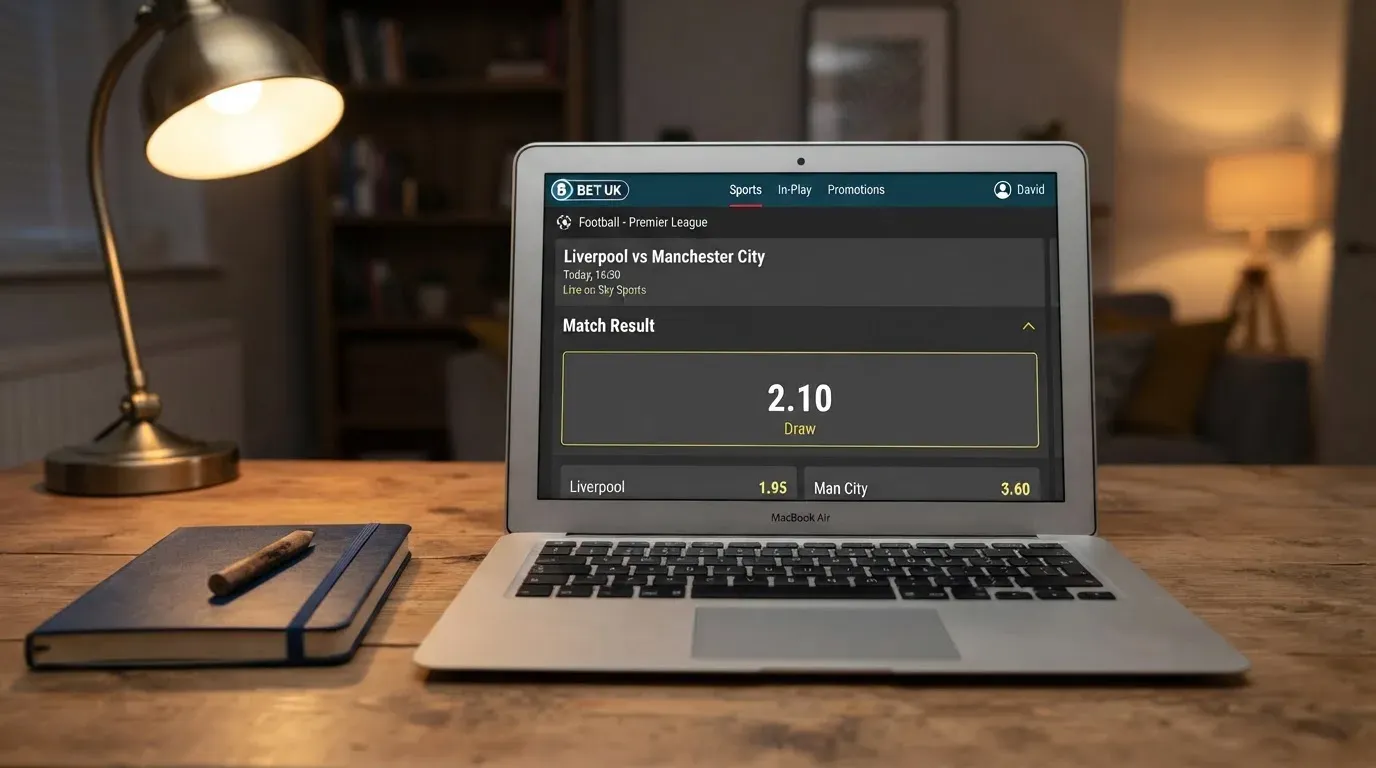
A boxing bout offers a small but well-defined menu of markets. The main market is the match result — sometimes shown as three-way (fighter A, draw, fighter B), sometimes as two-way when a draw is not offered. Boxing can end in a draw; the three-way market reflects this, and the draw line is normally the longest price on the card. A two-way market (also called “to win”) hides the draw — you back one fighter to win, and the draw means your stake loses.
Other standard markets include method of victory (decision, knockout, technical knockout, disqualification), round groupings (in rounds 1–4, 5–8, 9–12 for a twelve-round bout, depending on the round length), and to go the distance. Fighter-specific markets such as “fighter A to win by knockout in round 6 or later” appear on bigger cards.
Boxing is unusually well suited to accumulators because the rounds are short and the schedule is predictable. A multi-fight acca from a Saturday night card is common — pick winners across three or four bouts and combine the prices. The market margin on each fight multiplies into the combined price, so the acca price carries the margin of every leg.
Best odds guaranteed, the bookmaker rule that pays the starting price if it is higher than the price you took, is a horse-racing term. Some UK books extend it to boxing under limited conditions. Most do not. Where it applies, the bettor is paid at the larger of the two prices; where it does not, you keep the price you were given at bet time, win or lose.
The betting exchange is the other venue for boxing prices, run on a separate licence category. Back and lay lets a bettor take either side of a fight, sometimes at a sharper price than the bookmaker offers. Liquidity on boxing is thinner than on football or horse racing; the most meaningful bouts trade actively from the week of announcement, smaller cards barely at all. An exchange price is what the market’s other participants will take, which makes it a useful sanity check on the bookmaker’s line.
A price carries the bookmaker’s margin, and the margin can be read directly from the market. For a fight shown three-way, take the decimal odds on each outcome and convert them into implied probabilities: 1 ÷ odds. Add them up and the sum is above 100; the gap above 100 is the overround, and 100 ÷ the sum is the share of every unit bet that the book pays back to winners on average. The remainder is the margin. A clean two-way market at 1.91 / 1.91 pays back roughly 95.2% of stakes and keeps 4.8% — the typical figure for a competitive bout. A three-way market on the same fight runs at a higher margin because the draw line gives the bookmaker extra room. The shape of the prices, in other words, is the cost of betting visible on the page.
What the margin means in plain terms
On a two-way bout priced 1.90 / 1.90, the implied probability of each outcome is 1 ÷ 1.90 = 52.63%. Add the two sides and you get 105.26%. Divide 100 by 105.26 and the bookmaker pays out about 95.0% of stakes on this market, keeping around 5.0% as the margin on every unit bet — give or take the exact rounding of the price. In a three-way fight at 1.40 / 7.50 / 2.80, the implied probabilities come to roughly 71.4% + 13.3% + 35.7% = 120.4%, giving a payout share near 83% and a margin closer to 17%. Heavy favourite pricing inflates the margin; an underdog-led card typically carries a tighter book. These numbers are illustrative bands, not quoted prices — actual margins differ by bout and by operator, and a single market’s margin is not the same as the bookmaker’s overall margin on boxing across a card or a season.
The boxing calendar and what is actually priced
Boxing runs on a calendar of its own: a heavyweight title fight or major pay-per-view card once every three to six weeks, midweek domestic cards most weeks, and sparse activity in the depths of summer. Professional bouts are scheduled to twelve rounds for world-title fights and ten rounds for most others, with shorter four-round contests the norm for developing fighters; each round runs three minutes with one minute between bells. The structure shapes the markets — round-grouping bets depend on the number of rounds scheduled, and “to go the distance” means the fight reaches the final bell.
Sanctioning matters more than the casual fan realises. The WBA, WBC, IBF and WBO each sanction world championships, and a bout sanctioned by all four — the rare “undisputed” fight — moves the price on the undercard as well as the main event. Interim titles, “regular” champions and the WBA’s super/regular distinction confuse the picture; a bout for the WBA “regular” title is not the same event, in market terms, as one for the WBA “super” belt. Licensed UK bookmakers price these distinctions in their settlement rules, and the difference in the rulebook can matter when the dust settles on a close decision.
A bout can end by knockout, technical knockout (the referee, doctor or corner stepping in), unanimous or split decision on the judges’ scorecards, or disqualification for fouls. Method-of-victory markets key off these outcomes; settlement depends on the official result recorded by the sanctioning body, not on what the broadcaster’s booth said.
The Olympics sit outside the professional sanctioning structure. Olympic boxing is amateur, run under different rules and a shorter format, and UK bookmakers treat it as a separate event. The price depth is much thinner: a couple of dozen bouts priced, with most attention on the British squad.
UK bettors see the most coverage on US pay-per-view cards, UK domestic cards on BT Sport / TNT Sports, and Mexican or Saudi-staged cards that are televised in this country. Eastern European, Asian and South American cards are sparsely covered; if a fight is not on a UK broadcaster’s schedule, fewer than half of UK-licensed bookmakers will price it.
Where the calendar limits the markets
A bookmaker with twenty fights on its boxing page covers two or three cards. A bookmaker with two fights covers one club night. The thinness of the calendar means the choice of bookmaker is partly a choice of which calendar they have bought into. For the televised heavyweight title, every major book has a price inside an hour of announcement. For the Yorkshire-area title fight on a Tuesday in March, perhaps two books in the country. The form work above goes wider than the prices; the betting work has to go where the prices are.
The shortlist of UK-licensed bookmakers
A UK-licensed bookmaker answers to the Gambling Commission and takes part in GAMSTOP — the national self-exclusion scheme. Ten currently hold a remote general betting licence for real events and price boxing to a useful depth. They are listed below in the order they appear on the Commission’s public register; the order is not a recommendation.
| Bookmaker | UKGC licence | What their own terms state on boxing |
|---|---|---|
| VBet | 044662-R-324273-022 (SCGO Limited) | A £10 free bet for a new, verified customer on a first bet of £10 or more that loses |
| LiveScore Bet | 056859-R-332720-005 (LiveScore Betting and Gaming (Gibraltar) Limited) | Bet Builder accepts up to ten selections across match result, BTTS, corners, total goals, player scoring and cards |
| Betfred | 039544-R-319290-010 (Petfre (Gibraltar) Limited) | App covers twenty-one sports, including boxing, alongside a casino suite |
| Bet Ahoy | 100094-R-341742-003 (Bet Ahoy Ltd) | Welcome offer of £10 in free bets (£5 sports plus £5 acca) on a £10 first bet |
| Betmaster | 065699-R-339929-002 (BM Solutions GB Ltd) | App covers football, cricket, horse racing, NFL and esports (League of Legends, Dota 2) |
| BoyleSports | 039469-R-319383-025 (Boylesports Enterprise) | £20 in free bets for UK players from a £10 qualifying bet |
| Betfair | 039439-R-319330-013 (PPB Counterparty Services Limited) | In-play betting, Bet Builder, live streaming of UK and Irish racing and football, plus a 90-minute payout market |
| Octobet | 062545-R-337248-006 (Octopus Game Limited) | 50% back as a free bet to £50 plus a £10 casino bonus for new customers |
| Copybet | 053774-R-330743-010 (Copybet UK Limited) | Best Odds Guaranteed all day on UK and Irish racing; pays first past the post on horse racing |
| Lottoland | 038991-R-319408-020 (EU Lotto Limited) | Licensed for customers in Great Britain; combines casino, lottery betting, sports betting and scratchcards |
Five mid-tier names — Spreadex, Kalooki Sportsbook, Midnite, Unibet and Fitzwilliam Sports — also hold Commission licences relevant to boxing. Spreadex is regulated by the FCA for spread betting and by the Commission for fixed-odds betting, and notes that spread-betting losses can exceed deposits; the fixed-odds book is the relevant product for boxing. Kalooki Sportsbook, run by Kalooki Sports Book Ltd, sits under account 57730 and is a GAMSTOP member. Midnite’s site cites licence 101839 and an active in-play product with a build-an-acca feature and price boosts. Unibet has run since 1999 under Platinum Gaming Limited in Gibraltar, account 45322. Fitzwilliam Sports, an independent Irish book, sets deposit limits and self-exclusion at the account level.
The table is a view of the ten, not the only ten: the Commission’s register lists many more. Boxing depth varies meaningfully between the brands: bet365, the most-downloaded sports betting app in the UK and the official global betting partner of the UEFA Champions League, runs an extensive boxing menu with Bet Builder+, Super Boosts, Winnings Boosts and live streaming; Spreadex does not pretend to compete on boxing depth and is built around spread products. Even the names that look interchangeable on paper — Bet Ahoy and Betmaster — answer to different licences, run different apps and price different fights.
What a UK-licensed bookmaker actually gives you
Licensed status is not a marketing badge; it is a set of obligations enforced by the regulator and bound to the operating licence under which every product is offered. The protections that go with the licence shape the bettor’s day-to-day experience.
Identity is checked before the first deposit or bet. A licensed book verifies name, address and date of birth, including for free bets and bonuses; a Commission rule that has been in force since 7 May 2019. The verification is normally a soft credit-search-style check against public records; a deeper source-of-funds request comes later for higher spend. Anonymity at a licensed site does not exist.
GAMSTOP enrolment is mandatory for online operators: every brand above is a member. A self-excluded customer cannot open an account, deposit, or place a bet with any of them during the chosen period — six months, one year, five years, or five years with auto-renewal. After the minimum period, the exclusion runs for a further seven years unless the customer asks GAMSTOP to remove it. If a self-exclusion is in place, no licensed book will let the bet in.
Bonus terms are now capped by ASA-promotion rules in force since 19 January 2026: any wagering requirement on a bonus is limited to 10x the bonus amount, and mixed-product promotions (one offer that requires play on two or more product types — for example “bet on football, get free spins”) are banned. The cap resets the worst excesses of the last decade; it does not make every offer a good one.
Credit cards are banned for gambling in Great Britain, including credit-card-funded e-wallet payments. Debit cards and bank-based methods (open banking, bank transfer) are not covered by the ban. The bookmaker cannot tell you to use a credit card; the payment provider blocks it.
Financial vulnerability checks apply to customers whose net deposits cross £150 in a rolling 30-day window. The check is a public-record check — bankruptcy, county court judgments — not a credit search and not an income check. A second set of “financial risk assessments” — sometimes called affordability checks in the press — has been announced in a staged plan with no start date as of this writing.
The Commission’s register is the whole test of licence status. Searchable by business name, trading name, domain or account number, it carries every active remote licence and the categories each one covers. If a brand is not on the register, it is not licensed in Great Britain. The bookmakers named above appear in their order on the register, but a registration date is not a quality stamp — being licensed has nothing to say about whether the price is sharp, the offer fair, or the boxing menu deep.
What being unlicensed actually means
An unlicensed brand running from Malta, Curaçao or elsewhere has no obligation under the Gambling Act 2005. The bettor sees no GAMSTOP enrolment, no British complaints route, no approved alternative-dispute-resolution body, no British consumer redress if funds are withheld. The 10x bonus cap does not apply; the £150 vulnerability check does not apply; the credit-card ban does not apply.
Some unlicensed books do enforce identity checks; some accept cryptocurrency and offer what looks like a faster, lighter sign-up. The convenience is real. The risk is the absence of any UK-based route when a withdrawal stalls, an account is closed, or a bonus term is read differently by customer services and the bettor. An offshore licence does not make the brand illegitimate in its home jurisdiction — it simply does not give a UK consumer the protections that come with a Commission licence.
HMRC does not tax the bettor on UK-licensed sports-betting winnings. General Betting Duty is the operator’s tax on gross profits — currently 15%, with a new 25% remote rate applying from 1 April 2027 to remote bets other than on UK horse racing and certain other categories. Whether operators pass the higher rate through the odds is not yet established; betting sites do not advertise it. Spread betting has its own rates (3% for financial, 10% for other) — those are operator-taxes and do not change what a winning punter receives.
The legal frame, in one paragraph
UK gambling law is the Gambling Act 2005 for England, Scotland and Wales — together Great Britain. Northern Ireland runs on older legislation and is not part of the Act, so “Great Britain-licensed” is the precise phrase, never “UK-licensed”. Since the Gambling (Licensing and Advertising) Act 2014, an operator needs a Commission licence wherever it is based if its remote facilities are used in Great Britain. A Curaçao or Maltese licence is not a substitute. The Commission’s public register is the single source for licence status; no operator’s own marketing tells the whole story.
Safer gambling and where help is
The licensed operators above are bound by the Commission’s social responsibility code, which sets the minimum standard for customer protection. Each site offers deposit limits, timeouts and self-exclusion at the account level — set them before the first bet, not after a bad run. GAMSTOP enrolment stops the licensed bookmakers collectively; a bettor who wants one exclusion across all of them uses it once.
The free help is real. GamCare runs the National Gambling Helpline. GambleAware funds treatment and research. The NHS runs gambling clinics in several cities. Gamblers Anonymous runs peer support groups, online and in person. Fitzwilliam Sports, like most licensed books, links out to these services from its safer-gambling page.
The protective framing is not a marketing line: it is the difference between a lost stake and a closed account when control slips. Set the limit at a number you can afford to lose on a bad night, and the rest of the decisions flow from there.
Cryptocurrency and the question of anonymity
Cryptocurrency has been advertised as a route around identity verification. Several offshore-facing books accept Bitcoin and other coins; a few of them price boxing. They sit outside the Commission’s licence regime and outside the protections that go with it. A bettor who puts a Bitcoin stake down with such a brand has no GAMSTOP coverage, no British complaints route and no recourse under UK consumer law if a withdrawal is delayed. The convenience of opening an account in three minutes is the convenience of having no protection in three months.
Among the UK-licensed brands in this guide, cryptocurrency acceptance is not the norm and is not the recommended path. Identity is verified before the first deposit at every Commission-licensed operator; a UK bettor who wants to keep their betting activity off a bank statement is asking the wrong bookmaker. The licensed bookmakers in this guide take debit cards and bank-based payments (open banking, bank transfer); some support e-wallets such as PayPal and Skrill, subject to the e-wallet’s own policies on gambling merchants.
Litecoin, Bitcoin Cash and other altcoins sit in the same position as Bitcoin for offshore sites. The technology is the same; the regulatory position is the same. None of them reach a Great Britain betting account without conversion to sterling, and the conversion comes with a fee and a rate you should check before transferring.
Anonymity versus pseudonymity
A crypto wallet is pseudonymous, not anonymous. Every transaction is on a public ledger; chain-analysis firms track flows to and from known exchanges. The path from a coin purchase funded from a UK bank to a betting deposit is shorter than it looks. What is changing is not the public visibility of betting activity but the absence of any UK route to complain when things go wrong.
Bonuses and free bets, and what they really cost
The marketing words are “free bet”, “risk-free”, “boosted odds”, “100% bonus”. None of them mean what they seem to say.
A “free bet” is a stake the bettor does not put up themselves, normally issued after a qualifying bet. The book pays winnings — stake times odds minus the stake — but does not return the stake. A £10 free bet at 3.00 returns £30 of profit (£10 × (3.00 − 1)); the stake vanishes. The value of a free bet at average market margin is about £10 × (odds − 1) ÷ odds × (1 − margin). At 3.00 odds and a 5% margin, a £10 free bet is worth about £12.7 — less than the headline figure but rarely zero.
A “risk-free” bet is normally a free bet issued if the qualifying bet loses. The headline “if your first bet loses, get a free bet” reads like insurance; the settlement is a free bet with the stake-not-returned rule above. The bettor has risked their own money for the right to a smaller free bet, in the worst case, on a fight they lost.
A “boosted odds” offer raises the price the book publishes, normally with a stake cap and a settlement as a free bet rather than cash. The boost looks generous; the cap on winnings is the part that flattens it.
A “100% bonus” matches the deposit with a bonus, subject to a wagering requirement. The 10x cap introduced on 19 January 2026 puts a ceiling on the rollover: a £10 bonus now needs £100 of qualifying bets, capped at no more than £100 of rollover. The bonus funds are released to withdrawable cash only after the rollover is complete. The bonus is not “free money”; it is a deposit match with a turnover cost.
Mixed-product promotions — “deposit to get free spins” or “bet on football for casino credit” — are now banned. Single-product offers still stand.
The arithmetic — turnover, stake, qualifying bets, payout share — is worth working through before claiming any offer. A bonus whose rollover costs more than the bonus is worth is a net loss, however the headline reads.
What an offer really costs
A £10 free bet at 3.00 odds, in a market with a 5% margin, returns about £12.7 of expected value. The bookmaker pays the profit in cash; the stake does not come back. If the offer is a “bet £10, get £10 in free bets” on a £10 qualifying bet that loses, the bettor has lost £10 of real money and gained a £10 free bet worth about £12.7 in expected terms — a net loss for the bettor of about £7.3, before any subsequent bets are placed. If the bet wins, the bettor keeps the cash winnings and forgoes the free bet. Either way, the headline is not the cost.
Apps and the mobile experience
Boxing is largely a small-screen sport — fights happen in the evening, after the working day, in front of a phone. The app is the venue. The licensed bookmakers in this guide each publish an app, with download routes through the Apple App Store and Google Play.
Depth varies. Betfred’s app covers twenty-one sports alongside a casino suite. Betmaster pairs betting markets with League of Legends and Dota 2. Betfair layers in live streaming, Bet Builder and a 90-minute payout market. Lottoland is unusual in mixing lottery betting, sports, casino and scratchcards in the same product.
The features that matter for boxing specifically are in-play betting (price movement round by round), cash out (settle the bet before the fight ends), bet builder (combine multiple markets on the same fight), price boosts and acca insurance. Some books offer them all; some offer a subset. The bookmaker’s app is the only place to see them in action — published feature lists age between releases.
A smaller set of books offers specific boxing-friendly features: dedicated round betting, method-of-victory groups, and “to go the distance” markets. These tend to appear on the bigger books for title fights and disappear quickly for domestic cards.
Choosing between mobile and desktop
The boxing calendar is mostly evening-only, and the live-betting window runs for twenty or thirty minutes at a stretch. The phone is the right tool for in-play work. The desktop is better for a Saturday card with multiple fights, where a wider screen and a faster keyboard help a bettor compare prices and build an acca.
Most licensed books run the same account between web and app; a bet placed on one is visible on the other. The price is normally the same. Where the books offer app-only price boosts, the boost applies only on the app — useful for a bettor who prices up the card once on desktop and confirms on mobile before kick-off.
In-play betting and cash out
Boxing has a small but well-defined in-play product. The bookmaker takes the bell as the start of in-play betting — the round groupings, method-of-victory and to-go-the-distance markets compress once the fight begins, and the match result stays open until one corner takes a knee.
Cash out closes the bet early. The bookmaker offers a sum in settlement; the bettor accepts and ends the bet. On a winning in-play bet, the cash-out price is below the full-win value but above the original stake; on a losing bet, the cash-out price is below the original stake, in some cases near zero. Cash out is most useful in the late rounds of a lopsided fight where the conclusion is inevitable but the bell has not rung.
Round-by-round in-play markets exist on the bigger cards. The bookmaker suspends and resumes pricing after each significant exchange. The refresh rate and the suspension window tell a bettor how seriously the book has priced the fight — a bookmaker updating prices every fifteen seconds has an active trader in the sport; one updating every two minutes has set-and-forget.
The legal framing of in-play is settled: Great Britain bookmakers offer in-play betting under their licence conditions, and the controls are part of the operator’s social responsibility code rather than a statutory prohibition. None of the restrictions in force today apply to in-play on boxing matches sanctioned by the recognised bodies.
Live streaming as the tie-breaker
Several books stream the fights they price. Betfair is notable here — its app streams UK and Irish racing and football within the product, alongside in-play betting and Bet Builder. bet365, the most-downloaded sports app in the UK, runs live streaming of events worldwide, plus its in-house Bet Track and Match Live views. For a sport whose action is so contained, a stream inside the betting app saves the bettor from alt-tabbing between the broadcaster and the betting slip.
Streaming is normally contingent on a funded account or a recent bet. The published terms vary by bookmaker — check before betting on a fight whose only watchable stream is the bookmaker’s own.
Frequently asked questions
How do I bet on boxing?
Pick a licensed bookmaker from the Commission’s public register, verify your identity, deposit by debit card or bank transfer, and find the boxing section of the site or app. Choose a market — match result, method of victory, round grouping or to go the distance — set your stake and confirm the bet on the slip. The price on the slip is the price you get; if the book offers best-odds-guaranteed on the sport, you may be paid the starting price if it is higher.
How does boxing betting work in the UK?
UK bookmakers take bets on professional boxing under a remote general betting standard (real events) licence from the Gambling Commission. The Commission does not maintain a list of permitted sports or markets; each operator prices and settles under its own rules and the LCCP. Betting exchanges run on a separate betting-intermediary licence. Identity is verified before the first deposit, age is set at 18 and above, and winnings are not taxed for the punter.
How do I bet on boxing online?
The bookmakers in this guide each have a website and an app; the same account works on both. Boxing sits under its own sport tab. A bet is confirmed on the slip with the price shown at the moment of confirmation; cash out closes the bet early; in-play updates the price round by round. Withdrawals go back to the payment method used for deposit, normally within one to three working days.
How can I check that a bookmaker holds a Gambling Commission licence?
Search the Commission’s public register by business name, trading name, domain or licence account number. The register lists every active licence, the licence holder, the licensed activities and the trading names under which the licence operates. If a brand is not on the register, it is not licensed in Great Britain — and a GB licence is what gives a UK bettor the protections in this guide. Some unregulated sites carry fake trust badges; the register is the only reliable check.
How is the return on a bet worked out from the stake and the odds?
At decimal odds, the total return on a winning single is the stake multiplied by the odds: a £10 stake at 3.50 returns £35 in total — £25 profit plus the £10 stake. For an accumulator, multiply the odds together first, then apply the stake. At fractional odds — the British form — convert to decimal by dividing the first number by the second and adding one: 5/2 is 5 ÷ 2 + 1 = 3.50 in decimal. Free bets are settled on profit only, not stake plus profit.
Combat & motorsport – oddsguaranteed
Content created by the «oddsguaranteed» team
