
UFC Betting Odds in 2026 — Which Bookmaker, Which Market, What the Price Is Really Worth
 Available in US

October 30, 2026 · Checked against the Gambling Commission’s public register for Great Britain.
The first question a UFC punter asks is rarely which fighter wins. It is where to put the money, on which market, and at what price. Three decisions live inside every wager, and a choice on any one of them changes the value of the other two. This page walks through all three — bookmaker, market, price — for a bettor working out a UFC card in 2026. The point is not to crown a winner on Saturday night. It is to give a punter the framework to read any price they see and decide what it is really worth.
UFC betting is unusual among sports for one reason: fights end in seconds. A knockout lands in the first exchange; a submission appears from nowhere. That collapses the distance between pre-fight research and in-flight action, and it is why live betting, method of victory and round-specific markets carry weight in this sport more than they do in, say, football. A reader who only knows the moneyline is missing most of what a UFC card actually offers.
Reading UFC Prices Before Placing a Bet
A price is two things at once. To the bookmaker it is the cost of laying the bet — the margin it builds into every market. To the punter it is the multiplier on the stake that decides whether a wager is worth placing. The two readings point in opposite directions: a bookmaker wants a price that pays out less than the true probability of the outcome, and a punter wants the opposite. The gap between them is the house edge.

A useful example: take an illustrative two-way market at decimal odds 1.90 / 1.90. The implied probabilities on the two outcomes add to 1 ÷ 1.90 + 1 ÷ 1.90, which is 0.5263 + 0.5263 = 1.0526, or 105.26 per cent. The 5.26 percentage points above 100 is the bookmaker’s margin on that market — sometimes called overround. A “fair” book would price both sides at decimal 2.00 each, summing to exactly 100 per cent; the closer a real market sits to 100, the less the bookmaker is keeping. Most UFC pre-fight moneylines carry margins somewhere between four and eight per cent depending on the book and how competitive the card is. Cards where the public piles onto one fighter tend to widen the margin on the other side, because the book is laying off risk rather than seeking balanced action.
The decimal-odds form research uses throughout this page is the international standard; British bookmakers also display fractional odds, where 9/10 means a profit of nine pounds for every ten staked, which is decimal 1.90. The conversion is straightforward: a/b in fractions becomes a ÷ b + 1 in decimals. The figure is the same either way; only the display changes.
A punter who knows only the headline price is missing half the picture. The same fighter at 1.91 with one bookmaker and 1.85 with another is a six per cent difference in expected return on the same bet — and that gap shows up only in the decimal, never in the marketing line about “competitive odds”.
What the margin costs in real money
On an illustrative £100 single at decimal 1.90 with a five per cent market margin, the bookmaker keeps around £5 of every £100 bet on that market across many bets. On the same stake at decimal 1.85, the margin widens and that £100 returns £185 instead of £190 — £5 less profit on a win, and the bookmaker’s expected take rises. Over a card of twelve bets, even a small difference in margin compounds. A punter who spends an hour moving between books before placing each wager is not being precious; they are recovering a real slice of expected return.
The calculation belongs to the bettor: pull the two sides of any market, divide each into 1, add the two figures together, and the surplus above 1 is the margin. Anything between two and four per cent is a sharp line; anything above seven per cent on a UFC main event is the bookmaker leaning on one side of the action.
How UFC Markets Are Built Around Five Rounds
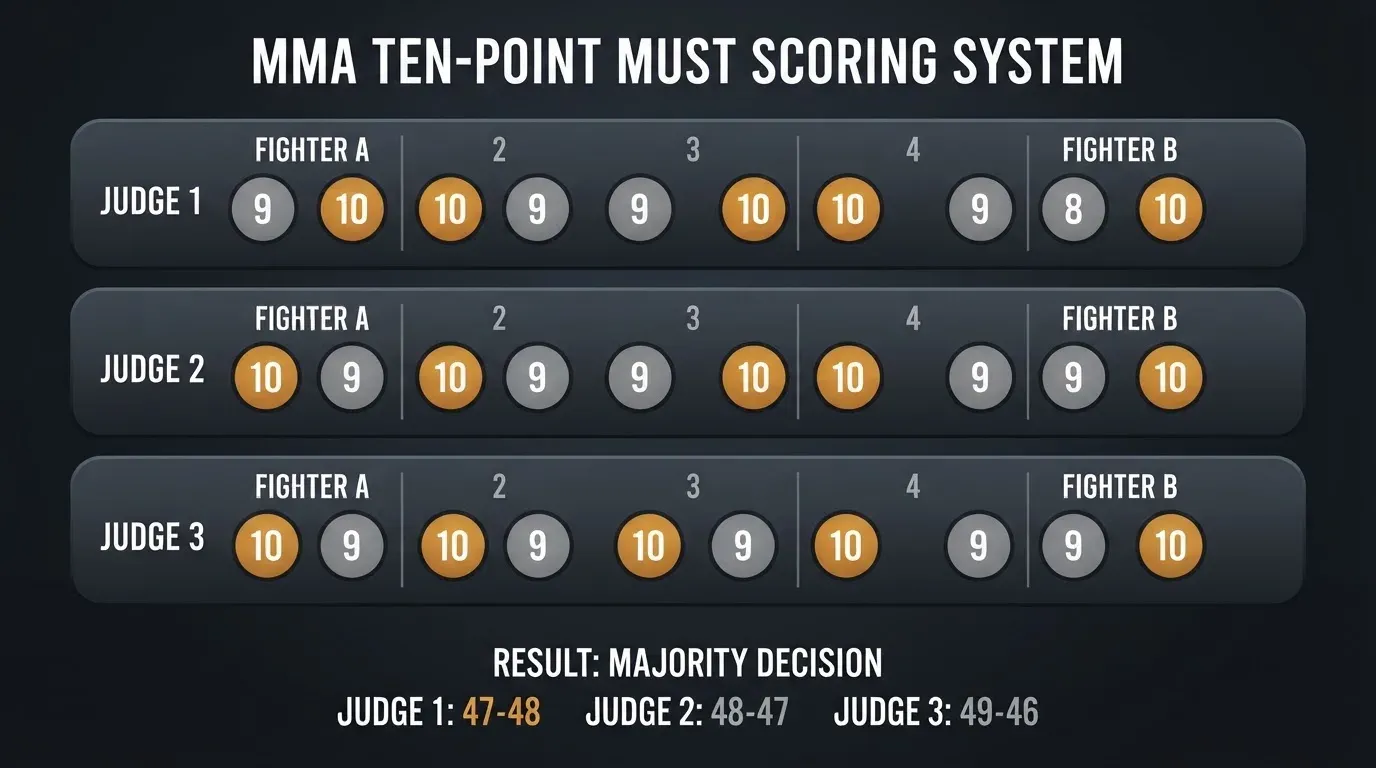
UFC fights have a structure every market leans on. Championship bouts and main events run a maximum of five rounds of five minutes each, with one minute rest between rounds; non-title bouts run three rounds. A bout ends by knockout, technical knockout, submission, judges’ decision (unanimous, majority, split or technical) or disqualification; a no contest is also possible. Judges score each round under the ten-point must system: the round winner gets ten points, the loser nine or fewer, with 10-8 typical for a dominant round. Title fights that end in a draw see the defending champion retain the belt.
That structure produces the markets a punter sees. The moneyline picks a winner. The method-of-victory market splits winners by finish — knockout or technical knockout, submission, decision, with each finish carrying its own price because the probability of each is different. Round-specific markets pin the finish to a particular round or round grouping. Over/under on the total number of rounds exploits the fact that five-round fights reach the judges more often than fans expect. Goes-the-distance is its own market because it carries a specific probability distinct from any other finish. Each market prices a different slice of the same bout, and the bookmaker’s margin differs across them — the method-of-victory market typically carries a wider margin than the moneyline because it asks the punter to predict more.
Why method-of-victory markets matter
A punter who has watched a fighter closely often has an opinion that goes beyond “who wins”. They know a grappler is unlikely to be knocked out, or that a striker has never been taken to a decision. That view is wasted on a moneyline bet, which collapses every finish into one outcome. The method-of-victory market pays the punter for being specific: a knockout win for the striker at 3.50 prices the same belief as a 1.70 moneyline, but with a much higher payout when right and a stake lost when wrong. Whether the higher price justifies the lower hit rate is a calculation only the punter can make, and the answer depends on how confident they are in the predicted method, not just the predicted winner.
Strategy Means Deciding What You Are Betting On, Not Who Will Win
The word “strategy” does a lot of work in UFC betting discourse. Punters chase systems that pick winners, and the internet does not. No model can know that a fighter will catch a knee in round two or that a corner will pull their man at the end of a round; the outcome of any single fight is too contingent on a small number of high-variance moments for a system to forecast reliably. What a punter can control is the structure of their own betting: which markets they use, how they size stakes, which bookmakers they use, and how they handle the inevitable losing runs.
A bankroll framework matters more than a pick. Staking a fixed percentage of the betting bank per wager — somewhere between one and three per cent depending on confidence — flattens the variance that destroys most casual bankrolls. Chasing losses with bigger stakes is the most common way a UFC punter blows a bankroll in a single event: a Saturday card of twelve fights produces enough variance that even a sharp-eyed bettor will lose six or seven of them, and the temptation to double the next stake is the route from a bad night to a wiped account.
The other half of strategy is knowing when not to bet. UFC cards sometimes have only two or three fights worth a wager — main event, co-main, and one stylistic mismatch the punter has a view on. The rest of the card carries too much uncertainty for any price to offer value. A punter who bets every fight on a card is paying the bookmaker’s margin twelve times for the privilege of action on fights they have no edge in; a punter who bets two or three fights pays the margin fewer times and only on the markets they have actually studied.
Models, tipsters and the trouble with both
The internet is full of UFC tipsters selling picks and models selling projections. Some are run by people who know the sport well; most are not. The clean test of any model is its closing-line value — whether the prices it picks beat the price available just before the fight starts. A model that consistently beats the closing line is finding real value, because the closing line is the most efficient price the market produces. A model that does not beat the closing line is finding nothing the public is not already pricing in. Punters without the time or inclination to run that test are better off skipping the model entirely and betting only on the fights they have watched and thought about.
Live Betting and the In-Fight Market
UFC live betting is its own discipline. The odds update round by round, sometimes after a single significant strike, and the punter watching the fight has information the bookmaker’s algorithm is still digesting. A fighter who wins round one cleanly is often available at a better price than they were before the bell; a fighter who gets dropped in the opening exchange but recovers is sometimes available at longer odds than their pre-fight price. The window between an in-fight event and the bookmaker’s price update is the entire reason live betting exists.
The trade-off is volatility. Prices move faster than a punter can react, markets suspend during exchanges, and the bookmaker’s margin on in-play UFC is typically wider than on the pre-fight line because the book is laying off more risk with less time to balance the book. A punter who bets in-play should accept that they are paying a higher margin for the privilege of betting on information the pre-fight market did not have. The wider margin is the cost of the information advantage; whether the cost is worth paying depends on how much information the punter actually has.
Cash out adds another layer. A bookmaker’s cash-out feature lets the punter settle a bet before the fight ends, locking in a profit if the wager is winning or cutting a loss if it is not. The cash-out price is the bookmaker’s own valuation of the current position, built from the live odds, and it is never as generous as a punter might hope. The bookmaker knows the punter’s original stake and the current state of the bet; the punter knows only what they can see on the screen. Used sparingly, cash out is a useful tool for freeing a stake to use elsewhere on the card; used as a routine, it bleeds the punter’s edge.
The UFC Schedule in 2026 and How It Shapes the Markets
The UFC has run more than 750 events since its first card on 12 November 1993 in Denver, Colorado. The promotion now runs roughly one numbered event and several Fight Nights per month, with eight men’s and three women’s divisions on the active roster. By the close of 2026 the calendar features UFC 334 at Madison Square Garden on 14 November (Gane vs. Hokit) and UFC 335 at the T-Mobile Arena in Las Vegas on 12 December (Oliveira vs. Lopes). Each card runs through the betting markets on the books of every operator licensed to take UK customers.
The schedule matters because UFC cards are not interchangeable. A numbered event with a title fight on top carries deeper markets, more prop bets and tighter margins than a Fight Night in the middle of the month. The punter looking for the widest range of markets should target numbered events; the punter looking for the softest lines should look at Fight Nights, where the bookmaker has less action to balance against.
How a punter reads a card before it starts
The week before a card, the punter should know which fights they intend to bet and which they intend to skip. The lines worth playing are the ones the punter has watched tape on, has an opinion about, and can price against the bookmaker’s line. Everything else is action for its own sake. A punter who logs into a bookmaker on fight night without a plan is the punter the bookmaker’s margin was built for.
The Bookmakers: Ten UK-Licensed Names Worth Comparing
Ten operators hold a Gambling Commission remote licence for Great Britain and offer UFC markets through 2026. They differ on welcome offer, app quality, market depth and how each one prices the same fight. The set is not a ranking; it is a comparison of what each book does well, where each one falls short, and which kind of punter each suits.
The comparison runs through four columns: the brand, the Gambling Commission licence number and licence holder, and what the operator’s own terms say about UFC markets specifically. The licence is the floor — every brand on this list has one — and the value above that floor is what the punter actually buys.
| Brand | Gambling Commission remote licence (holder) | UFC offer on the operator’s own terms |
|---|---|---|
| Bet600 | 044731-R-323941-016 · Tyche Tech Limited | Best Odds Guaranteed on UK and Irish horse racing; UFC markets under standard general betting terms |
| BoyleSports | 039469-R-319383-025 · Boylesports Enterprise | Sports welcome: £20 in free bets for new UK players staking £10 |
| Matchbook | 039504-R-319407-024 · Triplebet Limited | Betting exchange — punters lay and back against each other; Bet Builder and in-play available |
| Betboro | 044181-R-324363-007 · Webmedia Development N.V. | 100% matched free bet up to £25 on first wager; minimum three selections at decimal 3/5 (1.60) or higher |
| Tote | 054779-R-331321-008 · TDCO Limited | Pool betting heritage; UFC markets under standard general betting terms |
| Fitzwilliam Sports | 048760-R-335434-009 · SBKI Limited | Dublin bookmaker with capped membership; instant deposits and fast withdrawals; “High Stakes Welcome” by compliance criteria |
| Bet Ahoy | 100094-R-341742-003 · Bet Ahoy Ltd | “Bet £10 & Get £10 in Free Bets”: a £5 sports bet plus a £5 acca |
| Unibet | 045322-R-324275-019 · Platinum Gaming Limited | “Get £40 in Free Bets when you bet £20”: minimum odds 2.0 (1/1), free bets expire in 7 days, debit card or instant bank transfer deposit |
| Kalooki Sportsbook | 057730-R-333396-005 · Kalooki Sportsbook Limited | Operated by Kalooki Sports Book Ltd; GAMSTOP member; identity verified before first deposit |
| Copybet | 053774-R-330743-010 · Copybet UK Limited | Best Odds Guaranteed all day, every day on UK and Irish racing; pays first past the post on horse racing even on later disqualification |
Every operator above is checked against the Gambling Commission’s public register. A punter can do their own confirmation by searching the register by business name, trading name or domain. A licence is not a recommendation and not a quality mark — it is a baseline that ensures GAMSTOP coverage, the 10x bonus wagering cap, and access to the Commission’s complaints route. Each operator write-up below covers what that baseline buys on top.
Bet600
Bet600 is a UK-facing bookmaker with a Gambling Commission remote licence held by Tyche Tech Limited. Its headline feature on the racing side is Best Odds Guaranteed: if the starting price exceeds the price taken, the bet is paid at the SP. UFC markets fall under the operator’s standard general betting terms; the welcome offer and the racing-specific promotion are the main differentiators. The app is functional rather than feature-rich, and the punter looking for the widest range of UFC props may find the menu slimmer than at the bigger books. For the punter who values the BOG concession across the board and is happy to bet UFC on a smaller menu, Bet600 is a clean second-book option behind whichever book is offering the best price on the night.
BoyleSports
BoyleSports is the UK arm of an Irish bookmaker; its sports welcome offers £20 in free bets when a £10 bet is placed. Irish customers get the euro equivalent. The licence is held by Boylesports Enterprise. BoyleSports runs a deep UFC menu on numbered cards and a slimmer one on Fight Nights, with the usual moneyline, method of victory and round groupings. The punter who values a generous welcome and a recognisable high-street name gets that here; the punter hunting for the absolute tightest in-play margin may want to price-compare before locking in. BoyleSports’ main appeal is brand familiarity and a welcome that converts quickly.
Matchbook
Matchbook is a betting exchange — a different model from a traditional book. Punters back and lay against each other rather than against the bookmaker, the prices are set by users and the operator takes a commission on net winnings. That structure produces two consequences for UFC markets: the margin on the exchange is typically tighter than at a traditional book because there is no overlaid margin on top of true probability, and the punter can lay a fighter to lose, which is unavailable at a traditional book. Matchbook offers Bet Builder, multiples and in-play betting, plus live streaming of horse racing and greyhounds (UFC streams are not part of the offer). For the sharp punter who understands back and lay, Matchbook is the source of the best prices on the card; for the casual punter who just wants to back a fighter, the traditional books offer a smoother experience.
Betboro
Betboro’s sports welcome is a 100 per cent matched free bet up to £25, requiring a debit card deposit of at least £10 and a first bet of between £5 and £25 with at least three selections at minimum odds of 1.60. The licence is held by Webmedia Development N.V. The bonus structure rewards accumulators over singles, which suits the punter who already builds accas and looks less attractive to the single-bet punter. The minimum price of 1.60 per leg is well below the 2.0 that some books set, which gives the punter more flexibility in selection. The free-bet stake is typically not returned on a win, so the value of the offer depends on the punter’s ability to find an acca at a price that beats the implied probability of the bet losing.
Tote
Tote runs under TDCO Limited with a Gambling Commission remote licence and a heritage in pool betting. UFC markets are offered under standard general betting terms rather than any Tote-specific pool product — the operator’s pool-betting expertise is on horse racing. For the punter looking for a brand with a long history and a recognisable name on the high street, Tote delivers that; the UFC menu itself is similar to what the punter finds at the other general-betting books on this list, with no specific differentiator on MMA markets. A useful second book for price-comparison rather than a primary destination for UFC.
Fitzwilliam Sports
Fitzwilliam Sports describes itself as a Dublin bookmaker with capped membership, which means the operator does not accept every customer who applies. The welcome is a “High Stakes Welcome” subject to compliance criteria. The licence is held by SBKI Limited. Fitzwilliam offers instant deposits, fast withdrawals, timeouts and deposit limits, with links to GambleAware, GamStop and Gamblers Anonymous. For the punter who values a curated bookmaker with a smaller, controlled customer base and a high-stakes welcome, Fitzwilliam offers something the mainstream books do not. The capped membership is the trade-off: applying does not guarantee entry, and the punter who is accepted gets access to a book that is not open to everyone.
Bet Ahoy
Bet Ahoy’s welcome is “Bet £10 & Get £10 in Free Bets”, made up of a £5 sports bet and a £5 acca. The licence is held by Bet Ahoy Ltd. The split between a single sports bet and an acca means half the welcome reward is geared toward a multi-leg bet, which suits the punter who already builds accumulators and gives the single-bet punter half the headline value. The smaller welcome overall positions Bet Ahoy as a brand worth trying for the initial offer rather than as a primary UFC book; the punter who finds the menu competitive on price after the welcome is welcome to stay.
Unibet
Unibet has operated since 1999, with the UK site run by Platinum Gaming Limited under Gambling Commission account 45322. The sports welcome is “Get £40 in Free Bets when you bet £20”: a deposit and sports bet of £20 or more at minimum odds of 2.0, with free bets expiring within seven days of issue, for new GB customers using a debit card or instant bank transfer. Unibet’s menu on numbered UFC cards is broad and includes live betting, bet builder, and the standard market set. For the punter looking for a familiar international brand with a generous welcome and a deep UFC offering, Unibet is a strong first-book option. The seven-day free-bet expiry is a real constraint for anyone who bets infrequently, and the minimum odds of 2.0 rules out heavy-favourite singles as qualifying bets.
Kalooki Sportsbook
Kalooki Sportsbook is operated by Kalooki Sports Book Ltd (company number 12938274), licensed under Gambling Commission account 57730, and is a GAMSTOP member. The book sits within the new wave of UK-licensed operators and offers the standard set of UFC markets on numbered events. The punter who values a clean, smaller-brand interface with the same protections as the bigger books gets that here. The brand’s appeal is its simplicity rather than any single feature; the menu, the welcome and the in-play offer are functional and the protections are the standard UKGC set.
Copybet
Copybet’s licence is held by Copybet UK Limited. The book offers Best Odds Guaranteed all day, every day, on UK and Irish racing, and pays first past the post on horse racing even if the winner is later disqualified. UFC markets are offered under standard general betting terms. The punter looking for an across-the-board BOG concession and a bookmaker with a clear racing heritage gets that here; for UFC specifically, Copybet functions as a price-comparison option rather than a primary destination. The “follow other punters” feature that the brand is named for is a separate product from the sportsbook and the punter should treat the two as distinct.
How the Law Treats a UFC Bet in Great Britain
Betting on UFC in Great Britain is regulated under the Gambling Act 2005, with the Gambling Commission licensing every operator that takes remote bets from GB customers. Since the Gambling (Licensing and Advertising) Act 2014, an operator whose remote facilities are used in Great Britain needs a Commission licence wherever it is based — a Curaçao, Maltese or Gibraltar licence is not a substitute. The Commission’s public register is the test of who holds one; it can be searched by business name, trading name, domain or account number. The punter who wants to verify a brand should use the register directly rather than relying on a footer or a marketing claim.
There is no statutory list of permitted sports or markets. An operator holds a licence for a category — remote general betting standard (real events), remote general betting standard (virtual events), remote general betting limited, remote pool betting or remote betting intermediary (the betting exchange licence) — and offers markets under its own rules and the Licence Conditions and Codes of Practice. UFC is treated like any other sport under the general betting licence; there is no special UFC rule, and no prohibition on in-play betting, which is why every bookmaker on this list offers live UFC markets.
The minimum age is 18. Identity verification — name, address and date of birth — happens before a customer can deposit or gamble, including with a free bet or bonus. That means no anonymous play at a licensed UK site, and source-of-funds questions at higher spend are a normal part of the compliance process under money-laundering rules. The punter who wants to stay anonymous has no route through a licensed book; that option lives only at offshore sites, and at the cost of every protection a UK licence provides.
What the punter loses at an unlicensed site
A bookmaker serving GB customers without a Gambling Commission licence is committing an offence under section 33 of the Gambling Act 2005. The offence is aimed at the operator. The punter who bets at such a site does not commit a UKGB offence but loses every protection a UK licence provides: no GAMSTOP coverage, no access to the Commission’s complaints route, no approved dispute-resolution body, no British consumer redress if funds are withheld, and no cover under the 10x bonus wagering cap or the £150 financial vulnerability check. Funds held by an unlicensed operator are recoverable only through the operator’s own jurisdiction — Curaçao, Malta, Anjouan — and the punter should assume they are not recoverable in practice.
The framing is not “unlicensed is illegal” — it is “unlicensed means the punter is on their own”.
Bonuses, Free Bets and What the Wagering Cap Actually Means
Bonuses and free bets at UK-licensed bookmakers are now capped under promotion rules in force since 19 January 2026: wagering requirements on bonuses are capped at 10x, so a £10 bonus requires no more than £100 of qualifying bets before withdrawal. The cap applies to the bonus, not the deposit-plus-bonus sum, and mixed-product promotions — offers that require gambling on two or more product types, like “bet on football to get free spins” — are banned. The cap covers bonuses with a wagering condition; a free bet with no rollover is a different structure, and the rules on those are stated in each operator’s own terms.
The shape of a typical welcome is now familiar: a deposit, a qualifying bet at minimum price, a free-bet reward that expires within seven days. Unibet’s £40-in-free-bets on a £20 qualifying bet at minimum odds 2.0 is one of the larger figures; BoyleSports’ £20-in-free-bets on a £10 qualifying bet is a tighter version of the same model; Bet Ahoy splits the welcome between a single and an acca; Betboro’s matched free bet up to £25 favours the acca punter. The arithmetic that matters is the value of the free bet, not its headline size. A £40 free bet on a market with a five per cent margin is worth roughly £40 × (decimal odds − 1) ÷ decimal odds × 0.95 on average — a £40 free bet at decimal 3.00, for example, is worth about £25.33 on average before considering the chance of losing.
What the punter reads before claiming
The terms to read are the minimum odds on the qualifying bet, the expiry window on the free-bet reward, whether the free-bet stake is returned on a win, and any restriction on which markets the free bet can be used on. The 10x cap on bonus wagering is the law; everything else is the operator’s choice. A punter who skips the terms accepts whatever the operator enforces.
Mobile Apps and What They Actually Do for UFC Betting
Most UK-licensed bookmakers offer a native app for iOS and Android, and the apps have converged on a similar feature set: pre-match markets, in-play, cash out, bet builder, account management and the safer-gambling controls. The differences between apps are in the details — how fast the in-play price updates during a fast-moving fight, whether bet builder is available in-play or only pre-match, how the app handles partial cash out on a multi-leg acca.
bet365 offers Bet Builder+ on UFC events, combining markets from one event into a single bet available pre-match and in-play, alongside Super Boosts, Winnings Boosts on Bet Builders and selected singles, and daily Bet Boosts. The bet365 app is described as the most downloaded sports betting app in the UK and the operator is the official global betting partner of the UEFA Champions League. For the punter who bets across multiple sports and wants a single app that handles everything, bet365 is the obvious first stop. Lottoland UK’s app combines casino, lottery betting, sports betting and scratchcards, with a Gambling Commission licence for GB customers, which makes it useful for the punter who wants casino and lottery on the same login rather than a sports-focused bookmaker.
The punter who bets only on UFC fights and does not care about casino or lottery is better served by a sports-focused book with a tighter menu and a faster in-play update cycle. The punter who bets across many sports is better served by one of the full-service apps. The choice is not which app is best in the abstract — it is which app is best for the punter’s own betting pattern.
Live Betting and Cash Out on UFC Fights
Live UFC betting is offered by every operator above, with prices updating round by round and sometimes mid-round. The margin on in-play UFC is typically wider than on the pre-fight line because the bookmaker is taking on more risk with less time to balance the book; the punter is paying for the privilege of betting on information the pre-fight market did not have, and that privilege has a cost.
Cash out is offered by most UK-licensed books on pre-match and in-play singles and accumulators. The cash-out price is the bookmaker’s valuation of the current position, and it is built from the live odds with a margin on top. Used sparingly — to free a stake for use elsewhere on the card or to cut a loss on a fight that has gone the wrong way — cash out is a useful tool. Used as a routine, it bleeds the punter’s edge because the bookmaker’s margin on a cash-out valuation is wider than the margin on a fresh bet.
In-play versus pre-match for UFC specifically
UFC fights are short enough that in-play is genuinely informative. A fighter who wins round one cleanly is fighting well; a fighter who gets dropped and survives is tougher than the pre-fight price assumed. The window between an in-fight event and the price update is the punter’s edge, and the punter watching the fight has information the algorithm does not. The trade-off is the wider margin; the bettor’s edge has to be wider than the margin to be worth playing.
Responsible Gambling and the Real Cost of a Losing Run
Every UK-licensed bookmaker is a GAMSTOP member, with self-exclusion periods of six months, one year, five years, or five years with auto-renewal. After the minimum period the exclusion stays in place for a further seven years unless the customer asks GAMSTOP to remove it. GAMSTOP covers online sites and apps; betting shops use a separate service. A punter who self-excludes through GAMSTOP is locked out of every UK-licensed online bookmaker, which is the sharpest tool available for stopping a betting run.
A financial vulnerability check applies at every UK-licensed remote bookmaker when a customer’s deposits minus withdrawals exceed £150 in a rolling 30-day period — since 28 February 2025. The check is a public-record check (bankruptcy or county court judgments, for example), not an income check and not a credit reference check. Financial risk assessments — the “affordability checks” in the press — are announced in a staged plan with no start date as of mid-2026. The punter should expect a vulnerability check at modest spend and treat higher-spend accounts as subject to fuller source-of-funds questions under the money-laundering rules.
Deposit limits are offered by every UK-licensed bookmaker; the operator must offer a gross deposit limit on a fixed time frame, with the first changes in force since 31 October 2025 and a second phase postponed to 30 September 2026. There is no state-set deposit or loss ceiling for betting — limits are the customer’s choice. Help is available through GamCare (National Gambling Helpline), GambleAware, NHS gambling clinics and Gamblers Anonymous.
What a real losing run looks like
A serious UFC punter should expect to lose six or seven fights out of twelve on a card, even on a well-studied card. A run of three or four straight losses is normal at the start of a bankroll. The bookmaker’s edge is small per bet but cumulative across many bets, and the punter’s edge, where it exists, is even smaller. A punter who bets a flat one to three per cent of bankroll per wager survives losing runs; a punter who chases with bigger stakes does not.
Crypto, Anonymity and Where UFC Crypto Betting Actually Lives
The crypto and anonymity cluster sits awkwardly with the rest of this page. No UK-licensed bookmaker takes cryptocurrency deposits under the Gambling Commission’s framework; the licensed route in Great Britain runs through debit cards, bank transfers and a limited set of e-wallets, and identity is verified before the first deposit. A punter who wants to bet UFC with bitcoin has no route through a UK-licensed book.
The options that exist are all offshore — Curaçao, Anjouan, occasionally Malta — and they take cryptocurrency because they are outside the UK framework. They offer UFC markets, in some cases better prices than UK books, and the bonus offers are larger. What they do not offer is GAMSTOP coverage, the Commission’s complaints route, the 10x bonus wagering cap, or the £150 financial vulnerability check. Funds held by an offshore operator are recoverable only through that operator’s own jurisdiction.
The punter who wants crypto betting on UFC has decided — explicitly or by choosing not to think about it — that the loss of every UK protection is worth the convenience or the price. That is a real choice and a real trade-off; it is not the same choice a punter at a UK-licensed book is making, and the page should not pretend the two are interchangeable.
Choosing Between the Ten: What the Decision Actually Turns On
The decision between ten UK-licensed books reduces to a small number of factors. The punter who bets mainly UFC and wants the widest menu on numbered cards should start with bet365 or Unibet — both run deep UFC menus with live betting and bet builder. The punter who bets across sports and wants a single app for everything should start with bet365 for its feature set or one of the other full-service books. The punter who wants the best price on a single fight should price-compare across at least three books before placing the wager. The punter who values a high-stakes welcome at a smaller book should look at Fitzwilliam Sports, accepting that capped membership means applying does not guarantee access. The punter who values a betting exchange and the ability to lay fighters should use Matchbook.
The welcome offer is rarely the reason to pick a book. A £40 free bet that expires in seven days is worth what it is worth on average, and a punter who chases welcome offers across ten books spends more time signing up than betting. The book the punter keeps should be the one with the best combination of price, menu depth and app reliability for the sports they actually bet on.
The right book for the wrong punter
The page would be dishonest if it implied every book above suits every punter. BoyleSports’ welcome rewards the casual punter who places a £10 qualifying bet; a high-stakes punter who bets in units of £500 is better served elsewhere. Matchbook’s exchange structure rewards the punter who understands back and lay; the punter who has never laid a bet in their life will find the interface confusing. Fitzwilliam’s capped membership is the wrong fit for the punter who wants to sign up and bet tonight. A comparison that flatters every book on every axis is not a comparison; it is a marketing page.
How a Punter Builds a UFC Betting Routine
A working approach to UFC cards runs through the week before, the day of, and the night of the event. The week before, the punter watches tape on the fights they intend to bet, prices each fight against multiple books, and decides which markets to play. The day of, the punter checks for line moves — a price that has shortened overnight is the market moving against the public; a price that has drifted is the market moving with the public — and adjusts the staking plan accordingly. The night of, the punter watches the fights, bets the in-play markets they have a view on, and skips the ones they do not.
The routine is more important than any single pick. A punter with a disciplined routine and a flat one to three per cent staking plan beats a punter with a hot tip and a chasing stake habit, every time, over a season.
The difference between a routine and a tip
A routine produces a profit or a loss the punter can explain afterwards. A tip produces a win or a loss the punter cannot explain. The punter who keeps a record of every wager — date, event, market, odds, stake, result — knows what their edge looks like over a season. The punter who bets from memory does not. The record is the difference between a punter who improves and a punter who plays the same game in five years as they did today.
Where This Page Stops
The page is a framework, not a forecast. It explains how the market works, where each UK-licensed book sits, what the law requires and what a punter should look at before claiming any welcome. It does not pick winners. The fights on the cards in 2026 — UFC 334 at Madison Square Garden on 14 November, UFC 335 at the T-Mobile Arena on 12 December — will be settled by the fighters in the cage, and the odds before each fight are the market’s best guess at who wins, not a guarantee.
What the punter can control is the structure: which book, which market, which price, what stake, what routine. The page above is built around those choices, and the punter who uses them ends the year with a clearer picture of their own betting than the punter who chases a tipster’s card every Saturday.
Frequently Asked Questions
Where to bet on UFC fights?
Every bookmaker in this guide offers UFC markets on numbered events. The widest menus on UFC 334 and UFC 335 sit with bet365 and Unibet; for sharper prices, Matchbook’s betting exchange typically runs tighter margins than the traditional books. A punter who wants the simplest path signs up with one of the full-service apps; a punter who wants the best price runs the same fight across three or four books before placing the wager.
Where to bet on UFC?
In Great Britain, the answer is any bookmaker holding a Gambling Commission remote licence — the Commission’s public register is the test. The ten operators covered in this guide all hold one. Outside Great Britain the answer differs by jurisdiction, and the punter should check the regulator in their own country before signing up.
Where can I bet on UFC fights?
The licensed options in Great Britain include the ten operators above. Offshore options exist but carry none of the protections a UK licence provides — no GAMSTOP, no Commission complaints route, no UK consumer redress if funds are withheld, and no cover under the bonus wagering cap or vulnerability check. The punter who bets offshore accepts that trade-off explicitly.
How can it be checked that a bookmaker holds a Gambling Commission licence?
The Commission’s public register can be searched by business name, trading name, domain or account number. The punter enters the operator’s name, confirms the licence status is “active”, and checks the licence categories match what the operator offers — for UFC, “remote general betting standard (real events)” is the relevant category, with “remote betting intermediary” applying to exchanges. A licence number on a footer is not proof; only the register is proof.
How is the return on a bet worked out from the stake and the odds?
Return equals stake multiplied by decimal odds. A £10 bet at decimal 1.90 returns £19 (£10 × 1.90), of which £9 is profit. At decimal 3.50 the same stake returns £35, of which £25 is profit. For a combination bet the odds of the legs multiply into one price — three legs at decimal 1.90, 2.00 and 2.50 become a combined price of 9.50, so a £10 acca returns £95 if all three win. The formula is the same in fractional odds once converted to decimal.
What is the bookmaker’s margin and how can it be seen in the odds?
The margin is the share of every unit bet that the bookmaker keeps on average. It is visible by adding the implied probabilities of every outcome in a market: divide 1 by each decimal price, sum the results, and the surplus above 1 is the margin. On an illustrative two-way market at 1.90 / 1.90, the sum is 1.0526 and the margin is 5.26 per cent. A market priced at 2.00 / 2.00 has a zero margin and would be “fair”; real markets run between 2 and 18 per cent depending on the sport, market and bookmaker.
Combat & motorsport – oddsguaranteed
Content created by the «oddsguaranteed» team
