
Goliath bet explained: 247 lines, 8 picks and the cost no one mentions
 Available in US
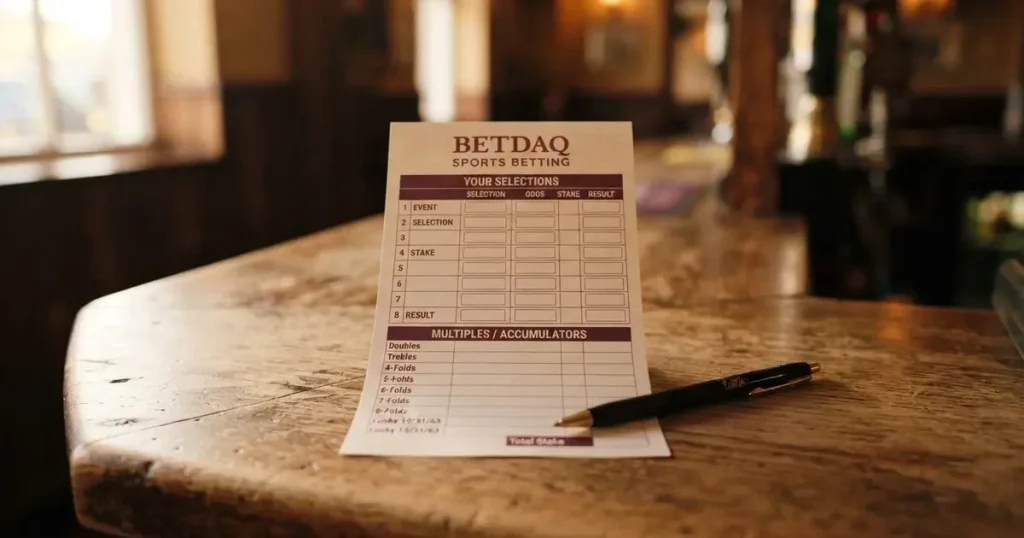
A Goliath is the heavyweight of British multiple betting: eight selections, 247 separate bets, every combination from doubles upward. The whole point is to catch the long shot without depending on every leg landing, but the cost of getting it wrong sits quietly under the headline. This page breaks down how the bet is built, what a win pays, what the bookmaker’s margin does to the price, and which UK-licensed bookmakers let a punter place one.
Current as of October 30, 2026 · checked against the Commission’s public register of operating licences.
The goliath in one paragraph
Take eight selections. A Goliath combines them into 28 doubles, 56 trebles, 70 four-folds, 56 five-folds, 28 six-folds, 8 seven-folds and 1 eight-fold accumulator — 247 bets in total, with no singles and no each-way element unless the operator allows it. To enter a Goliath, a punter chooses the unit stake per bet; the total outlay is unit stake × 247. Because the price of each combination multiplies from one leg to the next, even one short-priced favourite can drag the whole package down, and any losing leg kills every combination it sits in.
The bet earns its place when three or four of the eight picks come in. That sounds modest, but on eight random selections at average odds the chance of all eight winning is microscopic; what matters is the distribution of partial-landings across the 247 combinations.
How a Goliath stacks up
A Goliath belongs to the full-cover family of bets — multiples that cover every combination of the chosen selections from a fixed minimum size upward, without singles. The naming is arbitrary and historical: a Canadian (also called a Super Yankee) covers 5 selections in 26 bets, a Heinz covers 6 in 57, a Super Heinz covers 7 in 120, and a Goliath covers 8 in 247. Below 5 selections the naming convention shifts: a Trixie covers 3 in 7, a Yankee 4 in 11. The Lucky 15, Lucky 31 and Lucky 63 are full-cover bets that include singles — 15, 31 and 63 bets respectively — and are the usual “entry point” for a punter who wants singles insurance built in.

The bet size matters more than the name. Total stake is always unit stake × number of bets, so a £1 Goliath costs £247 and a £0.50 Goliath costs £123.50. A £2 stake per line — a more typical figure for a recreational punter — runs £494 across the whole package. Compared with a Patent (7 lines) or a Yankee (11 lines), the Goliath is roughly an order of magnitude bigger than the everyday multiple and demands a bankroll to match.
Selection and settling
A Goliath settles on the eight named selections in the order they were picked. Each combination settles independently, the same way a stand-alone double or treble would. Cash-out is offered by most bookmakers on a Goliath because the bet is treated as 247 separate bets with their own live prices; partial cash-out is available on some platforms, and full cash-out is sometimes suspended if any of the eight selections is no longer live (a non-runner, a player retired mid-match, an abandoned game). The bookmaker’s standard rule on abandoned or void selections is to treat the affected combination as a void bet — stake returned, no winnings on that line — and a non-runner in a horse race applies the operator’s non-runner deduction.
This is where the Goliath starts to look different from a single accumulator. In an eight-fold accumulator the bet lives or dies as one. In a Goliath the 247 lines live and die independently, so a non-runner in one leg does not finish the bet — it removes that leg from each affected combination and leaves the rest to settle at the reduced price.
What the legs multiply into
The price of any combination in a Goliath is the product of the prices of its legs, with each leg’s price taken in the format the bookmaker uses. The Commission does not regulate the odds format; most UK bookmakers offer fractional by default (5/1, 11/4, evens) and a decimal view (6.00, 3.75, 2.00). The conversion is a/b → a ÷ b + 1, so 5/1 = 6.00, 11/4 = 3.75, evens = 2.00.
Take three illustrative legs at decimal prices of 1.50 (1/2), 2.00 (evens) and 2.50 (6/4). Their individual prices are 1.50, 2.00 and 2.50. A treble on all three lands at 1.50 × 2.00 × 2.50 = 7.50. A double on any two lands at the product of those two: 1.50 × 2.00 = 3.00, 1.50 × 2.50 = 3.75, 2.00 × 2.50 = 5.00. The single returns the price of that leg. In a Goliath, every one of those combinations exists, paid at the price it earns.
For a unit stake of £2 per line on a £10-per-bet full-cover bet (a working figure for illustration), a treble on the three short-priced legs pays £2 × 7.50 = £15 return, £13 net profit. The eight-fold accumulator on all eight selections is the long-priced single bet — the one line that pays out only if everything wins, which is the rarest of all 247.
What a winning Goliath pays back
Take the same three illustrative legs at decimal odds of 1.50 (1/2), 2.00 (evens) and 2.50 (6/4), and a stake of £10 for a stand-alone accumulator. The accumulator’s return is £10 × (1.50 × 2.00 × 2.50) = £10 × 7.50 = £75, a £65 net profit. The payout-share gloss is what a winning bet returns, not how likely it is to win; the chance of all three legs landing is the product of their implied probabilities, which the bookmaker’s margin has already adjusted.
Now scale that to a Goliath with a unit stake of £2 per line. Total outlay is £2 × 247 = £494. The largest single return comes from the eight-fold accumulator line, which pays 2 × (price of all 8) — a figure that dwarfs everything else if all eight win, but contributes nothing if even one leg loses. The bulk of the payout in any realistic landing pattern comes from the 28 doubles and 56 trebles; those combinations have the highest probability of landing for any given price profile, and they are the lines that turn a partial landing into cash.
A goliath at 9 winners out of 8 is a contradiction; the realistic landing patterns are partial: 3 of 8, 4 of 8, 5 of 8. Each partial landing pays out the combinations that contain only winning legs, at the price those winning legs multiply into. A 5-of-8 landing at those illustrative prices pays out 56 trebles (C(5,3)) of which each treble is the product of three winning prices — the same arithmetic at a different scale, applied to each winning combination.
The result is a band, not a single figure. Where three of the eight legs come in at short prices, the payout covers a fraction of the £494 outlay and the bet is a net loss. Where five or six of the eight come in at mixed prices, the payout can return several times the outlay. Where all eight come in, the payout is enormous but the probability is small enough that a punter placing one Goliath a week would expect to see one full landing roughly once every few years on random selections.
Where the bookmaker’s margin lives
Every price a bookmaker quotes carries an overround — a margin above 100 % on the implied probabilities of all outcomes of a market. On a football match the overround is the bookmaker’s edge, set to ensure a profit on the market over the long run. The Commission does not cap the overround; each operator sets its own margin, and the bettor sees it in the gap between the true odds and the prices offered.
A Goliath pays out at the prices the bookmaker quotes, so the same margin that applies to a stand-alone double applies to every combination inside the Goliath. The arithmetic is straightforward: payout share = 1 ÷ (1/odds₁ + 1/odds₂ + … + 1/oddsₙ) for all outcomes of one market; margin = 1 − payout share. On a market priced at 100 % the payout share would equal 1.00 and the margin zero. On a typical Premier League 1X2 market the margin is around 5–7 %; on a less liquid market it can be twice that. A Goliath on eight 1X2 football matches compounds that margin across 247 combinations — and the compounding is not neutral: the more legs the bet stacks, the wider the bookmaker’s effective edge.
That edge is not a cost the punter can see on the betting slip. It is built into every price. The way to see it is to convert each price to its implied probability (1 ÷ decimal odds), add those probabilities together for a single market, and look at the gap above 100 % — that gap is the bookmaker’s margin on that market. The Goliath does not introduce a new margin; it inherits the margin of every leg it sits on.
Each-way and the Goliath
An each-way bet is two bets of equal stake: one on the win, one on the place. For a horse race the place terms vary by race type and number of runners; for a football match they vary by market. A Goliath is structurally a win bet only — there are no place lines. Most bookmakers allow an each-way flag on a Goliath, in which case the bet doubles: 247 win lines plus 247 place lines, 494 bets in total, total outlay unit stake × 494.
The place leg pays a fraction of the win price, typically 1/4 or 1/5 of the win odds for handicap races, with non-runner money paid to a defined rule. The each-way Goliath is the punter’s hedge against a strong fancied horse finishing third, but it doubles the outlay and turns a £2 Goliath into a £988 each-way Goliath. On smaller fields and at shorter odds the each-way flag costs more than it can return.
Statutory frame for the UK market
The Gambling Commission licenses the entire commercial market in Great Britain under the Gambling Act 2005. A bookmaker serving customers in England, Scotland or Wales is required by sections 33 and 36 of the Act (as amended by the Gambling (Licensing and Advertising) Act 2014) to hold a Commission licence regardless of where the operator is based — a Curaçao, Maltese or Gibraltar licence does not substitute. Northern Ireland has its own older law and is outside the 2005 Act; a Commission licence is therefore a Great Britain licence, not a UK-wide one.
The Commission’s public register lists every licence holder and is searchable by business name, trading name, domain or account number. It is the only place where a licence can be verified, and any brand that takes bets from a British customer without a Commission licence is committing an offence under section 33 of the Act. The penalties aimed at the operator are the formal response; there is no offence aimed at the customer who simply bets on an unlicensed site, but the customer loses the protections the framework guarantees.
There is no statutory list of permitted markets or bet types in Great Britain — an operator holds a licence for a category (remote general betting standard for real events, remote betting intermediary for an exchange, remote pool betting for horse-racing pools) and offers markets under its own house rules and the Licence Conditions and Codes of Practice. In-play betting, bet builders, accumulators and full-cover bets including the Goliath are all permitted; the controls sit in the operator’s licence conditions and customer-protection duties. Spread betting on financial markets is regulated by the Financial Conduct Authority, not the Commission; spread betting on sports sits inside General Betting Duty.
The player pays no tax on betting winnings in Great Britain. General Betting Duty is the operator’s tax, currently 15 % of gross profits, rising to a 25 % remote rate from 1 April 2027. Whether an operator passes the duty on through tighter prices is not settled; it is an operator cost, not a customer charge.
What the licence costs the operator
The licence governs more than the right to take bets. A licensed remote operator in Great Britain must verify the customer’s name, address and date of birth before the first deposit, since 7 May 2019 — including a free bet or bonus — so anonymous play is not available at a GB-licensed site. The credit-card ban has been in force since 14 April 2020, covering credit cards and credit-card-funded e-wallet payments; debit cards and bank transfers are not covered by the ban.
A financial vulnerability check applies at £150 of net deposits in a rolling 30 days — a public-record check for county court judgments or bankruptcies, not an income check. Financial risk assessments (the affordability checks of the press) have been announced in a staged plan; no start date is fixed. A deposit limit must be available on every licensed site under the Commission’s Remote Technical Standards, with the first changes in force since 31 October 2025 and a second phase postponed to 30 September 2026.
On bonuses, the Commission has capped wagering requirements at 10x and banned mixed-product promotions (offers that demand a bet on football to get free spins, for instance) since 19 January 2026. The cap applies to a £10 bonus at no more than £100 of qualifying bets; whether it applies to free bets with no wagering condition is not settled by the framework. Advertising runs through the ASA under the CAP Code, with the social-responsibility rule and the no-under-25s-in-advertisements rule.
Every GB-licensed online operator is in GAMSTOP, the national multi-operator online self-exclusion scheme. GAMSTOP is mandatory for online operators since 31 March 2020, with exclusion periods of six months, one year, five years, or five years with auto-renewal; after the minimum period the exclusion stays in force for a further seven years unless the customer asks for it to be lifted. Help is at GamCare (National Gambling Helpline), GambleAware, NHS gambling clinics and Gamblers Anonymous.
What the punter loses on an unlicensed site
A punter who places a Goliath with an unlicensed operator loses the protections the framework guarantees: no GAMSTOP coverage, no Commission complaints route, no approved dispute-resolution body, no British consumer redress if funds are withheld, and no obligation on the operator to honour the bonus cap, the vulnerability check or the identity-verification routine. The bet itself is not an offence by the customer, but the cost is real and the recourse is thin.
The lichecks a bookmaker passes
The licensed bookmakers on this page appear on the Commission’s public register and participate in GAMSTOP. The account number is the verifiable identifier; the licence number on the site reconciles to that account. Brand and licensee differ—for instance, BetMGM UK is published by LeoVegas Gaming—and the register provides the definitive link between them.
Responsible gambling
A Goliath costs £247 at a £1 unit stake and £494 at £2, with no singles to catch the early landing. A punter with a small budget is exposed to a sequence of partial landings where the outlay is not recovered, and the structure rewards adding legs rather than cutting them. Responsible gambling on this bet means:
- Setting a deposit limit before opening the account, and treating it as a hard ceiling rather than a target.
- Treating the Goliath as a recreational bet on a small number of selections, not as a strategy for a small bankroll to “have a go” at a long-odds outcome.
- Using GAMSTOP if a bet stops being a choice. The exclusion covers every GB-licensed online operator and lasts from six months upward.
- Calling GamCare on the National Gambling Helpline if gambling stops being fun. GamCare, GambleAware, the NHS gambling clinics and Gamblers Anonymous are the four routes research reaches for, in that order.
The Commission requires a financial vulnerability check at £150 of net deposits in a rolling 30 days; this is a public-record check, not an income check, and it is the operator’s first line of risk detection. The financial risk assessments that have been announced are not in force at the date of this page.
Reading the marketing language on Goliath offers
Bookmakers promote the Goliath as a “full coverage” bet that “still pays if some legs lose” — language that is true on its face and unhelpful in the gap it leaves. The arithmetic is the truth: the price of each combination is the product of its legs, and the bookmaker’s margin sits inside every one of those legs. A Goliath does not reduce the margin; it stacks it.
The bet’s structural appeal — partial landings pay something — is real. Its structural cost — the £247 outlay at a £1 stake, with no singles to fall back on — is also real. The two balance at a profile of selections where three or four of eight land often enough to cover the outlay over time, and at odds that justify the price. Outside that profile the Goliath is a more expensive way to back the same selection.
Strategy and bankroll
There is no system that beats a Goliath. The structure is a fixed-arithmetic contract: 247 lines, each priced by the operator, each settled independently. What a tips-and-strategy page on this bet can usefully say is the bankroll structure the bet demands.
A Goliath at £1 a line costs £247 to place. A punter running one Goliath a week on a recreational budget is committing £12,844 a year to the bet alone, before any other betting. A punter running one a day is committing roughly £90,000 a year, with no guarantee of return. The bankroll needs to absorb long losing runs without forcing stake increases — the usual discipline for any large multiple.
The second rule is to keep the selections price-diverse. A Goliath on eight short-priced favourites pays little because every combination’s price is the product of short numbers. A Goliath on eight long-priced outsiders pays well on partial landings but loses most weeks. The most common sensible construction is to mix three or four short-priced legs with four or five medium- and long-priced legs, accepting that the short legs will land more often and pull more combinations through.
The third rule is to think in net terms. A Goliath that returns its outlay once in four weeks at a £1 unit stake is, over a year, a £247 × 52 = £12,844 outlay for roughly £13 × 52 = £676 return — a net loss, before the joy of the occasional full landing is counted. The arithmetic is not a forecast; it is the cost of admission.
A working bankroll example
A punter with a £500 monthly betting budget. One Goliath a month at £1 a line costs £247 and leaves £253 for singles and smaller multiples. That punter should expect most months to be net losing on the Goliath, with the occasional month landing four or five legs at mixed prices and returning more than the outlay. The structure works only if the monthly budget is preserved through the losing months, and the bet is treated as one line in a broader betting plan rather than the plan itself.
A punter with a £100 monthly budget cannot afford a £1 Goliath without crowding out the rest of the betting. A £0.50 Goliath costs £123.50 and still consumes the whole monthly bankroll. The honest answer is that the bet is not built for a small budget — the unit stake is too high and the structure is too punishing on partial landings.
Settling a Goliath live
In-play betting on the Goliath works the same way it does on any multiple. As matches go in, the combinations settle and cash-out becomes available. Cash-out is the bookmaker’s offer to buy the bet back at a price derived from the live prices of the remaining legs, and its availability is not guaranteed — if any of the eight selections is no longer live the bookmaker may suspend cash-out. Bets stand if cash-out is unavailable; the punter waits for the bet to settle.
The bet builder / same-game multi is a single-event multiple and is not the same as a Goliath. A Goliath covers combinations across separate events; a bet builder combines markets on one match. The two can sit together on the same betting slip.
How a Goliath fits the modern British betting slip
The Goliath is a legacy of the pre-app betting era — the multiple was useful when betting slips were filled out by hand and a punter wanted coverage on a Saturday card without having to write out 247 lines individually. Today the same bet can be placed in a few taps, and the bet builder, the cash-out and the price boost have all but replaced it for most punters. The Goliath remains the right bet for the punter who has eight well-researched selections and wants the full coverage, and it is the wrong bet for the punter who wants one long-priced outcome on a small budget.
The Commission’s no-statutory-list rule means a bookmaker can choose whether to offer the Goliath. All the bookmakers on this page take full-cover bets including the Goliath; smaller operators and most betting exchanges offer the multiple as a manual construction rather than as a named product. The punter’s check is the betting slip: a Goliath button on the slip confirms the operator takes the named product.
What this means for the punter
A Goliath is a 247-line multiple bet on eight selections. The bet’s appeal — partial landings pay — and the bet’s cost — £247 at a £1 unit stake, with the bookmaker’s margin inside every leg — are the same fact seen from two sides. The punter’s job is to pick eight selections at prices the bookmaker’s margin does not eat, and to size the unit stake so that the outlay is the punter’s planned loss on a bad week.
The bookmakers below all hold a Gambling Commission remote licence for general betting on real events. The reviews look at what each one adds to the Goliath experience: the welcome offer, the cash-out, the bet builder, the price boost. The arithmetic on the bet itself is the same on every site — what changes is what the bookmaker brings to the slip.
How this list was put together
The ten bookmakers featured are all registered with the Commission and participate in GAMSTOP. They each support full-cover bets like the Goliath. The list is alphabetical, not a ranking. The distinction lies in the offer terms, in-play features, and the specifics of the welcome bonus.
The list covers licensed operators only. A bookmaker with a Curaçao, Maltese or Gibraltar licence is not on the Commission register and is not in this list, because a non-GB licence does not give a British customer the Commission’s protections. Naming an unlicensed brand beside licensed ones reads as a comparison and is one we do not make.
The ten licensed bookmakers
Fafabet — best odds guaranteed on UK and Irish racing
Fafabet is operated by Taichi Tech Limited under Commission account 41527. The standout feature is Best Odds Guaranteed on UK and Irish racing win and each-way bets from 9 am on race days: if the SP is larger than the taken price, Fafabet pays the bigger odds. On a Goliath, the BOG policy applies to every qualifying racing leg.
The welcome offer is modest against the larger names, and the racing focus shows in the platform’s weighting. A Goliath on a Saturday card is the natural use-case. Fafabet suits the racing-led punter who wants the SP guarantee on every leg.
Betway — familiar name, four free-bet tokens on sign-up
Betway is operated by Betway Limited under Commission account 39372. The welcome offer is four £10 free-bet tokens credited upon settlement of a first bet of at least £10 at minimum decimal odds of 2.00, valid for 7 days and exclusive to debit-card deposits.
The platform’s strength is in football, with a broad in-play product and a familiar interface. A Goliath on a Champions League card is the use-case that suits the platform best. The wagering requirements on the welcome offer sit under the 10x Commission cap. Betway is a strong choice for a punter seeking a familiar interface and a structured bundle.
Bar One Racing — Irish independent with racing sponsorships
Bar One Racing, now rebranded as Bar 1 Betting, is an Irish independent bookmaker with sponsorships at venues such as The Curragh and Fairyhouse. The operator is Bar-One Racing Limited, Commission account 56516.
The platform’s strengths are Irish racing and the smaller-fixture cards that larger bookmakers overlook. The Goliath is offered as a named product and the welcome offer is modest. Bar 1 Betting suits the punter whose eight selections include a couple of Irish racing legs and who wants a sponsor-aligned product on those meetings.
Unibet — established brand, free-bet bundle on a £20 trigger
Unibet has operated since 1999; its UK site runs under Platinum Gaming Limited, Gibraltar, against Commission account 45322. The welcome offer is “Get £40 in Free Bets when you bet £20”: a qualifying sports bet of £20+ at minimum fractional odds of 1/1 (decimal 2.00), with free bets expiring in 7 days, for new GB customers.
The platform covers a broad sports book with a named Goliath product and a deep in-play offering. Unibet attracts punters who value a high-profile brand and a deep Saturday card for their Goliath bets.
DAZN Bet — cash out and bet builder on every match
DAZN Bet is operated by DZBT Limited against Commission account 48756. The platform offers Cash Out, Bet Builder, and in-play betting; the terms explicitly state cash-out availability is not guaranteed and bets stand if it is unavailable. The bet builder is a same-game multi.
The Goliath is offered as a named product. The platform’s strengths are the in-play product and the daily price boosts on the high-profile matches. DAZN Bet is designed for the punter prioritizing the live in-play experience.
Midnite — modern app, broad sports welcome
Midnite is operated by Midnite Limited against Commission account 101839. The site features in-play events, an acca builder, and price boosts. The welcome offer provides £25 in free bets and 50 free spins for a £5 pre-match bet at minimum decimal odds of 2.00, valid for 7 days.
The platform’s strengths are the modern app and the price-boost product. A Goliath on the football card is the natural use-case. Midnite is the right option for a punter who prioritizes interface and price boosts.
Sporting Index — spread betting alongside fixed odds
Sporting Index is operated by Sporting Index Limited, Commission account 27343. The new-customer offer is a £10 fixed-odds bet at minimum fractional odds of 1/2 (decimal 1.50) unlocking three £10 fixed-odds free bets, three £5 Total Goals spread bets, three £5 Winning Favourites spread bets and a £1 Race Index spread bet — with the qualifying bet excluded from in-play and from cash-out.
The platform is unusual in combining fixed-odds betting with spread betting, and the spread bets have their own risk profile where losses can exceed the deposit. The financial spread-betting side is regulated by the FCA, not the Commission, and the fixed-odds Goliath sits on the Commission’s register. Sporting Index appeals to the experienced punter who manages both fixed and spread products.
BetMGM — LeoVegas-powered, four-token welcome
BetMGM UK is published by LeoVegas Gaming PLC, Commission account 39198. The welcome offer is four £10 free bets — two football accumulators of 4+ selections and two sports multiples of 2+ — on a deposit of £10 or more and a sports bet within 7 days, valid for 7 days with minimum odds and opt-in required.
The platform’s strengths are the casino product and the LeoVegas engine underneath. The Goliath is offered as a named product on the sports side. BetMGM suits the punter who splits time between sports and casino and wants a unified wallet.
Fitzwilliam Sports — Oddschecker-priced, app-first
Fitzwilliam Sports is operated by SBKI Limited, Commission account 48760. The platform prices its selections on Oddschecker’s average price for each selection — a deliberate decision to sit in the middle of the market rather than at the top or bottom — and provides Apple and Google mobile apps.
The pricing model means the Goliath is paid at the market average rather than at the best price available elsewhere. The welcome offer is modest. Fitzwilliam Sports targets the punter who prefers price certainty via an app-first interface.
Octobet — best odds guaranteed with a per-race cap
Octobet is operated by Octopus Game Limited, Commission account 62545. The platform offers Best Odds Guaranteed on UK and Irish horse racing — up to £150 per customer per race. The cap is a hard ceiling per race, not per bet, so a Goliath with multiple racing legs is constrained by the per-race limit.
The platform’s strengths are the racing product and the BOG policy. Octobet suits the racing-led punter whose Goliath includes several UK or Irish racing legs and who can structure the bet within the £150 per-race cap.
Comparison at a glance
| Brand | Gambling Commission remote licence | What the operator’s own terms state on the Goliath |
|---|---|---|
| Fafabet | Account 41527, Taichi Tech Limited | BOG on UK and Irish racing from 9 am on race days |
| Betway | Account 39372, Betway Limited | 4 × £10 free-bet tokens on a first £10 bet at minimum odds 2.00 |
| Bar One Racing | Account 56516, Bar-One Racing Limited | Irish-racing-focused, sponsorships across Dundalk, Fairyhouse and others |
| Unibet | Account 45322, Platinum Gaming Limited | £40 in free bets on a £20 trigger at minimum odds 1/1 (decimal 2.00) |
| DAZN Bet | Account 48756, DZBT Limited | Cash Out, Bet Builder, daily price boosts; cash-out not guaranteed |
| Midnite | Account 101839, Midnite Limited | £25 in free bets and 50 free spins on a £5 pre-match bet at minimum odds 2.00 |
| Sporting Index | Account 27343, Sporting Index Limited | Mixed fixed-odds and spread-betting welcome bundle |
| BetMGM | Account 39198, LeoVegas Gaming PLC | 4 × £10 free bets on a deposit and bet of £10 within 7 days |
| Fitzwilliam Sports | Account 48760, SBKI Limited | Priced on Oddschecker’s average price per selection |
| Octobet | Account 62545, Octopus Game Limited | BOG on UK and Irish racing, capped at £150 per customer per race |
The columns name the Commission account and licensee on the left, and one term from each operator’s own terms on the right. Each cell reflects a single published fact, not an inferred one.
How to check a bookmaker’s licence
The Commission’s public register is the whole test. A punter opens the register search, types the brand name or the domain, and checks the licence status. The account number on the register reconciles to the number the operator prints on its own site — the long form with the suffix. If the brand does not appear, or the licence does not cover the activity, the brand is not licensed for that activity in Great Britain.
The licence categories that matter for a Goliath on football and racing are remote general betting standard (real events). A remote pool betting licence covers horse-racing pools but not a Goliath. A remote betting intermediary licence covers an exchange and the back/lay market but not a fixed-odds Goliath on the same site. The category on the register is what determines the offer.
Frequently asked questions
What is a goliath bet?
A goliath is a full-cover multiple bet on eight selections, made up of 247 separate bets covering every combination from doubles upward. There are no singles, and the unit stake is multiplied by 247 to give the total stake; a £1 goliath costs £247, a £2 goliath costs £494, with each line settled independently at the price its legs multiply into.
How many bets in a goliath?
A goliath contains 247 bets: 28 doubles, 56 trebles, 70 four-folds, 56 five-folds, 28 six-folds, 8 seven-folds and 1 eight-fold accumulator. There are no singles in a standard goliath; an each-way flag doubles the bet to 494 lines at the same unit stake.
How does a goliath bet work?
The punter picks eight selections and a unit stake per line, and the bookmaker builds 247 combinations from the picks. Each combination settles independently — a winning leg pays on every combination it sits in, a losing leg voids every combination that contains it. Cash-out is available on most platforms but is not guaranteed, and any abandoned or void selection treats the affected combinations as void bets with stake returned.
How can it be checked that a bookmaker holds a Gambling Commission licence?
The Commission’s public register is searchable by business name, trading name, domain or account number. The punter enters the brand name or the website domain, confirms the licence status is active, and notes the account number and the licence holder. The account number reconciles to the number the operator prints on its own site, and the licence categories on the register confirm the activities covered. A brand that does not appear on the register, or appears under a category that does not cover the activity, is not licensed for that activity in Great Britain.
How is the return on a bet worked out from the stake and the odds?
For a single bet the return is stake × odds, with net profit = stake × (odds − 1). For a combination bet the odds of the legs multiply into one price, and the calculation is stake × (odds of leg 1 × odds of leg 2 × …). The odds are taken in the format the bookmaker quotes; the Commission does not regulate the odds format, and most UK bookmakers offer fractional by default with a decimal view. The conversion from fractional a/b to decimal is a ÷ b + 1, so 5/1 = 6.00, 11/4 = 3.75, evens = 2.00.
What is the bookmaker’s margin and how can it be seen in the odds?
The margin is the share of every unit bet on a market that the bookmaker keeps on average. It is calculated as 1 − payout share, where the payout share is 1 ÷ (1/odds₁ + … + 1/oddsₙ) over all outcomes of one market. The margin is visible in the gap between the true odds and the prices offered — converting each price to its implied probability (1 ÷ decimal odds) and summing those probabilities for a single market gives a figure above 100 %, and the gap above 100 % is the bookmaker’s margin on that market. A typical Premier League 1X2 market carries a margin of around 5–7 %; less liquid markets carry higher margins.
Bet types & in-play – oddsguaranteed
Content created by the «oddsguaranteed» team
