
Darts Betting Tips: A 2026 Guide to Reading Form, Markets and Margin
 Available in US

The punters who actually turn a long-term profit on darts are not the ones with the best predictions. They are the ones who read predictions well. A tip, a market and a stake are three separate decisions, and most online guides roll them into one paragraph as if reading form and placing the bet were the same act. They are not. Form narrows the field; the market decides whether the price is worth paying; the stake is set by how much of a bankroll the bettor can afford to lose on a single dart.
That is the shape of the page below. It begins with the question every bettor asks first — what is a “darts betting tip” actually selling — and works forward to the point where most guides stop: the difference between a price that looks generous and one that is, after the bookmaker’s margin is removed. The page then walks through the legal frame a UK bettor sits inside, the safer-gambling tools every licensed site has to offer, the way bonuses and free bets are structured, how live betting and cash out behave in a sport that finishes in minutes, the bet types and odds formats a darts market uses, and the tournaments the calendar revolves around. The last section reviews ten UK-licensed operators side by side. The five-question FAQ at the foot of the page answers the questions a research thread on this subject keeps turning up.
The data is current as of October 30, 2026 and was checked against the Gambling Commission’s public register.
What a “darts betting tip” actually is
A tip is someone’s opinion expressed as a selection. That is the whole thing. It can be the name of a tipster with a long track record, a tweet from a former professional, a headline on a bookmaker’s landing page, or a paragraph in a piece like this one. None of those are bets. None of them promise a win. A tip becomes useful only when it is run through three filters the tip itself does not contain: how recent the form being read is, what the rest of the market says about that form, and how the price compares to a probability the bettor has built for themselves.
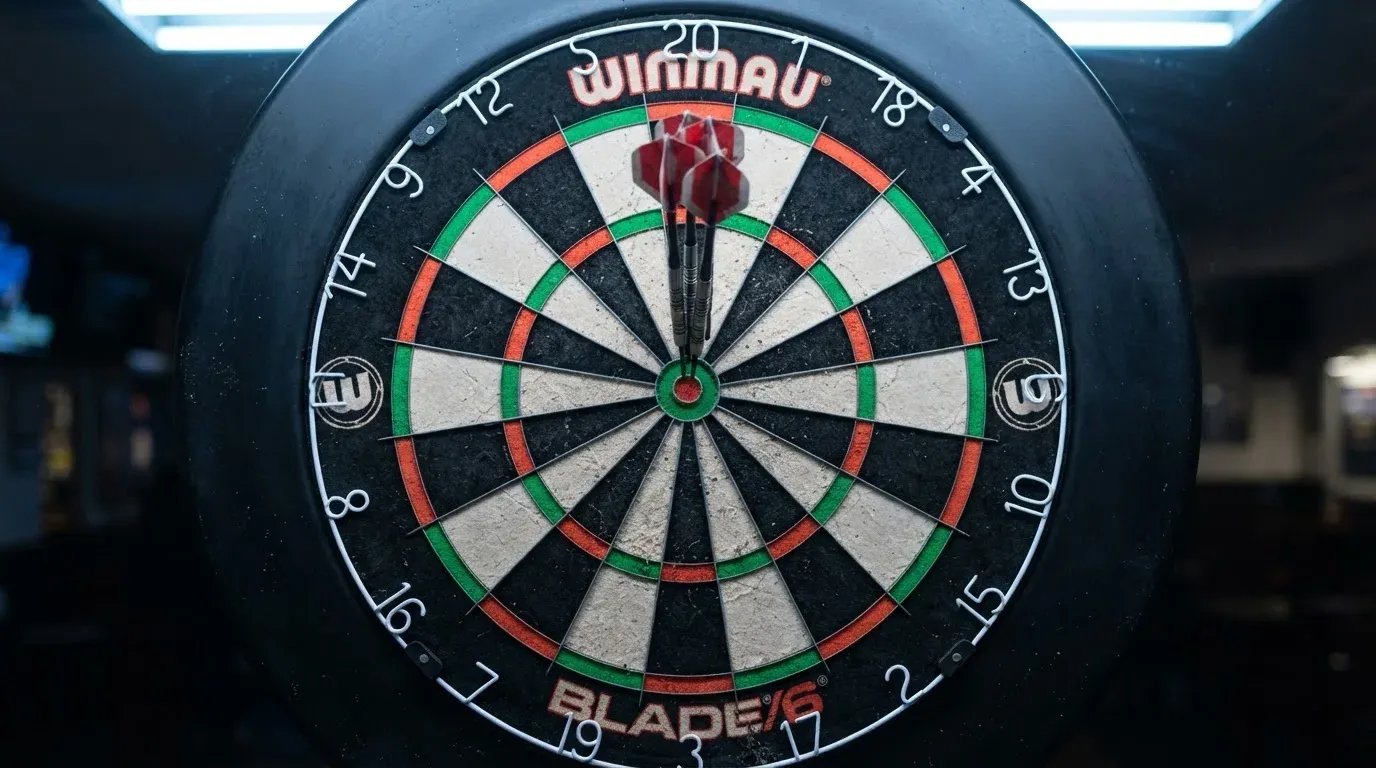
The form picture comes from the obvious places — Players Championship events on the PDC circuit, the floor tournaments, head-to-head meetings. A more honest reading also watches for context: a player returning from injury, a player with nothing to play for in the group stage, a debutant on the Ally Pally stage. None of those appear in a stat line. They are the difference between a tip that says “Player A is favourite” and one that says “Player A is favourite, at this price, against this opponent, on this stage.”
The second filter is the market. The market price is itself a tip — usually a heavily weighted one, because the bookmaker has spent money on a trading team to set it. When the market says one thing and an external tip says another, the bettor has to choose. The boring rule of thumb is that the market is more often right than any single tipster, but the point is not which side wins — it is whether either side is offering better than the true probability, after the margin is removed.
The third filter is the stake. A research-quality tip that is right 55 per cent of the time at decimal odds of 1.80 still loses money if the bettor stakes too large a share of the bank on it. Staking is the discipline that turns a stream of small edges into a long-term result; staking badly turns the same stream into the same loss a coin-flipping punter would collect.
Why no tip is ever certain
Darts finishes a leg in minutes. A single missed double at double 16 can flip a leg a player was winning. The short format sharpens variance — in a best-of-five-set match, the better player on form still loses roughly one match in three. The longer the format, the more form has time to express itself, but it never fully expresses itself: in the 2026 PDC World Championship final, Luke Littler beat Gian van Veen 7–1, the kind of scoreline that looks one-sided in hindsight and looked very different set by set.

That is the ceiling on what any tip can promise. The tipster who claims certainty is selling certainty, not delivering it. The tip a bettor should trust is the one that names a probability, names a price and lets the bettor do the maths; the tip that names a winner is asking the bettor to do something different — to take a recommendation on trust, against a margin the tip itself has not priced.
Form, fixtures and the calendar a tip has to sit inside
The 2026 PDC World Championship ran from 11 December 2025 to 3 January 2026 at Alexandra Palace, with 128 players in the draw. The tournament is the sport’s reference point, the one a season builds towards and the one a tip about “form” implicitly covers. Round lengths in the modern format are short — first to 3 sets in rounds 1 and 2, first to 4 in rounds 3 and 4, first to 5 in the quarter-finals, first to 6 in the semi-finals, first to 7 in the final — which is part of why the form picture wobbles. A best-of-three-sets match is closer to a coin flip than a tennis match at the same stage.
Around the Worlds, the PDC runs the Premier League, the World Grand Prix, the World Matchplay, the Grand Slam, the Players Championship Finals and the floor events that fill the rest of the calendar. Each tournament has its own draw size, its own format and its own quirk — the Grand Slam uses a group stage, the Matchplay is a single-elimination bracket, the Premier League runs a round-robin with knockouts. A tip that says “Player X is in form” without naming the surface and format is naming half a thing. Form on the ProTour floor is not the same form as form on the Ally Pally stage, and a tip that does not distinguish is one the bettor should discount.
The tip is a starting point, not a bet
Read the tip. Pull up the head-to-head. Check the price on at least two books. Decide whether the price is higher than the bettor’s own probability after taking the margin out. Set the stake as a fraction of a defined bankroll. Place the bet, or don’t, but place it because of the calculation, not because the tip said so. That is what a guide like this is for — not to issue tips, because no page can know who will win, but to give the reader the tools to read one.
The legal frame a UK darts bettor sits inside
The UK is not a single legal market for betting. The Gambling Act 2005 covers Great Britain — England, Scotland and Wales. Northern Ireland runs on older legislation. The regulator for Great Britain is the Gambling Commission, a non-departmental public body sponsored by the Department for Culture, Media and Sport. Since the Gambling (Licensing and Advertising) Act 2014, an operator whose remote facilities are used in Great Britain needs a Commission licence wherever it is based. A Curaçao, Maltese or Gibraltar licence is not a substitute where GB customers are being served. The Commission’s public register is the whole test of who holds one: search by business name, trading name, domain or account number, and the entry either says the brand is licensed or it does not.
Minimum age in Great Britain is 18. Identity — name, address, date of birth — has to be verified before a customer can deposit or gamble, including with a free bet or a bonus. That check is what stops anonymous play at licensed sites. From 30 August 2024 a financial vulnerability check applies to licensed remote betting when a customer’s deposits minus withdrawals exceed £150 in a rolling 30 days; it is a public-record check (bankruptcy, county court judgments), not an income check and not a credit reference check. A staged financial risk-assessment regime has been announced, but no start date has been set — write that it is “announced, staged, no start date”, not that it is in force.
A credit card has been banned for gambling in Great Britain since 14 April 2020, including credit-card-funded e-wallet deposits. Debit cards and bank-based payments are not covered by that ban. The player pays no tax on betting winnings in Great Britain, general information rather than tax advice — professional gamblers should ask HMRC or an adviser. General Betting Duty is the operator’s tax and sits at 15 per cent currently, with a new remote rate of 25 per cent from 1 April 2027 alongside the existing 15 per cent rate for remote bets on UK horse racing, self-service betting-terminal bets in licensed premises, pool betting and in-person betting. Whether that duty is passed on through odds is not established, and the page should not write that the player is charged duty.
Offshore brands remain an option a reader can find, and the question of whether to use one is one the page should answer plainly. A GB licence brings verification, deposit limits, GAMSTOP coverage, the bonus cap described below, and a Commission complaints route. An offshore brand running on a Curaçao or Anjouan licence brings none of those — no GAMSTOP, no Commission complaints route, no approved dispute-resolution body, no British consumer redress if funds are withheld, and none of the bonus-and-promotion caps the Commission enforces on its own licensees. Honest framing is that licensed means checks, limits, GAMSTOP and a bonus cap, and unlicensed means none of those protections and a possible loss of funds. Neither is “the safe choice” by default.
Spread betting is a different market
Spreadex, for instance, is regulated by the Financial Conduct Authority for spread betting and by the Gambling Commission for fixed-odds betting; the spread side of the business can produce losses that exceed the deposit. A reader who is being offered spread bets on darts — the totals market, the player index markets, the winning-margins — is looking at a financial product, not a sports bet. The risk profile is different, the tax treatment is different, and the safer-gambling tools the FCA requires sit alongside the Commission’s, not in place of them.
Safer gambling is a feature of the licensed market, not an extra
Every operator reviewed below is licensed by the Gambling Commission and bound by the same licence conditions. That licence carries obligations the licensed brand has to meet; the brand that meets them properly is the one whose site looks more like a customer-service operation and less like a casino floor.
GAMSTOP is the national multi-operator online self-exclusion scheme and a mandatory licence condition for online operators in Great Britain. Self-exclusion can run for six months, one year, five years, or five years with auto-renewal; after the minimum period the exclusion stays in place for a further seven years unless the customer asks GAMSTOP to remove it. GAMSTOP covers online sites and apps. Betting shops run a separate service. A reader who has self-excluded through GAMSTOP is excluded from every GB-licensed site simultaneously, and the exclusion is enforced, not advisory.
Deposit limits on a fixed time frame are a licence condition, and operators must offer them. The first changes applied from 31 October 2025, a second phase was postponed to 30 September 2026, and whether that second phase is live is not established. There is no state-set deposit or loss ceiling for betting — limits are the customer’s choice. Beyond deposit limits, a licensed operator must offer the safer-gambling controls that fit the product: time-outs, product restrictions, self-exclusion from that site alone, and reality checks during play. The menu varies slightly from bookmaker to bookmaker.
The financial vulnerability check, mentioned earlier, applies when a customer’s net deposits cross £150 in a rolling 30 days — a public-record check, not an income check. When a customer’s spend gets larger, source-of-funds questions become normal under the money-laundering rules, and a licensed operator is required to ask. The interaction with a customer who cannot produce what is asked for is to restrict further play. That is what the licence buys.
The free help a reader can use directly sits with GamCare, which runs the National Gambling Helpline, GambleAware, the NHS gambling clinics and Gamblers Anonymous. Two of those are NHS-funded. None of them require the customer to be in trouble to call.
When the safer-gambling tools are running well
Unibet’s safer gambling tools include deposit limits, a Player Profile test, product restrictions and self-exclusion, with live chat support and direct links to BeGambleAware, GamCare, GAMSTOP, Gambling Therapy and the Betting and Gaming Council. That is the shape of a properly licenced offering. The brand a reader is comparing against does not need to mention every support body by name, but it does need to make them reachable in two clicks from the safer-gambling page. A reader weighing two licensed brands on this alone is reading the small print on the safer-gambling page first.
What the safer-gambling menu cannot do
The licensed market’s tools are blunt at the boundaries. A self-exclusion does not stop a customer opening an account at an offshore brand. A deposit limit set to £100 a week does not stop a customer from setting the same limit at four sites and running £400 of weekly spend across them. The financial vulnerability check at £150 in 30 days is a trigger for an automated conversation, not a stop. The picture is one of a layered set of instruments, each catching a different slice of risky play; the layer the reader is on is the layer the page is for.
Bonuses and free bets in darts
The marketing calls them “free bets”, “boosted odds”, “risk-free” and “100 per cent bonuses”. The licence terms describe them more carefully. Wagering requirements on bonuses have been capped at 10x since 19 January 2026 — a £10 bonus at 50x needed £500 of betting turnover; under the cap, no more than £100 of wagering applies. Mixed-product promotions, where a betting offer requires play on another product to clear, are banned. The cap’s interaction with free bets without a wagering condition, and any cap on the money value of a bonus, is not established. A reader holding a promotion up to the light has to read the small print, because the bonus cap is the floor, not the ceiling, on what the terms can ask.
A welcome offer in this market usually runs along one of three lines. The first is a deposit match — deposit £10, get £30 in bonus funds, with the bonus subject to wagering. The second is a free bet bundle — bet £5 at minimum odds of evens (2.0), receive £25 in free bets. The third is an enhanced-odds or price-boost token — back a specific player at a boosted price for new customers only. Each one has the same shape: there is a qualifying condition, a sportsbook-side requirement, and a deadline.
Take the second as the worked example, because a typical sports welcome in this market reads along those lines. Midnite’s sports welcome offer: new customers who bet £5 or more on pre-match odds of EVS (2.0) or greater within 14 days of sign-up receive £25 in free bets and 50 free spins, valid for 7 days. The qualifying stake is small, the qualifying price is the industry-standard minimum for a “qualifying bet”, and the headline £25 hides the free-spins half. The free bet stake is not usually paid back with a win, which changes the value calculation: a £25 free bet at odds of 3.00 returns £75 (£50 profit), not £100 (£75 profit). That gap is the free bet’s hidden cost.
Bonus turnover is the second hidden cost. A £10 bonus at 10x wagering needs £100 of qualifying bets at the operator’s minimum price before withdrawal. The minimum price is usually 1.50 or 1.67 — a price so short that almost every bet on the slips will qualify, but the actual return on those bets is small. The combination of minimum-price bets, settled-on-win-only rules and a deadline (often seven days, sometimes 30) is the bonus’s clearing work, and a reader who skims the headline and ignores the small print pays for the skim.
How to clear a bonus without losing more than it is worth
The arithmetic the bonus does not print is its expected cost. Required turnover equals the bonus base times the wagering factor — so a £10 bonus at 10x needs £100 of qualifying bets, and a £30 bonus at 10x needs £300. Bet count at the operator’s minimum stake gives the number of bets the bettor has to place. The expected cost of clearing is the turnover times the margin of the market the bets are placed in. If the turnover is £300 and the market is the typical 5 per cent margin darts match-winner market, the expected cost is £15 — which means a £30 bonus carries a £15 expected cost and is worth roughly £15 on average. The bettor’s edge on the bets themselves, if any, sits on top.
That is the honest read of a bonus. A bonus that looks like £30 of value is £15 of value once the clearing work is priced in, and is negative value if the bonus expires before it is cleared. A reader who takes every bonus without doing the arithmetic is paying for the privilege of taking bonuses.
“Risk-free” and “no deposit” are the words to handle carefully
“Risk-free” usually means a first bet that, if it loses, is refunded as a free bet or bonus credit — not a refund in cash. The refund carries its own wagering condition. A reader who reads “risk-free” as “no cost” is the reader who finds the next morning that the refund is a bonus subject to turnover, on a seven-day clock. “No deposit” usually means a small bonus credited on signup, with a heavy wagering multiple and a maximum win — £10 of bonus credit that pays back a maximum of, say, £50 in winnings. The mechanical shape is the same across the marketing language: a headline number that looks like a gift, and a small print that makes it a loan.
Price boosts and acca insurance
A price boost — a token or money-back offer on a specific market, often a player to hit the most 180s or a player to win and hit a certain checkout — is a marketing instrument rather than a bonus in the wagering sense. The boost either wins at the boosted price or loses at the stake, with no rollover. Acca insurance works the same way: an accumulator that loses by one leg gets the stake back as a free bet or bonus, with the usual free-bet conditions attached. The reader who treats these as pure upside is right that they are upside, but the stake money on the bet itself is still the bettor’s money and the upsides that hit are the ones the bookmaker has already priced.
Live betting and cash out in a sport that finishes in minutes
In-play betting on darts has a different feel from in-play on football. A leg lasts minutes; a set lasts longer; a match in the early rounds of the Worlds is over in under an hour. The bookmaker’s screen updates between legs, sometimes mid-leg on the bigger events, and the price on a player doing what they just did depends on whether the lead has changed, who is throwing next, and how many legs remain.
LiveScore Bet accepts the spread of payment methods a reader would expect from a modern sportsbook — debit cards (Visa and Mastercard), Apple Pay, PayPal, Pay by Bank (Open Banking) and Revolut Pay. A reader on in-play bets often wants the deposit and the withdrawal to be frictionless, because the value of an in-play bet is in how quickly the book settles the next one.
The cash out button on an in-play bet settles the bet at a price the bookmaker offers rather than letting the bet run to its natural end. For a player who is throwing next in a leg they were losing and is now 80 points ahead with one dart at double 16 to go, the cash out price will be near the full return of an outright win, but lower than the outright price on the same selection. The bookmaker is paying the bettor to give up the upside of the dart landing in the double.
The mechanical shape of a cash out is that the bookmaker is offering a price the bettor can transact on; that price reflects where the market is now, where the bookmaker thinks it will go, and the small margin the bookmaker keeps. A reader who uses cash out often is paying the spread on every bet. A reader who uses cash out once — to lock in a profit that has appeared and would otherwise be at risk over the next three darts — is using the tool as it is meant to be used.
The case for in-play darts as a betting venue
Darts is fast. A set is over in 8 to 12 minutes at the top of the game. The volume of bets a reader can place inside an evening’s session is higher than for football or horse racing, and the variance on every leg is correspondingly higher. For a reader with a strict staking plan, in-play darts is a venue where a small edge can compound; for a reader without one, the same venue is a fast way to lose. The in-play tool does not change the math of the bet, only the speed at which the math runs.
In-play markets to know
The match-winner market stays live throughout. Handicap lines on sets and legs open as the match progresses and the lead changes. Markets on 180s hit, highest checkout and the race to a certain number of legs come and go inside a single match. The market vocabulary is wider on a televised Premier League night than on a Players Championship floor event, where the in-play offering is match-winner and very little else. A reader comparing two books on in-play depth will see the difference in the second and third tier of markets, not in whether the headline in-play button lights up.
The bet types and odds formats a darts market uses
The single is the spine. One selection, one price, settled on win or loss at the operator’s settled-result rule. Match-winner, most 180s, highest checkout — every one of these is a single market.
The accumulator, or “acca”, strings several selections into one ticket. Each leg’s odds multiply into one price, so a four-leg acca at 2.00, 1.80, 2.50 and 1.50 has a combined price of 13.50. The stake is at risk on every leg. The catch is that the bookmaker’s margin compounds across legs, and the implied probability of an acca is lower than the product of the implied probabilities of the legs would suggest. A four-leg acca that “looks” 10/1 is paid closer to 9/1 by the time the legs are settled through their margins.
The bet builder is the same shape as an acca but built from one event. A bet builder on a darts match might combine match winner, total 180s in the match, and the method of checkout for the winning leg. The legs all settle from one match, which is the part that makes it attractive — no correlating risk between tournaments, no overnight drift. The same margin-compounding observation applies. Paddy Power’s app offers Bet Builder+, Popular Bet Builders, Super Sub (a bet rolls over to the replacement if a selected player is substituted), expanded Win More markets and player and ACCA stats; the menu is the bookmaker’s answer to the bettor’s appetite for variety.
Each-way on darts is rare — the each-way concept comes from horse racing, where place terms vary by race type and number of runners. A darts match does not have runners in the same sense, so each-way bets on darts are usually a place-bet on the winner market in a tournament — back a player each-way and settle if they reach the final, the semis, or whichever place line the operator offers. The place terms are the bookmaker’s. Reading them is the difference between an each-way bet that paid the win half and the place half and one that paid the win half only.
The odds format a UK reader sees most often is fractional. Odds of 5/1 mean a £1 stake returns £6 (£5 profit, £1 stake returned). Odds of 1/2 mean a £2 stake returns £3 (£1 profit, £2 stake returned). Decimal odds — the form used by the exchanges and most online sportsbooks — translate fractional as a/b → a ÷ b + 1. So 5/1 becomes 6.00; 1/2 becomes 1.50. The two formats describe the same market, but the decimal form makes the multiplication for accumulators easier to read.
How a winning bet pays back
The math is the same in fractional or decimal form. Take a stake and multiply by the decimal odds to get the return: a £10 stake at decimal odds of 3.50 returns £35 (£25 profit, £10 stake). The math behind a combination bet multiplies the leg odds: a stake on three legs at 2.00, 1.80 and 2.50 yields a combined price of 9.00, so a £10 stake returns £90 (£80 profit). Each leg that wins adds a multiplication; each leg that loses ends the bet. There is no partial payout — the all-or-nothing nature of the acca is what makes the high odds possible and the long-term expectation worse than the headline suggests.
Where the margin hides in a darts market
The bookmaker’s margin is the share of every pound bet on a market that the bookmaker keeps on average. It is built into every price. Read it off the overround: the sum of the implied probabilities of all outcomes on a market exceeds 100 per cent by the margin. A two-way match-winner market priced at 1.90 / 1.90 implies 52.63 per cent on each side for a sum of 105.26 per cent, which is a 5.26 per cent margin. That is the book’s take. The bookmaker’s preferred overround for a televised darts match is 5 to 8 per cent depending on the operator and the round; floor events and Players Championship markets sit higher, sometimes 8 to 12 per cent, because the bookmaker has less data to set the price with.
The illustrative worked example sits in the margin the bookmaker keeps of every unit bet on a darts match-winner market. Two decimal prices of 1.90 against two outcomes give a payout share of 1 ÷ (1/1.90 + 1/1.90) = 0.95, so the bookmaker’s margin is 1 − 0.95 = 0.05, or about 5 per cent. That is the figure the bookmaker keeps of every £1 bet on that market, and the figure a tip — or a bettor’s own probability — has to beat on average before the bet is worth placing. The same arithmetic at 1.85 / 1.85 gives a margin of 8.1 per cent; at 1.80 / 1.80, 11.1 per cent. The reader can see the margin move with the price, and the price with the operator and the market.
The relationship between a payout share and a margin is the relationship between how much the bookmaker pays back and how much the bookmaker keeps — the same market seen from two sides. A payout share of 95 per cent and a margin of 5 per cent describe the same two-way market at 1.90 / 1.90. Neither is wrong; both are correct, and a reader who can move between the two reads odds more accurately than one who has to convert.
What a “value bet” looks like
A value bet is a price higher than the bettor’s own probability, once the bookmaker’s margin has been removed. If the bettor’s true probability of Player A winning is 60 per cent and the price is 1.80, the implied probability of 1.80 is 55.56 per cent, which is below 60 per cent, so the bet has value. If the price is 1.60, the implied probability is 62.5 per cent, which is above 60 per cent, so the bet does not have value. The bettor’s true probability is the part that requires work — head-to-head record, recent form, surface, fatigue — and the bookmaker’s margin is the part the market gives away for free in the price.
The reason no tip is ever certain is also the reason no tip is ever a value bet by definition. A tip is a tipster’s probability expressed as a selection. A value bet is a price comparison between that probability and the bookmaker’s. They are different acts, and the bettor who skips the second loses the discipline the first is supposed to provide.
Tournaments and the calendar the page sits inside
The PDC World Darts Championship is the sport’s reference event, held annually over the Christmas and New Year period at Alexandra Palace in London. The 2026 edition ran from 11 December 2025 to 3 January 2026 with 128 players in the draw, up from 96 in previous editions. The format in 2026 was as follows: rounds 1 and 2 played to first-to-3 sets, rounds 3 and 4 to first-to-4, quarter-finals to first-to-5, semi-finals to first-to-6, the final to first-to-7. Luke Littler won the title, beating Gian van Veen 7–1 in the final. The total prize fund was £5,000,000, with £1,000,000 to the winner.
The Premier League Darts runs from February to May, taking a roadshow format around UK and European arenas. The eight-player round-robin feeds into the play-offs and the final at a headline arena. Outright markets are open from the start of the season; the price shortens as the table takes shape, and the bettor looking at outright winner has to balance early value against later certainty.
The World Matchplay, at the Winter Gardens in Blackpool in July, is a major non-rankings event with a single-elimination bracket over nine nights. The World Grand Prix uses the double-start format — a player has to begin and end each leg on a double — which adds variance and is its own specialist skill. The Grand Slam of Darts, in November, uses a round-robin group stage followed by knockouts; the players who do well in the group stage often carry that form into the knockouts, but the format rewards consistency as much as peak.
The Players Championship Finals and the floor events sit beneath the major television tournaments. These are the events the players are graded on for seedings into the Worlds. The form picture a tipster reads usually starts here — the volume of matches, the surface (most floor events are quick), the variety of opponents. A reader building a tip picture for the Worlds would start with the floor form and read forward.
Major rankings events aside, the BDO legacy structure has moved to the World Darts Federation (WDF), which runs its own calendar of events and an alternative ranking. The two governing bodies — PDC and WDF — coexist rather than compete, but the bookmaker’s outright and match markets sit on PDC events. A reader looking for WDF markets will find a smaller offering and a smaller liquidity.
Tournament-specific market notes
Outright winner markets open early and shorten fast. Cash out is offered on outright markets in the early weeks, which gives a reader a way to lock in value if a player they backed is running hot. The deeper the tournament, the more in-play markets become available. Best Odds Guaranteed (BOG), a horse-racing convention where the book pays at the higher of the taken price and the starting price, does not apply to darts in the same way — but the same idea of “the price you took or better” appears on individual match markets at the bigger books, especially where in-play pricing lags by a few seconds.
Ten UK-licensed operators for darts betting
The operators reviewed below each hold a Gambling Commission remote licence and appear on the Commission’s public register. The order below is not a ranking. A licence is a licence — the comparison below is on what each operator does with that licence, not on which one is safest.
1. Paddy Power — feature-rich sportsbook
Paddy Power runs on PPB Counterparty Services Limited under Gambling Commission account 39439, remote general betting standard (real events). The app carries Bet Builder+, Popular Bet Builders, Super Sub (a bet rolls over to the replacement if a selected player is substituted), expanded Win More markets, and player and ACCA stats. That menu is what a feature-led sportsbook looks like in 2026 — bet builders on every televised event, a stat pane for player research, and a substitution-rollover that is one of the few of its kind at scale. For a reader who builds accas across multiple sports and uses in-play stats during the bet, Paddy Power’s offering is the long menu.
The dart markets on Paddy Power cover the televised events and the bigger floor tournaments, with the same market vocabulary as the other tier-one books. The verdict is that Paddy Power is a feature-led app with the dart coverage of a major sportsbook, best suited to the bettor who reads markets live and builds accas on the move.
2. Betmaster — focused sportsbook
Betmaster is operated by BM Solutions GB Ltd under Gambling Commission account 65699. The site states the licence prominently on its home page, which is the smaller end of the operator tier. The darts offering covers the televised events, the outright markets and the major floor events; the in-play menu is match-winner on most events, with deeper markets on the bigger televised nights. The verdict is a tidy sportsbook for the bettor who wants a licensed operator and a smaller app, without the feature menu of the tier-one books.
3. BetGoodwin — racing-led sportsbook
BetGoodwin runs on Goodwin Racing Limited under Gambling Commission account 2927. Its signature offer is Best Odds Guaranteed on all UK and Irish horse and greyhound racing, up to £1,000 — a racing product from a racing-led operator. The darts offering covers the televised events and the major floor tournaments, with the menu any smaller sportsbook carries. The verdict is that BetGoodwin is a racing-led book with a real darts offering, best suited to the bettor who bets across both and wants the racing best-odds guarantee on the side.
4. Sporting Index — spread and fixed odds
Sporting Index is operated by Sporting Index Limited under Gambling Commission account 27343. The new-customer offer is shaped around both fixed-odds and spread betting: a £10 fixed odds bet at minimum odds of 1/2 unlocks three £10 fixed odds free bets, three £5 Total Goals spread bets, three £5 Winning Favourites spread bets and a £1 Race Index spread bet, with the qualifying bet not placeable in play and not cashable out early. The spread side of the business is FCA-regulated; the fixed-odds side is Commission-regulated. A reader taking the welcome offer is opting into both sides of the business at once. The verdict is a hybrid sportsbook for the bettor who wants spread betting on football alongside fixed-odds darts — and who reads the offer small print before claiming it, because the qualifying condition and the in-play exclusion are the things the headline leaves out.
5. LiveScore Bet — payments-led sportsbook
LiveScore Bet runs on LiveScore Betting and Gaming (Gibraltar) Limited under Gambling Commission account 56859. The payment menu runs to debit cards (Visa and Mastercard), Apple Pay, PayPal, Pay by Bank (Open Banking) and Revolut Pay. That coverage sits inside the licensed bookmaker norm but is broader than several competitors on the Open Banking and e-wallet side. The darts offering covers the televised events with the standard menu. The verdict is a payments-led licensed operator suited to the bettor whose deposit and withdrawal method dictates the book, especially anyone using Open Banking or Revolut.
6. Midnite — feature-light, market-led
Midnite is operated by Midnite Limited under Gambling Commission account 101839. The site cites the licence and shows in-play events, an acca builder, popular accas and price boosts with maximum-stake limits. The sports welcome offer: new customers who bet £5 or more on pre-match odds of EVS (2.0) or greater within 14 days of sign-up receive £25 in free bets and 50 free spins, valid for 7 days. The free-bet stake is not usually paid back with a win, and the 7-day clock on the free bets is the part of the offer that bites.
The verdict is a market-led sportsbook with a tidy welcome offer and the kind of feature-light app that suits a bettor who reads markets more than builders. The maximum-stake limits on the boosted prices are the part of the offer that pays the offer’s cost back to the bookmaker.
7. DAZN Bet — deposit-led sportsbook
DAZN Bet runs on DZBT Limited under Gambling Commission account 48756. Deposits start at £5 by debit card, Apple Pay, Paysafecard, Trustly and Skrill, and at £20 by PayPal, with no processing fees. The low minimum deposit across most of the payment menu is what the brand is selling — a wide payments net without fees on top. The darts offering covers the televised events. The verdict is a payment-method-led book for the bettor whose deposit ceiling is small and whose payment method is one of the five with a £5 minimum.
8. Lottoland — wider-product bookmaker
Lottoland UK is operated by EU Lotto Limited under Gambling Commission account 38991. The site’s primary business is lottery betting, with casino, scratchcards and a sportsbook attached. The licenced UK offering handles customers in Great Britain under Gambling Commission licence. The darts offering is a sportsbook addition rather than a core product — depth on televised events, less depth on floor events. The verdict is a multi-product brand for the bettor who plays the lottery and the casino and wants a sportsbook on the same account, accepting that the sportsbook is the third product rather than the first.
9. Fitzwilliam Sports — Irish-roots sportsbook
Fitzwilliam Sports is operated by SBKI Limited under Gambling Commission account 48760. The site offers phone and live chat support, with the office open 09:00 to 21:00, Monday to Sunday, and messenger replies generally within 90 seconds. That hours-and-channel offering is what a smaller operator running a personal-service model looks like — phone, chat, response times named in seconds. The darts offering covers the televised events. The verdict is a personal-service book for the bettor who values phone and chat support over app features and wants a less algorithmic betting venue.
10. William Hill — Best Odds Guaranteed on UK racing
William Hill runs on WHG (International) Limited under Gambling Commission account 39225. The signature offer is Best Odds Guaranteed on UK and Irish horse racing from 8 AM on the day of the race, on single and multiple bets; the offer does not apply to ante-post, tote or pari-mutuel bets. The Best Odds Guaranteed policy is named on the help pages. The darts offering covers the televised events and the bigger floor tournaments with the standard menu.
The verdict is a feature-heavy sportsbook with the BOG-on-racing tradition, best suited to the bettor who plays both racing and darts and treats darts as a session-filler between the racing cards. The ante-post and tote exceptions are the small print the racing-side offer does not stretch to.
A side-by-side look
| Brand | Gambling Commission account | Licence holder | Offer side that shapes the account |
|---|---|---|---|
| Paddy Power | 39439 | PPB Counterparty Services Limited | Bet Builder+, Super Sub, Win More markets, player and ACCA stats |
| Betmaster | 65699 | BM Solutions GB Ltd | Focused sportsbook offering with the licence stated on the home page |
| BetGoodwin | 2927 | Goodwin Racing Limited | BOG on all UK and Irish horse and greyhound racing, up to £1,000 |
| Sporting Index | 27343 | Sporting Index Limited | Hybrid fixed-odds and spread offer with a £10 qualifying bet at 1/2 |
| LiveScore Bet | 56859 | LiveScore Betting and Gaming (Gibraltar) Limited | Broad payments menu including Pay by Bank and Revolut Pay |
| Midnite | 101839 | Midnite Limited | £5 qualifying bet at EVS or greater, £25 in free bets and 50 free spins in 7 days |
| DAZN Bet | 48756 | DZBT Limited | £5 deposit minimum across most payment methods, no processing fees |
| Lottoland | 38991 | EU Lotto Limited | Multi-product brand with lottery, casino, scratchcards and a sportsbook |
| Fitzwilliam Sports | 48760 | SBKI Limited | Phone and live chat support, 09:00–21:00 daily, 90-second messenger replies |
| William Hill | 39225 | WHG (International) Limited | BOG on UK and Irish horse racing from 8 AM, single and multiple bets |
The table is the licence holder and the operator-side feature that defines the brand, not a ranking. A reader choosing between them is choosing on payments, on features, on offer shape or on service model — the licence is the floor, not the differentiator.
Reading the odds once they are on the page
The illustration in the margin section earlier is one worked example, and a second is useful here because the picture widens with the price. A two-way market priced at 1.85 / 1.85 has a payout share of 1 ÷ (1/1.85 + 1/1.85) = 0.9259, which is a 7.41 per cent margin — about 2 percentage points higher than the 5 per cent at 1.90 / 1.90. A market at 1.80 / 1.80 has a payout share of 0.9 and an 11.11 per cent margin. A market at 1.95 / 1.95 is a 2.56 per cent margin — very tight by UK sportsbook standards, more often seen on the bigger televised events where liquidity is highest. Floor-event pricing at 1.80 / 1.80 to 1.85 / 1.85 is the norm; televised pricing at 1.90 / 1.90 to 1.95 / 1.95 is the norm. The reader can see the margin move with the price in the bookmaker’s display without needing to ask.
The relationship is that every 0.05 of decimal odds on a two-way market moves the margin by roughly 1.5 to 2.5 percentage points depending on where you start — and the practical effect is that a bettor betting price rather than probability is paying the bookmaker’s margin twice: once in the implied probability, once in the reduced win rate over many bets at the shorter price.
What the margin is for, on a sportsbook’s books
The margin is the bookmaker’s gross profit per pound bet, before fixed costs and operating expense. A 5 per cent margin on a £10m darts turnover book is £500,000 of gross profit, which has to cover the trading team, the licensing fees, the safer-gambling controls, the customer service and the marketing. A bookmaker running a 9 per cent margin is running a profitable book, a bookmaker running a 3 per cent margin is taking a thinner margin in pursuit of volume. The bettor’s relationship with the margin is that it is the cost of using the book — the spread the book keeps for the service of offering the market.
The condition on a payout share and a margin in one line
Take the 1.90 / 1.90 illustration. The bookmaker pays 95p on every £1 bet on a winning outcome, on average across the market, and keeps 5p. The payout share is 95 per cent. The margin is 5 per cent. Same market, two angles. The 1.85 / 1.85 illustration pays 92.59p on the £1 and keeps 7.41p. The 1.80 / 1.80 illustration pays 90p on the £1 and keeps 10p. The bookmaker’s books work because the 5 to 8 per cent on every pound compounds across the volume of bets a major televised event attracts.
The bettor’s setup
The setup a reader can build themselves is a list of habits and a list of tools.
The habits: a defined bankroll, a fixed stake as a percentage of that bankroll, a written record of every bet, a hard stop on the size of any single bet, and a hard stop on the size of the day’s loss. The record is what tells the bettor whether the approach is working six months in; without the record, the bettor cannot distinguish the variance of darts from the cost of an unprofitable approach.
The tools: an odds-comparison site to find the best price, a banking app with a deposit-limit-set option, a separate email address for the betting account, and a clear calendar reminder for any bonus deadlines. The bookmaker’s safer-gambling tools — deposit limits, time-outs, self-exclusion — are the tools of last resort, not the tools of first resort, but they sit in the same setup.
Bankroll and stake discipline
A bankroll is the amount of money the bettor has set aside for betting, separate from household money and separate from any other gambling. A stake is a fixed percentage of that bankroll — 1 to 5 per cent is the band most staking guides recommend. A bettor with a £500 bankroll staking 2 per cent per bet is staking £10 a time; the same bettor chasing a loss with £50 stakes is staking 10 per cent of the bankroll on one dart. The boundary between staking 2 per cent and staking 10 per cent is the boundary between a session and a recovery that costs the bankroll.
The records that the page recommends
Every bet recorded, every stake noted, every result settled. The columns: date, event, selection, market, price, stake, return, profit-and-loss running total. The running total is the column that tells the bettor whether the approach is working. A betting record that does not include a running P&L is a list, not a record.
Dartboards, distances and the rules that govern the betting format
A standard dartboard has 20 numbered segments arranged in a ring, each with single, double and treble areas. The bullseye is worth 50 and the outer bull 25; the doubles and trebles are the scoring areas that finish a leg. Players throw from 2.37 metres (7 feet 9 inches), with the bullseye 1.73 metres above the floor. The standard game for tournament darts is 501 — players start at 501 and must finish on a double or the bullseye. The highest possible three-dart finish is 170 (treble 20, treble 20, bullseye), and the minimum possible leg is nine darts. Those rules govern the markets a bookmaker prices — most 180s is a market because the maximum on three darts is three treble 20s; highest checkout is a market because the maximum is 170; method of checkout is a market because the doubles are scored on the standard board.
The sport is governed by the PDC and the World Darts Federation, with the PDC the higher-profile body and the WDF running the alternative ranking and the BDO-legacy structure. The two organisations run separate calendars and separate world championships; the betting markets follow the PDC.
A reading list for the punter who wants more
A reader with this page in hand has the framework; the reading that follows builds the muscle. The PDC’s own site carries the results, the order of merit and the seeding points. The bookmakers’ help pages carry the offer small print that this guide has referred to throughout. The Commission’s public register carries the licence status of every operator reviewed. The GamCare site carries the National Gambling Helpline and the screening tools a reader can use on themselves or on someone they are worried about.
The reading does not include a tipster who promises certainty. The market price is rarely worse than a tipster’s tip, and where the tipster’s tip diverges from the market, the question is which probability the bettor trusts, not which side to back. The reading does include a staking plan, a written record, and a hard stop on the day’s loss. Those three together are what a long-term punter’s setup looks like, on darts or anywhere else.
Frequently asked questions
How do you bet on darts?
Pick a licensed UK bookmaker, open and verify an account, deposit with a debit card or another accepted payment method, browse the darts section for the match or tournament you want to back, build a single or accumulator, set the stake, and confirm the bet on the slip. The bet settles with the operator’s settled-result rule once the match or tournament reaches its settled state. Withdrawals are to the original payment method where possible.
What is darts betting?
Darts betting is a sports betting market where the bookmaker offers prices on darts matches and tournaments — match winner, set betting, handicap, most 180s, highest checkout, method of checkout, outright tournament winner. The bettor backs a selection at the offered price; the bet settles on the operator’s settled result. Some brands offer spread betting alongside fixed odds, where the bettor’s profit and loss depends on how right the line is, not whether the result goes one way or the other.
How does darts handicap betting work?
A handicap market gives one player a fictional lead or deficit in legs or sets before the match starts. A market of Player A −1.5 sets means Player A starts the match one-and-a-half sets down — the bet wins only if Player A wins by two sets or more. The handicap turns a one-sided match into a more even price on both sides, and is the market a reader uses when the form picture has a player short of the headline favourite.
What is a value bet, and why is no tip ever certain?
A value bet is a price whose implied probability is below the bettor’s own probability for the selection. If the bettor’s probability is 60 per cent and the price is 1.80 (implied 55.6 per cent), the bet has value. No tip is ever certain because darts is a sport of inches — a missed double at double 16, a couple of 180s in a row from the underdog, a leg taking nine darts rather than 17. Variance is the rule, not the exception. The tip a bettor can trust is the one that names a probability and lets the bettor do the maths.
What is the bookmaker’s margin and how can it be seen in the odds?
The margin is the share of every pound bet on a market that the bookmaker keeps, on average. It is built into every price. A two-way market at decimal odds of 1.90 / 1.90 has a payout share of 95 per cent and a margin of about 5 per cent; the same market at 1.85 / 1.85 gives a margin of about 7.4 per cent. The wider the margin, the lower the expected return on the same bet. The reader who can read the margin off the price reads odds more accurately than the reader who reads them as numbers alone.
Tennis, darts & cue sports – oddsguaranteed
Content created by the «oddsguaranteed» team
