
Reading Esports Betting Odds: How Licensed UK Bookmakers Price the Markets in 2026
 Available in US

A bettor looking at a League of Legends match on a UK sportsbook in 2026 sees something familiar from football: a moneyline, a handful of map handicaps, totals, and the occasional “first blood” prop. The plumbing under those numbers is the same plumbing that prices Premier League fixtures. The UK Gambling Commission treats esports like any other event, and the same Commission rules on licensing, identity checks, and self-exclusion apply whether the event is contested on grass or on Summoner’s Rift. What changes between the sports is the fixture list, the market vocabulary, and — crucially — how disciplined the bookmaker is about the margin built into each price.
This page is written for the bettor who wants to understand that picture before staking money. It runs the twelve questions a reader usually meets in order — apps, live betting, tips and strategy, the bet types and their odds, the tournaments themselves, then the top-ten comparison, with the legal frame, safer-gambling tools, crypto, bonuses and payments closing it out. Each operator review carries its licence number and a verdict. The illustrative two-way margin worked through the middle of the page is the central piece of arithmetic: the band of percentages that every esports price sits inside, with the condition that defines it.
Current as of October 30, 2026, with each operator’s licence status verified against the Gambling Commission’s public register.
Apps and Mobile Coverage for Esports Betting in 2026
The mobile app is where most UK esports bets are placed, and the shape of the market follows the shape of the App Store charts. A bookmaker that does not ship a working iOS or Android app has lost half the staking volume before kick-off. For esports specifically, three things decide whether an app is usable for the markets this page is about — fixture depth, in-play latency, and how cleanly the bet builder handles maps and rounds rather than just goals.
The major UK-licensed sportsbooks treat the app as a first-class product, not a wrapper around the desktop site. bet365 ships Bet Builder+, which combines markets from one match into a single wager and works pre-match and in-play, alongside Super Boosts, and daily Bet Boosts. The app carries in-play betting, live streaming of events worldwide, Bet Track, Match Live, and a Live Golf Tracker; the golf tracker is irrelevant to esports but the architecture shows the live-data plumbing the esports markets ride on. The brand is the official global betting partner of the UEFA Champions League and its app is described as the most downloaded sports betting app in the UK. For a bettor whose priority is one app that handles everything, that footprint matters.
888sport’s app is built for pre-match and in-play, with Cash Out, Bet Builder, racing streams, BetFinder form tools, a live bet feed, and daily boosted odds. Esports coverage inside the app uses the same bet builder infrastructure, so combining a map winner with total rounds works the same way a same-game multi works on a football match. The form tools are horse-racing shaped and do not transfer to esports, but the live bet feed and the in-play latency are the parts an esports punter actually uses.
Betfair’s app is the betfair Sportsbook, distinct from the exchange, and offers Bet Builder, in-play, free live streaming of UK and Irish horse racing and football within the app, and a 90 Minute Payout market. The streaming catalogue does not include esports tournaments, which is the one limit a bettor shopping for an app should know about. For an esports-heavy punter the live streaming is decoration; for someone who splits staking between football and esports it is a meaningful inclusion.
BetVictor’s app centres on horse racing — Best Odds Guaranteed on UK and Irish racing, enhanced live race streaming, a BetFinder racing tool, Smart Stats — and carries sports on the same platform. Esports coverage sits inside the wider sportsbook rather than as a dedicated tab, which is a fair description of how most UK bookmakers treat it. Sporting Index is the outlier for spreading: the app switches between fixed odds and spread betting, with in-play, a Bet Builder for football, auto cash-out, and Multi-Markets. Spread betting is FCA-regulated rather than Commission-regulated, and a spread bet can lose more than the deposit, which is the reason the brand carries that warning on its homepage. A punter who only wants fixed-odds esports should treat Sporting Index as a fixed-odds bookmaker first and the spread product as something to read about before touching.
Fitzdares’ app carries cash out, accumulators, Lucky 15s, specials and antepost markets on horse racing, football, tennis, rugby, cricket, golf and American football, with in-play live odds. The market list does not include esports explicitly on its App Store listing, which means an esports bettor would be navigating the wider sportsbook rather than a labelled esports tab. Kwiff’s app is licensed by the UK Gambling Commission, carries a 17+ App Store age rating, and describes itself as a Spryme Ltd trademark. BetGoodwin’s app supports a sports welcome offering of a £5 sports bet, a £5 acca and a £5 Sub-Cover bet, with the rest of the sportsbook running on the same platform. Lottoland UK’s app combines casino, lottery betting, sports betting and scratchcards, and states it is licensed by the Gambling Commission for customers in Great Britain; the product mix is wider than a pure sportsbook, with lottery betting and scratchcards sitting alongside the sports product.
The smaller and more specialised apps fill a different slot. Betmaster’s app is published by Bm Solutions Gb Limited and covers football, cricket, horse racing, NFL and eSports (League of Legends, Dota 2) — the only UK-licensed app on this list that calls esports out as a covered headline market in the App Store description. Coral’s app is the front end for one of the largest UK high-street names; the sports welcome offer is £40 in free bets when £20 is staked at minimum odds of 2.0 (1/1), with free bets issued within seven days and expiring seven days after issue. Kwiff and Fitzdares do not advertise esports as a primary vertical in their App Store listings, which is the kind of detail a punter should check by opening the app and looking at the in-play tab rather than by trusting a marketing line.
For the punter who only wants one app for esports, bet365 and 888sport cover the depth and the latency, Betfair adds Bet Builder plus football streaming for a punter with mixed interests, and Betmaster carries the most explicit esports labelling in its App Store description. The middle ground — Coral, BetVictor, BetGoodwin, Kwiff — works for an esports bettor who treats the markets as a corner of a wider sportsbook. The verbiage is less important than the in-play feed being live, the bet builder accepting the markets the punter wants to combine, and the deposit and withdrawal flow being friction-free on a phone.
Live Esports Markets and Cash Out Across UK-Licensed Bookmakers
Esports is an in-play sport by construction. A League of Legends best-of-five can swing on a single team fight; a Counter-Strike map can flip inside two rounds; a Dota 2 game can collapse from a 10k gold lead inside one buyback window. The bookmaker’s in-play product has to handle that volatility, and cash out has to handle it without forcing the punter to lock in a price that has already moved. The UK-licensed books vary in how cleanly they do it.
bet365’s live product is the deepest of the group. The app offers in-play betting, live streaming of events worldwide, Bet Track, Match Live, and a Live Golf Tracker for following bets in play. The architecture is the same one that handles Champions League in-play, which is the comparison that matters: a CS:GO match on bet365 in-play runs on the same engine as a Premier League game. Super Boosts and Bet Builder+ all work in-play as well as pre-match. For an esports punter this is the difference between a feed that updates in seconds and one that freezes during a pause.
888sport’s in-play product is built for the same use. The app carries a live bet feed, Bet Builder in-play, Cash Out, and daily boosted odds. Cash Out on 888sport is the auto/manual kind: an in-play bet can be closed at the current price by the punter, and some markets offer auto cash-out when the price hits a level the punter sets before the event. The brand does not advertise live streaming for esports specifically, which is a fair description of where most UK books sit — they stream football, tennis, basketball and the racing sports, and they leave esports to the game publishers’ own Twitch feeds.
Betfair Sportsbook offers in-play, Bet Builder, and free live streaming of events such as UK and Irish horse racing and football within the app, and a 90 Minute Payout market. The 90 Minute Payout is football-shaped and does not apply to esports. The brand’s exchange product sits on a separate app and handles esports with a depth that no sportsbook matches, but the Sportsbook app is the consumer-facing sportsbook on this list.
The cash-out product on the smaller brands is workable but thinner. BetVictor offers Best Odds Guaranteed on UK and Irish horse racing, enhanced live race streaming, a BetFinder feature for finding racing bets, and Smart Stats; the in-play feed carries the wider sportsbook and includes esports, with cash out available on selected markets. BetGoodwin, Kwiff and Fitzdares all run standard cash-out products. Sporting Index’s auto cash-out is part of its spread betting product as well as fixed odds — the spread product settles on a closing price rather than a result, which is a different product and not what most esports bettors want.
The honest version of the picture: live esports betting is the part of the UK-licensed product where the larger books earn their keep, and the smaller books catch up where the markets are liquid. For a major League of Legends fixture or a Counter-Strike event with broadcaster coverage, the in-play latency and the cash-out speed on bet365 and 888sport sit at the front. For a lower-tier fixture the depth drops everywhere. A punter who wants in-play esports as a primary product should be on the apps that ship a live feed, not the ones that treat in-play as a marketing tick-box.
Predictions, Tips, and Strategy: What an Esports Bettor Can and Cannot Know
The search results for “esports betting tips” and “esports betting predictions” are full of confidence, and the search results are mostly wrong. A tipster who tells a reader who will win a best-of-five between two Counter-Strike teams is selling a story; the actual result depends on map pool, side selection, form over the last thirty days, the playoff structure, and a dozen variables a human reader cannot price. No one can name who wins a match in advance, and a reader who bets on a tipster’s prediction is staking real money on someone else’s guess.
What a strategy can do is narrower and more useful. Bankroll management is the first of them: a punter who stakes a fixed percentage of a defined bank on each bet, rather than chasing losses, survives the variance that esports pricing carries. Esports results cluster more than football results do — a League of Legends team on a ten-match run has more signal than a football team on the same run — but the variance still bites, and the bettor who doubles the stake to recover a loss is the bettor who loses the bank.
Specialisation is the second. A punter who follows the League of Legends World Championship qualifiers will price a map handicap better than a punter who splits attention across six esports titles. The pricing edge that experts think exists in this market is small — the bookmaker’s margin absorbs most of it — but a punter who watches the patch notes, the team compositions, the draft, and the map veto can find prices that are slightly off. A punter who does not watch is betting blind, and the bookmaker’s margin is the only thing the punter is paying for.
The “statistics” angle is real but limited. Some esports titles publish detailed player and team stats, and a punter who reads them with the right scepticism can spot pricing gaps on player props (first blood, first tower, total kills). The punter should remember that the stats are a sample, the sample is small, and a five-match sample on a roaster change is noise. A betting strategy built on small samples is a strategy that loses on the next patch.
The honest framing: there is no system that wins at esports betting, and the marketing words “guaranteed”, “sure bet” and “lock of the day” are not honest. A punter’s edge is bankroll discipline, specialisation, and reading the bookmaker’s margin before staking. The rest is noise.
Esports Bet Types, Odds Formats, and How UK Bookmakers Price the Markets
The odds format a UK punter meets is fractional — 5/1, 11/4, evens — with decimal odds (6.00, 3.75) running alongside. Conversion is a/b to a/b + 1: 5/1 is 6.00 in decimal, 11/4 is 3.75 in decimal, evens is 2.00 in decimal. Odds-on means shorter than evens, and odds-against means longer. The return on a winning bet is stake times the decimal odds; the profit is stake times (decimal odds minus 1). A £10 stake at 3.75 returns £37.50 (£10 stake plus £27.50 profit), which is the same arithmetic written in two ways. The phrase “the bookies’ price” means the same thing as “the odds”, and “the SP” for horse racing means the starting price, which is a separate concept.
The bet types for esports sit inside the same vocabulary football uses, with map-shaped substitutes for goal-shaped concepts. The moneyline (called “match winner” or “map winner” depending on the bookmaker) names the team that wins the match or the map. The map handicap gives one side a virtual map advantage; a League of Handicap level -1.5 makes a best-of-three effectively a best-of-five with the favourite starting one map down. The totals market (over/under on total rounds, total kills, total maps) is the same shape as the football over/under on total goals. The props market is where esports-specific markets live: first blood, first to ten kills, first to destroy an inhibitor, pistol round winner, total aces. The bet builder combines markets from one event into a single wager — bet365’s Bet Builder+ does this pre-match and in-play across the wider sportsbook, including esports where the bookmaker supports it.
The accumulator — the “acca” — multiplies the odds of the legs into one price. A four-fold acca at decimal odds 1.80, 2.20, 1.95 and 2.50 prices to 1.80 × 2.20 × 1.95 × 2.50 = 19.3050; a £10 stake returns £193.05 if all four legs win. The acca is a high-variance product: the more legs, the more variance, and the more the bookmaker’s margin compounds. A four-fold at 19.31 prices 1/19.31 = 5.18% implied probability before margin, which is the “true odds” the acca would carry in a fair market; the price the bookmaker offers is shorter, and the difference is the margin.
The bet builder is a related but different product: markets from one event, combined into one wager. The maths is the same as an acca — the odds of the legs multiply — but the punter is not crossing events, and the legs have to come from one match. A bet builder on a CS:GO match combining map 1 winner, total rounds over 26.5, and first blood on map 2 prices at the bookmaker’s three markets multiplied together. The margin on a bet builder sits inside each leg, and the overall margin is roughly the leg margin applied to the combined price.
Each-way betting is a horse-racing-shaped product that does not apply to most esports markets. The bookmaker’s terms list the markets where each-way is offered, and esports is not usually one of them. Antepost is a racing-shaped product for events that have not started: a bet placed before the field is confirmed. Esports tournaments have antepost products for outright winner markets, where the price runs from the day the market opens until the final.
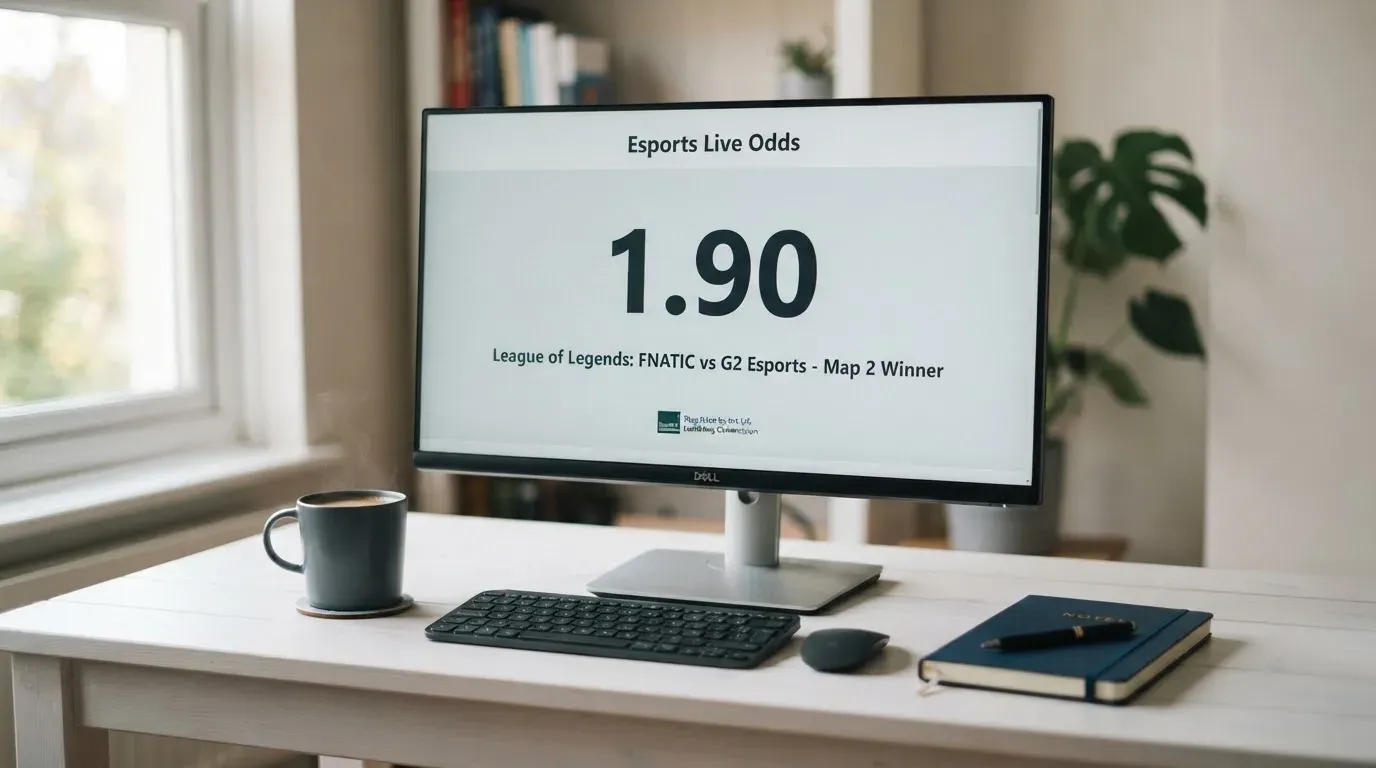
The price the bookmaker offers on a market is shorter than the “true odds” the market would carry in a fair world, and the difference is the margin. The illustration worked through in the next section is the central piece of arithmetic for this page: a two-way market priced at 1.90/1.90 carries a 5% margin, which is the percentage of every pound staked the bookmaker keeps on average. The illustration is exactly that — an illustration, not a quoted price. A real League of Legends moneyline at a major fixture runs closer to 1.85/1.95, which is a margin closer to 5.13%, and the overround figure on a five-way FIFA esports outright runs higher because the bookmaker has to price more outcomes. The arithmetic is the same in every case.
The Margin Inside an Esports Price
A bookmaker’s margin is the percentage of every unit staked the bookmaker keeps on average. The arithmetic is straightforward for a two-way market: payout share is 1 ÷ (1/odds₁ + 1/odds₂), and the margin is 1 minus the payout share. For a three-way market (draw, home, away) the formula extends to three terms.
The illustrative case used across this page is a two-way market at decimal odds 1.90 and 1.90, which is the fractional price 9/10 on each side. The payout share works out as 1 ÷ (1/1.90 + 1/1.90) = 1 ÷ (0.5263 + 0.5263) = 1 ÷ 1.0526 = 0.9500, or 95.00%. The margin is 1 − 0.95 = 0.05, or 5%. The condition for the result is the two prices being equal at 1.90 — a punter reading 1.85/1.95 on the same market runs at 1 ÷ (1/1.85 + 1/1.95) = 1 ÷ (0.5405 + 0.5128) = 1 ÷ 1.0534 = 0.9493, or a 5.07% margin. The 1.90/1.90 illustration sits at the lower edge of esports pricing; a market priced at 1.80/2.00 runs at 1 ÷ (0.5556 + 0.5000) = 1 ÷ 1.0556 = 0.9474, or a 5.26% margin.
The band the page reads as “the esports pricing band” runs from roughly 4% on a heavily liquid League of Legends moneyline to roughly 8% on a less-liquid prop market, with the majors priced tighter and the small markets priced wider. A punter who prices at the bottom of the band pays the bookmaker less per pound staked, which is the only honest measure of a price being “best”. The marketing phrase “best odds” usually means the bookmaker’s own promotion rather than a structurally tighter margin — Super Boosts and Winnings Boosts on Bet Builders move the offered price up, but the base margin on the unboosted price is unchanged.
The margin does not predict any individual bet, and the margin is the average over many bets. A punter who places one bet at 1.90/1.90 wins or loses based on that single event, and the 5% margin is not a charge on the win or a refund on the loss. The 5% is the percentage of every pound staked that the bookmaker keeps across the whole market over many bets, and the figure is an estimate.
A punter who wants to read the margin on a real esports market can do the arithmetic themselves: convert each price to decimal, take the reciprocal, add the reciprocals, divide 1 by the total, subtract from 1. The result is the margin. The procedure works on any market with any number of outcomes, and the calculation is the same one bookmakers use to set prices in the first place.
Esports Sports and Tournaments: The Fixtures UK Bookmakers Price
The titles a UK sportsbook offers in 2026 cover the multiplayer video-game competition market from top to bottom. League of Legends and Dota 2 carry the multiplayer online battle arena (MOBA) vertical, with Counter-Strike and Valorant carrying the tactical shooter vertical, Overwatch carrying the hero shooter vertical, and Call of Duty, Fortnite and Rocket League rounding out the wider catalogue. StarCraft sits in the strategy vertical and remains a professional esport, though at a smaller scale than the leaders. Each title carries its own tournament calendar, its own betting vocabulary, and its own set of bookmakers that price it.
The headline tournament for League of Legends is the World Championship, run by Riot Games at the end of each competitive year. The headline tournament for Dota 2 is The International, run by Valve, with The International 2021 holding a prize pool above US$40 million — the largest in esports history at that time. The Evolution Championship Series (EVO) is the headline tournament for fighting games, run annually with a community-organised structure. Intel Extreme Masters is the headline tournament circuit for Counter-Strike, run by ESL across multiple events each year.
The Esports World Cup sits at the top of the multi-title circuit. The Esports World Cup 2026 runs from 6 July to 23 August 2026 in Paris with a US$75 million prize pool and 24 games; the 2025 edition carried a US$71.5 million prize pool. Team Falcons won the Esports World Cup Club Championship in 2025, defending its 2024 title, which makes them the form team across the multi-title circuit heading into the 2026 event. UK bookmakers price outright winner markets for the Esports World Cup months in advance, and the outright market is where antepost pricing lives.
The bookmaker’s fixture list runs to the league structure underneath each title. The League of Legends EMEA Championship (LEC), the League of Legends Champions Queue in North America, the LCK in Korea and the LPL in China sit underneath Worlds. The Dota 2 Pro Circuit sits underneath The International. ESL Pro League and the BLAST circuit sit underneath IEM for Counter-Strike. The Valorant Champions Tour (VCT) sits underneath the Valorant Champions event.
The betting vocabulary a UK punter meets for a League of Legends fixture runs: match winner, map handicap, total maps, first blood, first to ten kills, first inhibitor, total kills, player props. Counter-Strike carries map winner, map handicap, total rounds over/under, pistol round winner, first to sixteen rounds (on MR12), and player props. Dota 2 carries match winner, map handicap, first blood, first Roshan, total kills, and a longer props list. FIFA esports carries the football-shaped vocabulary adapted to a one-player-per-side format: match winner, total goals over/under, both teams to score, correct score. NBA 2K carries the same football-shaped vocabulary adapted to basketball: match winner, spread, total points over/under.
The market depth a UK bookmaker offers depends on the title and the tournament. League of Legends, Counter-Strike, Dota 2 and FIFA carry the deepest coverage. Valorant, Overwatch, Call of Duty, Rocket League and Fortnite carry thinner coverage, with outright winner markets for the headline tournaments and match markets for the bigger fixtures. StarCraft carries outright winner markets on a smaller number of fixtures. A punter shopping for a market should know which bookmaker carries the deepest coverage of the title they follow, and the answer changes by title.
The fixture schedule a punter should plan around runs the calendar year. League of Legends splits run January to August, with Worlds in September to November. Dota 2’s Pro Circuit runs most of the year, with The International in the late summer. Counter-Strike’s major circuit runs most of the year, with the majors spaced roughly two months apart. Valorant’s Champions Tour runs the calendar with regional leagues and the Champions event. The Esports World Cup runs July to August, sitting across multiple titles. A punter who follows one title gets the rhythm of one calendar; a punter who follows multiple gets the rhythm of all of them.
The Top 10 UK-Licensed Esports Bookmakers in 2026
The ten brands on this list are the UK-licensed sportsbooks reviewed in detail further down the page. The table below carries the licence number and holder for each brand alongside what the operator’s own terms state on esports. The detail on each operator — the welcome offer shape, the in-play product, the bet builder, the app features — sits in the operator reviews that follow the table.
The ranking is not a ranking of a vendor’s “best esports bookmaker”, because no single brand is the only licensed UK bookmaker for esports, and no licence entitles a bookmaker to be “best” at a market. The honest framing: each brand is a Commission-licensed sportsbook that offers esports markets under its own terms, and the comparison is between products, not between licences.
| Brand | Gambling Commission remote licence and holder | What the operator’s own terms state on esports |
|---|---|---|
| Coral | 054743-R-330863-014 (account 54743), held by LC International Limited | Sports welcome offering of £40 in free bets for a £20 sports bet at minimum odds 2.0 (1/1); free bets issued within 7 days, expire 7 days after issue |
| Betmaster | 065699-R-339929-002 (account 65699), held by BM Solutions GB Ltd | App covers football, cricket, horse racing, NFL and eSports (League of Legends, Dota 2) — the only UK-licensed app on this list that calls esports out as a covered headline market in its App Store description |
| Sporting Index | 027343-R-308898-011 (account 27343), held by Sporting Index Limited | Switches between fixed odds and spread betting, with in-play, Bet Builder for football, auto cash-out and Multi-Markets; spread betting is FCA-regulated and can lose more than the deposit |
| Betfair | 039439-R-319330-013 (account 39439), held by PPB Counterparty Services Limited | In-play, Bet Builder, free live streaming of UK and Irish horse racing and football in the app, and a 90 Minute Payout market — the streaming catalogue does not include esports tournaments |
| Fitzdares | 000400-R-103839-030 (account 400), held by Fitzdares Limited | Cash out, accumulators, Lucky 15s, specials and antepost on horse racing, football, tennis, rugby, cricket, golf and American football, with in-play live odds — esports coverage runs inside the wider sportsbook |
| BetGoodwin | 002927-R-327985-008 (account 2927), held by Goodwin Racing Limited | Sports welcome offering of £5 sports bet, £5 acca and £5 Sub-Cover bet for a £10 qualifying bet, with the wider sportsbook running on the same platform |
| Kwiff | 044448-R-323408-017 (account 44448), held by Eaton Gate Gaming Limited | Licensed by the UK Gambling Commission, app carries a 17+ age rating; the operator describes itself as a Spryme Ltd trademark |
| bet365 | 055148-R-331498-002 (account 55148), held by Hillside (UK Sports) ENC | Bet Builder+ combining markets from one event pre-match and in-play, Super Boosts, Winnings Boosts on Bet Builders and selected singles, daily Bet Boosts, in-play, live streaming worldwide, Bet Track, Match Live; official global betting partner of the UEFA Champions League |
| BetVictor | 039576-R-319370-028 (account 39576), held by BV Gaming Limited | Best Odds Guaranteed on UK and Irish horse racing, enhanced live race streaming, BetFinder racing tool and Smart Stats; esports sits inside the wider sportsbook |
| 888sport | 039028-R-319297-014 (account 39028), held by 888 UK Limited | Pre-match and in-play betting, Cash Out, Bet Builder, racing streams, BetFinder form tools, a live bet feed and daily boosted odds |
The table is the snapshot of what each brand’s own terms state at the time of writing. The licence numbers are the entries on the Gambling Commission’s public register that a punter can verify by searching the register against the brand name or the account number. The terms column carries what the operator itself publishes about its esports product; a punter should always read the betting rules on the operator’s site before staking, because market-specific rules — voiding on a server disconnection, settlement on the in-game result versus the broadcast feed — change by title and by operator.
The honest judgement in the comparison is that the larger books — bet365, 888sport, Betfair — earn their place on in-play depth, latency, and bet builder coverage; the racing-shaped books — BetVictor, BetGoodwin, Fitzdares — earn their place on Best Odds Guaranteed, streaming quality, and form tools, with esports a corner of the wider sportsbook rather than a dedicated tab; the smaller books — Betmaster, Kwiff — earn their place on a focused product with esports explicitly named; the spread product — Sporting Index — earns its place on a different FCA-regulated product, with fixed-odds esports the smaller part of the offer.
Overview: What Esports Betting Is and How the Market Works in 2026
Esports is a form of competition using video games, usually organised multiplayer competitions between professional players, individually or in teams. The titles span the multiplayer online battle arena (League of Legends, Dota 2), the tactical shooter (Counter-Strike, Valorant), the hero shooter (Overwatch), the battle royale (Fortnite), the arena sports (Rocket League), the strategy game (StarCraft), and the console shooter (Call of Duty). Each title carries its own publisher, its own competitive circuit, and its own bookmaker coverage.
UK bookmakers price esports like any other event under a Commission-issued remote general betting standard (real events) licence. The Gambling Commission treats esports betting like betting on any other event; what may be bet on is not on a statutory list. A bookmaker offering esports holds a remote general betting standard (real events) licence, and the markets it offers are the markets it has chosen to price. The Commission’s public register lists the licence and the categories it covers, and a punter can verify the register entry against the brand’s own statement of licence.
The bookmaker’s product for esports runs moneyline, map handicap, total maps, totals, and props. The bet builder combines markets from one event. The accumulator multiplies the odds of the legs into one price. Cash out closes a bet in-play at the current price, with auto cash-out available on selected markets. The margin inside the price is the bookmaker’s edge, and the margin is what the punter pays for the service of having a market priced.
A punter who bets on esports in 2026 stakes at a UK-licensed sportsbook that has verified their name, address and date of birth before the first deposit, with a deposit method that is not a credit card, with a GAMSTOP self-exclusion in place if the punter has signed up for one, with the bookmaker’s terms in front of them, and with the realisation that the margin inside the price is the only thing the bookmaker has to win. The rest of the page unpacks each piece.
Legality, Licensing, and the Gambling Commission Framework
A bookmaker serving customers in Great Britain needs a Gambling Commission licence wherever it is based. The Gambling Act 2005 covers Great Britain — England, Scotland and Wales; Northern Ireland is outside the Act and runs its own older law. The Gambling (Licensing and Advertising) Act 2014 amended the 2005 Act so that an operator whose remote facilities are used in Great Britain needs a Commission licence wherever it is incorporated. Sections 33 and 36 of the 2005 Act, as amended, are the offence provisions: providing gambling facilities in Great Britain without the licence the Act requires is an offence under section 33 (on summary conviction up to 51 weeks’ imprisonment, a fine up to level 5, or both; six months in Scotland). A Curaçao, Maltese or Gibraltar licence is not a substitute.
There is no state monopoly and no cap on the number of licences. The licensing categories are remote general betting standard (real events), remote general betting standard (virtual events), remote general betting limited, remote pool betting, and remote betting intermediary (the licence for betting exchanges). Each operator on this page holds a remote general betting standard (real events) licence. The Commission’s public register can be searched by business name, trading name, domain or account number, and is the whole test of whether a brand holds a licence. Licensed operators use .com as well as .co.uk, so the domain proves nothing. A single licence holder can run several brands: LC International Limited is the licence holder for Coral; PPB Counterparty Services Limited is the licence holder for Betfair; Paddy Power and Betfair sit under the same Flutter group on the Commission’s register. Never call a single brand “the only” licensed one.
Financial spread betting is regulated by the Financial Conduct Authority, not the Commission. The distinction matters for Sporting Index’s spread product, which is FCA-regulated rather than Commission-regulated, and which can lose more than the deposit — the warning is on the operator’s own homepage.
The minimum age is 18. Name, address and date of birth are verified before a customer can deposit or gamble, and the requirement has been in force since 7 May 2019, including for a free bet or bonus. A punter who tries to deposit anonymously at a UK-licensed sportsbook cannot do so, and an offshore site that lets a customer deposit without verification is not subject to the Commission’s customer-protection rules.
The in-play product is offered by GB bookmakers under the operator’s own licence conditions and customer-protection duties; no statutory rule opens or closes the in-play product, and the controls are the operator’s compliance with the LCCP and the Commission’s social responsibility code. Esports are treated like any other event under the Commission’s framework; virtual events (computer-generated fixtures) are a separate licence category. Bets on politics, TV shows and novelty markets are offered by GB bookmakers and no statutory prohibition was found. Betting exchanges run under a betting intermediary licence; rates and rules specific to exchanges are stated from each exchange’s terms.
No statutory cap on stakes in sports betting was found. Operators set their own maximum stakes and may restrict customers, and the maximum stake on a boosted market is often lower than the maximum stake on the unboosted market. The Commission’s deposit-limit rules (RTS 12) require operators to offer a gross deposit limit on a fixed time frame; the first changes have applied since 31 October 2025, a second phase was postponed to 30 September 2026, and whether that second phase is live is not established. There is no state-set deposit or loss ceiling for betting: limits are the customer’s choice.
A financial vulnerability check applies to licensed remote betting when a customer’s deposits minus withdrawals exceed £150 in a rolling 30 days (since 28 February 2025). The check is a public-record check (bankruptcy, county court judgments), not an income check and not a credit reference check. Financial risk assessments — the “affordability checks” of the press — are announced in a staged plan with no start date, and the framing is “announced, staged, no start date” rather than “in force”. The punter who triggers the £150 threshold should expect a public-record check, and the punter whose deposit pattern draws a financial risk assessment will be asked for evidence of funds.
The advertising framework is not the Commission’s. Advertising runs through the CAP Code (non-broadcast) and BCAP Code (broadcast), enforced by the ASA, alongside the LCCP marketing conditions. CAP Code section 16: marketing must be socially responsible, must not be of strong appeal to under-18s, and no one who is or seems to be under 25 may be featured gambling or play a significant role (with an exception for marketing placed where a bet can be made directly). The rule concerns who may appear in the advertisement, not who may bet. Promotion rules in force since 19 January 2026: wagering requirements on bonuses are capped at 10x (a £10 bonus at 50x needs £500 of bets; under the cap no more than £100), and mixed-product promotions — an offer that requires gambling on two or more product types such as betting, casino, bingo and lottery, for example “bet on football to get free spins” — are banned. Whether the cap applies to free bets with no wagering condition, and any cap on the money value of a bonus, are not established.
“Whistle-to-whistle” is an industry code, not law: since 1 August 2019 betting advertisements are not shown on TV from five minutes before a live sporting event to five minutes after it, before the 9pm watershed, with horse and greyhound racing excluded. The Premier League clubs’ withdrawal of gambling sponsorship from the front of matchday shirts (from 2026/27; sleeves and hoardings remain) is voluntary, not law. Operators are responsible for marketing by their affiliates.
The tax treatment: the player pays no tax on betting winnings in Great Britain, which is general information rather than tax advice, and a professional gambler should ask HMRC or an adviser. General Betting Duty is the operator’s tax on gross profits, currently 15%; from 1 April 2027 a new remote betting rate of 25% applies within it, while remote bets on UK horse racing, bets on self-service betting terminals in licensed premises, pool betting and in-person betting stay at 15% (HM Government policy paper of 26 November 2025). Spread betting has its own rates (3% financial, 10% other). Until 1 April 2027 the remote rate stays at 15%; whether operators pass duty on through odds is not established, and the page never claims the player is charged duty.
The offshore picture: a GB licence is compulsory at the point of consumption. An operator providing gambling facilities in Great Britain without the licence the Act requires commits the offence under section 33 of the 2005 Act. No offence aimed at a customer who merely bets on an unlicensed site was found: state the loss of protection — no GAMSTOP coverage, no Commission complaints route, no approved dispute-resolution body, no British consumer redress if funds are withheld, not bound by the 10x bonus cap or the £150 vulnerability check — and never “legal to use”. Enforcement is disruption, not blocking: cease-and-desist notices, search-engine referrals, work with registrars, hosts and payment providers; the Commission has been given, or is about to receive, court-order DNS blocking powers — never write that ISP blocking is in operation. The honest framing: licensed means checks, limits, GAMSTOP, bonus cap, but also verification before the first bet; unlicensed means none of those protections and possible loss of funds. Neither is “the safe choice” by default.
Responsible Gambling Tools: GAMSTOP, GamCare, and the LCCP Framework
GAMSTOP is the national multi-operator online self-exclusion scheme and a mandatory licence condition for online operators since 31 March 2020. Every operator on this page is a GAMSTOP member. The self-exclusion periods are six months, one year, five years, or five years with auto-renewal, and after the minimum period the exclusion stays in place for a further seven years unless the customer asks GAMSTOP to remove it. GAMSTOP covers online sites and apps; betting shops use a separate service.
The financial vulnerability check — LCCP condition 3.4.4 — applies to licensed remote betting when a customer’s deposits minus withdrawals exceed £150 in a rolling 30 days, in force since 28 February 2025. The check is a public-record check (bankruptcy, county court judgments), not an income check and not a credit reference check. The financial risk assessments announced in a staged plan are not yet in force; the framing is “announced, staged, no start date”. A punter who triggers the £150 threshold should expect a public-record check.
The deposit-limit rules (RTS 12) require operators to offer a gross deposit limit on a fixed time frame; the first changes have applied since 31 October 2025, and a second phase was postponed to 30 September 2026. Whether the second phase is live is not established. Limits are the customer’s choice; there is no state-set ceiling.
The safer-gambling tools at operator level — deposit limits, time-outs, reality checks, product blocks, session timers — are part of the LCCP and the operator’s licence conditions. Fitzwilliam Sports, a brand outside this page’s licensed set but referenced for its tool disclosure, lists instant deposits, fast withdrawals, timeouts, deposit limits and links to GambleAware, GamStop and Gamblers Anonymous on its homepage; the disclosure is the kind of safer-gambling surface a punter should expect from any UK-licensed operator. The links to GambleAware, GamCare, Gamblers Anonymous and the National Gambling Helpline are the standard signposting.
GamCare runs the National Gambling Helpline; GambleAware funds treatment and research; NHS gambling clinics run in several regions; Gamblers Anonymous runs peer-support meetings. The help services are free, confidential, and available whether or not the punter has self-excluded. The punter who is chasing losses, betting more than they can afford, or hiding their betting from family has the warning signs of harm; the help services are the next step.
The honest framing: the safer-gambling framework is the part of the licensed product that earns its keep, and the punter who uses the tools uses them. A deposit limit the punter sets is the only deposit limit that bites; a self-exclusion the punter registers is the only self-exclusion that holds.
Cryptocurrency and Anonymity at UK-Licensed Esports Bookmakers
A bookmaker licensed by the Gambling Commission verifies the customer’s name, address and date of birth before the first deposit, including for a free bet or bonus, and the requirement has been in force since 7 May 2019. The verification rules are part of the money-laundering framework the operator runs under, and the operator is responsible for source-of-funds questions at higher spend. Identity verification before the first deposit means no anonymous play at a licensed site.
The licensed operators on this page do not advertise cryptocurrency deposit methods. The Commission’s published framework does not establish a ban on cryptocurrency deposits at licensed operators, and the rule is described qualitatively from each operator’s terms: a punter should expect to deposit in pound sterling by debit card, bank transfer, or e-wallet, and the operator should verify the customer’s identity before the first deposit. The offshore sportsbooks that advertise “esports crypto betting” run outside the GB licence regime; they verify lightly or not at all, and the loss of protection covers the absence of GAMSTOP, the absence of a Commission complaints route, the absence of approved dispute resolution, the absence of British consumer redress if funds are withheld, and the absence of the 10x bonus cap. The page never describes an unlicensed brand as a viable alternative to a licensed one.
The honest framing: a punter who wants to bet on esports at a UK-licensed sportsbook is identified, the funds are traced where the rules require it, and the product is paid for in sterling. The punter who wants anonymity bets offshore and accepts the loss of protection that goes with it. Neither is “the safe choice” by default, and the page makes that judgement plain.
Bonuses and Free Bets at UK-Licensed Esports Bookmakers
The marketing word “free bet” usually means the stake is not returned with the win. A £10 free bet at decimal odds 3.00 returns £20 (£10 × (3.00 − 1) = £20 profit, no stake returned), which is the same arithmetic as a £10 stake at 2.00 returning £20 (£10 × 2.00 = £20 return, £10 stake plus £10 profit). The “free” is on the stake, not on the return, and the punter who reads “free £30” should price it as a £30 stake that does not come back with a win.
The promotion rules in force since 19 January 2026 cap wagering requirements on bonuses at 10x — a £10 bonus at 50x needs £500 of bets, and the cap forbids anything above £100 of bonus turnover — and ban mixed-product promotions (an offer that requires gambling on two or more product types). Whether the cap applies to free bets with no wagering condition, and any cap on the money value of a bonus, are not established. A punter who claims a welcome offer at a UK-licensed sportsbook should read the wagering requirement, the minimum odds, the expiry, and the eligible markets before staking.
The welcome offers at the operators on this page sit at the simpler end of the spectrum. Coral’s sports welcome offer is £40 in free bets when £20 is staked at minimum odds of 2.0 (1/1), with the free bets issued within 7 days and expiring 7 days after issue, for new GB customers who opt in. BetGoodwin’s sports welcome offer is £5 sports, £5 acca and £5 Sub-Cover in free bets for a £10 qualifying bet. The remaining operators on the list advertise welcome offers of their own shape, and the page does not detail every one — the punter should check the operator’s promotions page for the current shape, the eligible markets, and the expiry.
The daily Bet Boosts on bet365 are the product-shaped boosts rather than welcome offers: a boosted price on a named selection, with a stake cap that is usually lower than the unboosted market. The value of a boost is the difference between the boosted price and the unboosted price, multiplied by the stake; the punter who reads “Super Boosted” should look at the unboosted price beside it and decide whether the boost is worth the stake cap.
The honest framing: the welcome offer is paid for in the wagering requirement, the eligible markets, and the expiry. A punter who claims a £40 free bet offer with a 1x wagering requirement on any sports market at minimum odds 2.0 walks away with a different expected value than a punter who claims the same offer with a 5x wagering requirement on esports markets only at minimum odds 4.0. The marketing word “free” is the marketing word, and the conditions under it are the page that follows.
Payments and Payout Speed at UK-Licensed Esports Bookmakers
Credit cards are banned for gambling in Great Britain (since 14 April 2020, LCCP condition 6.1.2), including credit-card-funded payments through an e-wallet; debit cards and bank-based payments are not covered by that ban. Identity verification before the first deposit means no anonymous play at a licensed site, and source-of-funds questions at higher spend are normal under the money-laundering rules. A British named-account rule, a state list of permitted payment methods and any rule for or against cryptocurrency deposits at licensed operators are not established.
The licensed operators on this page accept debit cards and bank-based payments; the e-wallet coverage varies by brand. PayPal, Skrill, Neteller and Trustly are widely accepted at UK-licensed sportsbooks, and paysafecard is accepted at most brands as a prepaid voucher. Apple Pay and Google Pay are increasingly available as mobile wallet options, with the underlying payment a debit card rather than credit. The exact mix sits on the operator’s banking page; the punter should check the deposit and withdrawal methods before opening an account, particularly if the punter wants fast withdrawals to a specific e-wallet.
Withdrawal speed is the second part of the picture. Most UK-licensed sportsbooks process withdrawals back to the original deposit method within 24 to 48 hours, with the receiving bank’s processing time adding another 1 to 3 working days for debit cards and 1 to 2 working days for bank transfer. E-wallet withdrawals (PayPal, Skrill, Neteller) are typically faster — same-day or next-working-day once the operator has approved the withdrawal. The punter who wants fast withdrawals should check the operator’s stated payout time before staking, and the punter who wants the fastest payout should use an e-wallet.
The honest framing: the licensed operators on this page offer a similar payment product, with the speed difference sitting in the e-wallet coverage rather than the debit card coverage. A punter who values PayPal deposits and same-day withdrawals will read the operator’s banking page first; a punter who values bank transfer and is willing to wait two working days will read the welcome offer first.
Operator Reviews
The reviews below cover the ten UK-licensed bookmakers. Each review carries the licence number, the licence holder, what the operator’s own terms state on esports, the welcome offer shape where relevant, and a one-paragraph judgement on who the brand suits for esports betting in 2026. The judgement is the page’s own, drawn from what the operator’s terms say and what the product offers.
Coral
Coral runs under Gambling Commission remote licence 054743-R-330863-014 (account 54743), held by LC International Limited. The categories on the Commission’s register cover remote general betting standard (real events) and remote betting intermediary. The brand is one of the UK high-street names, with the sportsbook sitting alongside the wider gambling product. The sports welcome offer is £40 in free bets for a £20 sports bet at minimum odds of 2.0 (1/1), with free bets issued within 7 days and expiring 7 days after issue.
For esports, Coral offers the markets inside the wider sportsbook: moneyline, map handicap, totals, and the props list where the bookmaker supports it. The in-play feed and the bet builder are standard for the wider sports product. Coral’s strength is its position as a UK high-street name with deep sportsbook coverage and the cash-out product behind it. A primary disadvantage for the esports-focused bettor is the lack of a dedicated esports vertical; markets are integrated into the general sportsbook. Coral is a robust option for the multi-sport bettor who values a familiar high-street interface over a dedicated esports portal.
Betmaster
Betmaster runs under Gambling Commission remote licence 065699-R-339929-002 (account 65699), held by BM Solutions GB Ltd. This operator is registered with the Commission under the remote general betting standard (real events) category. The app is published by Bm Solutions Gb Limited and covers football, cricket, horse racing, NFL and eSports (League of Legends, Dota 2). Betmaster is the only operator on this page whose App Store description calls esports out as a covered headline market alongside the bigger sports.
For esports, the named coverage of League of Legends and Dota 2 is the headline feature, and the in-play feed runs through the wider sportsbook. The bet builder and cash out are standard. Betmaster’s strength is the explicit esports labelling and the focused product; the weakness is the smaller absolute fixture depth compared to bet365 and 888sport. Betmaster suits a punter who follows League of Legends and Dota 2 specifically and wants an app that treats those titles as a primary product rather than a corner of the sportsbook.
Sporting Index
Sporting Index runs under Gambling Commission remote licence 027343-R-308898-011 (account 27343), held by Sporting Index Limited. The operator is listed on the Commission’s register under the remote general betting standard (real events) category. The brand is FCA-regulated for spread betting and Commission-regulated for fixed-odds betting, and the site carries the warning that spread betting losses can exceed the deposit.
The product switches between fixed odds and spread betting, with in-play, a Bet Builder for football, auto cash-out and Multi-Markets. For esports, the fixed-odds product offers the standard markets; the spread product offers indexes on named fixtures, with settlement on the closing price rather than the result. Sporting Index’s strength is the spread product for a punter who wants a different kind of exposure; the weakness for a casual esports punter is the complexity of the spread product and the FCA-regulated frame that surrounds it. Sporting Index suits a punter who reads spread betting as a deliberate product choice, not as a side feature.
Betfair
Betfair runs under Gambling Commission remote licence 039439-R-319330-013 (account 39439), held by PPB Counterparty Services Limited. The category on the Commission’s register is remote general betting standard (real events). The brand is the consumer-facing sportsbook; the exchange sits on a separate app under the same licence holder. The product offers in-play, Bet Builder, free live streaming of UK and Irish horse racing and football within the app, and a 90 Minute Payout market.
For esports, the Sportsbook app offers moneyline, map handicap, totals, and the props list; the exchange offers the deeper market with back and lay prices. The streaming catalogue does not include esports tournaments, which is the limit a punter should know. Betfair’s strength is the combination of the sportsbook and the exchange, and the depth of the in-play feed; the weakness for an esports-only punter is the absence of esports streaming. Betfair is best for the punter who wants to toggle between sportsbook and exchange markets in one account.
Fitzdares
Fitzdares runs under Gambling Commission remote licence 000400-R-103839-030 (account 400), held by Fitzdares Limited. The app offers cash out, accumulators, Lucky 15s, specials and antepost markets on horse racing, football, tennis, rugby, cricket, golf and American football, with in-play live odds.
For esports, the markets sit inside the wider sportsbook, and the App Store description does not list esports as a primary vertical. The cash out and accumulator products run through the wider sports product. Fitzdares’ strength is the premium positioning on horse racing and the antepost markets; the limitation for an esports-focused bettor is that these markets are not hosted under a dedicated tab. Fitzdares is tailored for the premium bettor who prioritises horse racing and football, treating esports as a secondary market.
BetGoodwin
BetGoodwin runs under Gambling Commission remote licence 002927-R-327985-008 (account 2927), held by Goodwin Racing Limited. The brand carries a sports welcome offer of £5 sports bet, £5 acca and £5 Sub-Cover in free bets for a £10 qualifying bet. The app supports the wider sportsbook on the same platform.
For esports, the markets sit inside the wider sportsbook, with moneyline and map handicap available on the bigger fixtures. The in-play feed and cash out are standard. BetGoodwin’s strength is the focused welcome offer and the racing-shaped product; the weakness for an esports-heavy punter is the racing-shaped focus. BetGoodwin is a straightforward choice for the punter who appreciates a clear, racing-focused welcome offer.
Kwiff
Kwiff runs under Gambling Commission remote licence 044448-R-323408-017 (account 44448), held by Eaton Gate Gaming Limited. The brand describes itself as a Spryme Ltd trademark; the app carries a 17+ age rating.
For esports, the markets run inside the wider sportsbook. The “supercharged” pricing product is the brand’s headline feature — a randomly applied odds boost on selected markets — and the boost is the marketing shape rather than the structural edge. Kwiff’s strength is the boost mechanic for a punter who wants a surprise on the price; the weakness for a punter who prices structurally is that the boost does not change the base margin on the unboosted market. Kwiff caters to the punter who enjoys a randomised price boost rather than a consistent pricing structure.
bet365
bet365 runs under Gambling Commission remote licence 055148-R-331498-002 (account 55148), held by Hillside (UK Sports) ENC. The brand is the official global betting partner of the UEFA Champions League, and the app is described as the most downloaded sports betting app in the UK. The product offers Bet Builder+ combining markets from one event pre-match and in-play, Super Boosts, Winnings Boosts on Bet Builders and selected singles, daily Bet Boosts, in-play betting, live streaming of events worldwide, Bet Track, Match Live, and a Live Golf Tracker.
For esports, bet365 offers the deepest market depth of any operator on this page: moneyline, map handicap, totals, full props, bet builder on the bigger fixtures, in-play with live data, and cash out across most markets. The streaming catalogue does not always include esports tournaments, but the in-play feed is the deepest. bet365’s strength is the combination of in-play depth, bet builder coverage, and app polish; the weakness is that the product is large enough that a casual punter can struggle to find the smaller markets. bet365 suits the punter who follows multiple esports titles and wants one app with depth across all of them.
BetVictor
BetVictor runs under Gambling Commission remote licence 039576-R-319370-028 (account 39576), held by BV Gaming Limited. The category on the Commission’s register is remote general betting standard (real events). The brand offers Best Odds Guaranteed on UK and Irish horse racing, enhanced live race streaming, a BetFinder feature for finding racing bets, and Smart Stats. The wider sportsbook sits alongside the racing-shaped product.
For esports, the markets sit inside the wider sportsbook, with moneyline and map handicap on the bigger fixtures. The in-play feed and cash out are standard. BetVictor’s strength is the horse racing product and the form tools; the weakness for an esports-heavy punter is the racing-shaped focus.
888sport
888sport runs under Gambling Commission remote licence 039028-R-319297-014 (account 39028), held by 888 UK Limited. The category on the Commission’s register is remote general betting standard (real events). The product offers pre-match and in-play betting, Cash Out, Bet Builder, racing streams, BetFinder form tools, a live bet feed, and daily boosted odds.
For esports, 888sport offers moneyline, map handicap, totals, and props on the bigger fixtures, with the bet builder running through the wider sportsbook. The in-play feed and cash out are standard. 888sport’s strength is the combination of pre-match and in-play depth with the cash-out product behind it; the weakness for an esports-heavy punter is the absence of esports as a labelled tab. 888sport suits the punter who follows multiple sports with esports one of them, rather than the punter who treats esports as the primary staking product.
Verdict Across the Ten
The honest comparison across the ten operators on this page comes down to two questions. The first is whether the punter follows esports as a primary product or as a corner of a wider sportsbook; the second is whether the punter wants the deepest in-play feed or the simplest welcome offer. For the punter who follows esports full-time, bet365 is the strongest fit on product depth, in-play latency and bet builder coverage; 888sport is the close second with the cash-out product and the boosted odds. For the punter who wants esports named as a primary vertical, Betmaster is the cleanest fit on the App Store description. For the punter who wants the spread product as a deliberate choice, Sporting Index is the only option. For the punter who wants the racing-shaped product with esports as a corner, Coral, BetVictor, BetGoodwin, Fitzdares and Kwiff sit at the same level with different shapes. For the punter who wants the exchange plus the sportsbook, Betfair is the only option.
The marketing phrase “best esports bookmaker” is not one the page uses. The honest judgement: a punter who picks the right bookmaker for the punter’s staking pattern bets at a Commission-licensed sportsbook with the markets the punter wants priced at a margin the punter has read. The rest is marketing.
FAQ
How does a bettor place a bet on esports at a UK-licensed sportsbook?
A bettor opens an account with a Commission-licensed sportsbook, completes identity verification (name, address, date of birth) before the first deposit, deposits in sterling by debit card, bank transfer or e-wallet, picks an esports fixture from the sportsbook, selects a market (moneyline, map handicap, totals, props, bet builder), enters a stake within the operator’s minimum and maximum, and confirms the bet. In-play bets work the same way once the match starts, with cash out available on selected markets.
What is esports betting in the UK?
Esports betting is wagering on competitive video game events at a UK-licensed sportsbook. The titles include League of Legends, Dota 2, Counter-Strike, Valorant, Overwatch, Call of Duty, Fortnite, Rocket League and StarCraft; the tournaments include the League of Legends World Championship, The International, EVO, Intel Extreme Masters, and the Esports World Cup. The Commission treats esports betting like betting on any other event under a remote general betting standard (real events) licence.
Which UK-licensed sportsbooks offer esports markets?
The ten operators reviewed on this page all hold a Gambling Commission remote general betting standard (real events) licence and offer esports markets under their own terms. The market depth varies: bet365 and 888sport carry the deepest coverage of the bigger titles; Betmaster labels esports as a primary vertical in its App Store description; Coral, BetVictor, BetGoodwin, Fitzdares, Kwiff, Betfair and Sporting Index offer esports inside the wider sportsbook. A punter should verify the brand on the Commission’s public register before staking.
How can a bettor verify a UK bookmaker’s Gambling Commission licence?
The Commission’s public register is searchable by business name, trading name, domain or account number. A bettor enters the brand name or the account number (for example, 54743 for Coral), checks the licence categories (a remote general betting standard (real events) licence covers esports), checks the licence holder against the brand’s own statement of licence, and confirms the entry is current. A .com domain does not prove a licence, and a single licence holder can run several brands.
How is a bet’s return worked out from the stake and the odds?
In decimal odds, return = stake × odds and profit = stake × (odds − 1). In fractional odds (for example 5/1, 11/4, evens), decimal odds = numerator ÷ denominator + 1, so 5/1 = 6.00, 11/4 = 3.75, evens = 2.00. A £10 stake at decimal odds 3.75 returns £37.50, which is the £10 stake plus £27.50 profit. For a combination bet, the odds of the legs multiply into one price.
What is the bookmaker’s margin and how does it appear in the odds?
The margin is the percentage of every unit staked the bookmaker keeps on average across a market. The arithmetic for a two-way market at decimal odds o₁ and o₂ is payout share = 1 ÷ (1/o₁ + 1/o₂) and margin = 1 − payout share. The illustrative 1.90/1.90 case prices at 1 ÷ (0.5263 + 0.5263) = 0.95, or a 5% margin; a 1.85/1.95 market prices at 5.07%; a 1.80/2.00 market prices at 5.26%. The margin is an average across many bets, and the figure is an estimate rather than a charge on any single bet.
US & other team sports – oddsguaranteed
Content created by the «oddsguaranteed» team
