
Badminton betting tips 2026: a guide, not a tip sheet
 Available in US

The shape of badminton on a betting slip is small and quiet — a market tucked behind the football and the horse racing, with fewer matches on the coupon and fewer writers shouting about it. That quietness is part of why the sport tempts confident tipsters. Form tables for BWF World Tour events are published, head-to-heads exist, and the temptation to crown a winner is real. The purpose of this page is the opposite: a working understanding of how a tip is actually built, why a price can still be wrong even when the prediction is right, what a bookmaker’s margin costs the bettor who ignores it, and which British bookmakers hold the Gambling Commission licence that lets them take a bet from a customer in Great Britain.
The angle here is consequence — what follows from each fact once it sits beside another. A 1.90/1.90 line on a final tells the reader a number; the same number next to the market’s margin tells the reader what that number is worth. A “free bet” written in marketing type tells them a thing exists; the same offer next to its wagering requirement and minimum odds tells them what it costs. The page makes those pairings, in the order a reader needs them, from how a match is scored through to the operators that will take the bet.
As of October 30, 2026, the licence figures below were verified against the Gambling Commission’s public register.
How a Badminton Match Is Built and What That Means for a Tip
A badminton match is the best of three games, each played to 21 points under rally-point scoring. That single rule, more than any form line, decides the shape of a match — and therefore the shape of a bet. At 20–20, play continues until one side leads by two; at 29–29, the next point wins. The “game point” the commentator announces at 20–16 is not the last meaningful point of the game, because the side that trails can still string together enough points to force a deuce. A bet on the match winner that reads like a coin-flip at 19–17 is not a coin-flip at 29–28; the player serving into the deuce end holds a quiet edge that the odds may or may not have priced in.

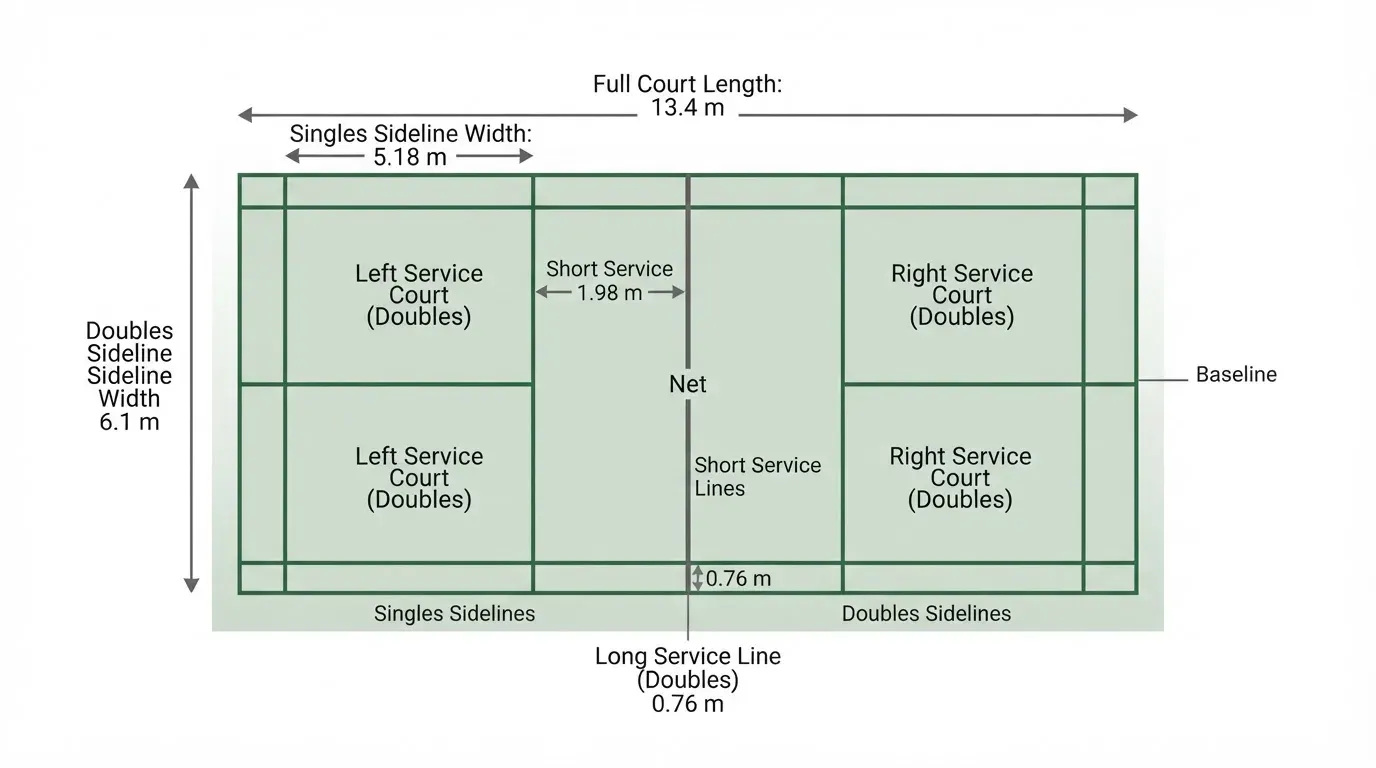
A badminton court is 13.4 m long, 6.1 m wide for doubles and 5.18 m wide for singles, with a net 1.524 m at the centre and 1.55 m at the posts. The five disciplines of the sport are men’s singles, women’s singles, men’s doubles, women’s doubles and mixed doubles. The smaller court for singles sounds trivial until the reader remembers that the same player covers the entire 5.18-metre width in defence, which is why long rallies in men’s singles stretch further than long rallies in doubles and why momentum in a singles game can swing three or four points in a row. Live bettors who have not watched this notice only that the favourite is “fighting back”; bettors who have notice that the backhand cross-court has started landing and the smash is back in play, and they read the line movement differently.
The Badminton World Federation (BWF) has governed the sport since 1934, when it was founded as the International Badminton Federation. Badminton has been an official Summer Olympic discipline since 1992, with mixed doubles added at the 1996 Games. The major team trophies are the Thomas Cup for men, the Uber Cup for women, and the Sudirman Cup for mixed teams — all three held every two years, with the Sudirman Cup running since 1989. The All England Open Championships, the sport’s oldest, date to 1900; the BWF World Championships to 1977. None of these dates by itself tells a bettor who wins on Tuesday — but they fix the calendar a reader plans around. A year with both a Thomas Cup and an Olympics carries a longer, denser run of top-level matches; a year with neither has fewer fixtures and a thinner coupon.
What a “tip” actually contains
A tip is not a name. A tip is a chain of four claims, each of which can fail on its own:
- A claim about the form of each player — recent results, fitness, head-to-heads, the rackets in use.
- A claim about the conditions — court surface, altitude, indoor or outdoor, the shuttle batch, and how each player’s game fits the venue.
- A claim about the probability of each outcome, translated into a fair price.
- A claim that the bookmaker’s price is higher than that fair price — the value bet.
A prediction that names the eventual winner proves none of the four on its own. A 1.70 favourite who wins 2–0 has paid less than the 1.90 outsider who wins 2–1; the favourite-winner is not the value-winner. This is the distinction the rest of the page turns on, because it is the one marketing copy collapses and the one a reader can apply without any insider knowledge of the sport.
The rule the marketing never volunteers
Every price on a coupon carries the bookmaker’s margin — the cut the bookmaker keeps on every unit bet, whatever the result. That margin is the reason the same market at different firms reads differently and the reason two bookmakers can disagree on a match both of them have priced honestly. The margin is not a charge on a winning bet; it is a tax on every bet. A reader who does not see it is paying it anyway. The arithmetic of it is given later in plain numbers; the consequence of it is everywhere on this page.
Regulation and the British Licensing Frame
A bookmaker taking bets from customers in Great Britain needs a Gambling Commission licence, no matter where the company is based. That is the simple, hard shape of the law. Since the Gambling (Licensing and Advertising) Act 2014, an operator whose remote facilities are used in Great Britain needs a Commission licence, full stop — a Curaçao, Maltese or Gibraltar licence is not a substitute, and the Commission’s public register is the whole test of who holds one.
The framework itself sits on the Gambling Act 2005, which covers England, Scotland and Wales. Northern Ireland has its own, older law, and a GB-licensed operator is not “licensed in Northern Ireland” by virtue of that GB licence — though several do accept customers from there under the local regime. The regulator is the Gambling Commission, a non-departmental public body sponsored by the Department for Culture, Media and Sport.
Licences are issued by category. A remote general betting standard (real events) licence covers sports betting on real fixtures; a separate category exists for virtual events; another for pool betting; another for betting intermediary, the licence a betting exchange runs on. A spread-betting firm that takes bets on financial markets is regulated by the Financial Conduct Authority, not the Commission. Spreadex, for example, sits on both registers because it offers financial spread betting under the FCA and fixed-odds sports betting under the Commission.
There is no state monopoly and no cap on the number of licences. What the Commission does enforce is the Licence Conditions and Codes of Practice — the LCCP — which carry the social responsibility rules, the marketing code, the technical standards and the bonus cap that took effect in 2026. The reader does not need to read the LCCP. The reader needs to know it exists, because every safeguard further down this page is a consequence of a line in it.
What a licence buys a customer
A GB-licensed bookmaker has to verify a customer’s name, address and date of birth before the first deposit or bet — including with a free bet or a bonus. There is no anonymous play on a licensed site. The bookmaker has to be a member of GAMSTOP, the multi-operator self-exclusion scheme, and offer deposit limits, product restrictions and self-exclusion as standard. Disputes go to an approved alternative dispute resolution (ADR) provider, and the operator’s licence can be reviewed, suspended or revoked for breach. A British credit card has been banned for gambling since 14 April 2020, including credit-card-funded payments through an e-wallet — debit cards and bank transfers are not covered by the ban.
A bookmaker without a GB licence can still run an attractive website, advertise in British-facing media, accept a British customer’s deposit and pay out the occasional win. The same customer has no Commission complaints route, no approved ADR, no access to GAMSTOP, and no British consumer protection if the firm withholds funds. The Commission’s enforcement does not block access; it sends cease-and-desist notices, refers pages to search engines, and works with registrars, hosts and payment providers to take facilities down. The customer is the one who loses the protections if they bet there, not the one who gains a price.
Verifying a licence
The Commission’s public register is searchable by business name, trading name, domain or account number. Every operator reviewed on this page is named with the Commission’s account number; a reader who wants to check the licence themselves types that number into the register’s search. A licensed operator may use .com as well as .co.uk, so the domain proves nothing — the register does. The register is also where a reader who sees a brand claiming to be “the only licensed one” can confirm that several others sit beside it. A licence is a permission, not a ranking.
Responsible Gambling in Great Britain
GAMSTOP is the national multi-operator online self-exclusion scheme, and a GB-licensed remote operator has been required to participate since 31 March 2020. The minimum commitment is six months; the next step up is one year; the longest is five years with auto-renewal. After the chosen minimum period ends, the exclusion stays in place for a further seven years unless the customer asks GAMSTOP to remove it. Coverage is online — betting shops use a separate self-exclusion scheme. Every operator reviewed on this page takes part; Kalooki Sportsbook, for instance, is listed on the GAMSTOP roll.
Licensed bookmakers also offer deposit limits, time-out periods, product restrictions (for example, suspending casino access while keeping sports betting open), reality checks and full self-exclusion. Some, including Unibet, also surface a Player Profile test and live chat support, with links to GamCare, GambleAware, GAMSTOP, Gambling Therapy and the Betting and Gaming Council. These are not marketing extras. They are the LCCP conditions that come with the licence.
Two newer rules change what a customer meets on the way in. The first is the financial vulnerability check (LCCP condition 3.4.4, in force since 30 August 2024). Once a customer’s deposits minus withdrawals cross £150 in any rolling 30-day period, the operator runs a public-record check — bankruptcy, county court judgments, the registers of insolvency and the like. It is not a credit reference check and not an income check, and the rule is a vulnerability check, not a “means test”. The second is the staged set of financial risk assessments the regulator has announced, with phased start dates and no single launch day; the press sometimes calls these “affordability checks”. Until a start date is fixed, treat any operator statement of “we already run full affordability checks” as a marketing line, not a regulatory one. Finally, the operator must offer a gross deposit limit on a fixed time frame (Remote Technical Standard 12), with the first phase live since 31 October 2025 and a second phase scheduled to come into effect on 30 September 2026 — the live status of that second phase has not been confirmed on this page.
There is no state-set deposit or loss ceiling. Limits are the customer’s choice. Help lines run in parallel: GamCare and its National Gambling Helpline, GambleAware, the NHS gambling clinics and Gamblers Anonymous. A reader who needs any of these does not need to read the rest of the page first.
What changes for a bettor who uses these tools
A bettor who sets a £50 weekly deposit limit and sticks to it has done more for their bankroll than any staking formula on the rest of this page. A bettor who registers with GAMSTOP removes the ability to chase at the operator’s own tables for the period chosen. A bettor who walks away from a session after a planned stop-loss has made the only decision a staking plan ever really makes: the one to stop. The arithmetic further down assumes a bettor who is still in control of the betting. Without that, the arithmetic is decoration.
Bonuses and Free Bets on a Badminton Coupon
The marketing names for offers on a UK sportsbook fall into a small set: deposit match, free bet, enhanced odds, price boost, acca insurance, money-back-as-free-bet, and bet-and-get. The names overlap, and the same word can mean different things on different sites. Reading the small print is the only way to know which.
A free bet is a token the bookmaker credits to a customer’s account, usually in return for a qualifying bet at minimum odds. The stake is not paid back with a win on a free bet — the winnings are. A £10 free bet at 3.00 returns £20, not £30, because the £10 stake disappears. A deposit match credits the customer with a percentage of their first deposit as bonus funds, which are usually subject to a wagering requirement before withdrawal. The wagering requirement is the multiple of the bonus (or the bonus plus deposit) that has to be turned over in qualifying bets before winnings become withdrawable.
The Commission capped wagering requirements at 10x from 19 January 2026. A £10 bonus therefore needs no more than £100 of qualifying bets to clear under that cap. Mixed-product promotions — an offer that compels gambling on two or more product types, such as “bet on football to unlock free casino spins” — are banned under the same package of rules.
BoyleSports’ Acca Insurance illustrates the structure. The promotion is opt-in, requires a £5 minimum stake, takes bets at minimum odds of 1/2 (1.50 decimal), pays a maximum refund of £20 as a free bet that expires in 7 days, and the qualifying bets have to be placed and settled on the same day. That is a real protection against one leg of an accumulator letting the punter down — for a maximum of £20, on bets of £5 or more, at odds of 1.50 or bigger, on legs that all settle in a single day. The marketing copy will call it “acca insurance”; the small print is what the customer should read.
A “money-back” offer that refunds in a free bet rather than cash is not a refund in money. A “risk-free” bet in marketing copy usually means exactly this: the stake is returned only as a free bet if it loses, and the free bet carries its own conditions. A price boost is a one-off enhanced price on a chosen outcome, usually with a small stake cap. A best-odds-guaranteed offer (BOG) is horse-racing-specific and applies on UK and Irish racing — it does not touch a badminton coupon. A bet-and-get offer credits a small free bet for placing a qualifying bet at minimum odds, with the free bet carrying its own minimum odds and expiry.
The hidden cost of a “free” offer
Every wagering requirement is a target the customer has to hit. Hitting it means placing bets; placing bets at a margin below 100% payout share means losing, on average, the margin times the turnover. A £10 bonus at 10x means £100 of bets; if the market’s margin is 5%, the expected cost of clearing the offer is £5. The “free” £10 has therefore cost £5 to realise, and £5 of net value is what the customer walks away with on average. That arithmetic is exact, and it is the cost of the offer before the customer has won or lost a single match. It is also why two offers with the same headline value can carry very different real cost: the higher the wagering multiple, the bigger the margin tax on the turnover, the smaller the value.
There is no free lunch in a wagering requirement. The closer a customer looks, the smaller the lunch turns out to be.
Live Betting and Cash Out on Badminton
Live betting on badminton is offered by GB-licensed bookmakers — Midnite’s site, for example, lists in-play events alongside an acca builder and price boosts. The controls are the operator’s licence conditions and customer-protection duties; there is no statutory “in-play is restricted” line, and there is no statutory “in-play is unrestricted” line either. What a bookmaker offers and what a bookmaker suspends is set by the house.
Live betting on badminton rewards a particular kind of watching. A reader who has tracked a player’s backhand cross-court landing rate across a season will see the price on the next game move before the commentator names the reason. A reader who has not will see only a swinging number and react to the last point. That gap is the live edge, when one exists, and the live trap when it does not — the bookmaker’s in-play traders are not asleep.
Cash out is the bookmaker’s offer to settle a bet before the match is over, at a price the bookmaker sets. The offered cash-out figure is rarely the true mid-price of the position; the spread is the bookmaker’s edge on closing the trade early. A punter who cashes out a winning position at a lowball price has paid for the convenience of not having to wait. A punter who cashes out a losing position to “stop the bleeding” has locked in the loss rather than watched it resolve. The cash-out button is not a friend or an enemy; it is a tool with a price.
bet365’s app lists in-play betting and live streaming across a wide range of events, with a Bet Tracker, Match Live and a Live Golf Tracker to follow bets in play. Live streaming is not the same as live data — a stream shows what is happening, a tracker shows what the bookmaker thinks the price should be now. The Fitzdares app carries cash out, accumulators, Lucky 15s, specials and antepost markets across horse racing, football, tennis, rugby, cricket, golf and American football, with in-play odds on those sports. Swifty Sports lists Best Odds Guaranteed, Cash Out on markets including horse racing and football, daily price boosts, live streaming and in-play betting; its Bet Builder is listed as coming soon. None of these features is badminton-specific, and a badminton punter should check each operator’s in-play list for the discipline before assuming coverage.
The live trap
Live betting is where the bankroll goes to die if discipline is missing. The price moves because the market is re-pricing the match in real time; the punter’s edge, if any, has to be re-priced in real time too. A bettor who has not prepared cannot react in the eight seconds between a break point and the bookmaker’s next suspension. A bettor who has prepared — knows the player’s usual comeback rate, knows the opponent’s service pattern under pressure, knows the deuce-end serving bias — has a fighting chance. The preparation is the edge; the live slip is only where the edge is exercised.
Predictions, Strategy and Bankroll Discipline
A prediction is a forecast. A strategy is a set of rules for acting on forecasts without going broke. Most pages called “badminton betting tips” are full of forecasts and short on rules; that is why they read like tip sheets and not like guides. The guide’s job is the other way around.
Form, statistics, line-ups
A tip built on form alone is fragile. A player returning from injury may carry a recent loss that flatters the next opponent; a player’s head-to-head against a particular rival may be unrepresentative because they met on a faster court last time; a tournament’s draw may have separated the seeded opponents into opposite halves. Form is a starting filter, not a verdict. Statistics are useful when they are kept by the same source, season after season, so the trend is visible — the BWF publishes tournament-level results and player rankings, but a single win–loss line on a third-party site is not the same instrument. Line-ups matter more in doubles than in singles, where the chemistry between two players decides the unforced-error rate that no ranking captures.
The question is not “who wins”. It is “who wins more often than the bookmaker’s price assumes”. A 1.50 favourite who wins 70% of the time is fairly priced; the same favourite who wins 60% of the time is being overpaid. The reader’s edge, if any, is in the gap between the bookmaker’s probability estimate and the reader’s own. That gap has to be earned.
The value bet
A value bet is a price whose decimal odds are higher than the reciprocal of the bettor’s estimate of the true probability. If a bettor estimates a player has a 60% chance of winning, the fair decimal price is 1 ÷ 0.60 = 1.67. A bookmaker offering 1.85 on that player is offering value; a bookmaker offering 1.50 is offering the favourite tax. The bettor places the value bet when the offered price exceeds the fair price; the bettor does not place the bet when the offered price is below it, even if the player is the favourite.
This is the part the marketing copy collapses. A tipster who backs the favourite at 1.30 every match is not offering value tips; they are offering favourite tips, and the bookmaker’s margin is going to eat the difference over a season. A tipster who backs the underdog at 4.00 when the true price is 3.00 is offering the wrong way. The discipline is the price, not the name.
A value bet does not guarantee a win. The 60% player still loses four times in ten. The bettor’s job is to be right on the price more often than the bookmaker, in aggregate, across many bets. A reader who treats any single bet as the bet that proves the system has misunderstood what a value bet is.
Staking and bankroll
A bankroll is the amount of money a bettor has set aside for betting, separate from rent, bills and savings. A staking plan is the rule that decides how much of the bankroll goes on each bet. The simplest staking rule is flat staking: a fixed percentage of the bankroll — commonly 1% to 3% — on every bet, regardless of confidence. Flat staking does not maximise returns; it maximises the number of bets the bankroll survives through, which is the property a bettor actually wants.
A more ambitious plan is the Kelly criterion, which sizes each stake to the edge the bettor believes they have. A bettor who estimates a 60% chance at a price of 1.85 has an edge, and Kelly sizes the stake accordingly. Kelly in full is volatile — it asks the bettor to accept large swings — and most bettors who use Kelly use a fractional Kelly (a half or a third) for the same reason. A plan that asks for 20% of the bankroll on a single bet is not a plan; it is a description of how the bankroll ends.
The unit stake in this page is one unit per bet, on a flat-stake plan. That keeps the maths legible and the bankroll intact.
Why no tip is ever certain
A badminton match is decided by human performance under fatigue, pressure, weather inside a hall, shuttle condition, racket tension and the state of the opponent’s knee. A forecast that names the winner of a single match is a forecast that ignores half of those factors. A forecast that names the winner of every match over a season is a forecast that pretends the factors do not move. Both are wrong, and both will produce losses over a sample large enough to expose them.
Betting is not an income. A reader who reads this page and concludes otherwise has read a different hand.
Bet Types, Odds and How a Price Is Read
Badminton markets at GB bookmakers include the match winner (sometimes called the moneyline), handicap games or points, total games (over/under 2.5), total points, set winner within a match, and outright markets on tournament winners. The available markets vary by operator and by event, and a feature called a bet builder or same-game multi lets a punter combine several selections from the same match into one priced bet.
The standard accumulator, or “acca”, is the same on a badminton coupon as it is anywhere else: legs multiply into one price, all legs have to win, and the stake is lost if any leg loses. A Lucky 15 is fifteen bets across four selections — four singles, six doubles, four trebles and one four-fold accumulator — at a unit stake per bet. A Patent is seven bets across three selections. A Trixie is four bets across three. A Yankee is eleven bets across four. A Heinz is fifty-seven bets across six. A Goliath is two hundred and forty-seven bets across eight. Each combination’s total stake is the unit stake multiplied by the number of bets, and a £1 Lucky 15 costs £15. The each-way bet is two equal stakes — one on the win, one on the place — and the place terms vary by event and by operator. Each-way bets on outright tournaments usually pay a quarter of the win odds on the place half of the field; each-way bets on a single match are less common.
An odds boost or enhanced odds offer is a one-off price increase on a chosen outcome, with a small stake cap. Best Odds Guaranteed (BOG) applies on UK and Irish horse racing from 8 AM on the day of the race — on singles and multiples, not on ante-post, tote or pari-mutuel bets — and pays the starting price if it is bigger than the price taken. BOG does not extend to badminton, and the marketing copy that uses “best odds” on a badminton coupon is using a phrase, not the rule.
Reading a price
British bookmakers display fractional odds by default — 5/1, 11/4, evens — and decimal odds beside them. A 5/1 shot pays 5 units for every 1 staked (decimal 6.00); 11/4 pays 2.75 units for every 1 staked (decimal 3.75); evens pays 1 unit for every 1 staked (decimal 2.00). A bet at shorter than evens is “odds-on” — 4/6 (decimal 1.67), 1/2 (decimal 1.50), 1/3 (decimal 1.33). Conversion is straightforward: a/b in fractional form is a ÷ b + 1 in decimal. A £10 stake at 5/1 returns £60 (£50 winnings plus the £10 stake); a £10 stake at 1/2 returns £15 (£5 winnings plus the £10 stake).
The return on a winning single is stake multiplied by decimal odds. The profit is stake multiplied by (decimal odds minus 1). A £10 stake at 2.50 returns £25 (£15 profit); a £50 stake at 1.85 returns £92.50 (£42.50 profit). That arithmetic is the entire betting slip’s worth, before the bookmaker’s margin is taken into account.
The margin and how to see it
A bookmaker’s margin is the cut the bookmaker keeps of every unit staked, across all outcomes of a market. On a two-way market with decimal odds 1.90 on each side, the payout share — the share of every £1 staked that is returned to customers in aggregate — is 1 ÷ (1 ÷ 1.90 + 1 ÷ 1.90) = 1 ÷ (0.5263 + 0.5263) = 1 ÷ 1.0526 ≈ 0.95. The margin is 1 minus the payout share, which is 0.05, or about 5%. Roughly five pence in the pound goes to the bookmaker, before any individual customer wins or loses.
That figure is illustrative, not a quoted price. A real badminton match winner market at a real bookmaker on a real day will show a payout share somewhere in the same neighbourhood — somewhere between 90% and 97% on a major event, often lower on the small fixtures the bookmaker has priced thinly. The point is not the figure; it is the method. Anyone with the two prices can run the sum, and the result is the cut the bookmaker is taking on that market before the punter has risked a penny.
The margin is what makes the same match at two different bookmakers different bets. A reader who has access to two prices on the same match can lay the lower-margin one and quietly improve the long-term return without changing the pick. The reader who does not have that comparison is paying the higher margin without knowing it.
Sports, Tournaments and Where the Coupon Comes From
A British bookmaker’s badminton coupon draws on the BWF World Tour — the season-long series of tournaments that includes the All England Open, the Malaysia Open, the Indonesia Open, the Denmark Open and the China Open, among others — together with the BWF World Championships, the Thomas Cup, the Uber Cup, the Sudirman Cup and the Olympic badminton competition in an Olympic year. The five disciplines in each event are men’s singles, women’s singles, men’s doubles, women’s doubles and mixed doubles.
The All England Open, the sport’s oldest, has run since 1900; the BWF World Championships since 1977. The Thomas Cup (men) and Uber Cup (women) have run for decades and remain the most prestigious team events; the Sudirman Cup, the mixed team event, has run since 1989. None of these events is a daily fixture. A badminton punter’s week looks like two or three top-level matches at peak, and quiet days at the trough.
What a reader checks before a bet
The match is on the BWF World Tour calendar or in the team-event schedule. The two players are entered, fit and not carrying an injury that has been publicised. The bookmaker is offering a market — a moneyline at minimum, ideally a handicap and a total — and the price is competitive with the rest of the market. The bet is then sized under the staking plan, the coupon is filled, and the bettor waits.
A bettor who bets on a player they cannot name on a tournament they have not heard of has not done the work. The work is the edge.
The Bookmakers Reviewed and How They Compare
The ten bookmakers below all hold a Gambling Commission remote licence for betting on real events in Great Britain. Each card carries the Commission’s account number, the licence holder named on the register, and what the operator’s own terms state on the subject. The table that follows is the comparison; the prose around it is the consequence of what the comparison shows.
| Operator | Gambling Commission licence | Licence holder | Stated position on the page’s subject |
|---|---|---|---|
| Ladbrokes | Account 54743 | LC International Limited | Odds boosts on horse and greyhound bets; Best Odds Guaranteed on UK and Irish horse racing; in-play betting; Acca Boosts |
| Copybet | Account 53774 | Copybet UK Limited | Best Odds Guaranteed all day, every day, on all UK and Irish racing; first-past-the-post payout on horse racing |
| BoyleSports | Account 39469 | Boylesports Enterprise | Acca Insurance (opt-in, £5 minimum stake, minimum odds 1/2, £20 max free bet refund, 7-day expiry, same-day settlement) |
| BetTom | Account 64959 | Bet Tom Limited | Sports welcome offer of 50% back as a free bet up to £50, with a matching 50% back up to £50 as free slot funds for casino play |
| Tote | Account 54779 | TDCO Limited | Pool betting on UK horse racing; no price-boost or BOG scheme marketed in the same way |
| Swifty Sports | Account 58957 | Swifty Global (UK) Ltd | Best Odds Guaranteed; Cash Out on selected markets; daily price boosts; live streaming; in-play; Bet Builder coming soon |
| Fitzdares | Account 400 | Fitzdares Limited | Cash out; accumulators; Lucky 15s; specials; antepost markets; in-play odds across horse racing, football, tennis, rugby, cricket, golf and American football |
| Betmaster | Account 65699 | BM Solutions GB Ltd | Standard sportsbook licence; betting and odds across mainstream sports |
| Bet600 | Account 44731 | Tyche Tech Limited | Best Odds Guaranteed on horse racing; SP-paid-if-bigger on horse racing; in-play and bet builder features |
| bet365 | Account 55148 | Hillside (UK Sports) ENC | In-play betting and live streaming worldwide; Match Live; Bet Tracker; Live Golf Tracker |
The table covers the licences and the operators’ stated positions. Three patterns stand out. The first is the BOG cluster — Ladbrokes, Copybet, Swifty Sports and Bet600 — which is horse-racing-specific and does not transfer onto a badminton coupon. A badminton punter reading “BOG” on a sportsbook description is reading about the racing offer, not about badminton. The second is the acca insurance cluster — BoyleSports’ explicit Acca Insurance is the clearest case — which is also racing/football-oriented. The third is the in-play cluster — Midnite, bet365, Fitzdares, Swifty Sports — which is the one that does extend to badminton, because in-play is the badminton punter’s working tool. The operators that list bet builder features and in-play coverage are the operators a badminton punter should compare for the discipline, not the operators that lead with horse-racing accas.
Ladbrokes
Ladbrokes is operated under licence by LC International Limited, with Commission account 54743. The Ladbrokes app lists odds boosts on horse and greyhound bets, Best Odds Guaranteed on UK and Irish horse racing, in-play betting and Acca Boosts. The acca boost is a percentage uplift on accumulator winnings that scales with the number of legs; the marketing copy calls this a power-up, and the percentage is published on the relevant promotion page. None of these is badminton-specific. Ladbrokes has been on the British high street since the 19th century and on the British internet since the late 1990s, and the breadth of the sportsbook — every sport the BWF lists, plus everything else — is the operator’s strongest suit. When weighing Ladbrokes for badminton, the bettor should evaluate the price on the next World Tour final on its own merits.
Copybet
Copybet is operated by Copybet UK Limited, with Commission account 53774. Copybet offers Best Odds Guaranteed all day, every day, on all UK and Irish racing, and pays first past the post on horse racing even if the winner is later disqualified. Copybet is also a betting exchange-style platform, and the customer-facing copy references “followers” copying the bets of tipsters — a feature with its own risk profile, because a tipster’s record over a small number of bets is not a forecast of the next one. Whether Copybet suits a badminton punter is best judged by comparing its live price against broader market alternatives.
BoyleSports
BoyleSports is operated by Boylesports Enterprise, with Commission account 39469. The brand’s Acca Insurance requires opt-in, a £5 minimum stake, minimum odds of 1/2 (decimal 1.50), pays a maximum refund of £20 as a free bet that expires in 7 days, and the qualifying bets must be placed and settled on the same day. The offer is honest as acca insurance goes — a real refund, capped, with an expiry that bites — and the reader should note that the £20 cap is the ceiling, not the floor. BoyleSports is strong on horse racing and football accas; the badminton coupon is present and the in-play product runs.
BetTom
BetTom is operated by Bet Tom Limited, with Commission account 64959. The sports welcome offer is 50% back as a free bet of up to £50, with a matching 50% back up to £50 as free slot funds for casino play. The 50% back as a free bet, with a £50 cap, is the sportsbook component; the matching 50% back on casino slots is a casino offer and runs on its own terms. BetTom’s welcome offer requires a careful review of its specific wagering requirement and minimum odds before any value can be accurately gauged.
Tote
Tote is operated by TDCO Limited, with Commission account 54779. The Tote is a long-running British pool-betting brand, and pool betting is the product — the bettor backs a horse into the pool, the pool is divided among winning tickets after the operator’s take. Pool betting on horse racing is a separate licence category from sports betting on real events, and the Tote’s sportsbook is its secondary product. Tote’s role in badminton betting is mainly that of a name on the licence register, as its pricing is not always the market headline.
Swifty Sports
Swifty Sports is operated by Swifty Global (UK) Ltd, with Commission account 58957. The app lists Best Odds Guaranteed, Cash Out on selected markets, daily price boosts, live streaming and in-play betting; the Bet Builder is listed as coming soon. The “coming soon” is the kind of marker that matters: a Bet Builder is the modern badminton punter’s bet-builder-on-the-day tool, and an operator without one is operating with a hand missing. Swifty Sports is a name to watch on the in-play product; the cash-out spread on badminton will be the line that decides it.
Fitzdares
Fitzdares is operated by Fitzdares Limited, with Commission account 400 — the lowest account number on this list, which is a function of how long the brand has held a licence rather than of any ranking. The Fitzdares app lists cash out, accumulators, Lucky 15s, specials and antepost markets on horse racing, football, tennis, rugby, cricket, golf and American football, with in-play live odds. The brand carries a premium positioning in its marketing; the badminton product is present, the price is not always the headline. Fitzdares suits a punter who likes the betting-shop-on-your-phone feel and a brand with a long British history, less so a badminton specialist shopping the discipline.
Betmaster
Betmaster is operated by BM Solutions GB Ltd, registered in Malta, with Commission account 65699. The brand carries a Maltese registration and a GB-licensed sportsbook, which is the standard shape for an operator that wants British customers under a Commission licence. The sportsbook covers the major sports and the standard markets; the price is competitive on headline events and quiet on the smaller ones. Betmaster is a brand on the register, not a brand with a feature that sets it apart on a badminton coupon.
Bet600
Bet600 is operated by Tyche Tech Limited, with Commission account 44731. The brand’s Best Odds Guaranteed offer on horse racing pays at the starting price if the SP is bigger than the price taken. That is the same BOG principle every other racing-focused brand offers. Bet600’s coupon is best evaluated by checking the current price, rather than by relying on marketing focused on horse racing.
bet365
bet365 is operated by Hillside (UK Sports) ENC, with Commission account 55148. The bet365 app lists in-play betting and live streaming of events worldwide, with Bet Tracker, Match Live and a Live Golf Tracker. bet365 is the largest of the British sportsbooks by customer count and the one against which other brands’ in-play product is measured. The price on a badminton match winner is usually sharp; the bet builder is the strongest in the market; the live streaming catalogue includes badminton events when the rights allow. For a badminton punter, bet365 is the brand to beat on price, even where the brand is not the cheapest on every fixture.
What this table does and does not say
The table does not say which bookmaker offers the cheapest badminton. None of the ten operators reviewed displays a price for a named badminton match at a named snapshot. The table says which operators carry the licence and what each one’s own terms state. The next step — comparing the live price on a specific match — is the bettor’s, not the table’s.
The table also does not say which operator is “best for a beginner” or “best for a sharp” — those are framing words, and the framing is the punter’s. The brands with the strongest in-play product are the brands with the strongest badminton product, because in-play is where badminton lives. The brands with the strongest horse-racing BOG are not, on this page, the brands a badminton punter should chase.
How the Margin Works in Numbers
Take an illustrative two-way market — a match winner with decimal odds 1.90 on each player, an example, not a quoted price. Run the sum: the payout share is 1 ÷ (1 ÷ 1.90 + 1 ÷ 1.90), which is 1 ÷ (0.5263 + 0.5263), or 1 ÷ 1.0526, which is approximately 0.95. The margin is 1 minus 0.95, or about 5%.
That 5% is the bookmaker’s cut of every unit bet on this market in aggregate. If customers bet £100 in total across the two players, the bookmaker keeps about £5 and returns about £95 in winnings. The cut does not depend on who wins; it depends on the prices the bookmaker set.
The practical consequence is the comparison. A reader who can see the same match at 1.85 / 1.85 at one bookmaker and 1.90 / 1.90 at another should expect the lower-margin bookmaker to return more in aggregate over many bets, all else equal. The 5% margin above is illustrative. The same arithmetic with real prices will produce a margin closer to 8% or 12% on a thin badminton market and closer to 4% on a major final. The reader who learns the arithmetic can compute the margin of any market they are offered, and the margin tells them more about the long-term cost of betting at that operator than any welcome offer does.
The margin also explains why the same outcome at the same bookmaker can be a value bet at one price and a bad bet at a slightly different price. A bettor who estimates a 60% chance on the favourite is looking for a price above 1.67. At 1.85 the bet is value; at 1.50 it is the favourite tax. The margin is not in the bettor’s estimate; it is in the bookmaker’s price. The bookmaker’s price carries the margin; the bettor’s estimate carries the edge; the gap between the two is the value.
What the Reader Checks Before Placing a Bet
A reader who has decided to bet on badminton at a GB-licensed bookmaker has four checks to make. First, the licence: the Commission’s account number on the brand’s site matches the register’s record for the legal entity named. Second, the offer: if a welcome bonus or a price boost is the trigger, the small print reads the wagering requirement, the minimum odds, the expiry and the cap on winnings. Third, the market: the price is competitive with the rest of the market, the bookmaker’s margin is in the same band as the discipline’s major events, and the bet type is one the bettor understands — a single on the match winner, a handicap on the games, an outright on the tournament. Fourth, the bankroll: the stake is the staking plan’s unit, the bankroll is the bankroll, and the bet is placed with the plan, not against it.
A reader who skips any of these has skipped the work. The work is the edge.
Frequently Asked Questions
How is a bet on badminton placed from start to finish?
A reader chooses a GB-licensed bookmaker, completes the account verification with name, address and date of birth, deposits with a debit card or bank transfer (credit cards are banned for gambling in Great Britain), opens the badminton coupon, picks a market — match winner, handicap, total games — and enters the stake on the betting slip. The bet is confirmed at the price displayed at the time of placement; the bookmaker may suspend the market on a key event in the match and re-price it in play. Settlement follows the match result; the return on a single is stake multiplied by decimal odds.
What is a value bet and why is no tip ever certain?
A value bet is a price whose decimal odds are higher than the reciprocal of the bettor’s own estimate of the true probability — a 60% chance at a price above 1.67 is value, the same 60% chance at 1.50 is not. No tip is ever certain because a badminton match is decided by performance under fatigue, pressure, weather inside the hall, shuttle condition and the state of the opponent’s body, and any forecast that ignores those factors is fragile. A value bet still loses four times in ten at a 60% probability; the discipline is to be right on the price more often than the bookmaker, across many bets.
What is the bookmaker’s margin and how is it seen in the odds?
The margin is the cut the bookmaker keeps of every unit bet on a market in aggregate, across all outcomes. On a two-way market with decimal odds 1.90 on each side, the payout share is 1 ÷ (1 ÷ 1.90 + 1 ÷ 1.90), approximately 0.95, and the margin is 1 minus that, approximately 5%. The same arithmetic with real prices gives the margin on any market the reader is offered; the lower the margin, the more of every pound returns to customers in the long run.
How is the return on a bet worked out from the stake and the odds?
The return on a winning single is the stake multiplied by the decimal odds. A £10 stake at 2.50 returns £25; the profit is the stake multiplied by (decimal odds minus 1), which is £15 in this example. On an accumulator, the odds of the legs multiply into one price, and the return is the stake multiplied by that combined price; all legs have to win for the bet to pay. On a free bet, the stake is not returned with a win — a £10 free bet at 3.00 returns £20, not £30.
How is it checked that a bookmaker holds a Gambling Commission licence?
The Commission’s public register is searchable by business name, trading name, domain or account number. A reader who sees a brand claiming account 53774 (Copybet), 54743 (Ladbrokes), 55148 (bet365) or any of the numbers on this page can type that number into the register’s search box and confirm the legal entity, the licence category and the date the licence was issued. A licensed operator may use .com as well as .co.uk, so the domain does not prove the licence — the register does. A licence is a permission, not a ranking.
Which tools for controlling play does a licensed bookmaker have to offer?
A GB-licensed operator has to be a member of GAMSTOP, the multi-operator self-exclusion scheme, and offer deposit limits, time-out periods, product restrictions and full self-exclusion as standard. The operator also runs a financial vulnerability check once deposits minus withdrawals exceed £150 in a rolling 30-day period, and offers a gross deposit limit on a fixed time frame. Help lines run in parallel: GamCare and the National Gambling Helpline, GambleAware, the NHS gambling clinics, and Gamblers Anonymous.
Tennis, darts & cue sports – oddsguaranteed
Content created by the «oddsguaranteed» team
