
What's a Trixie bet, and when does the maths actually work in your favour?
 Available in US
Current as of October 30, 2026 against the Gambling Commission’s public register.
A Trixie is the small end of the full-cover family: four bets stitched together from three selections, three doubles and one treble, and nothing else. The attraction is obvious. Three legs that look capable of winning are turned into four shots at a return rather than one, and a single loser does not finish the bet the way it finishes a straight accumulator. The cost is less obvious. Four bets means four slices of margin, and the total stake multiplies by four even when only one of the bets can pay out. Whether the trade is worth it turns on what each of the three legs is priced at, which the punter sees only at the moment of placing the bet. The page works through how the bet is built, what it pays when something lands, what it costs when something does not, and which UK bookmakers list it under a Gambling Commission licence.
The betting logic behind a four-bet cover
Why punters add the doubles
A single accumulator pays the multiplied odds of three legs or nothing; the whole stake is lost the moment one selection lets the side down. A Trixie splits that risk into three doubles and a treble. Two winners pay at least one double; three winners pay all three doubles plus the treble. The shape of the payout depends on which legs win and at what odds, which is why a Trixie is described as a full-cover bet rather than a single instrument: it covers every possible multiple bet over the given number of selections.
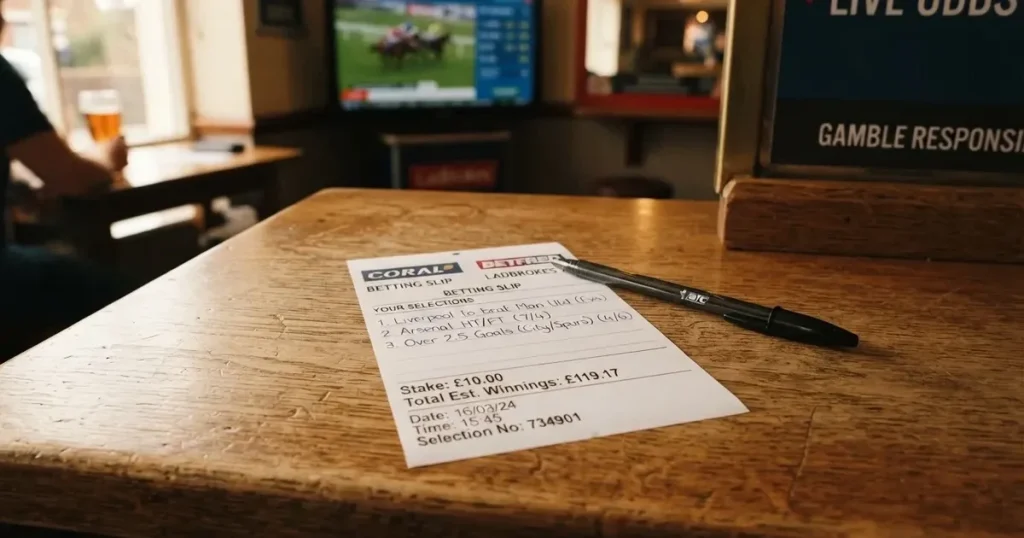
The trade is stake for coverage. A £1 stake on a straight treble risks £1 to win whatever the multiplied odds produce; the same three selections at £1 per line in a Trixie risks £4 to win the same treble plus three doubles. The extra £3 is the price of those three doubles, and a punter pays it whether or not those doubles ever become payable bets. If only one of the three selections wins, the Trixie pays nothing and the stake is lost across all four bets; the bet cannot return anything on a single winner.
That is the first consequence worth holding onto. The Trixie rewards the case where two or three selections win and punishes the case where only one does. A bettor who already expects one loser should think hard before layering cover on top of it, because the cover assumes the other two will hold.
Selection as the central decision
The mechanics of a Trixie are fixed: three selections, four bets. The variable is which three. The price of each leg carries the bookmaker’s margin, and four bets mean four margins layered into one stake. A Trixie built from three short-priced favourites looks safe on paper but pays little in return, because the doubled and trebled odds of short prices stay modest. A Trixie built from three longshots pays enormously when it lands and almost never lands, because the legs each carry a high margin and high implied probability of losing.

The worked numbers come later in the page. What sits underneath them is a single editorial point: the bet does not change the probability of any of its three selections, it only multiplies how the return behaves when the probability resolves. The bettor pays for that multiplication in stake and in margin. Whether the multiplication is worth paying for is the question that the rest of this page answers.
When a Trixie fits the situation
A Trixie suits the case where the bettor expects all three legs to win but cannot be certain of any one of them in isolation. Two strong favourites and a third leg that looks likely but exposed, or three mid-priced selections from different sports on the same afternoon, are the shape it is built for. The doubles soften the consequence of one upset without paying out on a single upset. The treble captures the upside when all three arrive.
It fits less well when the bettor has one strong opinion and two weak ones. The weak legs drag the doubles down without much prospect of returning on their own. A Patent, which adds the three singles, sits closer to that case; a straight treble sits closest. Picking between them is less about which is “best” than about which picture of the three selections the bettor actually holds.
How a Trixie bet is built and settled
The four bets inside a Trixie
The structure is fixed and worth memorising. Three selections, labelled A, B and C, produce exactly four bets: the AB double, the AC double, the BC double, and the ABC treble. Each line is staked separately, and the unit stake is the figure the bettor enters once; the betting slip multiplies it by four to show the total stake. A £2 unit stake means an £8 outlay across the four bets, and a return on any one line pays independently of the others.
The unit stake is the only number the punter controls. The odds are set by the bookmaker at the moment the bet is placed and the leg is confirmed; subsequent price changes do not alter a Trixie that has already been struck. Each-way terms are not built into the standard Trixie structure the way they are built into a Lucky 15 or a Patent, and adding each-way to a Trixie doubles every line to eight bets at twice the stake.
Worked example from the three selections
The mechanics come through clearly with a small worked example. Take three selections at decimal odds of 2.0, 3.0 and 4.0 and place £1 on each of the four bets, a total stake of £4. If all three selections win, the three doubles return 2.0 × 3.0 = 6.0, 2.0 × 4.0 = 8.0 and 3.0 × 4.0 = 12.0, and the treble returns 2.0 × 3.0 × 4.0 = 24.0. Add the unit stakes back to those returns and the total paid out is 6.0 + 1 + 8.0 + 1 + 12.0 + 1 + 24.0 + 1, which lands at £54 in returns from a £4 stake. Subtract the stake and the profit is £50.
If only two of the three selections win, only one of the three doubles pays. The bettor takes the return from that single double and loses the stake on the other three lines. If only one selection wins, every line loses and the entire stake is gone. The example is a small one in pounds but a complete one in shape, because every Trixie pays out along one of those three paths.
What the slip shows and what it does not
A modern betting slip displays the unit stake, the total stake, the odds of each leg and the potential return if all four bets win. It usually shows the potential return if only the doubles win as well, by toggling the assumption on which legs land. It does not show the bookmaker’s margin on each leg, and it does not show the joint margin across the four bets. The punters who care about margin have to derive it themselves from the prices, which the next section addresses.
The maths the slip hides
A worked payout for the page’s calculation
The page’s own calculation takes three illustrative selections at fractional odds of 1/2 (decimal 1.50), evens (decimal 2.00) and 6/4 (decimal 2.50), and a stake of £10 for a straight accumulator or £2 per line for a Trixie. The accumulator returns £10 × 1.50 × 2.00 × 2.50 = £75 if all three win, for a profit of £65 on a £10 stake. The Trixie at £2 per line totals £8 in stake across the four bets. The three doubles return £2 × 1.50 × 2.00 = £6.00, £2 × 1.50 × 2.50 = £7.50, and £2 × 2.00 × 2.50 = £10.00. The treble returns £2 × 1.50 × 2.00 × 2.50 = £15.00. With the unit stakes returned, the total payout is £6.00 + £7.50 + £10.00 + £15.00 + £8.00 = £46.50, and the profit is £38.50 on an £8 stake.
The interesting comparison is between the two structures at the same selections. The accumulator pays £75 from a £10 stake; the Trixie pays £46.50 from an £8 stake. The accumulator returns more in absolute pounds because it compounds the same three odds on a single line. The Trixie returns less because part of its stake is paid on doubles that the accumulator does not run at all. Whether the Trixie is worth its extra stake depends on which of the three legs looks likeliest to let the side down: the doubles capture the case where it does, the treble captures the case where it does not, and the punter pays for both at once.
If only two of the three selections win, the calculation changes shape. Say the 1/2 and evens legs win and the 6/4 leg loses. The accumulator pays nothing and loses the £10 stake. The Trixie pays only the double on the two winning legs, £2 × 1.50 × 2.00 = £6.00 plus the £2 unit stake, total £8.00, against an £8 stake: the bettor breaks even. Lose the evens leg instead and the Trixie pays £2 × 1.50 × 2.50 = £7.50 plus the £2 unit stake, total £9.50, against the £8 stake: a £1.50 profit on an £8 outlay. The Trixie’s edge over the accumulator lives precisely in these two-leg cases, and the edge is smaller than the headline price comparison suggests.
The result, stated as a band with its condition, runs as follows. With all three legs winning, the accumulator pays £75 and the Trixie pays £46.50; the accumulator wins. With exactly two legs winning, the Trixie returns somewhere between £8.00 and £9.50 depending on which leg loses, and the accumulator returns £0; the Trixie wins. With one leg winning or none, both bets lose the full stake.
Margin as the cost a punter actually pays
The odds the bookmaker quotes include a margin, sometimes called the overround, which is the cut the book keeps on every unit staked across all outcomes of a market. A market with no margin would have the implied probabilities of all outcomes sum to exactly 100%; on a real sportsbook they sum to more. Take a football match priced at 2.10, 3.40 and 3.60 decimal: the implied probabilities are 47.6%, 29.4% and 27.8%, summing to 104.8%. The extra 4.8% is the bookmaker’s margin on that market.
A Trixie stacks four of those margins into one stake, and a punter pays all four even if only one or two of the bets can ever settle. The compound effect on a longshot treble is severe: three legs at 10% margin compound to a margin well above 30% on the treble alone, before the doubles add their own slice. The maths the slip does not show is exactly the maths the bettor needs in order to decide whether the cover is worth paying for.
The fixed-formula gloss
The calculation section above applies the standard payout formula: return on a winning bet equals stake multiplied by the decimal odds, and net profit equals stake multiplied by odds minus one. For a combination bet the odds of the legs multiply into a single price, which is how the doubles and the treble above were derived. The formula is a clean description of what a winning bet pays back; it says nothing about how likely that win is, and the page treats it as such.
What a Trixie looks like next to a Patent, Yankee and Lucky 15
The full-cover family in numbers
The Trixie sits inside a family of full-cover bets whose structures are easy to confuse. A Patent adds the three singles to the Trixie’s four bets, producing seven bets in total: three singles, three doubles, one treble. A Yankee covers four selections across eleven bets: six doubles, four trebles, one fourfold, with no singles. A Lucky 15 stretches across four selections and fifteen bets: four singles, six doubles, four trebles, one fourfold. A Heinz adds a fifth and sixth selection to produce fifty-seven bets across six selections, twenty doubles, twenty trebles, fifteen fourfolds, six fivefolds and one sixfold. A Goliath adds a seventh and eighth to reach two hundred and forty-seven bets.
The structures are nested. A Trixie is a Yankee with the singles removed and one fewer selection. A Lucky 15 is a Yankee with the singles added. A Heinz is a Goliath with the singles removed and two fewer selections. The cost of adding singles is the entire stake on each of those singles whether or not they win: a Lucky 15 pays the bettor something whenever one of the four legs wins alone, because one of the singles has paid out; a Yankee returns nothing on a single winner because it carries no singles.
How to read the differences without picking a winner
The practical question is not which structure is “best”. Each one redistributes the same stake across a different shape of bets, and the shape that suits the punter depends on which picture of the four (or six, or eight) selections they hold. The bettor who thinks two of four selections will win and the other two will not is best served by a structure that pays out on doubles only, which a Yankee does. The bettor who thinks any one of the four might win outright is best served by a structure that pays on singles, which a Lucky 15 does. The bettor who is confident in all four is best served by a structure that concentrates stake on the multiples, which a Lucky 15 also does because the fourfold sits inside it.
A Trixie handles three selections, not four. A bettor with four confident selections who wants the same logic as a Trixie — multiples only, no singles — takes a Yankee and accepts the eleven-bet structure. A bettor with three selections who wants the singles included takes a Patent. The trade-off between Trixie and Patent is the trade-off between stake and singles coverage; the trade-off between Trixie and straight treble is the trade-off between cover and concentration.
When the cover is worth the extra stake
Cover is worth paying for when the punter believes in the three selections broadly but not absolutely. The doubles give the bettor a payout on the two-leg combinations, and the treble captures the upside if all three arrive. Cover is not worth paying for when the punter has one strong opinion and two weak ones: the weak legs drag the doubles down to almost nothing, and a Patent’s singles would have at least paid out on the strong leg alone. Cover is not worth paying for when the punter is confident of all three: a straight treble concentrates the stake on the highest-paying line and skips the doubles entirely.
The page does not pick a structure on the reader’s behalf. It sets out what each one costs and what each one pays, and leaves the choice to the picture of the three selections the reader actually holds.
The comparison: ten licensed bookmakers and what their terms say
The table below lists the ten operators the comparison covers, with the Gambling Commission remote licence number, the licence holder on the Commission’s public register, and what each operator’s own terms state about the Trixie specifically or about full-cover bets more broadly. A column of dashes is not used: where an operator’s terms do not address the structure directly, that is left for the prose below the table rather than filled with an empty cell.
| Bookmaker | Gambling Commission remote licence | Licence holder | What the operator’s terms say on full-cover bets |
|---|---|---|---|
| NetBet | 039170-R-319343-032 (account 39170) | Netbet Enterprises Limited | Lists Daily Boosts, Profit Boosts, a Bet Builder with dynamic odds and free bet offers; full-cover structures are placed through the standard betting slip rather than named on the promotions page. |
| QuinnBet | 061011-R-335683-004 (account 61011) | QuinnBet (Gibraltar) Limited | Free bets valid 7 days from credit, minimum odds 1/2 (1.5), maximum odds 50/1; straight accumulators permitted, Trixies, Patents and Yankees are not eligible markets for the free bet stake. |
| BetTom | 064959-R-339314-003 (account 64959) | Bet Tom Limited | Sports welcome offer 50% back as a free bet up to £50 plus a matching 50% back up to £50 as free slot funds; full terms apply to wagering and eligible markets. |
| Dabble | 065677-R-340363-005 (account 65677) | Dabble Sports UK Ltd | Welcome offer Bet £10 Get £10 in free bets, 7-day free bet expiry, stake not returned, minimum odds apply. |
| BetUK | 039198-R-319450-029 (account 39198) | LeoVegas Gaming PLC | Free bets exclude virtual sports, esports and non-UK/IE horse racing; minimum odds apply. |
| DAZN Bet | 048756-R-327274-019 (account 48756) | DZBT Limited | Offers Cash Out, Bet Builder, daily bet boosts and in-play betting; cash out availability is not guaranteed and bets stand if it is unavailable. |
| 10bet | 043173-R-322899-023 (account 43173) | Blue Star Planet Limited | Lists Cash Out, Bet Builder and Live Streaming alongside the standard sportsbook; eligible markets for promotions are stated per offer. |
| Tote | 054779-R-331321-008 (account 54779) | TDCO Limited | Pool-betting heritage with fixed-odds products added; full-cover structures settle under the standard sportsbook rules. |
| Betfred | 039544-R-319290-010 (account 39544) | Petfre (Gibraltar) Limited | Lists Bet Builder, Sub Switch, Racing Post data, Extra Places and a live casino and bingo product; full-cover bets run through the standard slip. |
| Fitzdares | 000400-R-103839-030 (account 400) | Fitzdares Limited | App offers cash out, accumulators, Lucky 15s, specials and antepost markets on horse racing, football, tennis, rugby, cricket, golf and American football, with in-play live odds. |
The shape of the table is deliberately uneven. QuinnBet and BetUK state market-level exclusions on free bet stakes that bite the Trixie directly; the other operators leave the structure to the standard betting slip. Fitzdares lists Lucky 15s by name, which signals familiarity with full-cover products, and Betfred’s Bet Builder is the closest any operator comes to offering a same-game multiple alongside the traditional full-cover structures. The implication for a Trixie bettor is that two of the ten operators in the comparison explicitly name Trixies in their promotional exclusions, and the rest do not address the structure at all in the terms the public pages carry.
A reader who wants a Trixie on a free bet needs to read the small print carefully. QuinnBet excludes Trixies from the eligible markets for its free bet stake, and a bettor who places a free bet on a Trixie at QuinnBet is likely to find the bet either voided or settled without the free bet stake applied. The other operators in the table do not state an equivalent exclusion, which does not mean no exclusion exists; it means the bettor checks the operator’s own terms page for the specific promotion being claimed. The general principle holds: a free bet is the bookmaker’s money, the bookmaker decides where it goes, and the bettor reads the terms before placing it.
A read on each bookmaker
NetBet: Daily Boosts, Profit Boosts and a Bet Builder that runs alongside the slip
NetBet runs a sportsbook with Daily Boosts and Profit Boosts on selected markets, a Bet Builder that recalculates the odds dynamically as legs are added, and a sports stats module for major leagues. The Trixie itself is placed through the standard betting slip rather than promoted as a featured product, which is the usual arrangement at a general sportsbook. The Bet Builder is the closest the operator comes to a same-game multiple, and it sits alongside rather than inside a Trixie.
The verdict is one of breadth. NetBet covers the structure, lets the bettor build it, and surrounds it with price boosts and a Bet Builder that a multi-leg bettor will use. A reader who wants a Trixie placed quickly and quietly, without promotional framing, is well served; a reader who wants the operator to highlight the structure is not.
QuinnBet: explicit exclusions worth reading
QuinnBet’s free bet terms are unusually specific. Free bets are valid for seven days from credit, can be used on any market at minimum odds of 1/2 (1.5) and maximum odds of 50/1, and Trixies, Patents and Yankees are not eligible markets for the free bet stake. Straight accumulators are allowed. The exclusion is one of the few in the comparison that names the structure directly.
The verdict is one of clarity. A bettor who reads the terms before placing a free bet on a Trixie at QuinnBet will not be surprised by the result, and that is the point. QuinnBet is the operator to use with a Trixie when the stake is the bettor’s own cash rather than a promotional credit, and a reader who values that clarity in the small print finds it here.
BetTom: a sports-casino split welcome offer
BetTom’s sports welcome offer returns 50% as a free bet up to £50 and matches it with 50% back up to £50 as free slot funds for the casino product. Full terms apply to the wagering and the eligible markets for each half. The Trixie itself is placed on the standard sportsbook slip.
The verdict is one of caution. A reader who claims the welcome offer and then places a Trixie needs to check which side of the split the wagering sits on and at what minimum odds, because the sports half and the casino half of the offer run on separate conditions. A reader who treats the offer as two separate promotions rather than one bundle is less likely to be surprised by the result.
Dabble: a small welcome offer with a short fuse
Dabble’s welcome offer is Bet £10 Get £10 in free bets, with a 7-day expiry on the free bet and minimum odds applying; the stake is not returned with a winning free bet. The terms do not name the Trixie in the public material, and the exclusion sits in the small print rather than the offer headline.
The verdict is one of speed. A reader who wants the welcome offer cleared within a week and the Trixie placed before the free bet expires has a narrow window. A reader with three selections ready to go finds Dabble workable; a reader who needs a week to think finds the seven-day fuse tight.
BetUK: free bets that exclude most non-sports markets
BetUK’s free bet terms exclude virtual sports, esports and non-UK/IE horse racing, and apply minimum odds. The exclusions name three categories rather than bet structures, and a Trixie on real-event sports does not fall under any of them. The sports welcome offer is structured around eligible markets rather than eligible bet types.
The verdict is one of fit. A Trixie on three real-event football, tennis or horse racing selections sits inside the eligible set; a Trixie that mixes in an esports or virtual leg does not. The reader who reads the exclusions and sticks to real-event sports finds the operator well suited; the reader who wants an esports leg needs to look elsewhere.
DAZN Bet: in-play, boosts and cash out with a caveat
DAZN Bet offers Cash Out, a Bet Builder, daily bet boosts and an in-play product. Cash out is not guaranteed on every market, and bets stand if cash out is unavailable at the moment the bettor tries to use it. The Trixie itself is placed through the standard slip, and the in-play product applies to the individual legs rather than to the structure.
The verdict is one of feature. A Trixie bettor who wants the option to cash out a winning double mid-event finds DAZN Bet useful when cash out is available and useless when it is not. The caveat is the operator’s own: cash out is a feature, not a guarantee.
10bet: Live Streaming alongside the standard sportsbook
10bet covers football, tennis and horse racing with Cash out, a Bet Builder and Live Streaming. The streaming product is the differentiating feature in the comparison, and the Trixie sits inside the standard sportsbook product rather than inside the streaming offer.
The verdict is one of access. A reader who wants to watch one of the three legs live before deciding whether to cash out the rest finds 10bet useful; a reader who places the Trixie and walks away does not need the streaming product and gets little from 10bet that a tighter sportsbook would not also offer.
Tote: pool-betting heritage, fixed-odds present
Tote’s heritage is pool betting on British and Irish racing, and its modern product adds fixed-odds sports and a sportsbook. The full-cover structures settle under the standard sportsbook rules rather than the pool rules, and the Trixie sits inside the fixed-odds product. The operator’s brand recognition is strongest in racing, where it remains a familiar name.
The verdict is one of context. A Trixie on three racing selections is placed through the standard fixed-odds slip and settles at the prices the operator quotes at the off. A reader who knows Tote from the pool product and is curious about the fixed-odds side finds a familiar name in an unfamiliar product; a reader looking for the deepest fixed-odds sportsbook finds the operator narrower than the bigger brands in the comparison.
Betfred: Bet Builder, Extra Places and a broad product
Betfred’s app lists a Bet Builder, Sub Switch (a same-game substitution feature on football), Racing Post data integrated into the racing product, Extra Places on selected racing, and a live casino and bingo product alongside the sportsbook. The Trixie itself sits inside the standard slip, and the supporting features are designed for the same multi-leg bettor who might place a Trixie on three football or racing selections.
The verdict is one of breadth. Betfred is the operator in the comparison whose supporting features are most clearly aimed at a bettor who builds multi-leg bets, and a Trixie bettor who also uses Bet Builder and Extra Places finds the operator well suited. The breadth does not change the maths on the Trixie itself; it changes the experience of building it.
Fitzdares: Lucky 15s named, full-cover familiarity
Fitzdares names Lucky 15s in the app description, alongside cash out, accumulators, antepost markets and specials on horse racing, football, tennis, rugby, cricket, golf and American football, with in-play live odds. The naming of Lucky 15s signals that the operator is comfortable with full-cover structures, and the Trixie sits one step below the Lucky 15 in the family.
The verdict is one of fit. A reader who wants a Trixie placed at an operator that explicitly handles full-cover bets finds Fitzdares well suited; a reader who wants the broadest sportsbook finds the operator narrower than the bigger brands. The structure works; the product around it is the choice the reader makes.
The legal frame in Great Britain
Who holds a licence, and how a reader checks
A bookmaker serving customers in Great Britain needs a Gambling Commission licence wherever the operator is based. Since the Gambling (Licensing and Advertising) Act 2014, the licence attaches to the operator’s remote facilities at the point of consumption in Great Britain, under sections 33 and 36 of the Gambling Act 2005 as amended. A Curaçao, Maltese or Gibraltar business registration is not a substitute for a Commission licence when the operator takes remote bets from customers in Great Britain.
The Commission’s public register is the whole test. It can be searched by business name, trading name, domain or account number, and the search result is the proof that a brand holds a licence at a given date. A reader who wants to verify that an operator holds a current remote general betting standard (real events) licence looks the operator up by name or by the domain the operator publishes, and reads the licence number, the licence holder and the licence status from the register entry.
The remote licence number, the Commission account number and the licence holder for each operator in the comparison appear in the table earlier in the page, and each one is checkable against the register by name or account number. None of the operators in the comparison holds an expired licence; a reader who wants to confirm that the licence is still in force checks the entry on the day the bet is placed, because licences can be surrendered, revoked or have conditions varied.
What the licence covers
A remote general betting standard (real events) licence permits the operator to offer fixed-odds betting on real sporting events to customers in Great Britain. The category is one of five remote betting licence types: general betting standard (real events), general betting standard (virtual events), general betting limited, pool betting and betting intermediary (the licence for betting exchanges). A Trixie sits inside the general betting standard (real events) category because all three of its legs are real events priced by the operator. A Trixie that included a virtual or esports leg would still sit inside the same category at most operators, because the licence covers real events and the operator’s product catalogue determines what is offered.
Financial spread betting is a separate regulatory regime under the Financial Conduct Authority rather than the Commission, and it is regulated on a different basis. The two regulators cover different products, and the Commission’s licence does not extend to financial spread bets. A punter who places a financial spread bet at an FCA-regulated firm is in a different market from a punter who places a Trixie at a Commission-licensed bookmaker.
Identity, age and the first deposit
Since 7 May 2019, every Commission-licensed remote operator has verified the customer’s name, address and date of birth before the customer can deposit or gamble, including with a free bet or bonus. The minimum age is 18. The verification is not optional, and no anonymous play is available at a licensed site. The check uses public-record data, and it runs before the first pound is deposited.
The same verification regime is the reason the customer journey at a licensed bookmaker begins with a sign-up form that asks for more than an email address. A reader who places a Trixie at a licensed bookmaker has already passed identity and age verification, and the verification runs against the operator’s licence conditions rather than against the customer’s choice. The protection cuts both ways: it stops under-18s from signing up, and it gives the customer a regulated route to complain if the operator withholds funds.
Bonuses, free bets and the cap on wagering
Promotion rules that came into force on 19 January 2026 cap wagering requirements on bonuses at 10x. A £10 bonus at 50x wagering would have needed £500 of qualifying bets before withdrawal; under the cap, no more than £100 of qualifying bets is required. The cap applies to bonuses with a wagering condition, and the question of whether it applies to free bets with no wagering condition is not established in the public material the comparison covers.
Mixed-product promotions are banned. An offer that requires the customer to gamble on two or more product types, betting and casino, betting and bingo, betting and lottery, is not permitted. A sports welcome offer that bundles a sports free bet with casino free spins is not a permitted structure; a sports welcome offer that returns a single free bet on the sports product is. The split welcome offer at BetTom described earlier in the page, which returns sports free bet funds and casino slot funds as separate halves of the same deposit, is the kind of structure that the rules treat carefully, and the bettor reads the terms to see which side of the split a Trixie bet would fall on.
No cap on the money value of a bonus exists. A £50 free bet, a £100 free bet and a £200 free bet are all permitted at the headline level; what governs each one is the wagering condition, the eligible markets and the expiry, which the operator’s terms state per offer.
Tax
The player pays no tax on betting winnings in Great Britain. General Betting Duty is the operator’s tax on gross profits from betting, currently 15% on most bets and rising to 25% on remote bets from 1 April 2027, with bets on UK horse racing, self-service betting terminals, pool betting and in-person betting staying at 15%. The duty is the operator’s, not the customer’s, and whether the operator passes it on through tighter odds is not established in the public material the comparison covers.
A professional gambler is taxed differently from a recreational punter, and the page does not give tax advice. A reader whose betting has moved from recreational to something more structured asks HMRC or an adviser, because the line between the two is drawn by HMRC’s guidance and case law rather than by this page.
Responsible gambling and the protections a licence brings
GAMSTOP, the national self-exclusion scheme
GAMSTOP is the multi-operator online self-exclusion scheme, and it is a mandatory licence condition for Commission-licensed online operators since 31 March 2020. A customer who registers with GAMSTOP excludes themselves from every Commission-licensed online operator at once, for a minimum period of six months, one year, five years, or five years with auto-renewal. After the minimum period, the exclusion stays in place for a further seven years unless the customer asks GAMSTOP to remove it.
GAMSTOP covers online sites and apps. Betting shops run a separate service and are not covered by the GAMSTOP registration. A customer who has self-excluded through GAMSTOP cannot open a new account at a licensed online bookmaker under a different name or address, because the verification regime catches the duplicate identity. The protection is real, and it operates at the level of the operator’s licence conditions rather than the customer’s willpower.
Vulnerability checks and affordability
A financial vulnerability check runs under LCCP condition 3.4.4, in force since 30 August 2024, and applies when a customer’s deposits minus withdrawals exceed £150 in a rolling 30-day period at a licensed remote betting operator (since 28 February 2025). The check is a public-record check, looking for markers like bankruptcy or county court judgments, and it is not an income check and not a credit reference check.
Financial risk assessments, sometimes called affordability checks in the press, have been announced in a staged plan with no start date established at the time of writing. The Commission’s article of 7 July 2026 sets out the staged approach; whether the checks are live at any given moment is not established in the public material the page covers, and the page does not assert a start date.
Deposit limits are a separate requirement under RTS 12, and operators must offer a gross deposit limit on a fixed time frame. The first changes applied from 31 October 2025, and a second phase was postponed to 30 September 2026; whether the second phase is live is not established. The principle is that the operator offers the customer a way to set a limit, and the customer sets the limit. There is no state-set deposit or loss ceiling for betting in Great Britain; the ceiling is the customer’s choice, and the operator’s job is to make the choice available and to honour it.
Help and where it leads
GamCare runs the National Gambling Helpline, and the service offers confidential support by phone and online chat. GambleAware funds treatment and research and points bettors towards the help available in their area. NHS gambling clinics offer treatment for problem gambling in several regions of England, with a referral from a GP or a self-referral. Gamblers Anonymous runs peer-support meetings across the country. The four organisations are the main routes a reader in Great Britain has into help, and each one is free at the point of use.
A Trixie bettor who feels the betting has moved past the recreational reads the help section of the operator’s site, registers with GAMSTOP if self-exclusion is the right step, and contacts GamCare for confidential support. The page does not urge any of these steps on any reader; it states where the help sits because the protection framework is part of what the licence buys.
The unlicensed alternative, and what it loses
An unlicensed operator does not run identity verification before the first deposit, does not offer GAMSTOP coverage, does not apply the bonus wagering cap, does not apply the financial vulnerability check, does not answer to the Commission on complaints, and does not route disputes to an approved alternative dispute resolution body. A punter at an unlicensed site who is refused a withdrawal has no British consumer protection route to recover the funds. The page does not call an unlicensed site “the safe choice” by default; it sets out what the licensed site provides and what the unlicensed site does not, and the reader decides.
A GB licence is not optional for the operator; it is the requirement under section 33 of the Gambling Act 2005 as amended. Providing gambling facilities in Great Britain without the licence the Act requires is an offence aimed at the operator, on summary conviction up to 51 weeks’ imprisonment, a fine up to level 5, or both, with six months in Scotland. The Commission enforces through cease-and-desist notices, search-engine referrals and work with registrars, hosts and payment providers, and court-order DNS blocking powers have been given or are about to be given; ISP blocking is not yet in operation.
Bonuses, free bets and what they really cost
The shape of a free bet on a Trixie
A free bet is the bookmaker’s stake, not the punter’s. When a free bet wins, the bookmaker pays the winnings at the quoted odds and returns nothing of the free bet stake itself; the punter’s net is the winnings, not the winnings plus the free bet. A £10 free bet on a Trixie leg at 2.00 decimal returns £10 in winnings if it wins, not £20. The “free” in “free bet” is the right to place a bet the bookmaker funds; the “stake not returned” is the cost the punter pays for the funding.
A Trixie places a free bet on four separate bets when the unit stake is the free bet amount. A £10 free bet unit stake at £10 per line totals £40 of free bet stake across the four bets, and the punter’s payout on any winning line is the winnings only, not the winnings plus the line stake. The arithmetic matters at the close. A £10 free bet on the three-leg treble above (decimal odds 1.50, 2.00, 2.50, multiplied to 7.50) returns £10 × 6.50 = £65 in winnings, not £75; the £10 free bet stake is not returned. The same logic applies to each winning double: the double returns the winnings at the multiplied odds, not the winnings plus the line stake.
What a bookmaker’s “free bet” excludes
The exclusions are where the marketing word “free” gives way to the small print. QuinnBet’s exclusion of Trixies, Patents and Yankees from eligible markets for the free bet stake is the clearest example in the comparison. A punter who places a free bet on a Trixie at QuinnBet and wins may find the bet voided, or may find the free bet stake not applied, depending on how the operator’s system handles the breach.
BetUK excludes virtual sports, esports and non-UK/IE horse racing. A Trixie that mixes a real-event leg with an esports leg would fall under the exclusion on the esports leg, and the bet would settle under the terms the operator states for that case. A Trixie on three real-event sports selections sits inside the eligible set and is not affected by the exclusions.
The general rule holds across the comparison. A free bet is the bookmaker’s money, the bookmaker decides where it goes, and the eligible markets, the minimum odds, the maximum odds, the expiry and the stake-not-returned condition are stated in the offer terms rather than the offer headline. The bettor reads the terms before placing the bet, and the Trixie is checked against the eligible markets list as carefully as the stake.
The wagering cap in plain numbers
A £10 bonus at 50x wagering requires £500 of qualifying bets before the bonus and any associated winnings become withdrawable. Under the cap of 10x that came into force on 19 January 2026, the same £10 bonus requires £100 of qualifying bets at most. The cap is a hard ceiling on the multiplier, and the operator cannot set a higher one. Whether the cap applies to free bets with no wagering condition is not established in the public material the comparison covers, and the page does not assert that it does.
The minimum odds for qualifying bets sit in the offer terms, and they determine which of the bettor’s bets count towards the £100 turnover. A £10 free bet on a Trixie at minimum odds 1/2 (1.5) per leg counts each winning line at the qualifying odds, and the cumulative turnover across the four bets is four times the unit stake at the qualifying odds. A bettor working through a £100 turnover on a Trixie at £2 per line places fifty bets in qualifying conditions, which is the practical arithmetic of clearing the bonus through full-cover structures.
The honest read on bonus value
The marketing word for a bonus is “free” or “risk-free”, and neither word survives contact with the terms. A free bet is a bet the bookmaker funds, and the stake is not returned with a win. A risk-free bet is refunded as a free bet or bet credit when it loses, and the refund runs through the same stake-not-returned logic the next time. The bettor who treats the offer as a stake reduction rather than as a gift comes closer to the operator’s economics, and the arithmetic in the section above is the comparison the bettor makes: the free bet’s value is the winnings at the quoted odds, not the headline amount of the free bet.
The page does not tell the reader which offer to claim. It sets out what each offer costs in qualifying bets, in minimum odds, in expiry and in eligible markets, and it leaves the choice to the picture of the three selections the reader actually holds. A Trixie bettor who claims a free bet, places it on three real-event selections at qualifying odds and clears the wagering within the expiry is in the offer’s narrow corridor; a bettor who strays outside it pays the cost the small print states.
Frequently asked questions
What is a Trixie bet?
A Trixie is a full-cover bet on three selections made up of four separate bets: three doubles and one treble. Each line is staked separately, and the unit stake is multiplied by four to give the total stake. A Trixie returns nothing if only one of the three selections wins; it returns the relevant double if two win, and the three doubles plus the treble if all three win.
How does a Trixie bet work?
The betting slip takes three selections and the unit stake, then calculates the four bets internally. The doubles are AB, AC and BC; the treble is ABC. The return on each winning line is the unit stake multiplied by the multiplied odds of the legs in that line. A £2 unit stake across the four bets totals £8 in stake, and a winning treble at multiplied odds of 7.50 returns £15 from the treble line alone.
What’s a Trixie bet in plain terms?
It is a way of paying for cover. A straight treble risks the whole stake on three legs landing together; a Trixie risks the same three legs but adds three doubles alongside the treble. The trade is stake for coverage: the punter pays more in total and gets a payout on two-leg combinations that the straight treble does not run at all.
How can it be checked that a bookmaker holds a Gambling Commission licence?
The Commission’s public register can be searched by business name, trading name, domain or account number. The search result shows the licence number, the licence holder, the licence status and the licensed activities. A reader who wants to verify that an operator holds a current remote general betting standard (real events) licence looks the operator up on the day the bet is placed, because licences can be surrendered, varied or have conditions added.
How is the return on a bet worked out from the stake and the odds?
The return on a winning bet equals the stake multiplied by the decimal odds, and the net profit equals the stake multiplied by the odds minus one. For a combination bet the odds of the legs multiply into a single price, so a treble at decimal odds of 1.50, 2.00 and 2.50 returns the stake multiplied by 7.50. The calculation assumes the bet wins, and it says nothing about how likely the win is.
What is the bookmaker’s margin and how can it be seen in the odds?
The margin is the cut the book keeps on every unit staked across all outcomes of a market, also called the overround. A market with no margin would have the implied probabilities of all outcomes sum to exactly 100%; a real sportsbook’s prices sum to more, and the excess is the margin. A market priced at 2.10, 3.40 and 3.60 decimal has implied probabilities summing to 104.8%, and the 4.8% excess is the book’s margin on that market.
Bet types & in-play – oddsguaranteed
Content created by the «oddsguaranteed» team
