
Where to Bet on NASCAR Online in 2026: A UK Punter's Guide
 Available in US

NASCAR sits in an odd place in the British betting market. The Cup Series runs for ten months and crowns a champion, yet few UK punters will sit down to watch a stock car on a Sunday afternoon. They find the sport, instead, in clusters: the Daytona 500 in February, the Coca-Cola 600 on the same May Sunday as the Indianapolis 500, the playoff run from late summer, Homestead–Miami in November. Those weekends are when the sport books fill up, and they are when an unfamiliarity with how NASCAR is priced shows up in slips that settle badly.
This guide works through the picture a UK bettor actually faces: which bookmakers carry the Cup Series, how the odds are built, what an each-way NASCAR bet really costs, where the offers land, and where the small print cuts. Every figure comes from public sources and from each operator’s own terms. The aim is to leave a reader able to read a NASCAR market the way they would read a Premier League market, with the same scepticism applied to the same number on either.
*Data current as of October 30, 2026; operator licence claims verified against the Gambling Commission’s public register.*
NASCAR Betting Strategy: Reading Form Without Watching the Race
The right NASCAR bet does not start with a tipster, because the surface of the sport hides more than it shows. A driver can finish fifteenth two weeks running for opposite reasons: a clean run sabotaged by pit-road misjudgment, or a car fast enough to lead but unbalanced enough to chew its tyres. Form numbers from a results table mean little without the context of where the race sat on the schedule, the car’s intermediate-track rating, and whether the team had a setup change.

What an English bettor can work with is the season-long data layer that the bookmakers do not bother to summarise: practice and qualifying speed, average running position, lap-by-lap deltas where an in-house feed gives them up, and a driver’s record on the specific track type. Short tracks punish different drivers to intermediates and superspeedways, and a road course race like Watkins Glen is closer to a different sport than to Daytona. A bettor who treats a track as a venue and a track type as the unit of form goes in with more information than one who treats a track as a venue.
The bankroll side of the strategy is what the marketing hides. A driver finishing top ten on most weeks, at long odds, is the kind of position a tipster column will not name because it does not look like a tip. It looks like a £5 each-way at 12/1 that returns £65 if the driver makes the top six. When that bet comes in three times across the season, the bankroll has grown without a single “winner” being called. The opposite side is the accumulator: a 200/1 five-leg that reads well on a Saturday and reads worse on a Sunday. The marketing leans hard on accumulators because the marketing margin on a five-leg is several times the margin on a single, and the offer is dressed as a strategy. It is not a strategy; it is a price.
The cleanest habit is one the betting forums do not promote: pick a track type, pick a price band, and bet each race in that lane until the data disagrees. When the data disagrees, stop. This is not a winning system — no system is — but it is the difference between a season of receipts and a season of explanations.
NASCAR Bet Types and How the Odds Work
The NASCAR menu at a UK bookmaker is shorter than the menu for a Premier League match but the price logic is the same. Each market is a book, each book has a margin, and the margin is what the operator keeps on every pound staked regardless of which outcome wins.
The race-winner market is the simplest. Thirty-six cars (or thereabouts) take the green flag; the operator offers odds on each, and the implied probabilities add up to more than 100 per cent. The excess is the overround, the same overround that sits inside every Premier League match result. The favourite sits around 5/1 to 8/1 at most races, depending on the form of the field, and longer prices down the order. A £10 win bet at 7/1 returns £80 if the driver wins, for a net £70 profit.
Each-way betting is the sport’s signature bet. The operator splits the stake into two equal bets: one on the win, one on the place. The place terms depend on the field size — most Cup races offer a quarter of the odds for places one through three, larger races one through four, and a handful of books offer enhanced each-way terms for marquee events. A £10 each-way bet at 12/1 is in fact a £20 stake; the win half returns £130 if the driver wins, the place half returns £40 if the driver finishes in the place positions, and the punter collects one or both. The total stake is double what a single would be, and the place terms are the operator’s call, set out in the race terms before wagering.
Top-three, top-five and top-ten finish markets are the place bets without the each-way scaffolding. They are quoted on the race card with a single price, settled on official results, and the payout is a straightforward stake-times-odds. Group betting pairs drivers together, settling on whichever of the pair finishes higher: useful when a punter is confident one of two teammates will run well but cannot split them. Head-to-head and matchup markets do the same for two drivers, settled on finishing position regardless of where the rest of the field lands.
Stage betting is the modern wrinkle. Cup races are split into three stages, with stage points awarded to the top ten in each. A bookmaker offers prices on who wins each stage, settled on the official stage results. These markets can be priced tighter than the race-winner market because the sample is smaller, and a stage winner can be a longshot in the race outright.
The parlour games, the bet builder, the prop bet — these are the markets that bookmakers use to widen the page. A bet builder on a NASCAR race lets a punter combine, say, a driver to finish top ten with the race to have more than three caution flags, multiplying the prices. The same logic that makes a Premier League bet builder a five-per-cent market or a fifteen-per-cent market applies here, with the twist that the inputs to a NASCAR bet builder are less covered by the trading desks. The margin can be wider, and a punter who assumes the prices are built the same way as for football misreads them.
Live in-play betting is the area that exposes the model most. The in-play book on a NASCAR race settles on a continuous update, and the punter who backs a driver mid-race is betting on a price that the bookmaker is repricing every few seconds. For a 500-mile race with a three-hour run time, the in-play book is alive from green flag to chequered flag, and the offers that look generous on a Saturday morning (enhanced in-play odds on the race leader, acca insurance on a long losing streak) settle on the same numbers as any other bet.
The arithmetic that runs through every one of these markets is the calculation this page returns to: the bookmaker’s margin. Take a two-way market at decimal odds of 1.90 against 1.90 — a book on a head-to-head or a yes/no prop. The implied probability of each side is 1 ÷ 1.90, which is 52.63 per cent, and the two sides add to 105.26 per cent. The excess over 100 per cent is the overround, and the overround on this two-way example sits in a band of around 4 to 6 per cent for a sharp market, 6 to 8 per cent for an average one, and 8 to 10 per cent for a soft one. A market priced at 1.85 against 1.85 adds up to 108.1 per cent, which is a soft market. A market priced at 1.95 against 1.95 adds up to 102.6 per cent, which is sharp. The price the punter sees and the margin the operator keeps are the same number seen from two sides, and reading one is the same as reading the other.
The 2026 NASCAR Cup Series: What the Schedule Carries
The 2026 Cup Series is a 36-race points schedule plus three non-championship events. The non-championship trio are the Cook Out Clash at Bowman Gray Stadium, the Duel at Daytona (a pair of qualifying races for the Daytona 500), and the NASCAR All-Star Race. The points schedule opens with the 68th running of the Daytona 500 on 15 February 2026, runs through 1 March 2026 at the earliest end of the regular season, and closes with the Straight Talk Wireless 400 at Homestead–Miami Speedway on 8 November 2026.
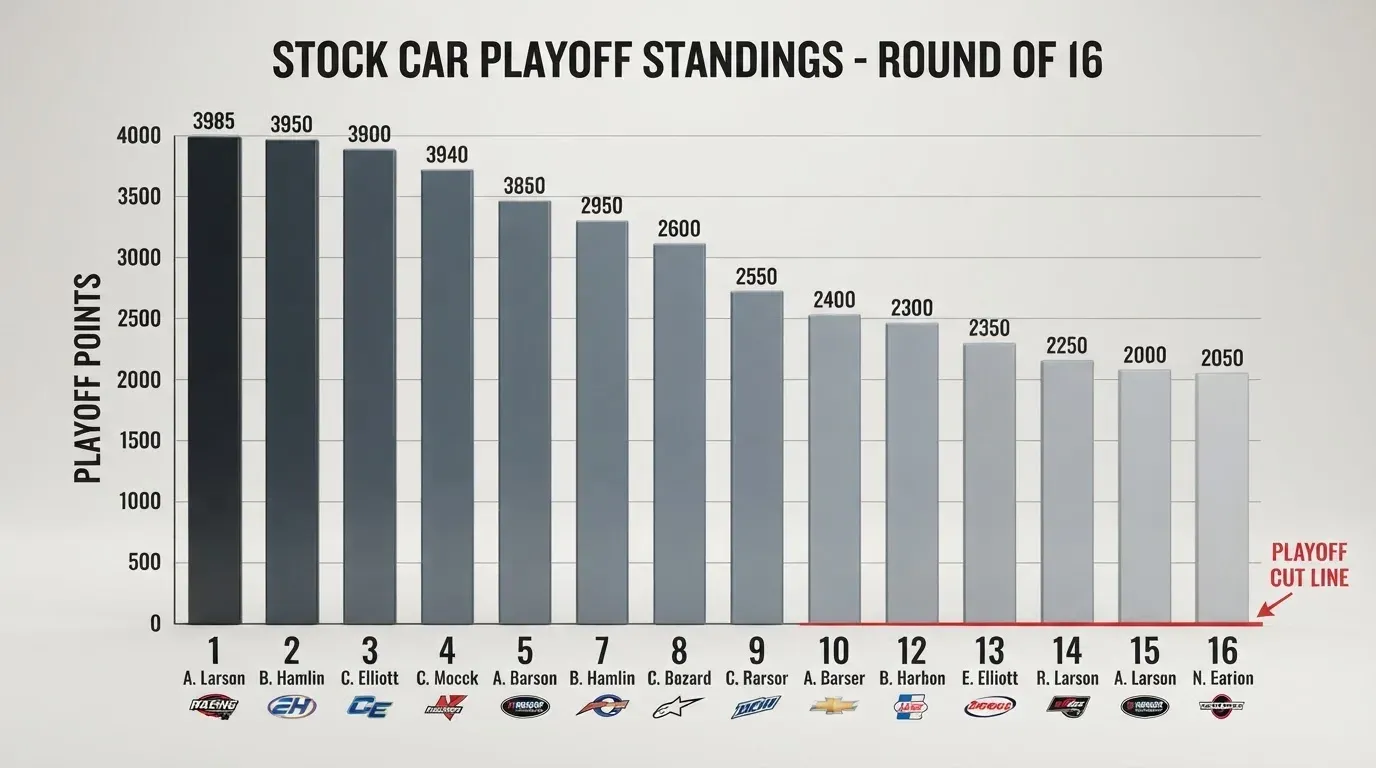
The playoff format this season is the version that drops the win-and-you’re-in rule from earlier formats: the top sixteen drivers in points after twenty-six races make the playoff, and playoff starting points are staggered by regular-season standings rather than reset to a baseline. The change matters to a bettor because it shifts the incentive structure in the closing races of the regular season. A driver who knows that wins no longer clinch a playoff berth has a different reason to race hard at, say, Bristol in late August than a driver under the old rule. The prices in those closing races reflect this — a tighter market on the regular-season contenders, a softer market on the playoff bubble drivers, and the odds on the in-play race winner in those weeks are tighter than they would have been a season ago.
The tracks themselves come in three families: superspeedways (Daytona, Talladega, Atlanta), intermediates (most of the calendar), and short tracks (Bristol, Martinsville, Richmond, and the new additions). Road courses (Watkins Glen, the Charlotte Roval, Sonoma, COTA) are a fourth family that draws a different driver profile. The bookmakers do not segment the schedule this way in their marketing, but the form split is what makes a season of bets readable, and a punter who treats Bristol like Daytona is pricing the wrong market.
The 2026 Daytona 500 was won by Tyler Reddick. That result does not make Reddick a Daytona specialist, but it does mark a season that started on a note the form book did not predict. The Cup Series is, by its nature, a sport in which a season’s first race rarely sets the tone of the season’s last race, and the form book on a driver at Daytona in February is a thin predictor of where that driver lands in November. The 2026 schedule, run through to Homestead–Miami in mid-November, gives a punter ten months of data points, and the right read on the data is the difference between a bet that lands and a bet that explains.
The Ten UK Bookmakers That Carry NASCAR
The shortlist below is the set of UK-licensed bookmakers on the Gambling Commission’s public register that carry a NASCAR menu, ordered as the page’s research hands them in. None of these is the only licensed operator, none is “best” by some universal measure, and the table that follows them gives the shape of the comparison rather than the answer.
BetVictor: Racing Heritage, NASCAR Coverage Included
BetVictor is one of the older British bookmakers and has a racing-first product. Best Odds Guaranteed runs on UK and Irish horse racing, and the BetFinder feature is built around the racing form book. NASCAR is part of the menu at the back of the racing section, priced alongside the Cup Series and the lower-tier Xfinity and Truck Series. The Smart Stats panel is the in-house form tool, useful for a punter who wants a track-by-track read. Best Odds Guaranteed does not extend to NASCAR — the feature is racing-specific to horses.
The site holds a Gambling Commission remote licence in the category of remote general betting standard (real events), and the operator trades as BV Gaming Limited. The racing depth is the brand’s edge, and a punter who bets mostly on NASCAR but wants a racing book underneath it for the rest of the calendar will find more here than at a football-first book.
Hollywoodbets: The South African Brand with a UK Sports Welcome
Hollywoodbets is best known in South Africa, but its UK arm runs a sportsbook that covers the Cup Series and a wider US racing menu. The sports welcome offer is the operation’s centrepiece: a new player who deposits £10 or more by card gets their stake back as a free bet of up to £30 on their first qualifying losing accumulator. The accumulator itself must have three or more legs, odds of 4/1 or greater, and settle within seven days. The free bet is for new customers, one per customer, and is settled as a free bet, not as cash.
The licence is held by Hollywoodbets International UK Limited under Gambling Commission remote licence 053028. The welcome offer is generous against the cluster, but the accumulator floor (three legs, 4/1 minimum) and the seven-day settle window are the kind of condition a punter should read before claiming. A punter who was already planning an acca for the weekend’s Cup race can fit this on top of their normal betting; a punter who bets singles should look elsewhere.
LiveScore Bet: The Bet Builder Specialist
LiveScore Bet’s product is built around the Bet Builder, and the Bet Builder allows up to ten selections across a single event. On a NASCAR race the selections cover match-result analogues (the race winner), top-three and top-five markets, and a range of props. The licence is held by LiveScore Betting and Gaming (Gibraltar) Limited, with the Gambling Commission account 56859.
The platform carries a live feed as part of the wider LiveScore group — the scores app is the parent brand — and the in-play experience is built around the same data stream. A punter who wants in-play markets on a NASCAR race, and is comfortable with the Bet Builder as the entry point, will find a more developed product here than at a bookmaker that treats NASCAR as a footnote. A punter who bets mostly on horse racing should note that the racing product is not the brand’s focus.
Spreadex: The Spread-and-Fixed Hybrid
Spreadex is unusual in this list because it combines fixed-odds betting with financial spread betting under one roof. The fixed-odds product covers NASCAR; the spread product covers financial markets and is regulated by the Financial Conduct Authority, not the Gambling Commission. A punter who opens a Spreadex account to bet on a Cup race will, by default, have access to both products, and the credit card on file is shared.
The fixed-odds product carries the same features as the cluster: bet builder across fixed odds and spread markets, partial cash out, and live streaming of UK and Irish horse racing, greyhounds, tennis, NFL and selected football. Live streaming does not extend to NASCAR under the current offering. The risk to a punter is the spread product itself: spread betting losses can exceed the original deposit, and the brand is candid about that risk. A punter who has opened an account to bet on a single NASCAR race should leave the spread product alone.
bet365: The Volume Operator
bet365 is the largest UK bookmaker by any reasonable measure and the official global betting partner of the UEFA Champions League. The brand’s NASCAR coverage is wide rather than deep: the full Cup Series, Xfinity, and Truck Series, the international NASCAR events where they apply, and the in-play markets that the volume of liquidity makes tighter. Bet Builder+ combines markets from one event into a single bet, available pre-match and in-play, and Super Boosts, Winnings Boosts on Bet Builders and selected singles, and daily Bet Boosts sit on top of the standard menu.
The licence is held by Hillside (UK Sports) ENC under Gambling Commission remote licence 055148. The in-play product is the brand’s edge: a live stream of selected NASCAR events (where the rights sit with the bookmaker), a live betting feed that updates faster than smaller books, and the cash out that the volume makes available across more markets. The trade-off is the marketing machine: the welcome offer is one of the most advertised in the UK, and the conditions on a free bet that is not paid back as cash are tighter than a one-line summary suggests.
NetBet: The Daily Boosts Shop
NetBet’s product is built around the daily boost calendar. Daily Boosts, Profit Boosts and free bet offers are the headline, the Bet Builder is a one-click product with instant dynamic odds, and the sports stats panel covers the major leagues. NASCAR is part of the menu and the menu is built around the boost, which means the price a punter sees on a NASCAR race is often the boosted price rather than the base price.
The licence is held by Netbet Enterprises Limited under Gambling Commission remote licence 039170. A punter who is comfortable with the boost structure — taking the boosted price where it sits and ignoring the offer when the boost does not apply — will find a competitive product. A punter who is looking for a bookmaker that prices NASCAR on its own merits, without a daily promotional layer, should look elsewhere.
QuinnBet: The Best Odds Guaranteed on Horses
QuinnBet is built around horse racing, and the Best Odds Guaranteed offer is the centrepiece. The offer applies to UK and Irish horse racing bets from 10:00am daily, on singles, multiples and system bets, with a maximum benefit of £150 per customer per race. The horse racing focus does not extend to NASCAR — Best Odds Guaranteed is a horse racing feature — but the wider sportsbook covers the Cup Series and the Xfinity Series.
The licence is held by QuinnBet (Gibraltar) Limited under Gambling Commission remote licence 061011. A punter who splits their bets between horse racing and NASCAR will find the offer structure useful across the two sports, but a punter who bets only on NASCAR is paying for a feature they do not use.
Kalooki Sportsbook: The Smaller Brand, the Sharper Market
Kalooki Sportsbook is a smaller operator in this list, run by Kalooki Sportsbook Limited under Gambling Commission account 57730. The site is GAMSTOP-registered, identity verification is in place before the first deposit, and the product is built around a tight sportsbook rather than a marketing-heavy welcome.
The NASCAR menu is present and the pricing is competitive, but the marketing footprint is small — a punter who is comparing a NASCAR bet across the cluster will not find a headline offer at Kalooki that matches the welcome structure at the larger brands. The trade-off is the product: a smaller bookmaker often prices tighter markets because the book is held by a smaller team with a sharper view, and a punter who knows what they want can find prices here that the larger books do not post.
Coral: The Ladbrokes Twin
Coral runs alongside Ladbrokes under LC International Limited, and the two brands share a parent licence under Gambling Commission account 54743. The sports welcome offer is a £40 free bet bundle on a £20 qualifying sports bet at minimum odds of 2.0 (1/1), with the free bets issued within seven days and expiring seven days after issue. New GB customers who opt in are eligible.
The product is a full sportsbook with a racing depth, a football depth, and a NASCAR section at the back. The welcome offer is competitive against the cluster, but the conditions (the minimum odds on the qualifying bet, the seven-day window, the issue and expiry timeline) are the kind of small print a punter should read before claiming. A punter who splits bets between Coral and Ladbrokes has access to the same market and the same offer, and the choice between the two is a product preference rather than a price preference.
888sport: The Established Brand
888sport is part of the wider 888 group, with a Gambling Commission remote licence held by 888 UK Limited under account 39028. The product is a full sportsbook: pre-match and in-play, Cash Out, Bet Builder, racing streams, BetFinder form tools, a live bet feed and daily boosted odds. The NASCAR menu is part of the wider product, priced alongside the Cup Series and the Xfinity and Truck Series.
The brand carries the marketing footprint of an established operator and the welcome offer structure that goes with it. A punter who wants a brand they have heard of, with the same kind of product as the larger books, will find what they expect. A punter who is comparing a NASCAR bet across the cluster will find that the prices at 888sport are not always the sharpest in the book, but the product is consistent.
What UK Law Says About Betting Online
Betting in Great Britain is regulated under the Gambling Act 2005, with the Gambling Commission as the licensing body for the commercial market. The Act covers England, Scotland and Wales; Northern Ireland runs on a separate, older law, and a Great Britain licence is not a Northern Ireland licence. An operator whose remote facilities are used in Great Britain needs a Commission licence wherever it is based, since the Gambling (Licensing and Advertising) Act 2014. A Curaçao, Maltese or Gibraltar corporate base is not a substitute for a Commission licence at the point of consumption.
The Commission’s public register is the whole test of who holds a licence. It can be searched by business name, trading name, domain or account number, and a brand that is not on the register for the relevant licence category is not licensed to take bets from customers in Great Britain. The licence categories that cover online sports betting are remote general betting standard (real events), remote general betting standard (virtual events), remote general betting limited, remote pool betting and remote betting intermediary (the latter is the betting exchange category). A brand that holds a casino licence but not a remote general betting standard licence cannot lawfully take a sports bet from a customer in Great Britain.
The minimum age is eighteen. Identity verification is required before the first deposit, in place since 7 May 2019, and includes a free bet or bonus bet. A punter who has not verified their name, address and date of birth cannot deposit or gamble at a licensed site, and a site that allows anonymous play is not licensed for the GB market. The verification is the entry gate; it is not optional, and a bookmaker that allows a punter to deposit without it is in breach of its licence conditions.
The credit card ban is the headline payments rule. Since 14 April 2020, no credit card can be used for gambling in Great Britain, including credit-card-funded payments through an e-wallet. A debit card, a bank transfer, or a non-credit-card e-wallet is fine. The ban is at the operator’s end; a punter who tries to use a credit card will be refused at the deposit stage.
The 10x bonus cap is the headline promotions rule. Since 19 January 2026, no bonus offered to a Great Britain customer can carry a wagering requirement of more than 10x the bonus amount. A £10 bonus at 50x required £500 of qualifying bets under the old rules; under the new rules, no more than £100 of qualifying bets can be required for a £10 bonus. The cap applies to wagering requirements; whether it applies to free bets with no wagering condition, and any cap on the money value of a bonus, are not settled in the public rules. A punter who sees a bonus with a 20x or 30x rollover is looking at an offer that does not comply with the current rules, and the bookmaker offering it is the party in breach, not the punter claiming it.
The advertising rules are not the Commission’s but the ASA’s. The CAP Code (non-broadcast) and BCAP Code (broadcast) cover gambling marketing, and the social responsibility rules are strict: no marketing of strong appeal to under-eighteens, no one who is or seems to be under twenty-five may feature in a gambling advertisement, and the “whistle-to-whistle” ban on TV advertising around live sporting events has been in place since 1 August 2019. The rules govern the marketing, not the betting; a punter who sees an ad is the audience, not the subject of the rule.
The tax side is the part the punter does not see. The player pays no tax on betting winnings in Great Britain, with the caveat that a professional gambler should ask HMRC or a tax adviser. General Betting Duty is the operator’s tax, currently 15 per cent on gross profits, with a new remote betting rate of 25 per cent applying from 1 April 2027 within the same duty. The rate change is the operator’s problem to manage, and how it is passed through into the odds is not established. A punter who sees prices tighten in 2027 is looking at the duty change working through the book; a punter who sees prices hold steady is looking at the operator absorbing it.
A punter who bets on a site without a Great Britain licence gives up a defined set of protections: no GAMSTOP coverage, no Commission complaints route, no approved dispute-resolution body, no British consumer redress if funds are withheld, and no obligation on the operator to apply the 10x bonus cap, the £150 financial vulnerability check, or the credit card ban. The site is not “illegal” for the punter — no offence aimed at a customer who bets on an unlicensed site was found in the public law — but the punter is outside the British consumer frame. The honest framing is that an unlicensed site offers no recourse if the operator decides not to pay out, and a licensed site offers the Commission’s complaints process as a backstop.
Safer Gambling and the Self-Exclusion Frame
The safer gambling tools at a licensed site are a mix of customer-set and regulator-set. Deposit limits are customer-set: the punter chooses a daily, weekly or monthly limit and the operator enforces it. Self-exclusion is a wider tool: a punter who self-excludes through GAMSTOP is barred from every GB-licensed online operator at once, for six months, one year, five years, or five years with auto-renewal, with a seven-year tail after the minimum period.
GAMSTOP has been a mandatory licence condition for online operators since 31 March 2020. A site that does not check GAMSTOP is in breach; a punter who has self-excluded and then bets on a non-GB-licensed site is outside the British frame and outside the GAMSTOP coverage. The punter who wants the protection of GAMSTOP is the punter who bets only on licensed sites.
The financial vulnerability check is a softer frame. Since 28 February 2025, when a customer’s deposits minus withdrawals exceed £150 in a rolling 30 days, the operator runs a public-record check for things like bankruptcy or county court judgments. It is not an income check, not a credit reference check, and it does not appear on the customer’s credit file. The £150 threshold is the trigger, not the cap; a customer with high net deposits does not get blocked, but the operator gathers information that may lead to a conversation, a deposit limit, or a self-exclusion. The check is at the operator’s discretion, and the punter who hits the threshold is treated as a customer whose pattern of play is worth a closer look.
Financial risk assessments — the “affordability checks” of the press — are a staged plan that the Commission announced on 7 July 2026. They are not in force, and no start date has been published. A punter who reads a press article about affordability checks is reading about a future measure, not a current one, and a licensed site that asks for payslips or bank statements today is asking because the operator has set that policy, not because the Commission has required it.
The help lines are the backstop. GamCare runs the National Gambling Helpline. GambleAware funds treatment and education. The NHS runs gambling clinics in several regions. Gamblers Anonymous runs peer-support meetings. A punter who is worried about their own betting, or about someone else’s, is not the kind of customer the industry likes to talk about, but the services exist and they are free at the point of use. A punter who cannot find a way to talk to someone about their betting has not looked hard enough.
Crypto and Anonymity: Not the Frame for Licensed UK Betting
The cluster of search terms around betting on NASCAR with bitcoin, ethereum or litecoin does not map to a Great Britain licensed product. No licensed UK bookmaker in the cluster accepts a cryptocurrency deposit, and the identity-verification rules that apply before the first deposit make anonymous play impossible at a licensed site. A punter who wants to bet on NASCAR with bitcoin is looking at an unlicensed operator, with the loss of protections that follows from that choice.
The licensed frame takes the position that gambling is a regulated activity, the player must be identified, and the operator must be licensed at the point of consumption. Crypto deposits sit outside that frame: the technology is not banned, but a licensed operator accepting a crypto deposit would need to clear the deposit with the source-of-funds rules that apply to any other payment, and the volatility of the asset is not the operator’s problem to manage. The operators in this list that accept a wide range of payment methods take debit cards, bank transfers and a range of e-wallets; they do not take bitcoin, ethereum or litecoin for the regulated product.
A punter who is set on a crypto deposit has three honest framings. They can use a licensed site with a non-crypto payment method and accept that the frame is fiat. They can use an unlicensed site and accept that the protections are gone, that the operator may withhold funds, and that the Commission’s complaints process is not available. Or they can hold the crypto and bet on the licensed product through a payment method the operator accepts. The choice is the punter’s, but the second option is the one the licensed frame cannot help with once the bet is placed.
Bonuses and Free Bets: Reading the Offer Past the Headline
The marketing language is the part of the offer the punter meets first, and it is the part the punter should read last. A “free bet” is not a bet the operator funds as if it were the punter’s money: the stake is not paid back with a win, and a £10 free bet at 5/1 returns £50 in profit, not £60. A “boosted odds” offer is a price enhancement on a specific selection, settled at the boosted price if the selection wins, with the stake paid back as cash. An “acca insurance” offer refunds a losing accumulator as a free bet if one leg lets the punter down, with the refund itself a free bet subject to the same stake-not-paid-back rule. A “cashback” offer returns a percentage of net losses over a period, usually as a free bet or bonus credit, with the wagering requirements that the 10x cap now bounds.
The 10x cap is the regulator’s line. A bonus with a 30x or 50x rollover does not exist in the current GB-licensed frame, and a bookmaker offering one is offering a product that does not comply with the Commission’s rules. The punter who sees such an offer is looking at an unlicensed site, a misprint, or a misunderstanding, and the first two options are the operator’s problem rather than the punter’s. A licensed offer with a 10x cap is a £10 bonus that needs £100 of qualifying bets; a licensed offer with a 5x cap is a £10 bonus that needs £50 of qualifying bets; a licensed offer with no rollover is a cash bonus or a free bet with the stake-not-paid-back rule as the only cost.
The minimum odds on a qualifying bet are the second line. A £20 qualifying bet at minimum odds of 2.0 (1/1) is a bet on something priced at evens or longer; a £10 qualifying accumulator with three legs at 4/1 or greater is a bet on an accumulator with a floor on each leg. The punter who wants to claim the offer but bets on shorter prices than the floor cannot do so, and the offer is not worth a forced bet at prices the punger would not otherwise take. The bookmaker sets the floor because the floor protects the offer from a low-margin claim; the punter reads the floor because the floor tells them what the offer is worth in their own betting pattern.
The expiry window is the third line. A free bet that expires in seven days is a free bet that has to be used inside a week, and a punter who cannot find a NASCAR race they want to back inside that window has not used the offer. The expiry also applies to the bonus credit after a deposit, and a punter who has cleared the bonus and not used the free bet at the end of the window has lost the free bet. The clock is part of the offer, and a punter who treats the offer as a one-day thing is more likely to claim it cleanly.
The 19 January 2026 promotion rules also ban mixed-product offers — a deal that requires the punter to bet on football to claim a free bet for the casino, for example — and the punter who sees such an offer is looking at a product the licensed frame does not allow. The CAP Code’s social responsibility rules are the other side: a welcome offer with a “huge” headline, a “massive” boost, or a “crazy” acca is an offer whose marketing language is part of the ASA’s frame, and a punter who takes the offer at the language’s word has misread the page.
Mobile and the App: The Handset Is the Console
The NASCAR bet at a UK bookmaker is, for most punters, an app bet. The browser product is functional, the in-play product is a fingertip product, and the live stream is a screen product — all three meet at the same physical interface, and the bookmaker that has not built the app to host all three is the bookmaker that loses the bet to a bookmaker that has.
The bet365 app is the most downloaded sports betting app in the UK, and the figure is a marketing claim that also happens to be a description of the product: the in-play engine, the bet builder, the live stream, the cash out, the partial cash out, the edit bet, the acca boost, the Bet Builder+, the price boost, the cash out on the bet builder — the app carries more markets in a single screen than most browser products, and the speed of the in-play update is what a volume bookmaker can do that a smaller one cannot. A NASCAR punter who wants the in-play product at the volume it is priced for is looking at this app.
The Spreadex app is the hybrid product, with fixed odds and spread in the same interface. The risk for the NASCAR punter is the spread product, which is licensed by the FCA rather than the Commission, and the credit card on file is shared. A NASCAR punter who wants the fixed-odds product and is comfortable leaving the spread alone has a tidy product; a NASCAR punter who is not sure what spread betting is should not be on the Spreadex app.
The Lottoland app is the lottery-first product, with sports betting as a secondary feature. The NASCAR menu exists; the menu is the depth the brand allows it. A NASCAR punter is not the Lottoland customer’s primary case, and the brand’s edge is the lottery and scratchcard product.
The BetVictor app is the racing product, with Smart Stats and the BetFinder feature at the front. A NASCAR punter who uses the racing depth will find more here than at a football-first app, but the NASCAR menu is the racing menu’s smaller sibling.
The smaller brands — Hollywoodbets, NetBet, QuinnBet, Kalooki — all carry the sportsbook as a mobile product, with the app and the browser version carrying the same menu. The bet builder, the in-play, the cash out and the partial cash out are standard features across this set, and the differences are in the depth of the NASCAR menu and the marketing on top.
A live-streaming note: a NASCAR race is a rights product, and the rights sit with the broadcast partners. Some bookmakers carry a live stream of selected NASCAR events; most do not. A punter who wants the in-play product with a stream underneath is looking at the brand that has paid for the rights, and the brand without the rights is a brand with a price feed and no picture.
Live Betting and Cash Out: The In-Race Market
In-play NASCAR betting is a continuous market from green flag to chequered flag, and the in-play book is repriced every few seconds by the bookmaker’s trading desk. A punter who backs a driver mid-race is betting on a price that is moving, and the in-play book is where the book’s most expensive mistakes show up. The bookmaker’s edge is the speed of the repricing, the punter’s edge is the read of the race that the bookmaker’s algorithm has not caught.
A typical Cup race settles in about three hours, and the in-play market is alive for the whole run. The early laps settle on the start, the middle laps settle on pit-stop timing and tyre wear, and the closing laps settle on fuel mileage and restarts. A bookmaker with a sharp in-play model reads the race in real time; a bookmaker with a slow in-play model posts prices that lag the picture, and the lag is the punter’s opportunity.
Cash out is the bookmaker’s offer to settle a bet before the race is over. A punter who has backed a driver and the driver is leading at half-distance can cash out for a price that the bookmaker sets, taking a profit less than the win profit and a stake return less than the full stake. The cash out price is a market price: the bookmaker pays out at the offer, the punter accepts at the offer, and the offer is the offer. Partial cash out is the same product with a partial settlement: a punter can settle half the stake at the cash out price and leave the other half to run.
The bet builder in play is the modern extension. A pre-match bet builder on a NASCAR race settles at the end of the race, an in-play bet builder on a NASCAR race can be settled mid-race if the bookmaker offers the cash out. The bet builder is the part of the product that is hardest for a bookmaker to price cleanly, because the inputs to the bet are correlated in ways the model does not always catch, and a sharp punter on a bet builder is sharper than the average punter on a single.
The acca insurance offer is a separate product. A punter who backs a four-leg acca and one leg lets them down gets the stake back as a free bet, with the free bet subject to the same stake-not-paid-back rule. The acca insurance is a marketing offer dressed as a strategy, and the punter who takes it at the marketing’s word is paying the marketing’s margin. A punter who reads the small print sees that the insurance pays out only on the specific losing legs the offer names, that the free bet has its own expiry, and that the offer is a hedge rather than a strategy.
The offer on the closing laps is the offer to settle before the chequered flag. A driver leading with five laps to go is a different price to a driver leading with fifty laps to go, and the cash out price reflects the gap. A punter who wants the win profit takes the win; a punter who wants a smaller certain profit takes the cash out. The choice is the punter’s, and the bookmaker pays out the same in either case.
| Brand | Gambling Commission remote licence | What the operator’s own terms say about NASCAR |
|---|---|---|
| BetVictor | 039576-R-319370-028 (account 39576) — remote general betting standard (real events) — BV Gaming Limited | NASCAR is priced in the racing section; Best Odds Guaranteed is horse racing only. |
| Hollywoodbets | 053028-R-330019-013 (account 53028) — remote general betting standard (real events) — Hollywoodbets International UK Limited | Sports welcome offer refunds a first losing accumulator (3+ legs, 4/1+, settled in 7 days) as a free bet up to £30. |
| LiveScore Bet | 056859-R-332720-005 (account 56859) — remote general betting standard (real events) — LiveScore Betting and Gaming (Gibraltar) Limited | Bet Builder allows up to 10 selections across match result, totals, player and card markets. |
| Spreadex | 008835-R-104580-022 (account 8835) — remote general betting standard (real events) — Spreadex Limited | Combines fixed-odds and spread betting; financial spread is FCA-regulated and losses can exceed the deposit. |
| bet365 | 055148-R-331498-002 (account 55148) — remote general betting standard (real events) — Hillside (UK Sports) ENC | In-play, live streaming, Bet Builder+, Super Boosts, Winnings Boosts on Bet Builders and selected singles, daily Bet Boosts. |
| NetBet | 039170-R-319343-032 (account 39170) — remote general betting standard (real events) — Netbet Enterprises Limited | Daily Boosts, Profit Boosts and free bet offers; Bet Builder with instant dynamic odds. |
| QuinnBet | 061011-R-335683-004 (account 61011) — remote general betting standard (real events) — QuinnBet (Gibraltar) Limited | Best Odds Guaranteed on UK and Irish horse racing from 10:00am, max benefit £150 per customer per race. |
| Kalooki Sportsbook | 057730-R-333396-005 (account 57730) — remote general betting standard (real events) — Kalooki Sportsbook Limited | GAMSTOP-registered; identity verified before first deposit; no published welcome offer. |
| Coral | 054743-R-330863-014 (account 54743) — remote general betting standard (real events) and remote betting intermediary — LC International Limited | Sports welcome: £40 in free bets on a £20 qualifying bet at minimum odds 2.0, issued in 7 days, expiring 7 days after issue. |
| 888sport | 039028-R-319297-014 (account 39028) — remote general betting standard (real events) — 888 UK Limited | Pre-match and in-play, Cash Out, Bet Builder, racing streams, BetFinder form tools, live bet feed, daily boosted odds. |
Calculating the Bookmaker’s Margin
The number every punter should be able to read is the one the bookmaker does not print. Take a two-way market — a head-to-head, a yes/no prop, a group bet reduced to two runners — priced at 1.90 against 1.90 in decimal odds (9/10 in fractional). Each side implies a probability of 1 ÷ 1.90, which is 52.63 per cent, and the two sides add to 105.26 per cent. The five-and-a-bit per cent above 100 is the overround, and the overround on this two-way example is the same as the margin the bookmaker keeps on every unit bet on the market.
The arithmetic is the same whatever the sport. A NASCAR head-to-head at 1.90 against 1.90 carries a margin in a band of around 4 to 6 per cent, depending on the depth of the market; a NASCAR top-three at 4.0 / 4.0 / 4.0 / 4.0 against the rest of the field carries a different margin because the number of runners is different and the bookmaker’s view of each runner is different. A market priced at 1.95 against 1.95 is sharp; a market priced at 1.85 against 1.85 is soft; a market priced at 1.80 against 1.80 is the kind of soft that the punter should walk past. The same market at 2.10 against 1.70 is a one-sided book with a wider margin on the favourite, and the punter backing the favourite is paying a higher margin than the punter backing the outsider.
Reading the margin is reading the price. A punter who wants to know what the bookmaker is keeping does not need a calculator, only the willingness to add the implied probabilities and look at the excess over 100. The sharper the book, the closer the sum to 100; the softer the book, the further from 100. A 2 per cent margin on a NASCAR race is a book that is competing hard for the punter’s money; a 10 per cent margin is a book that is not, and the difference is the punter’s edge in the long run.
A practical example: a Cup race head-to-head at 1.91 / 1.91 has a margin of 4.71 per cent; the same head-to-head at 1.85 / 1.85 has a margin of 8.11 per cent. A punter who backs the first market at level stakes over a season of head-to-heads keeps more of their bankroll than a punter who backs the second, and the difference is the price the bookmaker charges for the same product. The bookmaker does not advertise the margin, and the punter who reads the price is reading the margin.
Frequently Asked Questions
How do you bet on NASCAR?
Pick a licensed UK bookmaker from the cluster above, open an account, verify your identity and address, deposit by debit card or bank transfer, and find the NASCAR section under the racing or motorsport menu. Pick a market — race winner, each-way, top-three, top-five, top-ten, head-to-head, stage winner, group bet — enter a stake, and confirm the bet. Settled bets pay into the account balance; unsettled bets are shown on the open-bets screen until the race settles.
Where can you bet on NASCAR?
Any UK bookmaker that carries a motorsport menu covers the Cup Series at minimum, and the larger books carry the Xfinity and Truck Series as well. The licensed set is the only set that gives the punter the consumer protections the GB frame offers: GAMSTOP coverage, the Commission’s complaints route, an approved dispute-resolution body, the 10x bonus cap, and the £150 financial vulnerability check.
How do you bet on NASCAR races?
The race menu at a licensed bookmaker offers the markets above. A race-winner bet settles on the chequered flag; an each-way bet settles on the win and the place; a top-three or top-five bet settles on official results; a head-to-head settles on which of two drivers finishes higher; a stage bet settles on the official stage result. The price is the operator’s price, the stake is the punter’s stake, and the payout is stake-times-odds minus the stake for a win profit, or stake-times-odds for a return that includes the stake.
How do you check a bookmaker’s Gambling Commission licence?
The Commission’s public register is searchable by business name, trading name, domain or account number. A punter who has the brand name and the Commission’s register in front of them can confirm in a minute whether the brand holds a remote general betting standard (real events) licence and which corporate entity holds it. A brand that is not on the register, or that is on the register without a remote general betting standard (real events) licence, is not licensed to take a sports bet from a customer in Great Britain.
How is the return on a bet worked out from the stake and the odds?
A winning bet pays stake × odds in decimal form, or stake × (a/b + 1) in fractional form, where a/b is the fractional odds. The net profit is the return minus the stake. A £10 bet at decimal odds 3.75 returns £37.50, for a net profit of £27.50. A £10 each-way bet at 12/1, with a quarter of the odds for the place, is two £5 bets: a £5 win bet returns £65 (£5 × (12 + 1)) and a £5 place bet returns £20 (£5 × (3 + 1)) if the driver wins, for a total return of £85 on a £10 stake, or a £5 place bet returns £20 if the driver finishes in the place positions without winning, for a total return of £20 on a £10 stake.
What is the bookmaker’s margin and how is it read from the odds?
The margin is the proportion of every pound bet on a market that the bookmaker keeps on average, regardless of the outcome. It is the excess of the sum of the implied probabilities over 100 per cent. A two-way market priced at 1.90 / 1.90 has implied probabilities of 52.63 per cent each, summing to 105.26 per cent, for a margin of 5.26 per cent. The sharper the book, the smaller the margin; the softer the book, the wider the margin. A punter who adds the implied probabilities across a market and reads the excess is reading the price the bookmaker charges for the bet.
Combat & motorsport – oddsguaranteed
Content created by the «oddsguaranteed» team
