
NASCAR betting odds in the UK: markets, schedule and a 10-bookmaker read
 Available in US
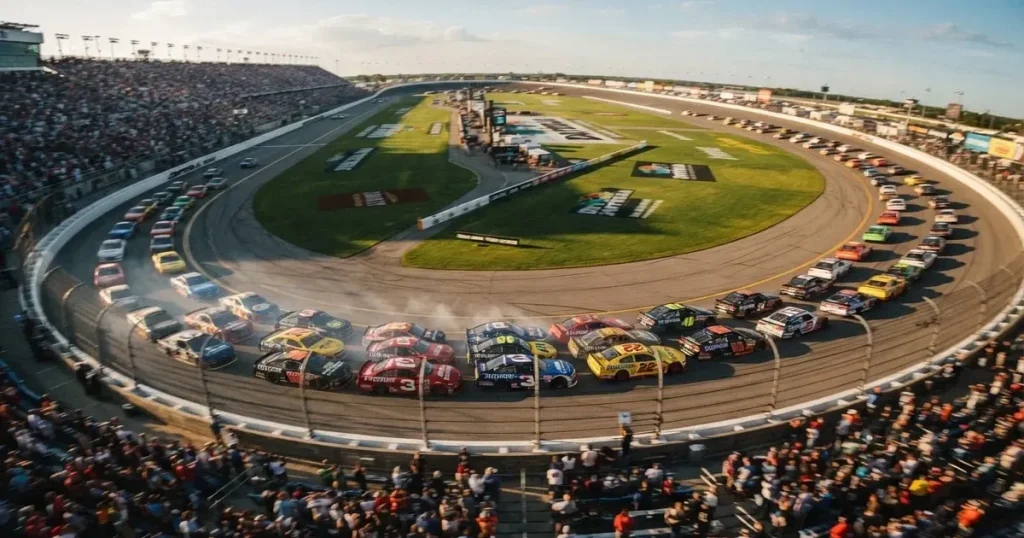
The 2026 NASCAR Cup Series runs 36 points-paying races plus three non-championship exhibitions (the Cook Out Clash, the Duel at Daytona and the All-Star Race), and the title fight ends at Homestead–Miami on 8 November 2026. British punters cannot walk up to a counter and back a stock car on a Tuesday — they open an account with a remote bookmaker licensed by the Gambling Commission and pick from whatever motors menu it serves. The menu varies wildly from brand to brand, the prices vary with it, and the gap between a careful book and a careless one shows up in the margin baked into every decimal line. What follows is a working map of that gap: the schedule that drives it, the bet types the Cup actually offers, the calculation that turns odds into a price, and ten licensed brands read against the same yardstick.
Current as of October 30, 2026 · licence and terms verified against the Gambling Commission’s public register and each operator’s own published terms.
How NASCAR betting strategy works in practice
Strategy in stock-car betting is a thinner word than it sounds in horse racing or football. There is no form-cycle of the kind that punter handicappers love, no head-to-head rivalry to lean on, and no transfer window to read. What there is, instead, is a small handful of structural edges that survive week to week — track shape, loop data, the way practice speeds translate into qualifying, and the schedule density that turns a four-race stretch into one long session. The honest job of a NASCAR strategy page is not to promise wins. It is to put the reader in front of the inputs a serious bet needs and to flag the inputs that look like inputs and are not.

The shape of a NASCAR weekend
A Cup weekend reads nothing like a Premier League Saturday. Practice runs on Friday, qualifying on Saturday morning in most formats, and the race itself in the afternoon or evening of Sunday — sometimes Saturday night, occasionally a Tuesday, depending on where the calendar lands. A punter who only watches the green flag misses the price. Books move in stages: futures printed weeks ahead, qualifying markets on Saturday morning, race markets after the starting grid is set, then in-play from lights to chequered. Each stage carries its own margin profile, because each stage is priced on a different information set.
A useful habit: log the opening price of a driver-to-win market at the start of the week and the closing price at lights-out. The difference is the bookmaker’s read on news, not a public insight. The Cup Series packs races closer together than Formula 1, so the signal from one race leaks into the next — a drivetrain failure at Martinsa carries into Texas through the same power-unit pool. Reading a race as a standalone event is the commonest strategy error.

Track type and the data behind it
NASCAR visits four rough families of track: short ovals under a mile, intermediate ovals between one and two miles, superspeedways around two and a half miles, and road courses. Each rewards a different driver profile and a different data set. Superspeedways are nearly random in finishing position — drafting lines, fuel strategy and the closing-lap concert produce chaos — and the market knows it, so the prices of a 40-car superspeedway field are tighter than the spread on an intermediate. Short tracks are the opposite: a regular winner emerges within three or four visits per season, and the books price them accordingly. Intermediate ovals are where the season gets decided — long green-flag runs, fuel windows that matter, and pit-road timing that bends the closing stint.
A punter who keeps a notebook of track type and finishing position by driver builds, over a season, the only database that matters. Lap-by-lap averages that the books already have are priced in. What is not priced in is the small-sample accident rate by driver at a specific track family — three races at a short oval is enough to tell a reader something the season-long average hides.
Bankroll, staking and the line between research and gambling
Stock-car racing tempts bettors into a specific shape of over-confidence. There are 36 points races; loading one type, contest after contest, builds the illusion that the bettor has more data than the bookmaker. In a 40-car field at a superspeedway, that illusion is wrong — the books have identical data and price accordingly. On an intermediate where two or three drivers dominate, the illusion is half-right and dangerous in its own way: the books tighten the price of the dominator, so a “confident” bet becomes a low-margin bet.
The bankroll rule that fits NASCAR is the same one that fits most sports with high field counts: stake a fixed unit (one or two per cent of the bank), never increase the unit after a win, and never chase a stretch of losers with bigger stakes because the next race “feels due”. The Cup schedule has clustering — Daytona and Talladega twice each, the round of sixteen at Bristol, the championship at Homestead — and the temptation to load up on the marquee races is the trap. A 40-car race with the right model is no better than a 40-car race without it; the books know.
Bet types and how NASCAR odds settle
The Cup menu at a GB-licensed book runs wider than the headline “race winner” market, but the bettor pays for that width. Each market carries its own margin, its own settlement rule and its own quirks on dead heats, mechanical failures and post-race inspection. Picking the right market is half the job; picking the right market at the right price is the other half.
The core markets
Race winner. The single selection that beats 39 others. Settled on the official classification at the chequered flag, regardless of whether the car reaches the post-race inspection bay. A car disqualified post-race for failing technical inspection loses its finishing position; this matters in stock-car betting because NASCAR does inspect to a threshold, and a car can win on the track and lose on the scale. Most books settle on the timing sheet and reserve the right to revise on official disqualification.
Each-way. A standard each-way bet is two equal stakes: one on the win, one on the place. Each-way terms on NASCAR vary — most books price place terms at a quarter of the win odds for the top three, others go to a fifth for the top five on bigger fields. The each-way punter doubles their stake on every bet; the place leg is where the value usually lives.
Top-three, top-five, top-ten finish. A flat stake on a finishing band, settled on official classification. Lower odds than the race winner and a smaller payout, but a much higher hit rate and a cleaner margin profile. This is the workhorse of the intermediate-oval specialist.
Head-to-head (match bet). Two drivers, two outcomes, the lowest-margin market most books offer because there is no dead-heat risk on a two-runner field. Books price match bets on qualifying performance, practice speeds and the loop data, but the headline here is the price — a tight head-to-head has tighter margin than the race winner on the same field.
Podium finish. Settled on the official top three. Sits between win and top-five in odds and is a popular compromise for a punter who likes a driver but wants a margin of error.
Group betting. Pick the winner out of a sub-group of the field — say, the four Hendrick Motorsports cars. Books price these tighter than the main field and the bettor is effectively hedging within an alliance structure. Useful when the data says one team owns a track but the books disagree on which driver is best.
Race-specific markets
Qualifying. A bet on who takes pole. Settled on the official qualifying result, including any penalties applied before the race. Note that NASCAR has adjusted qualifying formats across seasons; the qualifying session can be a single-car lap, a multi-round shootout, or a race-into-qualifying format. Each carries different price behaviour.
Fastest lap. Most books offer a fastest-lap market for the race itself, settled on the official loop data. In a stock-car race with limited green-flag passing and frequent cautions, fastest-lap prices are noisy and the books know it — shop the line.
Stage winner. The Cup races are split into three stages, and most books offer a stage-winner market for each. Settled on the official stage classification. Stages reward different strategies than the race does — a driver can win a stage and finish fifteenth overall — so this is its own handicapping exercise, not a derivative of the race-winner price.
Most laps led. A market that rewards dominant cars and rewards them heavily, because leading laps is rare in a 40-car field. The price reflects the rarity. Settled on official loop data.
Manufacturer winner. Ford, Chevrolet or Toyota — the manufacturer of the winning car. A novelty market, low-stakes by design, settled on the official classification.
Futures, parlays and the same-race combination bet
Futures (outright). Bets on the championship, on a manufacturer title or on race winner printed weeks ahead. Margin on futures is wider than margin on the race-week market because the information set is smaller and the book has more uncertainty to price in. A punter who is confident in a driver for the year benefits from the early price if it later tightens.
Bet builder (same-race multi). Combine markets from one race into a single bet — race winner plus fastest lap, or top-three plus the winning manufacturer. Books price these tight relative to the legs multiplied together, because the correlated outcomes are priced in. The bet builder is rarely an edge; it is mostly a way to express a view on a single driver across several outcomes.
Accumulator (acca). Multi-leg across races or markets. The legs multiply into one price and the bet is won only if every leg wins. Margin compounds across legs. A 40-car field acca as the dominant leg costs more than a 40-car field single.
Margin in practice: a worked example
Take a hypothetical two-way market priced at decimal odds 1.90 / 1.90 — an even-money pair, the kind a book might print on a head-to-head between two roughly matched drivers. The payout share is 1 ÷ (1/1.90 + 1/1.90), which works out to about 95.0%. That leaves a margin of roughly 5.0%, the cut the book keeps on every unit bet. A tighter real line (1.85 / 1.85) drops the payout share to about 92.5% and pushes the margin up to around 7.5%. A loose line (1.95 / 1.95) widens the payout share to about 97.5% and squeezes the margin to around 2.5%.
Across a season of small-stake bets, that 5-percentage-point swing is the difference between a hobby that costs almost nothing and a hobby that quietly drains a bankroll. Stock up real lines (say, 3.50 / 5.00 / 9.00 on a three-way outright) carry similar margins, though the calculation extends to three outcomes: 1 ÷ (1/3.50 + 1/5.00 + 1/9.00) is about 89.4%, margin about 10.6%. The Cup winner market is a wide-margin book because the field is large and the books need to price every car; the head-to-head is the tight-margin book and is where the punter should hunt for value.
Margin is not the only number — minimum stake, payout cap, settlement timing and the qualification of bonus bets all matter — but it is the only one that hides inside every price on the slip.
The 2026 NASCAR Cup Series schedule and why it matters to a bettor
The schedule is the betting calendar. Every race on it is a market, every off-week is a reset, and the back end of the season narrows the field in a way the front end does not. Knowing the order of races — which track comes when, which race closes a round, which is the finale — is the cheapest edge a NASCAR punter can buy.
The regular season
The 2026 Cup Series opened with the Daytona 500 on 15 February 2026, the 68th running, won by Tyler Reddick. From Daytona the tour moves through the early-season intermediate ovals — Atlanta, Las Vegas, Phoenix — and into the short-track run that opens spring. The regular season is 26 races long, and the top 16 in points after race 26 advance to the playoff.
The old “win-and-you’re-in” rule no longer applies for 2026. Playoff starting points are staggered by regular-season standings, so the top regular-season finisher begins the playoff with a small bonus and the sixteenth-ranked driver begins it with a heavier handicap. The change reshapes how the early-season races pay. A win in February used to be a playoff ticket; in 2026 it is points plus a head start. The books price this in, but the punter who understands the rule will read a futures market more sharply.
The playoff and the finale
The 2026 playoff structure runs the standard ten-race, three-round format, with the finale at Homestead–Miami Speedway on 8 November 2026 — the Straight Talk Wireless 400. The Cup finishes its playoff schedule at Homestead for the first time in the format’s modern layout, and the title is decided by the championship race alone, four cars in. The market on the finale is unique: four cars, three outcomes (winner, runner-up, last-place), the tightest pricing of the season because every contender is a known quantity. The week before the finale, by contrast, is the loosest: the four finalists are known, the round-of-eight elimination has just happened, and the books are still pricing a field that has lost half its plausible contenders.
Race types and their price character
| Stage | Approximate race count | Price character |
|---|---|---|
| Superspeedways (Daytona, Talladega) | 4 | Tight win-market, chaotic in-play, large field |
| Intermediate ovals (Texas, Kansas, Charlotte) | 10–12 | Medium margin, fuel and pit strategy dominate |
| Short ovals (Bristol, Martinsville, Richmond) | 8–10 | Predictable winners, tight prices on dominators |
| Road courses (Sonoma, COTA, Watkins Glen) | 3–4 | Road-course-ringer pricing, mid-pack cars priced up |
| Exhibition (Clash, Duel, All-Star) | 3 | Non-points, novelty rules, often restricted markets |
The breakdown is approximate because the ex-act completion of the calendar shifts year to year. The pattern is stable: superspeedways pay less per winner because chaos is priced in, short ovals pay less per winner because dominance is priced in, intermediates are where the price moves the most on information, road courses reward a small set of specialists. A punter’s bankroll follows the same logic — load the intermediates, watch the superspeedways, lean into the road courses when a ringer is on form.
The ten bookmakers, side by side
A fair comparison reads every brand against the same yardstick. The yardstick here is the one the Gambling Commission’s register gives: a remote general betting standard (real events) licence, held by a named UK entity against a Commission account number, with each brand’s own published terms stating the motors and racing content. The table that follows reads every featured operator against that test.
| Brand | Gambling Commission licence | What the operator’s own terms state on NASCAR and racing |
|---|---|---|
| QuinnBet | Remote licence 061011-R-335683-004 (Commission account 61011), held by QuinnBet (Gibraltar) Limited | Best Odds Guaranteed on Irish and UK horse racing from 10:00am daily, capped at £150 per customer per race |
| Betway | Remote licence 039372-R-319367-029 (Commission account 39372), held by Betway Limited | Free Bet Club: opt in for up to £10 in weekly free bets after £25 of qualifying sports stakes (2× £5) |
| Bet600 | Remote licence 044731-R-323941-016 (Commission account 44731), held by Tyche Tech Limited | Best Odds Guaranteed on horse racing — bet is paid at the starting price if SP exceeds the price taken |
| Geoff Banks | Remote licence 054095-R-330366-010 (Commission account 54095), held by GB Sports Advisors Limited | Live in-play and ante-post pricing on racing and other future events |
| London Bet | Remote licence 066162-R-340278-004 (Commission account 66162), held by Thistle Bet Limited | Combined sportsbook (football, tennis, horse racing, greyhounds, darts, golf, cricket, NFL, NBA, MLB, snooker) with in-play and Pragmatic Play casino content |
| 888sport | Remote licence 039028-R-319297-014 (Commission account 39028), held by 888 UK Limited | Pre-match and in-play betting, Cash Out, Bet Builder, racing streams, BetFinder form tools, daily boosted odds |
| bet365 | Remote licence 055148-R-331498-002 (Commission account 55148), held by Hillside (UK Sports) ENC | Bet Builder+ (same-race multi, pre-match and in-play), Super Boosts, Winnings Boosts, daily Bet Boosts, in-play and live streaming worldwide |
| Copybet | Remote licence 053774-R-330743-010 (Commission account 53774), held by Copybet UK Limited | Best Odds Guaranteed all day on UK and Irish racing; pays first past the post even if the winner is later disqualified |
| Fitzwilliam Sports | Remote licence 048760-R-335434-009 (Commission account 48760), held by SBKI Limited | Dublin bookmaker with capped membership and a “High Stakes Welcome” subject to compliance criteria; offers deposit limits, timeouts and links to safer-gambling bodies |
| LiveScore Bet | Remote licence 056859-R-332720-005 (Commission account 56859), held by LiveScore Betting and Gaming (Gibraltar) Limited | Bet Builder accepts up to 10 selections covering match result, both teams to score, corners, total goals, player scoring and cards |
The licence column is the part the reader should never take on a brand’s word for. Every brand in the table is licensed, and the Commission account number is the way to verify that licence against the public register at the Gambling Commission’s own service. Several brands carry the same form of racing-side guarantee (Best Odds Guaranteed) on horse racing rather than on stock cars; the table records what each operator’s own terms state, not what the reader should expect on NASCAR, where Best Odds Guaranteed does not apply in the same form.
What the table hides
A table reads as columns. What it does not read is the day-to-day motors menu — how deep each book goes on stock cars, whether it prices all 36 points races, whether its qualifying market is single-car or multi-round, whether its in-play line survives the first caution. The table is the licence test passed. The individual write-ups that follow are where each operator’s motors offering, prospect fit and trials emerge.
How NASCAR betting works in the UK
A British reader does not need a licence to bet on NASCAR. The bookmaker does — that is the whole content of the Gambling Act 2005 for online betting, and the test is the same whether the customer is in Glasgow, Truro or Belfast. (Northern Ireland sits outside the 2005 Act, so a GB-licensed site serving Great Britain does not, in the strict sense, serve Northern Ireland.) What the reader does need is an account at a licensed bookmaker, a verified identity, an age of 18 or over, and a payment method that is not a credit card.
The mechanics of a bet
Pick a market, pick a price, set a stake. The book records the bet. If the selection wins, the book pays stake × decimal odds — a £10 stake at 4.00 returns £40 (£30 profit plus the £10 stake). If the selection does not win, the stake is forfeit. For an each-way bet, the stake is doubled (£10 becomes £5 win and £5 place), and the place leg pays at a fraction of the win odds settled on the place terms. For a combination bet — an accumulator or a bet builder — every leg must win for the bet to pay, and the legs multiply into one price.
The mechanics are uniform across brands. What varies is the price itself, the settlement speed, the in-play offering and the conditions attached to any bonus or free-bet offer. The arithmetic that turns a stake and an odds figure into a return is the same arithmetic every book uses.
Reading a decimal line
Decimal odds collapse stake and profit into a single number. A line of 3.00 on a driver means a £1 stake returns £3 — £2 profit plus the £1 stake back. A line of 1.50 means the driver is odds-on and a £1 stake returns £1.50 (50p profit). The shorter the price, the more confident the book is — or the heavier the money on that runner. Margin sits inside the price, not next to it.
Fractional odds, the British native form, write the profit as a fraction of the stake: 5/1 means a £1 stake returns £6 (£5 profit plus the £1 stake back); 11/4 means a £4 stake returns £15 (£11 profit plus the £4 stake back). The conversion to decimal is straightforward — 5/1 = 6.00, 11/4 = 3.75 — but a bookmaker’s own betting slip does the conversion, so the punter does not usually have to.
The bookmaker’s margin in plain terms
A bookmaker’s margin is the cut it keeps on every pound bet. A 5% margin means the book keeps 5p on every £1 wagered across a market, on average. A 10% margin means 10p. The number is baked into the prices: if every outcome of a market were priced “fairly” the prices would sum to 100% of a unit stake; because the prices sum to less than that, the difference is the margin.
A worked example sits well in plain text. Take a hypothetical even-money match bet priced at 1.90 / 1.90 in decimals. The implied probability of each side is 1/1.90, or about 52.63% — and the two sides sum to about 105.26%. That overround is the margin. The payout share (what the punter gets back per £1 staked if either side wins) is the reciprocal of the sum: 1 ÷ 1.0526 = 95.0%, so the margin is 5.0%. A book that priced the same market at 1.95 / 1.95 would carry a payout share of about 97.4% and a margin of about 2.6%; a book that priced it at 1.85 / 1.85 would carry a payout share of about 92.7% and a margin of about 7.3%.
The conclusion the calculation supports is simple, and it says nothing about any single bet: across many bets at these prices, a punter pays the margin. A tight 2.6% margin costs £2.60 on every £100 wagered; a 7.3% margin costs £7.30. Whether the punter’s model is sharp enough to overcome the margin is a question the arithmetic does not answer.
Settlement and the small print
Settlement is the dull part until it is not. Stock-car betting has two recurring settlement disputes: the car that crosses the line first but fails post-race inspection, and the car that is classified behind another because of a penalty applied after the race. Most books settle on the official timing and reserve the right to revise if NASCAR revises the classification. A small number of books — Copybet among them on horse racing, with similar wording on stock cars — pay first past the post regardless of any later disqualification. That wording is in the terms, not on the betting slip.
The other small print that matters: minimum stake, maximum payout, dead-heat rules, the cash-out value, and the in-play suspension rules. A book that suspends in-play on every caution is a different book from one that runs through the caution. The NASCAR race is a high-caution sport, and suspension rules are part of the price.
The legal and regulatory frame for NASCAR betting in the UK
The framework is the 2005 Act, the Gambling Commission, the public register, and the licence conditions and codes of practice that go with each licence category. None of it mentions NASCAR, which is the point — there is no statutory list of permitted sports. What the Act requires is a Commission licence for the operator, and what the operator needs on its own side is a licence category (remote general betting standard, real events) that covers the markets it offers.
The Commission register
The public register at the Commission’s own service is the test. A reader who wants to verify a brand searches by business name, trading name, domain or account number; the register returns the licence type, the licence holder, the trading names and the account status. A brand that does not appear, or appears with a status of revoked or surrendered, is not licensed for that brand. Domains ending in .com and .co.uk are not, on their own, evidence either way; the test is the register.
Every brand in the featured set appears on the register against a remote general betting standard (real events) licence. Several brands run on licences held by Gibraltar entities — QuinnBet (Gibraltar) Limited, LiveScore Betting and Gaming (Gibraltar) Limited — and a few are held by UK entities. The Act since 2014 requires a Commission licence wherever the operator is based, so a Gibraltar holder needs its Commission licence to serve Great Britain.
Identity, age and the no-anonymity rule
A licensed book cannot let an anonymous punter deposit or bet. Since 7 May 2019 the operator has had to verify name, address and date of birth before the first deposit — including on a free bet or bonus offer — and the verifier is usually a credit-reference agency or a passport-and-driving-licence upload. The minimum age is 18.
The rule cuts two ways. On the side that protects the punter, it means a book that knows who it is paying out to. On the side that costs the punter, it means the sign-up is slower than a one-click form and the operator may ask for source-of-funds evidence at higher spend (a £500 deposit triggers more questions than a £20 deposit). A punter who wants to remain anonymous online cannot do it at a GB-licensed book, and that is by design.
Credit, debit and the wider payment frame
Credit cards have been banned for gambling in Great Britain since 14 April 2020, including credit-card-funded payments through an e-wallet — the operator is required to block them and is fined if it does not. Debit cards and bank-based payments are not covered by the ban, and the e-wallet itself is allowed provided the funding source is a debit card or a bank account.
Cryptocurrency sits in a different place. There is no statutory rule for or against crypto deposits at a GB-licensed operator in the published framework; the question is settled at the operator level. Some books take crypto; some do not; the position changes by brand and by month. A punter who wants to fund with bitcoin, ethereum or litecoin should check the cashier of the specific brand before signing up.
Tax
The punter pays no tax on betting winnings in Great Britain. General Betting Duty is the operator’s tax on its gross profit from betting — currently 15%, with a new remote rate of 25% taking effect on 1 April 2027 alongside the existing 15% rate that will continue to apply to remote bets on UK horse racing, pool betting and in-person betting. The duty sits in the operator’s margin; whether and how it is passed on through prices is the operator’s commercial decision and is not established.
For the punter, the only tax-shaped concern is the line on spread betting, where losses can exceed deposits and the punter may owe tax on winnings depending on status. Spreadex, which is regulated by the FCA for spread betting and by the Commission for fixed-odds betting, is explicit that spread betting losses can exceed deposits. That is a different product from fixed-odds NASCAR betting and lives under a different framework.
The unlicensed side
A brand without a GB licence cannot lawfully provide gambling facilities to customers in Great Britain, and the offence sits with the operator under section 33 of the 2005 Act. The punter does not commit an offence by betting on an unlicensed site, but loses the protections that come with a licence: GAMSTOP, the Commission’s complaints route, an approved dispute-resolution service, the 10x bonus cap and the £150 financial vulnerability check. Funds withheld by an unlicensed book are recoverable only through the operator’s own jurisdiction, if at all.
Enforcement is disruption, not blanket blocking. The Commission issues cease-and-desist notices, refers unlicensed brands to search engines and works with registrars, hosts and payment providers. Whether the Commission’s forthcoming court-order DNS blocking powers have moved into operation is not established in this material.
Responsible gambling and the safety net around NASCAR betting
The Cup runs 36 points races plus three exhibitions across roughly nine months, which is a heavier fixture load than the Premier League. The number of bets is the number of decisions, and the number of decisions is the part a punter under-estimates. A 40-car superspeedway race with ten Bet Types each is 400 small choices; over a season that compounds.
The national safety net
GAMSTOP is the national multi-operator online self-exclusion scheme, and joining it excludes the customer from every GB-licensed online book for the chosen period — six months, one year, five years, or five years with auto-renewal. After the minimum period the exclusion stays in place for a further seven years unless the customer asks GAMSTOP to remove it. GAMSTOP is a mandatory licence condition for online operators and a single registration covers every GB-licensed site; betting shops use a separate service and are not covered.
GamCare runs the National Gambling Helpline; GambleAware funds treatment and education; the NHS runs regional gambling clinics; Gamblers Anonymous runs peer-support meetings. The brand Fitzwilliam Sports is one of several that link directly to GambleAware, GamStop and Gamblers Anonymous from the footer of its site, and that pattern is widespread across licensed operators.
Affordability and the deposit-limit frame
Since 28 February 2025, a financial vulnerability check applies when a customer’s deposits minus withdrawals exceed £150 in a rolling 30 days. The check is a public-record check (bankruptcy, county court judgments) — not an income check and not a credit-reference check — and it is the operator’s job to perform it.
Financial risk assessments, sometimes called “affordability checks” in the press, are announced in a staged plan with no start date as of the material covered here. The plan exists; the date does not. A punter who is asked for source-of-funds evidence at a higher deposit is being asked under the existing framework, not under the announced staged plan.
Deposit limits are the customer’s own setting. The Commission requires operators to offer a gross deposit limit on a fixed time frame, and the first changes took effect on 31 October 2025, with a second phase postponed to 30 September 2026. The Commission does not set the limit itself — the punter does, on the operator’s safer-gambling page — and there is no state-set deposit or loss ceiling. The operator sets a maximum stake on a market in its own terms, but no statutory cap on stakes in sports betting exists.
The promotion rules
Since 19 January 2026, wagering requirements on bonuses at GB-licensed operators are capped at 10x — a £10 bonus at 50x wagering is unlawful, and under the cap no more than £100 of bonus needs to be turned over before withdrawal. Mixed-product promotions — an offer that requires gambling on two or more categories, such as betting plus casino — are banned. Whether the cap applies to free bets with no wagering condition is not established in the published framework.
The promotion rules do not change what a free bet is worth to the punter, which is governed by the bookmaker’s terms. A “free bet” with the stake not returned is worth a fraction of its face value — a £10 free bet at decimal odds 4.00 is worth £10 × (4.00 − 1) ÷ 4.00 = £7.50 in expected profit, before margin. A “risk-free” bet refunded as a free bet is not a refund in money; it is a free bet with the same arithmetic applied.
Crypto and anonymity in NASCAR betting
The framework treats cryptocurrency carefully. There is no statutory rule against cryptocurrency deposits at a GB-licensed operator and no statutory rule permitting them either. What is settled in the framework is that every GB-licensed operator verifies name, address and date of birth before the first deposit, including a deposit funded in crypto. A punter who wants pseudonymity on a public ledger — bitcoin, ethereum, litecoin — gets pseudonymity on the chain but not on the bookmaker’s books.
The mechanics at a GB-licensed book
A licensed book that accepts crypto deposits accepts them as a funding source into a verified account. The wallet address is logged, the deposit is converted to sterling at the operator’s own rate (or at the rate of the payment processor it uses), and the converted balance becomes the punter’s account balance. Withdrawals are paid back to a wallet or to a bank account, depending on the operator.
The verification step is the limiting factor. An anonymous crypto wallet cannot, on its own, satisfy a name-and-address check, and the operator will ask for ID regardless of how the deposit was funded. The punter gains the privacy of the chain (no bank statement on a casino trip) and loses the privacy of the account (the book knows exactly who they are). For most British punters, the practical question is whether the operator accepts their preferred coin and at what conversion cost — the chain anonymity is a small benefit compared with the book-level verification.
The unlicensed alternative
An unlicensed operator outside Great Britain may accept crypto, may verify nothing, and may pay no tax. None of that is a recommendation. The same trade the unlicensed punter makes on any other bet applies to crypto-funded NASCAR bets: no GAMSTOP coverage, no Commission complaints route, no British consumer redress, no 10x bonus cap. Funds withheld by the operator are recoverable only in the operator’s own jurisdiction, which may be friendly to the operator and not to the punter. The risk is not the chain; the risk is the book.
What to check before funding in crypto
Three things, in plain order. Whether the specific brand accepts the specific coin — bitcoin, ethereum, litecoin or otherwise — at the cashier today. Whether the operator verifies identity before the first deposit regardless of funding source. Whether the operator pays out in the same coin or only in sterling. A punter who answers all three before signing up avoids the commonest crypto-betting errors: the deposit that arrives as an unsupported token, the verification that arrives after the win, and the withdrawal that arrives in pounds at an unfavourable rate.
Bonuses and free bets on NASCAR betting
The promotion rules cap bonus wagering at 10x since 19 January 2026, ban mixed-product promotions, and apply to every GB-licensed operator. Within that frame, the offers that exist are the offers the brands list in their own terms — and the offer type (cash bonus, free bet, price boost, accumulator insurance) is the offer type the terms state, not a relabelled version of something else.
What the offers are
A free bet is a bet paid for by the book, with the stake usually not returned. A £10 free bet at decimal odds 4.00 pays £30 (£40 return minus £10 stake), and the £10 stake is gone whether the bet wins or loses. A cash bonus is a credit added to the account balance, with the bonus balance withdrawable only after the wagering requirement is met. A price boost is a higher price than the default line, on a specific market, for a specific window. An accumulator insurance is a refund of the stake as a free bet (or, less often, as cash) if one leg of an accumulator lets the bet down.
What the offers cost
A £10 free bet at decimal odds 4.00 is worth £7.50 in expected profit on a market with a 95% payout share. A £10 free bet at the same odds on a market with an 85% payout share is worth £6.75. The punter pays the margin on a free bet just as on a real-money bet, only with the bookmaker’s stake.
A bonus with a 10x wagering requirement on the bonus amount requires £100 of qualifying bets before the bonus balance withdraws. On a market with a 5% margin the expected cost of clearing the bonus is £5 — the punter pays the margin on £100 of qualifying bets. On a market with a 10% margin the expected cost is £10. The same arithmetic applies to a deposit-gated bonus with the bonus plus deposit as the base; the figure is twice as large for a 100% deposit match, and the expected cost doubles with it.
What to read in the terms
Five lines matter. The wagering requirement (capped at 10x since January 2026, but still worth reading because the brand’s own terms state the figure). The minimum price for a qualifying selection (most books price this at 1.50, some at 2.00, and a bet below the minimum does not count). The expiry window on the bonus or free bet (typically seven to thirty days). The cap on free-bet winnings (some brands cap the payout of a free bet, others do not). The list of excluded bet types (some books exclude each-way bets, system bets and accumulators from the qualifying calculation). None of these is exotic; all of them are routinely missed.
The honest read on “risk-free”
“Risk-free” in a brand’s marketing usually means the stake is refunded as a free bet if the bet loses. A refund as a free bet is not a refund in money. The arithmetic is the same as a free bet — the stake is gone, the free bet carries margin, the punter pays twice over (once on the original bet, once on the margin inside the free bet). A punter who reads “risk-free” as “no liability” wins a smaller amount than the headline suggests.
Mobile and app betting on NASCAR
The Cup schedule runs across the working week. Practice on Friday, qualifying on Saturday, race on Sunday — and the in-play window for the race itself runs three to five hours. A punter whose only access is a desktop is a punter who misses the price moves. The app is the operating environment for serious NASCAR betting.
What the apps do
The features that matter on a motors app are the in-play speed (the latency between the lap and the price), the market depth (does the book price the field, or just the head-to-head), the cash-out value (how often does the book offer cash out and at what haircut), the bet-builder (does the book offer same-race multi and how many selections does it accept), and the live data (loop data, lap charts, sector splits). The Commission does not regulate the features; the brands decide. LiveScore Bet’s bet builder accepts up to 10 selections across match-result, both-teams-to-score, corners, total goals, player scoring and cards markets — football-shaped features, but the engine is generic. bet365’s Bet Builder+ runs pre-match and in-play and is the most-downloaded sports betting app in the UK.
What the apps cost
The data cost is the line item, and on a long in-play race session a 40-car superspeedway running four hours with continuous market updates will burn through mobile data. Most books offer a “lite” data mode for in-play, and most offer a low-bandwidth view for slower connections. A punter who watches every lap on the train should check the data settings before the green flag.
The other cost is the cognitive cost of an app that pushes notifications. A book that sends a price-boost alert for every race is a book the punter should mute. A book that lets the punter set quiet hours is a book the punter should pick.
What the apps settle
Most apps settle NASCAR markets within minutes of the chequered flag, depending on the data feed and the official classification. The slow part is the withdrawal — which lives on the operator’s payment team, not on the app. A punter who wants fast withdrawals picks a book with the fastest payout track record at their preferred method, not the best-looking app icon.
Live betting and cash out on NASCAR
NASCAR is a high-tempo sport with limited green-flag running and frequent cautions, which makes the in-play book a different animal from the in-play book on football or tennis. The market pauses on every caution; the bookmaker’s screen flashes suspension; the punter waits. The brand that runs the suspension rules well is a brand the punter keeps; the brand that takes thirty seconds to re-open the market is a brand the punter leaves.
In-play mechanics
In-play on stock cars means a constantly updating board, mostly tight prices on the head-to-head and the top-five markets, with the race-winner market often suspended during green-flag running and re-opened on cautions. The information set inside the race — lap counts, fuel windows, tire wear, the gap to the car ahead — is priced in by the book within a few laps, and the edge shifts to the punter who has been watching the loop data.
Cash out
Cash out lets the punter close a bet before the race ends, at a price the book sets. The cash-out value is the price the book offers at the moment the punter accepts it, and it can be lower than the fair value of the bet at the same moment — the difference is the cash-out haircut. A punter who cashes out often is a punter paying the bookmaker’s spread on every close. The honest use of cash out is to lock a profit or cut a loss when the rest of the bet cannot be reassessed quickly, not to chase a price that has moved against the bet.
Live streaming
bet365 offers live streaming of events worldwide on its app, plus Bet Track, Match Live and a Live Golf Tracker for following bets in play. 888sport offers racing streams alongside its form tools and bet feed. Live streaming at a licensed book is a value-add, not a margin-bearing product, and the price the punter pays for it is the account (a verified, depositing account is usually required to access the streams). A punter who watches the race inside the bookmaker’s app is a punter who has the markets in the same screen as the data — the cleanest setup for in-play.
The calculation, in plain prose
The example in the strategy section worked an even-money two-way market at 1.90 / 1.90. The arithmetic is the same on every market the punter sees, and the conclusion the calculation supports is the same: across many bets at these prices, the punter pays the margin.
A two-way market priced at 1.90 / 1.90 has a payout share of about 95.0% and a margin of about 5.0%. A two-way market priced at 1.85 / 1.85 has a payout share of about 92.5% and a margin of about 7.5%. A two-way market priced at 1.95 / 1.95 has a payout share of about 97.5% and a margin of about 2.5%. The band — somewhere between roughly 2.5% and 7.5% for a tight two-way market — is the realistic range a GB-licensed book prints on a head-to-head. Outside that band, the price is either unusual (a book pricing for a reason) or wrong.
The number is a statistical estimate. It is the average over many bets at those prices; it is not a guaranteed outcome for any single punter. A punter with a sharp model can overcome a 5% margin; a punter without one pays it.
Frequently asked questions
How do you bet on NASCAR in the UK?
Open an account with a Gambling Commission-licensed bookmaker, verify your name, address and date of birth, fund the account by debit card or another non-credit method, pick a NASCAR market (race winner, each-way, top-three, head-to-head, qualifying, fastest lap, stage winner), set a stake at the price shown, and confirm the bet. Settled bets pay stake × decimal odds on the winning selection; losing selections forfeit the stake. The whole process runs inside the bookmaker’s app or site.
Where can you bet on NASCAR from Great Britain?
Anywhere a GB-licensed bookmaker offers a motors menu — which is most of them, but the depth varies from a thin race-winner line to a full card with qualifying, stage winners, fastest lap, head-to-heads and a same-race bet builder. The featured set in the comparison above (QuinnBet, Betway, Bet600, Geoff Banks, London Bet, 888sport, bet365, Copybet, Fitzwilliam Sports and LiveScore Bet) all hold remote general betting standard licences and all serve Great Britain. A punter should check the brand’s current motors menu before signing up, because the menu changes by season.
How do NASCAR race bets work end to end?
Pick a market, pick a driver, set a stake. The book records the bet. On race day, the book settles on the official classification — a car that crosses the line first but fails post-race inspection is revised; a car that wins under green but is later penalised is revised. A few books (Copybet’s horse-racing terms are the named example) pay first past the post regardless of any later disqualification. Most do not, and the punter should read the small print on settlement before staking.
How can a reader check a bookmaker holds a Gambling Commission licence?
Use the Commission’s public register, searchable by business name, trading name, domain or account number. The register returns the licence type (remote general betting standard for the brands covered here), the licence holder (a named UK or Gibraltar entity), the trading names and the account status. A revoked or surrendered licence means the brand is no longer licensed. The register is the only test — domains ending in .com or .co.uk prove nothing on their own.
How is the return on a bet calculated from the stake and the odds?
Multiply the stake by the decimal odds. A £10 stake at decimal odds 4.00 returns £40 (£30 profit plus the £10 stake). For a combination bet, multiply the legs into one price first: 2.00 × 3.00 × 4.00 = 24.00, so a £10 stake returns £240 if all three legs win. The arithmetic is uniform across decimal-odds books; the only conversion is fractional to decimal, which a bookmaker’s slip does automatically.
What is the bookmaker’s margin and how does it show in the odds?
The margin is the cut the book keeps on every pound bet, and it shows as the overround in the prices — the sum of implied probabilities across all outcomes of a market is more than 100%, and the excess is the margin. A 5% margin on a market means the punter pays 5p on every £1 wagered across the market, on average. The tightest NASCAR markets (head-to-head, qualifying) carry margins in the 3–7% band; the widest (race winner on a 40-car field) often run 10% or more. Comparing margins across books is the cheapest way to spot a tight book from a loose one.
Combat & motorsport – oddsguaranteed
Content created by the «oddsguaranteed» team
