
Badminton betting odds in the UK: who prices what, and how the margin sits in the price
 Available in US

The bookmaker’s margin sits inside every badminton price, and the rest of this page is the work of seeing it. A betting line on a Thomas Cup tie or a BWF World Tour final arrives in two formats at the counter — fractional, the British form (5/1, evens, 4/6), and decimal, the form most online slips default to (6.00, 2.00, 1.67). Both describe the same return on the same stake; both carry the same cut the operator takes. What follows is a working answer to where badminton can be bet on in Great Britain, which markets licensed brands carry, how the odds are built, and what a welcome offer on top of those odds actually asks the bettor to do.
Current as of October 30, 2026 and verified against the Gambling Commission’s public register.
Badminton in one paragraph: why the score cuts a betting line in three odd ways
Badminton is a 21-point game, played as the best of three. Every rally scores a point — the rally-point system, in place since 2006 — so the side that wins the rally wins the point, regardless of who served. At 20-all, play continues until one player leads by two; at 29-all, the next point wins the game. The first side to 21 takes the game; the first side to take two games takes the match. Five disciplines sit inside that structure: men’s singles, women’s singles, men’s doubles, women’s doubles and mixed doubles. The Badminton World Federation (BWF), founded in 1934 as the International Badminton Federation, governs the international calendar and runs the World Tour, the Thomas Cup and Uber Cup team events, the Sudirman Cup mixed team competition, and the World Championships. Badminton has been on the Olympic programme since the 1992 Games; mixed doubles joined four years later in Atlanta.
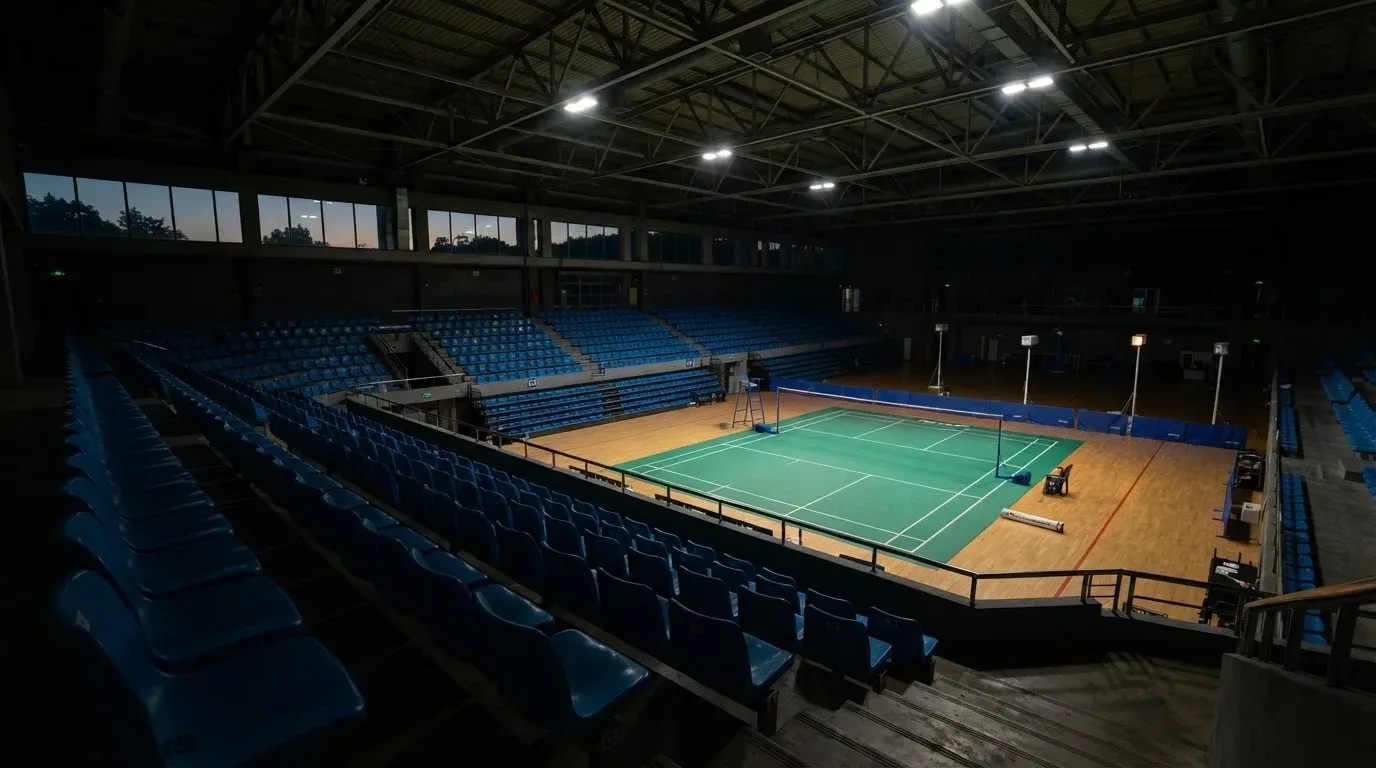
Three odd things follow for a betting line. First, the rally-point system compresses the comeback: a side two points from defeat at 19–21 is closer than the same deficit would feel in a 15-point table-tennis game, and the in-play price swings accordingly — the heavier favourite’s price can shorten sharply on the run to 11 in the second game. Second, the best-of-three frame keeps match prices live: a side a game down is not yet out and the in-play market reflects that, where a best-of-five frame would let a 2–0 lead settle the line. Third, each discipline carries its own depth — men’s singles is the deepest field and the prices reflect that, with the match-winner market tighter than in women’s doubles or mixed doubles where the ranking spread between top eight and the rest of the draw is wider.
What a badminton match looks like to a price: court size, game length and the lines the bookmaker offers
A badminton court is 13.4 m long, 6.1 m wide for doubles and 5.18 m wide for singles; the net stands 1.55 m at the edges and 1.524 m at the centre. A men’s singles match at top-level play averages around 40 minutes, sometimes closer to an hour if it goes deep; a doubles fixture can be over in half that. That timing matters for in-play betting — a bookmaker who only refreshes prices at the change of game in a match that finishes inside 35 minutes may show two prices per game and not the half-dozen a slower sport would carry. It also shapes the offer of live streaming, since a court-side camera running for a 35-minute match is a small commitment for an operator with a busy fixture list.

Where badminton lands in the GB-licensed market
There is no statutory list of permitted sports or markets in Great Britain. A bookmaker that takes bets from customers in Great Britain needs a Gambling Commission licence, and the licence categories on the register — remote general betting standard (real events), remote betting intermediary (the exchange category), and the rest — set the framework the operator offers markets under. A GB licence is the test of who is in; the domain (.com or .co.uk) and the country the operator is based in are not. The BWF calendar is short and event-led, so even a large bookmaker with a deep menu covers badminton on the events the calendar offers — the All England Open, the World Tour Super series, the Thomas and Uber Cups when they fall, the World Championships, and the Olympic cycle when the Games are in or near the calendar window. Outside those events, the betting line may shrink to outright winner markets or to a handful of pre-match prices, and an in-play book on a smaller BWF event is not something every operator will run.
How to read a price without being told what to think of it
Two prices from the same market are the quickest lesson. Take a two-way match-winner market priced 1.90 / 1.90 in decimal — fractional form, 9/10 against on either side. A £10 stake on either side returns £19 if it wins, a £9 profit on the £10 stake. The bookmaker’s margin in that price is what the bettor pays for the chance. The arithmetic is mechanical: the payout share of the market is 1 ÷ (1/odds₁ + 1/odds₂) — for 1.90 and 1.90, that is 1 ÷ (0.5263 + 0.5263) = 1 ÷ 1.0526 = 0.95, or 95%. The margin is 1 − 0.95 = 0.05, or 5%. The price charges 5% of every unit bet on the market; the rest is returned to winning bettors.
That number is a band, not a pegged figure. A 1.85 / 1.95 line on the same match gives a payout share of about 96.9% and a margin of about 3.1%; a 1.70 / 2.20 line gives a payout share of about 92.7% and a margin of about 7.3%. The market does not move on its own to that extent over a few minutes — the change is the operator’s own choice of price. A three-way market (the outright winner of a knockout tournament with three contenders still in it) carries a wider margin because the payout share sums across more outcomes: a 2.50 / 3.40 / 5.00 line gives a payout share of about 88.4% and a margin of about 11.6%. Three-way outright markets are expensive to back; two-way single matches are cheaper.
Reading the margin in the price is the test a bettor can do with a calculator and two decimal odds. The page later shows what a 5% margin does to a £10 bet on a 1.90 line over the long run; the headline is that a 3–7% band, depending on the operator and market, is the cost of the margin, which effectively charges 3–7% of every pound bet on the market.
The legal frame around a GB-licensed badminton bet
A GB licence is what binds the operator to the Commission’s rules; the player’s protection sits in those rules and not in the operator’s marketing. The framework is the Gambling Act 2005, which covers Great Britain — England, Scotland and Wales — and not Northern Ireland, which runs on its own older law. Since the Gambling (Licensing and Advertising) Act 2014, an operator whose remote facilities are used in Great Britain needs a Commission licence wherever it is based, so a Curaçao, Maltese or Gibraltar licence on its own is not a substitute. The Commission’s public register is searchable by business name, trading name, domain or account number and is the whole test of who holds a licence.
A few rules the bettor meets before a single badminton match is priced:
- Minimum age 18. Name, address and date of birth are verified before the first deposit, and have been since 7 May 2019 — including before a free bet or bonus is claimed. No anonymous play at a licensed site.
- Credit cards are banned for gambling in Great Britain since 14 April 2020, including credit-card-funded payments through an e-wallet. Debit cards and bank-based payments are not covered by that ban.
- Player protection: GAMSTOP, the national multi-operator online self-exclusion scheme, is a mandatory licence condition for online operators since 31 March 2020. Self-exclusion periods are six months, one year, five years, or five years with auto-renewal; after the minimum period the exclusion stays in place for a further seven years unless the customer asks GAMSTOP to remove it. Help lines: GamCare (the National Gambling Helpline), GambleAware, NHS gambling clinics, Gamblers Anonymous.
- A financial vulnerability check applies when a customer’s deposits minus withdrawals exceed £150 in a rolling 30 days. It is a public-record check (bankruptcy, county court judgments) — not an income check and not a credit reference check.
- Bonus wagering requirements are capped at 10x (a £10 bonus at 50x needed £500 of bets; the cap takes that to £100). Mixed-product promotions that require play across two or more product types — for example, bet on football to get free spins — are banned. The cap took effect on 19 January 2026.
The player pays no tax on betting winnings in Great Britain. General Betting Duty, currently 15%, is the operator’s tax on gross profits; from 1 April 2027 a remote betting rate of 25% applies, while remote bets on UK horse racing, self-service betting terminal bets in licensed premises, pool betting and in-person betting stay at 15%. Whether operators pass duty on through their odds is not established.
A financial product called spread betting sits outside the Commission’s remit and is run under the Financial Conduct Authority. Spreadex is the operator that runs both books — fixed-odds betting under the Gambling Commission and spread betting under the FCA — and its own terms state that spread betting losses can exceed deposits. The badminton lines in the comparison that follows are all fixed-odds lines, not spread betting positions.
Offshore bookmakers take bets from British customers without a GB licence; doing so is an offence aimed at the operator under section 33 of the Gambling Act 2005, not at the customer who places the bet. The cost of betting with an unlicensed brand is the absence of British protections: no GAMSTOP coverage, no Commission complaints route, no approved dispute-resolution body, no British consumer redress if funds are withheld, no binding by the 10x bonus cap or the £150 vulnerability check. Funds can simply go.
Responsible gambling on a daily-well-clad page
Safer gambling is the duty the licence binds the operator to, and the registered self-exclusion scheme is the strongest tool. GAMSTOP registration covers every GB-licensed online operator for the chosen period; a customer who has self-excluded cannot open a new one with a different brand for the duration of the exclusion. The licence also obliges the operator to offer deposit limits on a fixed time frame (RTS 12); the first changes applied from 31 October 2025, a second phase was postponed to 30 September 2026, and whether that phase is live at any given moment is not settled on the page.
Outside GAMSTOP, the bettor has the standard set of safer-gambling tools every licensed operator has to offer: deposit limits (daily, weekly, monthly), time-outs (24 hours, 48 hours, up to six weeks), reality checks (pop-up reminders during a session), and access to the customer’s own account history. Fitzwilliam Sports, one of the ten brands in the comparison later, names deposit limits and timeouts on its homepage and links to GambleAware, GAMSTOP and Gamblers Anonymous. The Commission’s own safer-gambling pages are that point for the regulator’s view.
For someone who feels the betting is moving outside their control, the entry points are:
- GamCare, the National Gambling Helpline, for confidential advice.
- GambleAware, for information and self-help tools.
- The NHS gambling clinics, for treatment in the NHS.
- Gamblers Anonymous, the peer-support fellowship.
A financial vulnerability check in the past 30 days does not flag a customer as a problem gambler. It is a public-record check that asks the operator to look at whether the customer has outstanding judgments or insolvency against their name, and to use it to decide whether to ask for further source-of-funds information. It is one of the triggers — alongside a customer’s own request and the operator’s monitoring of account behaviour — that can lead to a conversation between the operator and the customer about whether their gambling is sustainable.
Welcome offers on badminton: how a “free bet” actually pays
Three welcome offers in the comparison later carry terms that are worth reading as a worked example. Unibet’s sports welcome offer is “Get £40 in Free Bets when you bet £20”: a deposit and sports bet of £20 or more at minimum odds of 2.0 (1/1), with free bets expiring within 7 days of issue, for new GB customers using a debit card or instant bank transfer. The free bet stakes are not returned with a win — a £10 free bet at 3.00 returns £30, of which £20 is profit; the £10 stake is gone. Hollywoodbets’ sports welcome offer is “stake back as a free bet of up to £30” on a first qualifying losing accumulator: deposit £10 or more by card, stake £10 or more on an accumulator with three legs or more, at odds of 4/1 or greater, settled within 7 days; one free bet per customer. Bet Ahoy’s welcome offer is “Bet £10 & Get £10 in Free Bets”: a £5 sports bet plus a £5 acca. All three offers settle on the same template — a qualifying bet is required, free bets are issued on the result, and free bet stakes are not returned.
The arithmetic that follows uses the Unibet example, since the offer is the most generous of the three in headline value. A £20 qualifying bet at 2.00 returns £40 if it wins; the £20 stake returns and a £20 profit lands. The £40 in free bets is then split across the 7-day window; on a 3.00 badminton line, a £10 free bet returns £30 — a £20 profit on £20 of free bets, since two free bets of £10 each is what the headline usually translates to in practice. The cost of clearing is the £20 qualifying bet that has to be placed first. Across a large number of bettors claiming the offer, the qualifying bet is more often than not a wager on a heavy favourite, where the margin in the price is the fraction of every pound bet that the operator keeps. A £20 bet at 1.20 carries a margin closer to 8-10% on that single line, and that is the price of qualifying for the free bets.
The same arithmetic, applied to the Hollywoodbets offer, gives a different shape: the free bet only pays if the qualifying accumulator is a loser. A £10 acca at 5.00 (4/1) carries a margin that depends on each leg’s price; the accumulator’s margin is wider than a single match’s because the prices compound. A losing £10 acca returns the stake as a £30 free bet; that free bet at, say, 3.00 returns £60 if it wins, a £50 profit on the free bet since the stake is not returned. The cost of the offer to the operator is the £30 free bet paid to the customer who qualifies — paid out at the headline rate only when the free bet wins. Over a large number of customers, the operator’s expected cost is the free bet’s stake × (odds − 1) ÷ odds × payout share of the market the free bet is placed on, and the offer lands on the rate the qualifying accas lose at.
The cap on welcome offer wagering requirements — 10x since 19 January 2026 — is what stops a £10 bonus from being attached to a £500 turnover requirement. The Unibet and Hollywoodbets offers above carry no wagering requirement on the free bet (the offer is a free bet, not a cash bonus), so the cap does not bite on either. A £10 cash bonus at 50x would now be capped at £100 of turnover; the £10 cash bonus would settle into £10 of withdrawable cash after £100 of qualifying bets, where the £100 is the wagering requirement’s ceiling under the cap.
Live betting and cash out: what an in-play badminton line actually does
In-play betting on badminton is offered by GB-licensed bookmakers and the controls sit inside each operator’s own licence conditions and customer-protection duties. The framing is not “unrestricted” as a legal conclusion — in-play is licensed but is governed by the same safer-gambling rules as pre-match, including a financial vulnerability check once deposits minus withdrawals clear £150 in 30 days and a credit-card ban.
A badminton in-play line moves with the score. A 1.50 pre-match favourite in men’s singles who drops the first game 19–21 may shorten to 1.35 in-play if the form has held, or drift to 1.80 if the loss looked structural. The rally-point system tightens the comeback at 19–21 and the in-play price swings quickly. A best-of-three match settles inside 35 to 75 minutes depending on how long the games run, and an operator that only refreshes prices at the change of game offers two or three in-play prints per match; an operator that refreshes at 11 in the second game and at the match point offers more, and the difference shows up in the in-play book.
Cash out is the operator’s offer to settle the bet before the match finishes, at a price derived from the current in-play line and the stake the customer originally placed. A £10 bet at 2.00 pre-match, with the favourite leading 11–7 in the second game, may carry a cash-out value of £18 if the in-play line on the same selection has shortened to 1.80; the £8 difference between the £18 cash-out and the £20 full settlement is the operator’s cut for ending the bet early. A cash-out value that exceeds the full-settlement value is not a feature; a cash-out value that drops well below full settlement as the score turns is the everyday case. bet365, one of the ten brands in the comparison, offers Bet Builder+, Super Boosts, Winnings Boosts on Bet Builders and selected singles, plus daily Bet Boosts, and runs in-play betting alongside live streaming of events worldwide. The in-play line for badminton is offered where the BWF calendar offers an event the operator covers; for smaller events the in-play book may be light.
Live streaming is a separate question from in-play betting. The two are often offered together — the bettor watches the stream and bets on the in-play line beside it — and an operator may stream an event without running an in-play book on every point, or may run an in-play book without streaming. The BWF holds broadcast rights for its tournaments and the rights package varies by territory; a GB-licensed bookmaker may stream a tournament the rights holder has sub-licensed to UK platforms, and a different tournament the rights holder has not.
Betting tips and prediction markets: what a tip sells
A “tip” in this market is one of three things, and the value of each depends on what is being sold. A statistical model — feeds of historical match data, head-to-head records, ranking form, court-surface effects (none in badminton — every event is indoor) — produces a probability for each outcome, and a tipster publishes the model’s output as a price. The output is reproducible and is the form a serious tipster runs; the price the model produces is the price the tipster backs, and the bettor who follows the tip is backing the same model. A human tipster — a writer who picks matches, sets prices, and publishes them — sells a judgement. The judgement is what the tipster charges for; the price the tipster names is the tipster’s own, and the bettor who follows is trusting the tipster’s reading of form, not a model. A “guaranteed” tip — a service that markets a winning pick as certain — sells marketing, and a guaranteed outcome in a sport with a margin in every price is not a thing the page recognises. The audit at the end of this page is the bettor’s own: a price the bookmaker offers carries a margin in it, a tip that ignores the margin is selling without it, and the cost of following tips is the margin compounded across the bets the tip generates.
What a tip does not do: name the winner. A prediction is a probability, and the price is the price the probability carries after the operator’s margin sits on it. A 60% probability on the favourite, with a 5% margin in the price, comes out at 1.58 in decimal odds, not at the 1.67 the raw probability would produce. The difference is the operator’s cut. The tip that names the favourite at 1.58 has cleared the margin out of the price; the tip that names the favourite at 1.67 has not, and the bettor who takes the second tip is paying for the tipster’s price, not the operator’s.
The bet types an odds board carries: singles, accumulators and the betting exchange
A badminton betting line is offered as a single (one selection, one event), an each-way bet (two equal-stake bets — one for the win, one for a place — used more in horse racing than in badminton, where the “place” terms are operator-specific and not standardised), and a series of pre-made accumulators the operator names: the double (two selections), the treble (three), the accumulator or “acca” (four or more), plus the full-cover bets — Trixie (4 bets), Patent (7 bets), Yankee (11), Lucky 15, Super Yankee or Canadian (26), Heinz (57), Goliath (247). The total stake on a Lucky 15 at £1 unit is £15; the same bet on a Goliath at £1 unit is £247. The combination bet’s price is the product of each leg’s price — a treble of three 2.00 legs carries a price of 8.00, not 6.00 — and the margin in the combination’s price is the compounded margin of each leg.
A bet builder or same-game multi is the bettor’s own accumulator on a single event: the operator offers a set of markets for the match (match winner, total games, handicap games, first to 10 in game one, race to 5 in game two) and the bettor combines them into a single bet. bet365 calls its bet builder Bet Builder+ and combines markets from one event pre-match and in-play. The bet builder’s price is again the product of the legs, and the margin on each leg is the margin the operator has priced into that market. A bet builder on a 1.85 match winner and a 1.90 total games over 2.5 carries a price of 3.515 and a margin compounded across both legs.
A betting exchange — Smarkets is the one in the comparison — runs the same markets but lets customers back and lay, with the operator taking a commission on net winnings rather than a margin in every price. The exchange’s price on a 1.90 / 1.90 line is closer to 1.95 / 1.95 because the exchange’s cut sits in the commission rather than the margin, and the bettor who wins on the exchange pays commission on the winnings. The exchange’s deposit and withdrawal times are the test of whether the exchange is competitive: Smarkets UK, by its own terms, processes withdrawals within 6 hours from £10 up to £100,000, with deposits by open bank transfer instant from £10 up to £10,000.
Tournaments and the calendar: where badminton fits in a betting line
The BWF calendar runs the international game, with a small number of marquee events carrying the deepest betting lines:
- The Olympic Games every four years, badminton since 1992, mixed doubles since 1996.
- The BWF World Championships, first held in 1977.
- The All England Open Badminton Championships, the oldest and most prestigious tournament, first held in 1900.
- The Thomas Cup (men’s team) and Uber Cup (women’s team), held every two years.
- The Sudirman Cup (mixed team), held every two years since 1989.
- The BWF World Tour, a season-long series of Super 1000, Super 750, Super 500, Super 300 and Super 100 events.
A betting line on the All England final is offered by every GB-licensed bookmaker with a badminton menu; a betting line on a Super 100 event is offered by the deeper books; a betting line on a Super 300 qualifier may not be offered at all. The depth of the line tracks the depth of the field, and the depth of the field tracks the tournament’s place in the calendar.
A GB-licensed bookmaker that covers badminton well covers the BWF World Tour events from Super 500 upwards, the Thomas and Uber Cups when they fall, the Sudirman Cup, the World Championships, and the Olympic tournament when the Games are in. Outright winner markets on the All England and the Worlds are offered in the run-up to the event and settle on the winner of the tournament, not on the winner of a single match. In-play betting is offered on the bigger events; the smaller events may be pre-match only.
The ten reviewed operators
The ten operators that follow are reviewed against the same template: the licence on the Commission’s public register, the offer the operator’s own terms state for new GB customers, the markets the operator covers for badminton, and the deposit and withdrawal shape the operator runs.
Ladbrokes — the long-established high-street name now under Entain
Ladbrokes is run by LC International Limited under Gambling Commission account 54743, with remote general betting standard (real events) and remote betting intermediary on the licence. The Ladbrokes Sports Betting App is published by Entain Operations Limited, the same parent that runs Coral, and is rated 4.66 from 101,255 ratings in the GB App Store. The brand carries a deep sports menu across football, horse racing, greyhounds, tennis, golf, cricket and a long list of others, and badminton lines are offered on the bigger BWF events. Cash out, in-play betting and a bet builder sit alongside the singles and accumulators. The welcome offer on the sportsbook is the standard free-bet cluster, settled on the same template as the rest of the GB market — qualifying bet, free bets on the result, expiry inside 7 days. The verdict: a high-street name with a deep menu and a long odds board, the operator a customer opening an account once knew in a different form. For badminton specifically the line is solid rather than specialist — the All England and the Worlds carry the deepest in-play book, smaller BWF events may be pre-match only.
Bet Ahoy — a smaller UK bookmaker with a tight welcome offer
Bet Ahoy is licensed under Gambling Commission account 100094, with remote general betting standard (real events) on the licence; the licence holder is Bet Ahoy Ltd. The welcome offer, in the brand’s own terms, is “Bet £10 & Get £10 in Free Bets”, made up of a £5 sports bet and a £5 acca, for new GB customers. The brand is smaller than Ladbrokes or bet365 and the sports menu is shorter, but it covers the headline events and offers in-play betting on the bigger fixtures. The verdict: a tight welcome for a smaller balance, the £10 free bet headline is paid out fast on the qualifying bet’s result. For badminton specifically, the line is offered on the bigger BWF events and may not extend to the long tail of the World Tour. A bettor who wants a single welcome with a short expiry window and a small qualifying stake will find the offer the right shape; a bettor who wants the deepest badminton menu will find it elsewhere.
Fitzwilliam Sports — a Dublin bookmaker with capped accounts
Fitzwilliam Sports describes itself as a Dublin bookmaker with capped membership, licensed under Gambling Commission account 48760 (licence holder SBKI Limited). The welcome is a “High Stakes Welcome” subject to compliance criteria — a higher-stake offer aimed at customers the brand’s criteria select for — and the brand offers instant deposits, fast withdrawals, timeouts and deposit limits, and links to GambleAware, GAMSTOP and Gamblers Anonymous on its homepage. The verdict: a bookmaker that selects its customers rather than opening to all comers, the welcome is not a flat £10 free bet but a higher-value offer behind a screening. With its capped account structure, the brand tends to focus on major tournaments where the liquidity is more consolidated.
London Bet — a smaller UK brand bundling sports and casino
London Bet is licensed under Gambling Commission account 66162, under its Gambling Commission remote licence; the licence holder is Thistle Bet Limited. The app combines sports betting — football, tennis, horse racing, greyhounds, darts, golf, cricket, NFL, NBA, MLB and snooker — with Pragmatic Play casino slots and live in-play betting. Badminton is offered on the bigger events. The verdict: a brand that pairs a sportsbook with a casino, the badminton menu is offered on the bigger BWF events rather than across the calendar, and the welcome is the standard sportsbook cluster. This is a sensible fit for customers who mix sports betting with casino play and prefer a single-account experience.
Unibet — a 1999-founded brand with a £40 free-bet headline
Unibet has operated since 1999, and its UK site is run by Platinum Gaming Limited, Gibraltar, under Gambling Commission account 45322. The sports welcome offer, in the brand’s own terms, is “Get £40 in Free Bets when you bet £20”: a deposit and sports bet of £20 or more at minimum odds of 2.0 (1/1), with free bets expiring within 7 days of issue, for new GB customers using a debit card or instant bank transfer. The brand offers a deep sports menu, in-play betting, a bet builder, and live streaming on selected events. The verdict: a long-established brand with a higher-value welcome than the £10 cluster — the £40 free bet headline is paid out fast on a £20 qualifying bet, and the free bets expire inside 7 days. The marquee tournaments are where the operator’s in-play book sees the most action.
Smarkets — a betting exchange with tight deposit and withdrawal times
Smarkets is licensed under Gambling Commission account 39173, with remote betting intermediary on the licence; the licence holder is Smarkets (Malta) Limited. By its own payment-methods terms, deposits by open bank transfer are instant from £10 up to £10,000, and withdrawals are processed within 6 hours from £10 up to £100,000, with UK debit card deposits instant from £10 up to £15,000. The exchange runs back and lay markets on the headline events; the operator takes a commission on net winnings rather than a margin in every price. The verdict: an exchange rather than a traditional bookmaker, the price on a 1.90 / 1.90 line is closer to 1.95 / 1.95 because the exchange’s cut sits in the commission. For badminton specifically, the exchange covers the marquee events and the tighter price is the headline; the bettor who backs on the exchange pays commission on winnings, the bettor who lays on the exchange earns commission on the backer’s losses.
Fafabet — Best Odds Guaranteed on UK and Irish racing
Fafabet is licensed under Gambling Commission account 57385, under its Gambling Commission remote licence; the licence holder is Taichi Tech Limited. The brand pays Best Odds Guaranteed on UK and Irish horse racing win and each-way bets from 9am on race days: if the starting price is bigger than the original price taken, the bigger odds are paid. The brand carries a sports menu across football, tennis, horse racing, greyhounds, and a long list of others, with badminton lines on the bigger BWF events. The verdict: a brand whose standout feature is the racing Best Odds Guaranteed offer — a feature aimed at racing rather than badminton — alongside a sports menu that covers badminton on the bigger events. The racing-focused welcome offer is the standout here, with the broader sports menu serving the casual badminton bettor.
bet365 — the headline partner of UEFA Champions League and the most-downloaded UK sports app
bet365 is licensed under Gambling Commission account 55148, with remote general betting standard (real events) on the licence; the licence holder is Hillside (UK Sports) ENC. The brand is the official global betting partner of the UEFA Champions League and its app is described as the most-downloaded sports betting app in the UK. The brand offers Bet Builder+ (combining markets from one event pre-match and in-play), Super Boosts, Winnings Boosts on Bet Builders and selected singles, daily Bet Boosts, in-play betting, live streaming of events worldwide, Bet Track, Match Live and a Live Golf Tracker. The verdict: the deepest sports menu in the comparison, the operator whose bet builder is the headline, and the in-play book and live streaming together carry badminton coverage from pre-match through the change of every game. It remains the most comprehensive option for badminton, providing deep pre-match markets and in-play coverage across the Tour.
Hollywoodbets — stake back as a free bet on a first qualifying acca
Hollywoodbets is licensed under Gambling Commission account 53028, under its Gambling Commission remote licence; the licence holder is Hollywoodbets International UK Limited. The sports welcome offer, in the brand’s own terms: new players who deposit £10 or more by card get their stake back as a free bet of up to £30 on their first qualifying losing accumulator — stake £10 or more, three legs or more, odds of 4/1 or greater, settled within 7 days; one free bet per customer. The brand covers football, horse racing, greyhounds and a long list of others, with badminton lines on the bigger events. The verdict: a brand whose welcome offer is the shape of a stake-back on a losing acca — the offer is paid out to the customer whose qualifying acca loses, the operator’s expected cost is the free bet’s stake paid at the rate the qualifying accas lose at. The acca-focused welcome offer targets the accumulator bettor, with badminton coverage tending to center on the sport’s biggest events.
Kalooki Sportsbook — a smaller UK bookmaker with GAMSTOP membership and full verification
Kalooki Sportsbook is operated by Kalooki Sports Book Ltd (company number 12938274), licensed by the Gambling Commission under account number 57730, with remote general betting standard (real events) on the licence, and is a GAMSTOP member. The brand carries a sports menu with badminton lines on the bigger events, and runs identity verification before the first deposit. The verdict: a smaller UK bookmaker with full compliance — verification before the first deposit, GAMSTOP membership, the standard safer-gambling tools — and a sports menu that covers badminton on the marquee events rather than across the long tail of the World Tour. For badminton specifically, the line is solid rather than deep, and the welcome is the standard sportsbook cluster.
What the comparison looks like at a glance
| Brand | Gambling Commission remote licence and holder | What the operator’s own terms state |
|---|---|---|
| Ladbrokes | 054743-R-330863-014, LC International Limited | Entain-published app, 4.66-rated in the GB App Store, full sports menu with badminton on the bigger BWF events, in-play and cash out |
| Bet Ahoy | 100094-R-341742-003, Bet Ahoy Ltd | “Bet £10 & Get £10 in Free Bets” welcome for new GB customers |
| Fitzwilliam Sports | 048760-R-335434-009, SBKI Limited | “High Stakes Welcome” subject to compliance criteria; instant deposits and fast withdrawals, timeouts and deposit limits, links to GambleAware, GAMSTOP and Gamblers Anonymous |
| London Bet | 066162-R-340278-004, Thistle Bet Limited | Sports betting paired with Pragmatic Play casino slots and live in-play betting |
| Unibet | 045322-R-324275-019, Platinum Gaming Limited | “Get £40 in Free Bets when you bet £20” sports welcome, £20+ deposit and bet, minimum odds 2.0, 7-day expiry |
| Smarkets | 039173-R-319366-011, Smarkets (Malta) Limited | Betting exchange; deposits by open bank transfer instant from £10 to £10,000, withdrawals processed within 6 hours from £10 to £100,000 |
| Fafabet | 057385-R-333191-006, Taichi Tech Limited | Best Odds Guaranteed on UK and Irish horse racing from 9am on race days |
| bet365 | 055148-R-331498-002, Hillside (UK Sports) ENC | Official global betting partner of the UEFA Champions League, Bet Builder+, Super Boosts, Winnings Boosts on Bet Builders and selected singles, daily Bet Boosts, in-play and live streaming |
| Hollywoodbets | 053028-R-330019-013, Hollywoodbets International UK Limited | Stake back as a free bet of up to £30 on a first qualifying losing accumulator (stake £10+, 3+ legs, odds 4/1+, settled within 7 days) |
| Kalooki Sportsbook | 057730-R-333396-005, Kalooki Sportsbook Limited | GAMSTOP member, identity verification before the first deposit |
A licence number is the test of who holds a Commission licence; it is not a ranking. The headline terms in the third column are what each operator’s own site states; the deeper terms — minimum odds, expiry, qualifying bets, free bet stake return rules — sit in the operator’s full terms and should be read before claiming.
The margin in the price: a worked example
Take an illustrative two-way market at decimal odds of 1.90 / 1.90 — fractional form 9/10. A £10 stake on either side returns £19 if it wins, a £9 profit on the £10 stake. The payout share of the market is 1 ÷ (1/1.90 + 1/1.90) = 1 ÷ 1.0526 = 0.95, or 95%. The margin is 1 − 0.95 = 0.05, or 5%. The price charges 5% of every unit bet on the market; the rest is returned to winning bettors.
The same market at 1.85 / 1.95 gives a payout share of about 96.9% and a margin of about 3.1%; the same market at 1.70 / 2.20 gives a payout share of about 92.7% and a margin of about 7.3%. The market does not move on its own to that extent; the change is the operator’s choice of price. A 5% margin is the band a tight two-way badminton line carries; a 7-10% margin is the band a wider line carries; a 12-15% margin is the band an outright winner market on a three-way field carries.
The cost of the margin to the bettor is the lost expected value on every bet. A £10 bet at 1.90 with a 5% margin returns £19 only on the outcomes that pay out — the bettor’s expected value, before the margin, on a fair 50/50 line at 2.00 would be £20; after the 5% margin the expected value falls to £19. Over a large number of bets at the same price, the bettor loses 5% of every pound staked to the operator’s margin. A free bet at the same price has its own cost: the stake is not returned on a win, so the £10 free bet at 1.90 returns £19 if it wins, a £9 profit on a stake that has already been paid in free-bet credit. The free bet’s expected value to the bettor, before the operator’s cut, is the free-bet stake × (odds − 1) ÷ odds × payout share — for a £10 free bet at 1.90 on a 5% margin market, that is £10 × 0.90 / 1.90 × 0.95 = £4.50. The free bet is worth £4.50 on average, not £10, and the headline value of a “£10 free bet” is the credit the bettor receives, not the average value the bettor keeps.
What this leaves the bettor holding
Three things follow from the price. First, the price carries a margin the operator has chosen; the bettor who reads two prices from the same market can read the margin in them, and the bettor who reads the margin in a market can decide whether the price is worth taking. Second, the welcome offer is paid out on a template — qualifying bet, free bets on the result, expiry inside 7 days, free bet stake not returned — and the cost of qualifying is the margin in the price of the qualifying bet; the headline value of the offer is the free-bet credit, not the average value the bettor keeps. Third, the licence on the Commission’s public register is the test of who is in; the brand’s name and the brand’s licence number are the two pieces of information that tell the bettor whether the operator is bound by the Commission’s rules, and the safer-gambling tools and the dispute-resolution route a licensed operator offers are part of the price.
Frequently asked questions about badminton betting odds
How is a bet placed on badminton?
A bettor picks a GB-licensed bookmaker, registers an account, completes the identity verification the operator runs before the first deposit (name, address and date of birth, in place since 7 May 2019), deposits by debit card or bank transfer (credit cards are banned for gambling in Great Britain), and places a bet on a badminton market from the operator’s menu — match winner, total games, handicap games, outright winner of a tournament. The bet settles when the match or the tournament finishes, or earlier if the operator offers cash out and the bettor takes it. Badminton is offered on the bigger BWF events; smaller events may not carry a line.
How can a Gambling Commission licence be verified?
The Commission’s public register can be searched by business name, trading name, domain or account number. The brand on the register is the brand on the licence; the licence holder is the company behind the brand. A GB licence is the test of who is in. The brand’s own site states the licence number; the register is where the licence is checked. A licence number the brand prints but the register cannot confirm is not a GB licence.
How is the return on a bet calculated from the stake and the odds?
In decimal odds, return = stake × odds. A £10 stake at 2.50 returns £25 if it wins; net profit = stake × (odds − 1) = £15. In fractional odds, return = stake × (numerator ÷ denominator + 1). A £10 stake at 5/1 returns £60 if it wins; net profit = £50. The two formats describe the same return on the same stake.
What is the bookmaker’s margin and how does it show in the odds?
The bookmaker’s margin is the cut the operator takes of every unit bet on a market. For a two-way market, payout share = 1 ÷ (1/odds₁ + 1/odds₂); margin = 1 − payout share. For a 1.90 / 1.90 line the payout share is 95% and the margin is 5%. The margin is the cost the bettor pays for the chance to back the line; over a large number of bets at the same price, the bettor loses the margin to the operator.
How do fractional odds such as 5/1 convert to decimal odds such as 6.00?
Fractional a/b → decimal (a ÷ b) + 1. 5/1 → 5 + 1 = 6.00. 11/4 → 2.75 + 1 = 3.75. Evens (1/1) → 1.00 + 1 = 2.00. The decimal form is the British and European online slip’s default; the fractional form is the British high-street slip’s default. The two are the same price.
What safer-gambling tools does a GB-licensed bookmaker have to offer?
A licensed remote operator offers GAMSTOP registration for self-exclusion across all online operators, deposit limits on a fixed time frame, timeouts (24 hours to six weeks), reality checks, the customer’s own account history, and access to GamCare, GambleAware, NHS gambling clinics and Gamblers Anonymous. A financial vulnerability check applies when deposits minus withdrawals clear £150 in a rolling 30 days. The tools are operator-side; the self-exclusion is national.
Tennis, darts & cue sports – oddsguaranteed
Content created by the «oddsguaranteed» team
