
Booking points betting — the price of a yellow card, and where the licensed bookmakers sit
 Available in US
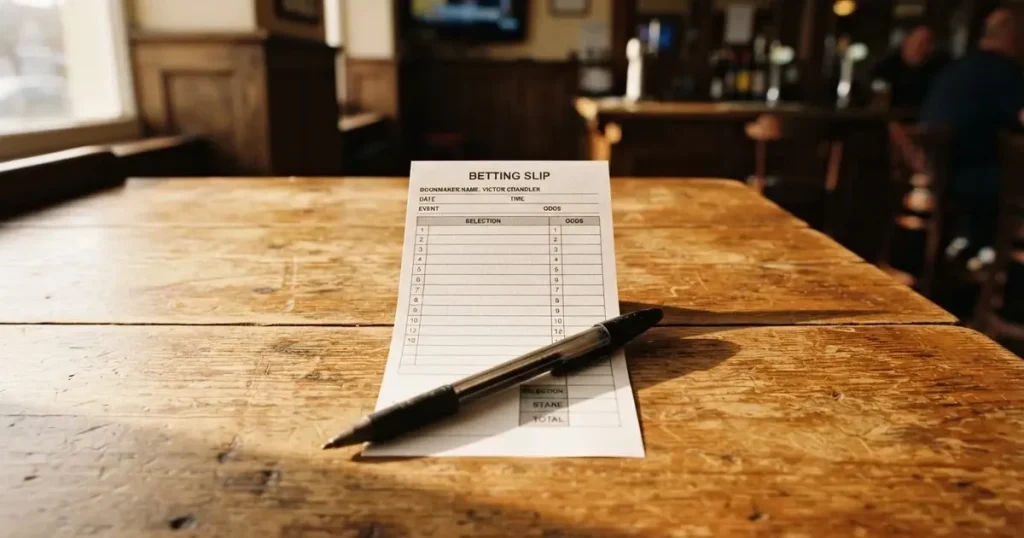
A yellow card in the Premier League is not a single thing on a betting slip. Some price it at ten points, some at twenty. A straight red adds more. A second yellow that sends a player off is graded differently from a caution awarded to the bench. Booking-points markets exist because football is a game of accumulated indiscipline, and bookmakers offer a way to price that accumulation before the whistle goes. The point of this page is to explain what those markets cost — what the bettor pays in margin, in minimum prices, in settlement rules and in the licence they stake their money under — and to name the ten UK-licensed brands whose terms state they offer this kind of market.
The data and licence claims below were checked against the Gambling Commission’s public register and against each operator’s own published terms on October 30, 2026.
How a booking-points market is built and settled
Selection, points and the shape of the slip
A booking-points market is a totals-style wager on the cautions (and, on some books, the sending-offs) inside a single football match. The bettor picks a line — say “over 30.5 booking points” — and a price, and the bookmaker settles on the card count once the game ends. The grading rule is mechanical: a yellow is worth ten points, a straight red is worth twenty-five, a second yellow that produces a red is worth fifteen (the ten for the card itself plus five for the dismissal, with no double-counting), and a card shown to a substitute or to a member of the coaching staff counts in the same way. Those point values are industry convention rather than statute, but every UK bookmaker offering the market uses them, and the price on the slip is built against that convention.
A betting slip in this market is therefore closer to a football totals line than to a match-result line. The bettor is not choosing a team; the bettor is choosing how many incidents the referee is going to produce. That choice has consequences for how the price is set and how it is read. A market with one obvious outcome — a heated derby with two aggressive midfields — will have a tighter line and shorter prices than a calm mid-table fixture, and a bookmaker’s margin rides on top of the line however the line is drawn. The bettor’s job, on this market, is to read the line and the price together.
Settlement: 90 minutes, extra time, and what VAR does to a card
The standard settlement window is the ninety minutes plus stoppage time. Extra time and penalties do not count on most UK books unless the market is explicitly named “to include extra time”, and that distinction is worth checking before staking. A card awarded after the final whistle, even for an incident during play, usually does not count. A card that the referee shows and then rescinds after a VAR review counts in line with the moment the card was originally brandished, not the moment it was withdrawn; the bookmaker’s settlement team typically follows the official match report, and a small number of books publish a rule that the official report is the binding document.
A card shown only after VAR intervention is settled as a card; the technology is invisible to the settlement. What VAR does change is the volume. Games with active VAR produce marginally more bookings than games without it, because video review catches incidents the on-field officials missed, and that volume feeds straight into the line. A line of 30.5 that would have been generous ten years ago is now closer to the middle of the distribution, and the bookmaker’s price reflects that. The bettor’s reading of the line has to keep pace.
Price, margin and the cost of a winning bet
The price on a booking-points line is fractional on most UK books (5/1, 11/10, 6/4) and decimal on the same book (6.00, 2.10, 2.50). The conversion is mechanical: a/b becomes a ÷ b + 1, so 5/1 is 6.00, 11/10 is 2.10, 6/4 is 2.50. The price the bettor sees is the price the bookmaker offers, and the price carries the bookmaker’s margin. The margin is the cut the bookmaker keeps from every unit staked on the market, and it sits inside the price whatever the format.
The margin of a single market can be read from the prices on every outcome. For an illustrative two-way line at decimal odds 1.90 / 1.90 — an example, not a quoted price — the margin is roughly 5 per cent: the inverse sum of the two prices is 1 ÷ (1/1.90 + 1/1.90) ≈ 0.95, meaning the book returns about 95p in winnings per pound wagered across both outcomes, and keeps about 5p. At evens that 5 per cent is the floor for this market; the further the price moves from 1.90 in either direction, the larger the margin tends to climb. A 1.50 / 2.80 pairing produces a margin of around 7 per cent. A 1.20 / 5.50 pairing produces a margin north of 12 per cent. The bettor pays that margin on every pound staked, win or lose, because it is baked into the price.
A bet of £10 at decimal odds 2.50 returns £25 if it wins — the £10 stake times 2.50 — for a net profit of £15. The £10 stake is included in the £25. A winning combination bet multiplies the legs into one price, so a treble at 2.00 / 3.00 / 4.00 settles at 24.00, and £10 returns £240. None of those returns is guaranteed; the calculation describes what a winning bet pays, not what a placed bet pays.
Minimum stakes, each-way and the small print
UK bookmakers set their own minimum stakes, typically £1 or £5 for online bets, with maximum stakes at the operator’s discretion and often higher for prominent customers. A booking-points line is a single fixed-odds market, not a place bet, so the each-way button does not apply — there is no “each way” on a totals-style line, and any site that offers one is offering something else. A bettor who clicks each-way on this market has, in most cases, accidentally doubled their stake on the same line.
The minimum price for a free-bet qualifying wager, where a free-bet offer requires a bet at or above a stated price, is normally 1.50 (1/2) or 2.00 (1/1). A free bet on a booking-points line at 1.30 does not qualify on most UK books. Where the offer states the minimum in fractional form, the decimal equivalent is the test; where the offer states decimal, the fractional equivalent is the test; the two formats describe the same price. A punt on the bookmaker’s own enhanced-odds version of the same line usually does not qualify either, because enhanced-odds prices are not the “real” price for the purpose of the offer.
The shortlist: ten UK-licensed bookmakers, ranked by how they handle this market
The shape of the comparison
The table below sets out the ten UK-licensed bookmakers reviewed on this page, the Gambling Commission licence each one operates under, and what the operator’s own published terms state about its sportsbook and its booking-points offer. It is a comparison of licences and stated terms, not a recommendation; no single brand is “the only” licensed operator, and a place in a comparison is not a licence.
| Brand | Gambling Commission remote licence number and licence holder | What the operator’s own terms state on booking points and the booking-points market |
|---|---|---|
| Bet Ahoy | Remote licence under Commission account 100094; licence holder Bet Ahoy Ltd | Welcome offer: Bet £10 and get £10 in Free Bets, split £5 sports and £5 acca; full sportsbook with pre-match and in-play markets |
| DragonBet | Remote licence under Commission account 64908; licence holder DragonBet Ltd | Welsh football and rugby, racing, American football, in-play betting and bet builder markets |
| BetTom | Remote licence under Commission account 64959; licence holder Bet Tom Limited | Sports welcome: 50 per cent back as a free bet up to £50, paired with a matching casino offer; full terms apply |
| Smarkets | Remote licence under Commission account 39173 (betting intermediary); licence holder Smarkets (Malta) Limited | Exchange model with a 2 per cent commission on eligible exchange bets; new customers have been offered 0 per cent commission for sixty days on a minimum £10 first deposit |
| Paddy Power | Remote licence under Commission account 39439; licence holder PPB Counterparty Services Limited | Bet Builder+, Popular Bet Builders, Super Sub (a bet rolls over to the replacement if a selected player is substituted), expanded Win More markets, player and acca stats |
| Bar One Racing | Remote licence under Commission account 56516; licence holder Bar-One Racing Limited | Irish independent bookmaker; horse racing sponsorships at Dundalk, Fairyhouse, Navan, The Curragh, Curraheen Park and Cork; rebranded as BAR 1 Betting |
| Fitzwilliam Sports | Remote licence under Commission account 48760; licence holder SBKI Limited | Prices based on Oddschecker’s average price for each selection; Apple and Google mobile apps |
| Betmaster | Remote licence under Commission account 65699; licence holder BM Solutions GB Ltd | Online sportsbook; holds the stated remote general betting standard (real events) category on the register |
| Lottoland | Remote licence under Commission account 38991; licence holder EU Lotto Limited | Combines casino, lottery betting, sports betting and scratchcards; holds a remote general betting licence for GB customers |
| 888sport | Remote licence under Commission account 39028; licence holder 888 UK Limited | Pre-match and in-play betting, Cash Out, Bet Builder, racing streams, BetFinder form tools, a live bet feed and daily boosted odds |
What the table is actually comparing
Three things sit behind the table. The first is the licence itself: every brand listed here is on the Gambling Commission’s public register, against the named licence holder and the named Commission account. The licence is the test of who is regulated in Great Britain; it is not a comparison of price or quality. A bettor who wants to confirm a licence can search the Commission’s public register by business name, trading name, domain or account number, and that search is the whole answer to whether the licence exists.
The second is the operator’s own terms. Each row records what the operator’s own site or app states on its sportsbook and on any feature it links to the booking-points market. Where the operator’s own statement does not name booking points specifically — and most UK sportsbooks describe the market under “match totals” or “player cards” rather than under a “booking points” tab — the row records the closest stated feature. Where the operator’s terms state a price or a feature that this page cannot independently confirm, the row records the operator’s statement and nothing more.
The third is the absence. Smarkets is on this page as a betting exchange; the other nine are traditional sportsbooks. A bettor comparing booking-points prices across the ten brands needs to know that an exchange and a sportsbook are not the same product — an exchange charges commission on net winnings and lets customers back and lay, while a sportsbook keeps the margin inside the price and runs one-way only. Both are licensed; both are regulated; both carry the same player-protection regime under the Gambling Act 2005; they are not the same offer.
Fundamentals: how booking-points markets fit into a UK sportsbook
The landscape of cards markets
Most UK bookmakers price booking points as a totals market on the whole match, alongside a small set of derivative markets: first card, time of first card, player to be carded, and team most cards. Some books price a “any player to be sent off” line as a separate market, with its own margin. The underlying settlement rule — yellow ten, straight red twenty-five, second yellow fifteen — is consistent across UK books, but the lines themselves are set independently, and a line of 30.5 at one book can sit alongside 32.5 at another on the same match. The bettor comparing books is therefore comparing two things at once: the line and the price.

The wider market for booking-points sits inside a much larger in-play product. UK bookmakers offer in-play betting on football across hundreds of leagues, and booking-points is one of the smaller markets inside that offering. In-play prices on booking-points tend to be wider than pre-match, partly because the in-play book has thinner liquidity and partly because the market is suspended for stretches of play when the referee is approaching a card. A bettor who wants to back “over 30.5” at 1.90 pre-match may find the same line at 1.70 in-play once the game has started — and that wider price is the bookmaker’s compensation for the heavier margin.
Why the margin on this market is what it is
The margin on a booking-points market is, on most UK books, comparable to the margin on a match-result market on the same fixture — somewhere between 4 and 8 per cent on a two-way line at evens, with the floor close to 5 per cent and the ceiling rising as the line gets further from evens. The reason is that the underlying distribution is harder to predict than a match-result distribution. The referee is a small sample. The bookmaker cannot price the referee’s card distribution the way it can price a team’s goals distribution, because there is no league-wide referee model that captures the variance. The margin compensates the bookmaker for that uncertainty, and the bettor pays it.
The bettor can read the margin from the spread of the prices. A book quoting 1.85 / 1.95 on the two-way line is offering a tighter margin than a book quoting 1.80 / 2.05 on the same line, even if the average price looks similar. The inverse-sum calculation works whatever the two prices are, and the result is the cut the book keeps. Two books with the same line and the same average price can carry different margins, and the difference is what the bettor pays in lost return.
What a booking-points bet looks like in practice
The slip on this market is short. The bettor chooses the fixture, the line and the price, and enters the stake. There is no player to pick, no team to pick, no combination of legs — it is a single wager on a number. A £10 stake at 1.90 returns £19 if it wins. A £100 stake at 2.50 returns £250. The cost to the bettor is the stake plus the margin, and the margin is the difference between the price the bettor took and the “true” price the market would clear at if every outcome paid at the same rate.
The settlement is mechanical and the rules are stated. The bettor does not need to read the small print to know what a yellow is worth; the bookmaker does. What the bettor does need to read is whether extra time counts, what happens to a card rescinded by VAR, and whether the official report or the bookmaker’s own settlement is binding. Those three points are where the small print lives, and they are where disputes tend to land.
Statute: the licence, the regulator and what protection a UK customer actually has
The Gambling Commission and the public register
The Gambling Commission regulates commercial gambling in England, Scotland and Wales under the Gambling Act 2005; Northern Ireland is outside the Act and runs its own older law. The Commission is a non-departmental public body sponsored by the Department for Culture, Media and Sport. It licenses operators, enforces licence conditions, and publishes a public register of every licence it has issued. The register can be searched by business name, trading name, domain or account number. That register is the test of who holds a licence.

Since the Gambling (Licensing and Advertising) Act 2014, an operator whose remote facilities are used in Great Britain needs a Commission licence wherever the operator itself is based — sections 33 and 36 of the 2005 Act, as amended. A Curaçao, Maltese or Gibraltar licence is not a substitute for a Commission licence when the customer is in Great Britain. There is no state monopoly and no cap on the number of licences; the market is open, the test is whether the operator holds the licence it needs.
Betting licence types matter because the licence states what the operator can do. Remote general betting standard (real events) covers fixed-odds betting on real sport, which is the licence every brand on this page holds. Remote general betting standard (virtual events) covers computer-generated events and is a separate category. Remote general betting limited is a smaller, more restricted category. Remote pool betting covers pool betting on horse and dog racing. Remote betting intermediary is the licence for betting exchanges, which is the licence Smarkets holds on this page. A customer comparing licences needs to know which category a brand operates under, because the licence states what markets the brand can offer.
Identity verification, age and the first deposit
UK-licensed bookmakers verify a customer’s name, address and date of birth before the customer can deposit or gamble — a requirement in force since 7 May 2019, and one that covers free bets and bonuses as well as cash stakes. The minimum age is 18. The verification is automatic in most cases (an electronic check against public records and credit-reference data), manual in others (a photograph of a passport or driving licence), and it happens before the first bet, not after.
This is the rule the offshore market cannot match. A bookmaker running on a Curaçao or Maltese licence does not have to verify a British customer’s identity before the first deposit, and the customer can place anonymous bets as long as the operator accepts them. A UK-licensed bookmaker cannot offer that product. The trade is real: the UK customer gives up anonymity and gives up the option of an unverified offshore book; in return, the customer gets GAMSTOP coverage, a Commission complaints route, an approved dispute-resolution service, a 10x bonus cap and a £150 vulnerability-check threshold. Both sides are on the page because both sides are real options; neither is “the safe choice” by default.
Bonuses, free bets and the cap on wagering
Since 19 January 2026, wagering requirements on bonuses at UK-licensed operators are capped at 10x. A £10 bonus with a 50x requirement used to need £500 of qualifying bets; under the cap no bonus can ask for more than £100 of qualifying bets for every £10 of bonus. The cap does not cap the money value of the bonus; a £100 bonus at 10x still needs £1,000 of qualifying bets. The cap applies to bonuses, not to free bets with no wagering condition: a free bet that pays out winnings with no turnover requirement is not a “bonus” in the sense of the cap, though a free bet whose stake is not paid back still costs the bettor the stake.
Mixed-product promotions are also banned under the same rule. An offer that requires gambling on two or more product types — an offer that, for instance, asks for a football bet to unlock free spins — cannot be marketed at UK customers. The ban stops cross-selling between betting, casino, bingo and lottery through bonus mechanics. It does not stop a sportsbook from running a sportsbook-only promotion. A bettor looking at a BetTom-style 50 per cent back offer is looking at a sportsbook-and-casino offer, and the casino leg cannot be the trigger for the sports leg.
No promo codes go on this page. The bonus mechanic is described from each operator’s stated terms, not from a code a customer types into a registration form.
Credit cards, payments and the absence of a national deposit ceiling
Credit cards have been banned for gambling in Great Britain since 14 April 2020, including credit-card-funded payments through an e-wallet. Debit cards and bank-based payments are not covered by the ban. There is no state-set deposit or loss ceiling for betting: limits are the customer’s choice, set inside the operator’s responsible-gambling tools, and operators must offer a deposit-limit facility under the Commission’s Remote Technical Standards. Whether a second phase of mandatory deposit limits has come into force is not established, so the page describes the limits as operator-set rather than state-set.
A British named-account rule, a state list of permitted payment methods, and any rule for or against cryptocurrency deposits at licensed operators are not established. The page describes payments qualitatively and from each operator’s own terms. A bettor who wants to know whether a brand takes Apple Pay, PayPal or a bank transfer reads the brand’s banking page; a bettor who wants to know whether a brand accepts crypto reads the brand’s banking page; a bettor who wants to know what the brand’s withdrawal time is reads the brand’s banking page. None of those questions is settled by the licence.
Tax: who pays what, and when
The player pays no tax on betting winnings in Great Britain. That is general information rather than tax advice, and a professional gambler speaks to HMRC or to a tax adviser, because the line between recreational and professional gambling is a tax line rather than a betting line. General Betting Duty is the operator’s tax on gross profits, currently 15 per cent. From 1 April 2027 a new remote betting rate of 25 per cent applies within that duty, while remote bets on UK horse racing, bets on self-service betting terminals in licensed premises, pool betting and in-person betting stay at 15 per cent. Until that date the remote rate stays at 15 per cent. Whether operators pass duty on through odds is not established, and the page does not write that the player is charged duty.
Advertising, ASA and the watershed
Advertising is not licensed by the Commission. It runs through the CAP Code (non-broadcast) and the BCAP Code (broadcast), enforced by the Advertising Standards Authority alongside the Commission’s marketing conditions. CAP Code section 16 states that marketing must be socially responsible, must not be of strong appeal to under-18s, and no one who is or seems to be under 25 may feature gambling or play a significant role in an advertisement, with an exception for marketing where a bet can be placed directly. That rule concerns who appears in the advertisement, not who may bet. The Premier League clubs’ withdrawal of gambling sponsorship from the front of matchday shirts, in place from 2026/27, is voluntary rather than statutory; sleeves and hoardings remain.
“Whistle-to-whistle” is an industry code rather than law: since 1 August 2019, betting advertisements have not been shown on British television from five minutes before a live sporting event to five minutes after it, before the 9pm watershed, with horse and greyhound racing excluded.
Offshore, and what the bettor loses by going there
A GB licence is compulsory at the point of consumption. Providing gambling facilities in Great Britain without the licence the Act requires is an offence under section 33 of the Gambling Act 2005, aimed at the operator; on summary conviction the penalty can reach 51 weeks’ imprisonment, a fine up to level 5, or both (six months in Scotland). No offence aimed at a customer who merely bets on an unlicensed site was found in the materials available to this page. The customer who bets on an unlicensed site loses the GB protections: no GAMSTOP coverage, no Commission complaints route, no approved dispute-resolution body, no British consumer redress if funds are withheld, not bound by the 10x bonus cap or the £150 vulnerability check, no automatic identity verification, and no requirement on the operator to offer deposit limits. The customer does not commit an offence by betting there; the customer does give up the protections a GB licence buys.
Enforcement is disruption rather than blocking: cease-and-desist notices, search-engine referrals, work with registrars, hosts and payment providers. The Commission has been given, or is about to receive, court-order DNS blocking powers, but ISP blocking is not in operation. The framing is honest: licensed = checks, limits, GAMSTOP, bonus cap, but also verification before the first bet; unlicensed = none of those protections and the possibility of withheld funds. Neither is “the safe choice” by default; both are real options the bettor can choose between.
Responsible gambling: GAMSTOP, the vulnerability check and the help that exists
GAMSTOP and self-exclusion
GAMSTOP is the national multi-operator online self-exclusion scheme for Great Britain, and a mandatory licence condition for online operators since 31 March 2020. The exclusion periods are six months, one year, five years, or five years with auto-renewal. After the minimum period the exclusion stays in place for a further seven years unless the customer asks GAMSTOP to remove it. GAMSTOP covers online sites and apps; betting shops use a separate service, Multi-Operator Self-Exclusion Scheme, and a customer who wants to be excluded from both must register with both.
A customer who has self-excluded through GAMSTOP cannot open a new account at any UK-licensed online bookmaker for the duration of the exclusion. The exclusion is enforced across every GB-licensed online operator. A customer who tries to bypass it by changing name, address or date of birth is committing fraud; the operator is required to detect that attempt under the licence conditions.
The financial vulnerability check and what it actually does
A financial vulnerability check applies to licensed remote betting when a customer’s deposits minus withdrawals exceed £150 in a rolling 30-day period, in force since 28 February 2025. The check is a public-record search — bankruptcy, county court judgments, IVAs, similar registers — not an income check and not a credit reference check. The check is run by the operator under the Commission’s social responsibility code (LCCP condition 3.4.4, in force since 30 August 2024), and the result feeds into the operator’s safer-gambling decision-making.
The “affordability checks” the press describes are financial risk assessments under a separate, staged Commission plan announced on 7 July 2026, with no start date. The page writes “announced, staged, no start date”, not “in force”, because the rule is not in force at the date this page was checked. Where a brand runs its own affordability questions — and most UK-licensed brands now ask for source-of-funds documentation at higher spend — those are operator-driven under money-laundering rules, not Commission-mandated affordability checks.
Help that exists
GamCare runs the National Gambling Helpline. GambleAware funds treatment and education. NHS gambling clinics run in several regions. Gamblers Anonymous runs peer-support meetings. A customer who wants to talk about a gambling problem can call the helpline, can self-exclude through GAMSTOP, can ask the operator to apply a deposit limit, and can close the account. None of these routes requires the customer to keep playing.
The ten operators, one by one
Each operator below is a UK-licensed bookmaker on the Commission’s public register. The description covers what the operator’s own published terms state; the verdict is the page’s own reading of those terms for a bettor choosing where to place a booking-points bet.
Bet Ahoy
Bet Ahoy operates under Commission account 100094, with Bet Ahoy Ltd as the licence holder and remote general betting standard (real events) as the licensed category. Its published welcome offer is “Bet £10 & Get £10 in Free Bets”, split into a £5 sports leg and a £5 acca leg. The split is a marketing choice rather than a regulatory one — under the 19 January 2026 rules, a bonus that asks for a sports bet to unlock an acca leg is two legs of a sports-only promotion and stays within the cap, while a sports-plus-casino split would not.
For the booking-points bettor, Bet Ahoy is a small, accessible bookmaker with a standard pre-match and in-play product. It does not differentiate itself on this market. The £5 sports free bet is the entry point; a bettor with a £10 budget for the week has enough to test the market at a £5 stake. The £10 cap on the matched free bets limits the size of any win from the welcome offer itself, but a bettor interested in Bet Ahoy for its sportsbook rather than its bonus does not need the welcome offer to be the reason.
Bet Ahoy fits a small-stakes profile, but price-conscious bettors comparing the top of the market will find it lacks a market-leading margin.
DragonBet
DragonBet operates under Commission account 64908, with DragonBet Ltd as the licence holder. The product leans into Welsh football and rugby alongside the standard racing, American football, in-play and bet builder markets. The Welsh angle is real — DragonBet sponsors Welsh rugby and offers markets on the Welsh leagues — and a bettor interested in those competitions will find a deeper book there than at a generic sportsbook.
For booking points, the Welsh football leagues are the niche. A bettor looking for cards markets on a Cymru Premier fixture will find more depth at DragonBet than at a brand without the Welsh focus. The trade is that the depth on Welsh football is partly paid for by a thinner book on the bigger European leagues — DragonBet does not match the Premier League depth of a bet365 or a William Hill.
DragonBet is a strong choice for those interested in Welsh football or rugby; however, the standard top-flight product is unremarkable, and those without a specific need for that Welsh focus will find stronger options elsewhere.
BetTom
BetTom operates under Commission account 64959, with Bet Tom Limited as the licence holder. The published sports welcome offer is 50 per cent back as a free bet of up to £50, paired with a matching 50 per cent back up to £50 as free slot funds for casino play. The casino leg is the part to read carefully: under the 19 January 2026 mixed-product rules, an offer that asks for a sports bet to unlock a casino benefit cannot be marketed in this shape to UK customers. BetTom’s published offer is therefore a sports-only 50 per cent back on the betting side, with the casino leg separately structured to stay within the rules. The page records what BetTom’s terms state, which is the offer as advertised.
For booking-points bettors, BetTom is a sportsbook whose distinguishing feature is the matched casino offer rather than anything on the football product itself. A bettor who wants to keep betting and casino in separate buckets reads the small print on which leg triggers which leg of the offer.
Worth it as a small-stakes sportsbook with a casino leg attached; the booking-points product is unremarkable.
Smarkets
Smarkets operates under Commission account 39173, with Smarkets (Malta) Limited as the licence holder and remote betting intermediary as the licensed category. The category matters: Smarkets is an exchange, not a sportsbook. The exchange charges a 2 per cent commission on net winnings on eligible exchange bets; new customers have been offered 0 per cent commission for sixty days on a minimum first deposit of £10. The exchange lets customers back and lay — bet for an outcome to happen, or bet against it — and the price is set by other customers rather than by the bookmaker.
For booking-points bettors, the exchange offers a different product. The “line” is set by the customers willing to back and lay at each price, and the margin is the difference between the best back and best lay price on each side — often tighter than a sportsbook on the same market, because the exchange has no built-in overround. The cost is the 2 per cent commission on net winnings. The product does not include a sportsbook bonus; the 0 per cent commission offer for new customers is the entry point. A bettor with a view on a booking-points line can either back the line on the exchange at a sharper price than a sportsbook offers, or lay the line if they think the bookmaker’s line is wrong.
Smarkets suits those who want sharper prices and are comfortable with an exchange interface; it is not the right fit, however, for a bettor who wants a traditional sportsbook welcome bonus.
Paddy Power
Paddy Power operates under Commission account 39439, with PPB Counterparty Services Limited as the licence holder. Paddy Power and Betfair run under related but separate licences; the page treats them as the related operators they are. Paddy Power’s app offers Bet Builder+, Popular Bet Builders, Super Sub (a bet rolls over to the replacement if a selected player is substituted), expanded Win More markets, and player and acca stats. Super Sub is the standout feature for booking-points bettors: a bet on a player who is substituted before the relevant card rolls over to the replacement, so a bet on a specific player to be carded does not lose when that player comes off.
For booking points, Paddy Power’s depth on Premier League and Champions League football is the draw, with the Super Sub mechanic reducing one of the standard risks of player-specific markets. The welcome offer and the price-boost frequency are the brand’s other selling points, and the page does not print a code.
Paddy Power provides excellent depth on major leagues, and the Super Sub feature adds a layer of value for player-card markets that most competitors simply cannot replicate.
Bar One Racing
Bar One Racing operates under Commission account 56516, with Bar-One Racing Limited as the licence holder. The brand has rebranded to BAR 1 Betting and is an Irish independent bookmaker with shops across Ireland and racing sponsorships at Dundalk, Fairyhouse, Navan, The Curragh, Curraheen Park and Cork. The Irish racing focus is the brand’s identity.
For booking-points bettors, BAR 1’s football product is narrower than its racing product, and the page records the brand for its racing depth rather than its football book. A bettor with an interest in Irish racing and an incidental interest in football has a single account that covers both; a bettor focused on Premier League cards has better options.
This brand is a specialist pick for the bettor focused on Irish racing who needs a smaller football book attached to the same account.
Fitzwilliam Sports
Fitzwilliam Sports operates under Commission account 48760, with SBKI Limited as the licence holder. The published model is that prices are based on Oddschecker’s average price for each selection — meaning Fitzwilliam’s prices track the market average rather than setting its own line, and the bettor reading the price is reading an average rather than a single bookmaker’s view. Apple and Google mobile apps are published.
For booking-points bettors, an average-price book is a useful comparator. The bettor comparing booking-points prices across UK books uses Fitzwilliam as the midpoint. The trade is that an average-price book does not usually lead the market on price; the bettor looking for an outlier price on a booking-points market finds it elsewhere.
This service acts as a useful price-tracking comparator for a primary bookmaker user; do not rely on this as a primary account if your goal is consistently finding the market-leading price.
Betmaster
Betmaster operates under Commission account 65699, with BM Solutions GB Ltd as the licence holder and remote general betting standard (real events) as the licensed category. The site states the licence number on its home page. The product is a standard online sportsbook with no distinguishing feature published on the materials available to this page.
For booking-points bettors, Betmaster is a smaller sportsbook whose distinguishing feature is the licence itself rather than the product. A bettor comparing Betmaster to the bigger brands on this page is comparing on product depth and price rather than on regulatory standing.
Betmaster is an option if you have a specific reason to choose it, but the product itself is unremarkable when set against the market leaders.
Lottoland
Lottoland operates under Commission account 38991, with EU Lotto Limited as the licence holder. The product combines casino, lottery betting, sports betting and scratchcards. The combination is the distinguishing feature: a customer with a Lottoland account has one wallet across four product types. The brand’s primary identity is lottery betting — betting on the outcome of a lottery rather than buying a lottery ticket — and the sportsbook sits alongside that.
For booking-points bettors, Lottoland’s sportsbook is the secondary product and the football depth is thinner than a brand whose primary product is sports. A bettor who wants a one-wallet account for lottery and football has it; a bettor who wants the deepest football book does not.
Lottoland is useful for those who want a single wallet across lottery, casino and sports; those seeking a dedicated sportsbook will likely find it lacking compared to more focused alternatives.
888sport
888sport operates under Commission account 39028, with 888 UK Limited as the licence holder. The product offers pre-match and in-play betting, Cash Out, Bet Builder, racing streams, BetFinder form tools, a live bet feed and daily boosted odds. The Cash Out and Bet Builder are the features a booking-points bettor uses; Cash Out is useful when the bettor wants to lock in a profit or a loss mid-match, and Bet Builder is the route to combining a booking-points leg with a different market on the same match.
For booking-points bettors, 888sport’s strength is the Cash Out on a wide product set. Cash Out is not guaranteed on every market and is not available on every bet type; 888sport publishes Cash Out availability at the bet level, and the bettor checks the slip before staking. The daily boosted odds are a separate mechanic.
Worth it for the bettor who values Cash Out on a wide product set and wants a major-market sportsbook with Bet Builder and racing streams.
The cost of a winning bet, and what the margin leaves the bettor
A worked example ties the calculation back to a stake the bettor might place. Suppose a bettor stakes £10 on “over 30.5 booking points” at decimal odds 1.90. If the bet wins, the return is £19 — the £10 stake times 1.90 — for a net profit of £9. The cost to the bettor if the bet loses is £10. The price of 1.90 carries the bookmaker’s margin, and the margin on an even-money two-way line at 1.90 / 1.90 is roughly 5 per cent; at 1.85 / 1.95 it is closer to 5 per cent; at 1.80 / 2.05 it widens.
That 5 per cent is the floor for this market on a UK book. The wider the price spread from evens, the larger the margin tends to climb, because the book has to build a buffer into the longer-priced outcome. A 1.50 / 2.80 pairing produces a margin of around 7 per cent. A 1.20 / 5.50 pairing produces a margin of around 12 per cent. The bettor pays that margin on every pound staked; on a £100 stake at 1.50 / 2.80 the bettor loses £7 of expected return to the margin. That £7 is the cost the bettor pays for the bookmaker’s service.
The other cost the bettor pays is the settlement rule. A card shown after the 90th minute does not count. A card shown after a VAR review that overturns an on-field decision may or may not count, depending on whether the bookmaker follows the official report or its own settlement. A card shown to a substitute counts. The bettor reads the rules before staking, because the rules decide what a winning bet looks like.
The calculation is a statistical estimate. It is the expected cost across many bets under the stated assumptions, not a guaranteed cost for any single bet. A bettor who places one booking-points bet at 1.90 either wins £9 net or loses £10; the average across many such bets is closer to losing 5p per pound staked, and the margin is the source of that loss.
Working out what a bet pays and what a market costs
The two calculations a bettor needs to read a booking-points price are simple, and they sit behind every slip on this market. The first is the return on a winning bet: a stake of £S at decimal odds D returns £(S × D), including the original stake. The second is the margin on the market: for a two-way line with prices D₁ and D₂, the inverse sum 1 ÷ (1/D₁ + 1/D₂) gives the share of every pound staked that the book returns in winnings; 1 minus that share is the margin.
The two together answer the bettor’s two questions. The return on a winning bet tells the bettor what one winning bet pays. The margin tells the bettor what the book keeps across many bets. Neither tells the bettor what the next bet will do. The bookmaker’s margin sits inside every price on this market, and the bettor who knows how to read the margin reads the price.
Frequently asked questions about booking points betting
What are booking points in betting?
A booking-points market is a totals-style wager on the cautions and dismissals inside a single football match. A yellow card is worth ten points, a straight red is worth twenty-five, and a second yellow that produces a red is worth fifteen. The bettor picks a line — for example, over 30.5 — and a price, and the bookmaker settles against the official match report once the game ends. Settlement is normally the ninety minutes plus stoppage time, with extra time and penalties excluded unless the market is explicitly named to include them.
What is booking points in betting, and how is it different from “player to be carded”?
Booking-points is a match-level totals line on the whole game’s cards. A “player to be carded” market is a player-specific wager on whether one named player is shown a card. The two markets settle differently: booking-points adds up every card and tests it against a line; player to be carded tests one player. Some UK books offer both markets, and the prices are independent. A bettor comparing markets on the same match reads the player market for the specific player and the totals market for the whole game.
What’s booking points in betting, in plain English?
The simplest way to read a booking-points line is the same way one reads a goals line: pick a total, pick a side, place the stake. The card-counting rule — ten for a yellow, twenty-five for a straight red, fifteen for a second yellow — is industry convention rather than statute, but every UK bookmaker offering the market uses it, and the price on the slip is built against that rule. A line of 30.5 means thirty or more points settle “over”, and twenty-nine or fewer settle “under”.
How can it be checked that a bookmaker holds a Gambling Commission licence?
The Gambling Commission’s public register is the whole test. Search by business name, trading name, domain or account number at the Commission’s website. Every licence is listed with the licence holder, the categories on the licence, and the licensed domain. A brand whose name does not appear on the register is not licensed for Great Britain, and a customer betting with that brand is outside the GB protections. A GB-licensed brand may trade under a .com as well as a .co.uk, so the domain by itself does not prove the licence; the register does.
How is the return on a bet worked out from the stake and the odds?
The return on a winning bet is the stake times the decimal odds. A £10 stake at decimal odds 2.50 returns £25, with the £10 stake included. The net profit is the stake times (odds minus 1): £10 × (2.50 − 1) = £15. For a combination bet the legs multiply into one price, so a treble at 2.00, 3.00 and 4.00 settles at 24.00 and a £10 stake returns £240. Fractional odds (5/1, 11/10, 6/4) convert to decimal by dividing the numerator by the denominator and adding one (5/1 → 6.00, 11/10 → 2.10, 6/4 → 2.50).
What is the bookmaker’s margin and how can it be seen in the odds?
The margin is the cut the bookmaker keeps from every pound staked on a market. For a two-way line with prices D₁ and D₂, the payout share is 1 ÷ (1/D₁ + 1/D₂), and the margin is 1 minus that share. At 1.90 / 1.90 the payout share is 0.95 and the margin is 0.05, or 5 per cent. The wider the price spread, the larger the margin: 1.50 / 2.80 produces a margin of about 7 per cent, and 1.20 / 5.50 produces a margin north of 12 per cent. The margin sits inside every price, and the bettor who reads the spread reads the margin.
Bet types & in-play – oddsguaranteed
Content created by the «oddsguaranteed» team
